
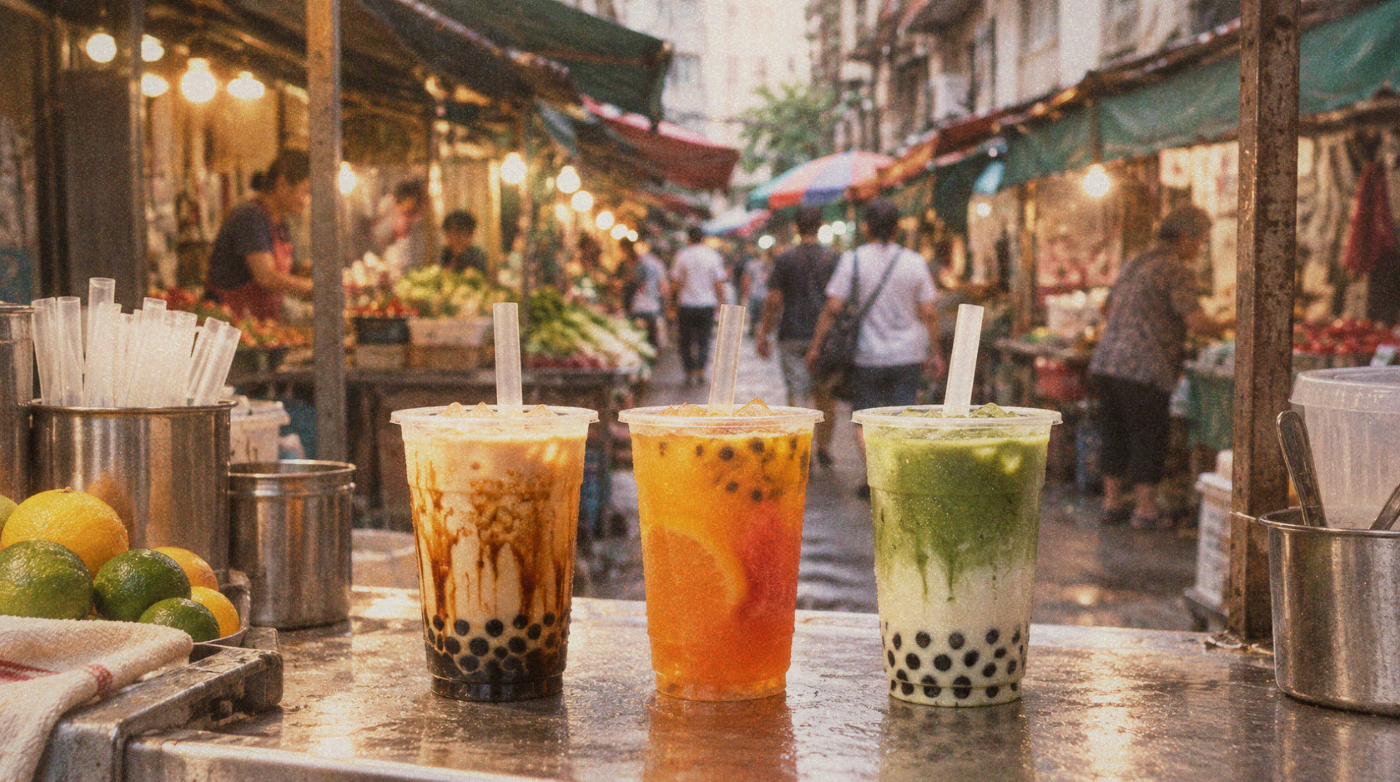
The line at 50嵐 on Zhongxiao East Road moves fast. Twelve people deep at 2pm on a Tuesday, and nobody looks impatient. The woman at the register doesn't ask what you want. She asks two things: sweetness and ice. You have about four seconds to answer before the person behind you starts shifting their weight.
Taiwan sells roughly 1.5 billion cups of bubble tea a year. The island has over 15,000 hand-shaken drink shops, which works out to about one for every 1,500 people. There are more bubble tea shops per capita here than convenience stores, and Taiwan has a lot of convenience stores. The drink that two Taichung teahouses claim to have invented in the late 1980s has become so woven into daily life that most Taiwanese people don't think of it as a cultural export or a trend. It's just what you drink at 3pm. Or 10am. Or midnight, walking home from the MRT.
But if you're visiting, or if you've been here a while and still default to pointing at the menu and saying "this one," the ordering system can feel like a test you didn't study for. The menu is in Chinese. The cashier speaks fast. There are choices you didn't know you had to make. And behind all of that, there's a deeper question: with thousands of shops on every block, which ones actually matter?
This is what follows. How to order without looking lost, what the choices mean, and which shops are worth walking to.
The origin story nobody can agree on
Two teahouses in central Taiwan both claim they invented bubble tea. The dispute has gone to court. Twice. Nobody won.
春水堂 (Chun Shui Tang) in Taichung says it happened in 1988. Lin Hsiu Hui, a product development manager, was at a staff meeting with a cup of Assam iced tea. She had tapioca balls from a nearby market. She dropped them in, stirred, drank, and liked it. The shop started selling it. Lines formed.
翰林茶館 (Hanlin Tea Room) in Tainan says it happened in 1986, two years earlier. Founder Tu Tsung-ho saw white tapioca balls at a market, thought they looked like pearls, cooked them, added them to milk tea, and named the drink pearl milk tea on the spot.
A decade of lawsuits settled nothing. The courts ruled that because bubble tea was never patented or trademarked, the question of who invented it was legally irrelevant. Both shops still serve it. Both are worth visiting. Chun Shui Tang now has locations across Taiwan and charges more than most chains (their original pearl milk tea runs around NT$120 to NT$150), but the tea quality is genuinely a cut above.
The truth is probably that several people had the same idea around the same time, which is how most food innovations actually happen. What matters is what came after: an entire industry, a national identity, and a drink that 23 million people consume like water.
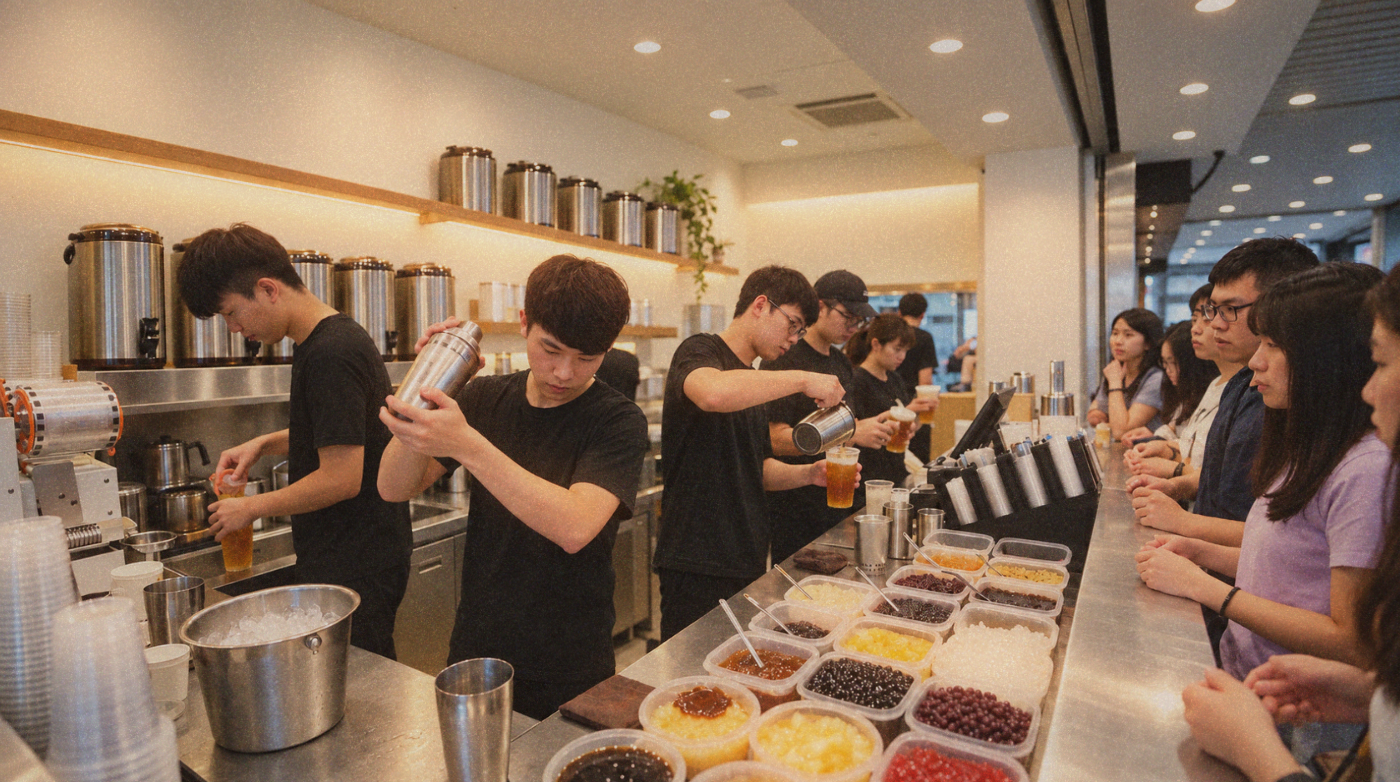
 FIRST SIGHTWEBGLShakers, tea urns, and a counter full of toppings during the afternoon rush. · Color and grain by First Sight · Gold 200. · First Sight 色彩與顆粒調校 · Gold 200
How to order: the 30-second version
Every hand-shaken drink shop in Taiwan will ask you the same two questions after you pick your drink: 甜度 (sweetness level) and 冰塊 (ice level). This is not optional. If you don't answer, they'll ask again. Here's what your options are.
Sweetness (甜度)
全糖 (quán táng) = full sugar, 100%. This is sweet. Really sweet. Most locals don't order this.
少糖 (shǎo táng) = less sugar, 70%. The default for a lot of regulars.
半糖 (bàn táng) = half sugar, 50%. Safe starting point if you're new to this.
微糖 (wēi táng) = light sugar, 30%. Where I usually land.
無糖 (wú táng) = no sugar, 0%. Good for straight tea orders. With milk tea, it can taste flat.
Ice (冰塊)
正常冰 (zhèng cháng bīng) = regular ice.
少冰 (shǎo bīng) = less ice. Most common local order.
微冰 (wēi bīng) = light ice.
去冰 (qù bīng) = no ice, but the drink is still cold.
溫 (wēn) = warm. Yes, you can get warm bubble tea. Especially good in winter.
熱 (rè) = hot. Not available with all drinks, but great with straight teas.
The move that marks you as someone who knows what they're doing: 少糖少冰 (less sugar, less ice). You get more drink per cup because there's less ice diluting it, and 70% sweetness lets the tea flavor come through without tasting bitter. If the cashier nods without repeating it back, you've done well.
One more thing. Size. Most chains offer medium (中杯, zhōng bēi) and large (大杯, dà bēi). The price difference is usually NT$10. Large is almost always worth it.
The chains: what's actually good
Taiwan has hundreds of bubble tea brands. Most are fine. A few are great. Here's an honest ranking of the ones you'll see everywhere, based on what they do best.
50嵐 (Wǔshí Lán) The workhorse. Over 500 locations since 1994. Not flashy, not trying to be. The menu is huge, prices are low (medium boba milk tea around NT$50, large NT$60), and the quality is consistent no matter which location you walk into. Their 四季春 (Four Seasons Spring oolong) is one of the best value drinks in Taiwan: clean, lightly floral, NT$25 to NT$30 for a plain tea. I order it with light sugar and light ice when I want something refreshing that isn't a production. The pearls are decent. Not the star of the show, but they do the job.
清心福全 (Qīngxīn Fúquán) Started in Tainan in 1987, which makes it older than bubble tea itself. Over 800 locations. The menu leans heavier on fruit teas, wintermelon drinks, and yogurt-based options than pure milk teas. Their wintermelon tea is genuinely one of the best things you can drink for under NT$40. It tastes like autumn. If you're in central or southern Taiwan, you'll see these more than 50嵐. The vibe is unpretentious. Neighborhood drink stand, not a brand experience.
可不可熟成紅茶 (KEBUKE) Founded in Taichung in 2008 and now one of the fastest-growing chains in Taiwan. KEBUKE's whole thing is aged black tea, and they take it seriously. The base teas are genuinely good, which you notice most when you order without milk. Their signature 麗春紅茶 (Lìchūn Black Tea) is a straight black tea, no toppings, and it's one of the best plain teas you'll find at a chain. Prices are a step up from 50嵐 (most drinks NT$45 to NT$65) but the tea quality justifies it. Good for people who actually like tea, not just sweetened milk.
老虎堂 (Tiger Sugar) The brown sugar boba milk that launched a thousand Instagram posts. Tiger Sugar opened in Taichung in 2017 and went global almost immediately. The signature drink is brown sugar boba with fresh milk. No tea at all. The caramelized sugar creates brown streaks down the inside of the cup, which is where the "tiger stripe" name comes from. It's rich, sweet, and very photogenic. One cup is satisfying. Two would be too much. Prices run NT$55 to NT$75 depending on size and location. Worth trying once. Not an everyday drink unless your dentist has given up on you.
迷客夏 (Milksha) No artificial creamer. That's the selling point, and it's a real one. Milksha uses fresh milk sourced from 綠光牧場 (Lv Guang Pasture) and you can taste the difference. Their fresh milk tea has a cleaner, less cloying flavor than most chains. The honey-marinated white pearls are smaller and chewier than standard boba. Prices are mid-range (NT$50 to NT$70). If you're particular about ingredients and tired of the powdered creamer taste that a lot of budget shops rely on, Milksha is the answer.
大苑子 (Dayunzi) The fruit tea specialist. Dayunzi uses fresh, seasonal fruit, squeezed to order. No syrups, no concentrates. Their 柳橙綠 (fresh orange green tea) is exactly what it sounds like: oranges and green tea, and it's spectacular in summer. Prices are slightly higher because fresh fruit costs more than syrup (most drinks NT$55 to NT$80), but you're getting actual fruit. Worth it when mangoes are in season, roughly May through September.
珍煮丹 (Truedan) Started at Shilin Night Market, built a reputation entirely on pearl quality. Their brown sugar pearls have a deeper, more molasses-like sweetness than Tiger Sugar's, with a chewier texture. The milk tea itself is straightforward. The pearls are the point. If you care about the boba more than the tea, Truedan is where you go. Prices around NT$55 to NT$70.
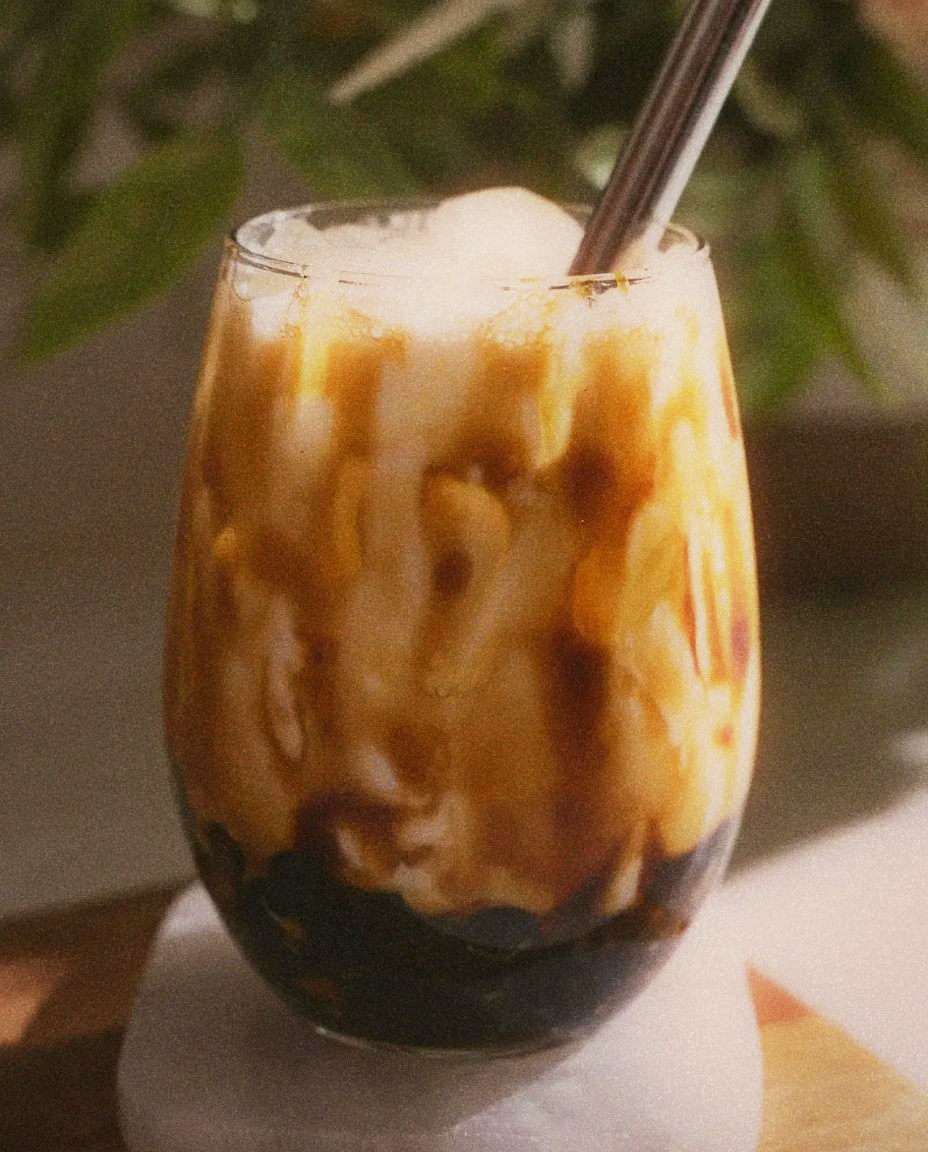 FIRST SIGHTWEBGLBrown sugar boba in fresh milk. No tea, no flavoring. The caramel streaks happen naturally as the warm pearls hit the cold milk. · Color and grain by First Sight · Gold 200. · First Sight 色彩與顆粒調校 · Gold 200
The shops worth a special trip
Chains are convenient. They're everywhere, they're consistent, and they're good enough for a daily fix. But a few independent or small-batch shops in Taiwan are doing something different, and they're worth going out of your way for.
陳三鼎 (Chen San Ding), Gongguan, Taipei Address: No. 2, Alley 8, Lane 316, Section 3, Roosevelt Road, Zhongzheng District. Right next to National Taiwan University, in the thick of the Gongguan student neighborhood. The signature drink is 青蛙撞奶 (Frog Crashes Into Milk). There is no tea. It's brown sugar tapioca pearls and cold fresh milk. That's it. The name comes from the pearls, which supposedly resemble frog eggs. The texture is exceptional: the pearls are cooked in brown sugar syrup until they're soft on the outside and slightly chewy at the center. A cup costs around NT$40 to NT$50.
Note: The original location has had closures and reopenings. Check current status before making the trip. The Gongguan area itself is excellent for an afternoon walk, with bookshops, cheap eats, and NTU's campus nearby.
A Nice Holiday (好日子) A newer chain that's been gaining serious attention. Their buckwheat tea with grass jelly is unlike anything the bigger chains offer. The buckwheat gives the tea a toasted, nutty base that works surprisingly well with the herbal bitterness of grass jelly. It's the kind of drink that makes you rethink what a hand-shaken beverage can be. They also do a grass pearl milk tea that's become a crowd favorite. Prices comparable to KEBUKE range.
春水堂 (Chun Shui Tang) Yes, one of the two claimants to the invention of bubble tea. Their original pearl milk tea (roughly NT$120 to NT$150) costs double what you'd pay at a chain, and the experience is completely different. It's served in a teahouse, not a takeaway counter. The tea is brewed stronger, the pearls are cooked in smaller batches, and you sit down and drink it from a glass. Worth doing once, especially at the Taichung original location on Siwei Street, to understand the distance between where bubble tea started and the grab-and-go version it became.
Beyond the pearls
Boba gets all the attention, but the topping menu at most Taiwanese shops goes much further. A few worth knowing about.
仙草 (Xiancao) / Grass jelly. Cool, herbal, slightly bitter. Cuts through the sweetness of milk tea better than pearls do. Popular in summer. If you've never tried it, order a grass jelly milk tea at any chain and see if you like the texture. It's slippery and soft, nothing like boba.
椰果 (Yēguǒ) / Coconut jelly. Translucent, mildly sweet, with a firm bite. Works well with fruit teas. Less heavy than pearls.
芋圓 (Yùyuán) / Taro balls. Chewy, starchy, subtly sweet. Common in Jiufen, where the famous taro ball dessert shops are, but also available as a topping at many chains. Good with milk tea.
布丁 (Bùdīng) / Pudding. Egg pudding, similar to Japanese purin. Adds richness without adding chewiness. Tiger Sugar's golden pudding series is built around this.
粉條 (Fěntiáo) / Tapioca noodles. Thinner than boba, with a different chew. If you like the tapioca texture but find the pearls too heavy, try these instead.
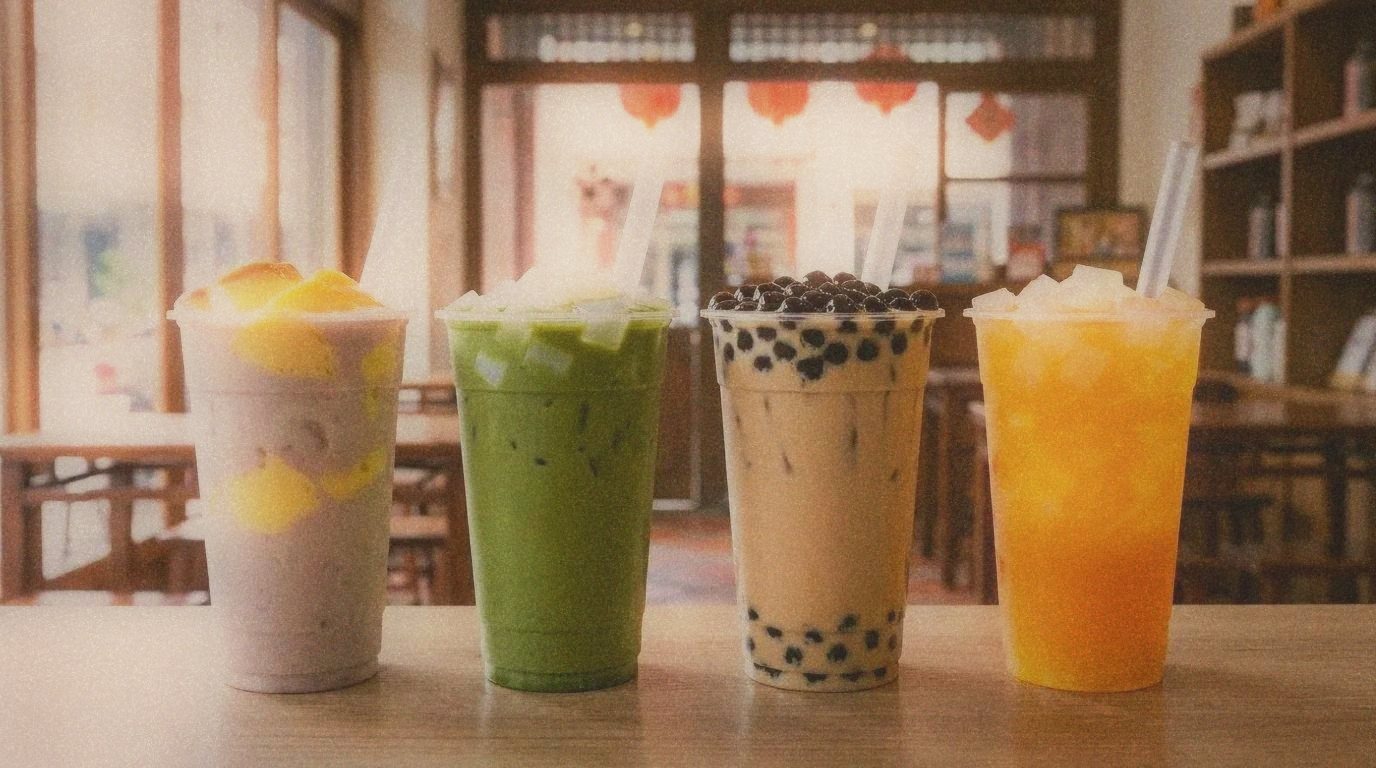 FIRST SIGHTWEBGLNot all bubble tea has bubbles. Grass jelly, coconut jelly, taro balls, pudding. The topping menu is where regulars get creative. · Color and grain by First Sight · Gold 200. · First Sight 色彩與顆粒調校 · Gold 200
Where to drink in Taipei
You can find bubble tea on literally every block, but a few neighborhoods concentrate the best options in walkable clusters.
Gongguan (公館). The NTU student district. Chen San Ding is here (check if reopened). 50嵐, KEBUKE, and Milksha all have locations within a five-minute walk. Cheap food, bookshops, and the energy of a university neighborhood. Take the MRT to Gongguan Station, Exit 1.
Yongkang Street (永康街). More polished, more tourist-friendly, but still good. Chun Shui Tang has a location here. The street is better known for beef noodle soup and mango shaved ice, but there are several quality tea shops within walking distance. Dongmen Station, Exit 5.
Zhongxiao Dunhua (忠孝敦化). The commercial heart of eastern Taipei. Every major chain is represented here. Good for comparison shopping if you want to try three or four different brands in one afternoon. The streets around the intersection of Zhongxiao East Road and Dunhua South Road have the highest density.
Ximending (西門町). Loud, young, neon-lit. Tiger Sugar has a prominent location here. Good for an evening walk with a drink in hand. Ximen Station.
Seasonal drinking
The menu changes with the calendar, and knowing what's in season helps.
Spring (March to May). Strawberry teas and drinks appear at fruit-focused chains like Dayunzi. Light oolong teas taste best this time of year.
Summer (June to September). Mango season. This is when Dayunzi and other fruit chains peak. Fresh mango green tea, mango smoothies, mango everything. Also the best time for iced straight teas, because the heat makes you want something clean and cold.
Autumn (October to November). Wintermelon drinks come into their own. Grapefruit teas start appearing.
Winter (December to February). Hot bubble tea becomes a real option. Many chains offer warm or hot versions of their milk teas. Taro milk tea is particularly good in cold weather. The chewiness of the pearls with warm milk is a different, cozier experience.
FAQ
What's the difference between 珍珠 and 波霸?
Both are tapioca pearls. 珍珠 (zhēnzhū) are small, about the size of a pea. 波霸 (bōbà) are large, roughly marble-sized. Most shops default to 波霸 when you order "boba" or "bubble tea." If you want the smaller ones, specify 珍珠.
Can I order in English?
At major chains in Taipei, usually yes. The staff may not be fluent but they know the English names for most menu items. In smaller cities or independent shops, having the Chinese terms ready helps. Knowing 半糖少冰 alone will get you through 90% of situations.
How much should I tip?
You don't. Taiwan doesn't have a tipping culture. The price on the menu is the price you pay.
Is bubble tea actually unhealthy?
A full-sugar boba milk tea with large pearls is roughly 500 to 700 calories. That's a meal. But you control the sugar level, and a no-sugar straight tea with no toppings is basically zero calories. The drink is as healthy or unhealthy as you make it. Ordering 微糖 or 無糖 and choosing smaller toppings like coconut jelly instead of boba cuts the calorie count significantly.
Why do some shops not let me choose sugar level for certain drinks?
Fruit teas and specialty drinks often come at a fixed sweetness because the recipe is calibrated for a specific balance. If the menu shows a locked sugar level, that's the shop saying "trust us, we've tested this." Respect it.
What should I order on my very first visit to a Taiwan bubble tea shop?
Classic pearl milk tea (珍珠奶茶), half sugar, less ice, large. This is the baseline. Once you know what the standard tastes like, you can start exploring.
Comments (0)
Loading comments...