

You're sitting at a cafe in Taipei's Songshan District, your laptop open, a bubble tea steaming next to your keyboard. The wifi is blazingly fast. The person next to you is also typing away on their laptop. This could be your reality as a digital nomad in Taiwan, one of Asia's most underrated bases for remote workers.
In 2026, Taiwan offers three visa pathways for remote workers, average internet speeds above 130 Mbps, a one-bedroom apartment in Da'an for around NT$25,000 a month, and a 7-Eleven on every other block. The practical question for most people is which visa route makes the most sense for their situation.
The Three Visa Routes to Consider
Taiwan offers three main pathways for digital nomads and remote workers, each with different income requirements and flexibility.
Digital Nomad Visa (DNV)
Launched in 2025 and expanded in January 2026, the Digital Nomad Visa is the most straightforward option if you want to stay short-to-medium term. You need to prove an annual income of at least USD 40,000 (roughly TWD 1.3 million) if you're 30 or older, or USD 20,000 if you're between 20 and 29. The income can come from self-employment, freelancing, or remote work for a foreign company. You don't need to work for a Taiwan employer.
The DNV grants you a six-month legal stay that can be extended in six-month increments, for a maximum cumulative stay of two years. This is the big 2026 update. Previously the visa was six months with limited extension options. Now you can stay up to two years total if your circumstances remain stable.
No health insurance is required. You can't take local employment. But you can run a freelance business, consult for foreign clients, or collect salary from abroad without legal friction.
Gold Card (Talent Taiwan)
If your income is higher, the Gold Card becomes relevant. The Gold Card is actually a "4-in-1" visa that functions as your work permit, residence visa, re-entry permit, and ARC (Alien Residence Certificate) all in one.
To qualify, you must demonstrate a monthly salary of at least TWD 160,000 (roughly USD 5,000). This is specifically for people earning W income (taxable employment income), not self-employment or variable income. If you have a contract job paying that threshold monthly, or you earned that much in the past three years on average, you qualify.
The Gold Card is valid for three years and comes with a pathway to permanent residency within 1 to 3 years if you maintain your income. It also includes national health insurance, which is a significant perk and costs around TWD 1,200 per month (USD 38) for foreigners.
The catch: the Gold Card requires documented employment income, which is harder to prove for pure freelancers or people with highly variable income.
Employment Visa (Long-term Resident Visa)
There's also a traditional employment visa route if you secure a job with a Taiwan company. This requires a local employer sponsorship, so it's less relevant if you're explicitly trying to stay location-independent. But it's worth mentioning: if you find Taiwan work, this is the legal path.
The Real Difference
For most digital nomads reading this, the Digital Nomad Visa is the most accessible entry point in 2026. It's lower friction, doesn't require documented employment, and the two-year extension option gives you time to evaluate whether Taiwan is long-term for you. The Gold Card makes sense if you're earning above TWD 160,000 monthly and want the stability of a longer visa period plus health insurance.
What You'll Actually Spend Per Month
Let's get concrete about money. How much runway do you actually need to live in Taipei as a remote worker?
Rent
A one-bedroom apartment in central Taipei (think Daan District or Zhongshan) averages TWD 15,000 to 30,000 per month (USD 500 to 1,000). Studios and shared apartments drop the costs; many digital nomads find comfortable places in the TWD 10,000 to 15,000 range (USD 330 to 500) in central neighborhoods.
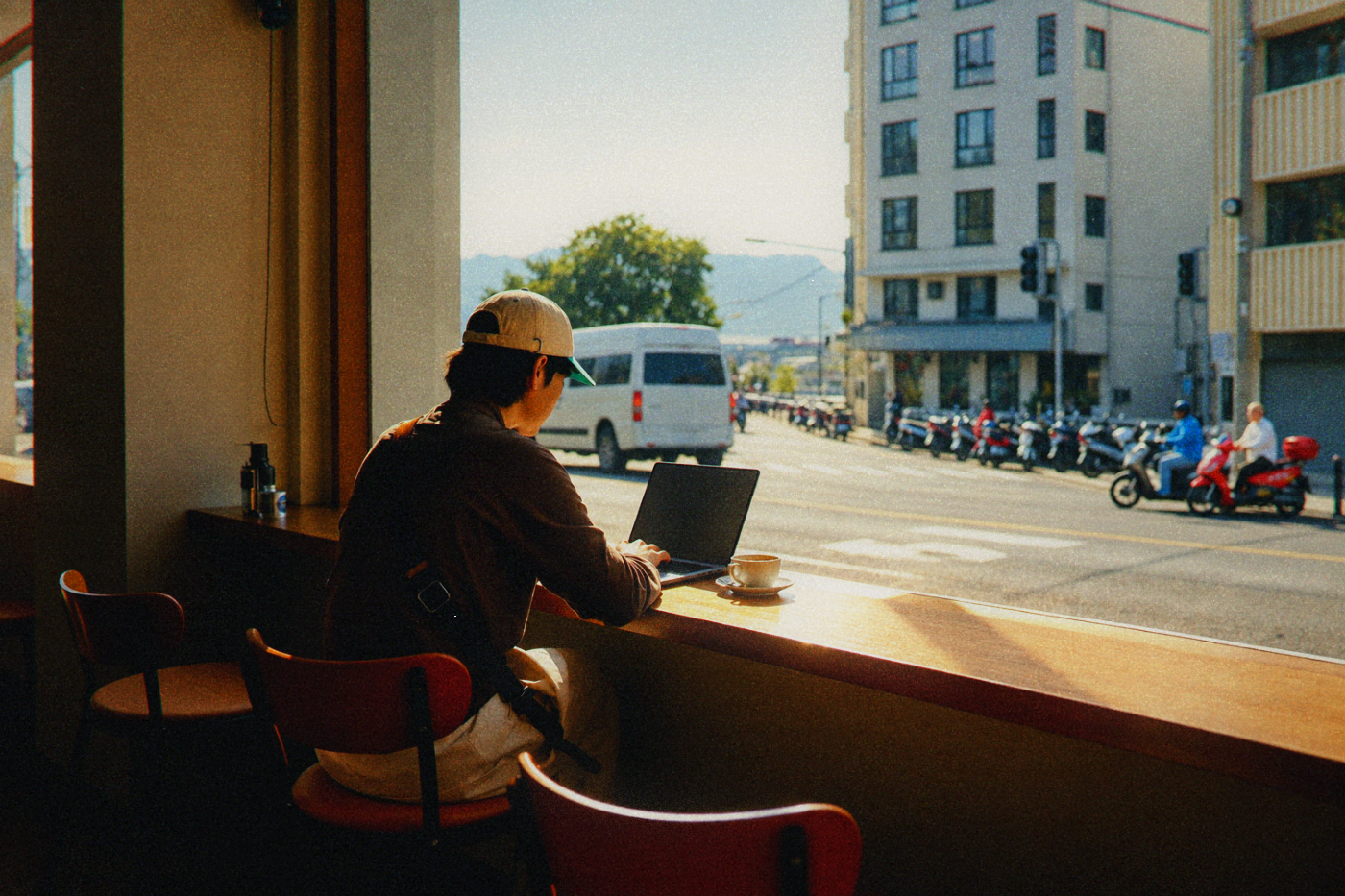
 FIRST SIGHTWEBGLA window seat, a laptop, and the city moving outside. · Color and grain by First Sight · Superia. · First Sight 色彩與顆粒調校 · Superia
If you're willing to live further out (Beitou, Neihu), rents can be even lower. But the consensus among the remote work community is that central neighborhoods are worth the extra cost. The MRT is fast and affordable, but being walkable to coworking, cafes, and your social circle matters.
Food and Daily Costs
Taiwan's food is absurdly cheap compared to most developed countries. A meal from a street vendor or small restaurant costs TWD 50 to 100 (USD 1.60 to 3.20). A coffee from a cafe is TWD 50 to 80. Groceries are similarly affordable. Budget-conscious nomads get by on TWD 8,000 to 10,000 per month for food (USD 260 to 330).
Coworking and Workspace
If you need a dedicated desk, coworking spaces range from TWD 5,000 to 13,500 per month for dedicated desks (USD 160 to 440), depending on location and amenities. Hot desks (shared, first-come-first-served) start at around TWD 5,000 (USD 160) per month. Day passes run TWD 620 to 880 (USD 20 to 28).
Popular coworking spots include Home Sweet Home Share House (multiple locations, mixed community vibe), The Executive Centre (premium, TWD 13,500 per month for dedicated desks), and Makerbar Coworking Space in Songshan. Prices have remained relatively stable since late 2025.
Total Monthly Budget
A comfortable digital nomad lifestyle in Taipei averages TWD 50,000 to 80,000 per month (USD 1,600 to 2,600) if you live in a central neighborhood, eat well, use coworking regularly, and enjoy some weekend activities. You can absolutely do it for less if you're frugal. You could also spend more if you prefer higher-end neighborhoods or premium coworking.
The key: Taiwan is significantly cheaper than Tokyo, Hong Kong, or Singapore, with better internet and a more relaxed pace.
Internet, Power, and Logistics
Taiwan's internet infrastructure is among the best in the world. Median fixed broadband speeds are around 251 to 260 Mbps, with Taipei itself reaching 258 Mbps. For comparison, that's faster than most US and European cities. Mobile data is also reliable, with 4G/5G coverage throughout urban areas.
Getting connected is simple. You can buy a local SIM card at any convenience store (7-Eleven, FamilyMart, OK Mart) for around TWD 300 to 500 (USD 10 to 16) and pay as you go, or grab a monthly plan. Home broadband requires coordination with your landlord, but most apartments have available options.
Power is stable. Taiwan operates on 110V, 60Hz. If you're from a 220V country, you'll need adapters.
Neighborhoods That Work for Remote Workers
Not all of Taipei is equal for the digital nomad lifestyle. Here's the breakdown of where other remote workers actually live.
Daan District (大安區)
This is the default choice for expats and digital nomads. It's central, has good MRT access, and hosts a mix of international residents and young creatives. Cafes are plentiful, including spots explicitly set up for remote work. The vibe is upscale but approachable. Rent is on the higher end (TWD 20,000 to 35,000 for one-bedrooms), but the neighborhood rewards the cost.
Fulong Street and Fuxing South Road are the main hubs. There are coworking spaces, good restaurants, bookstores, and the kind of infrastructure that makes you feel less like you're "roughing it" abroad.
Zhongshan District (中山區)
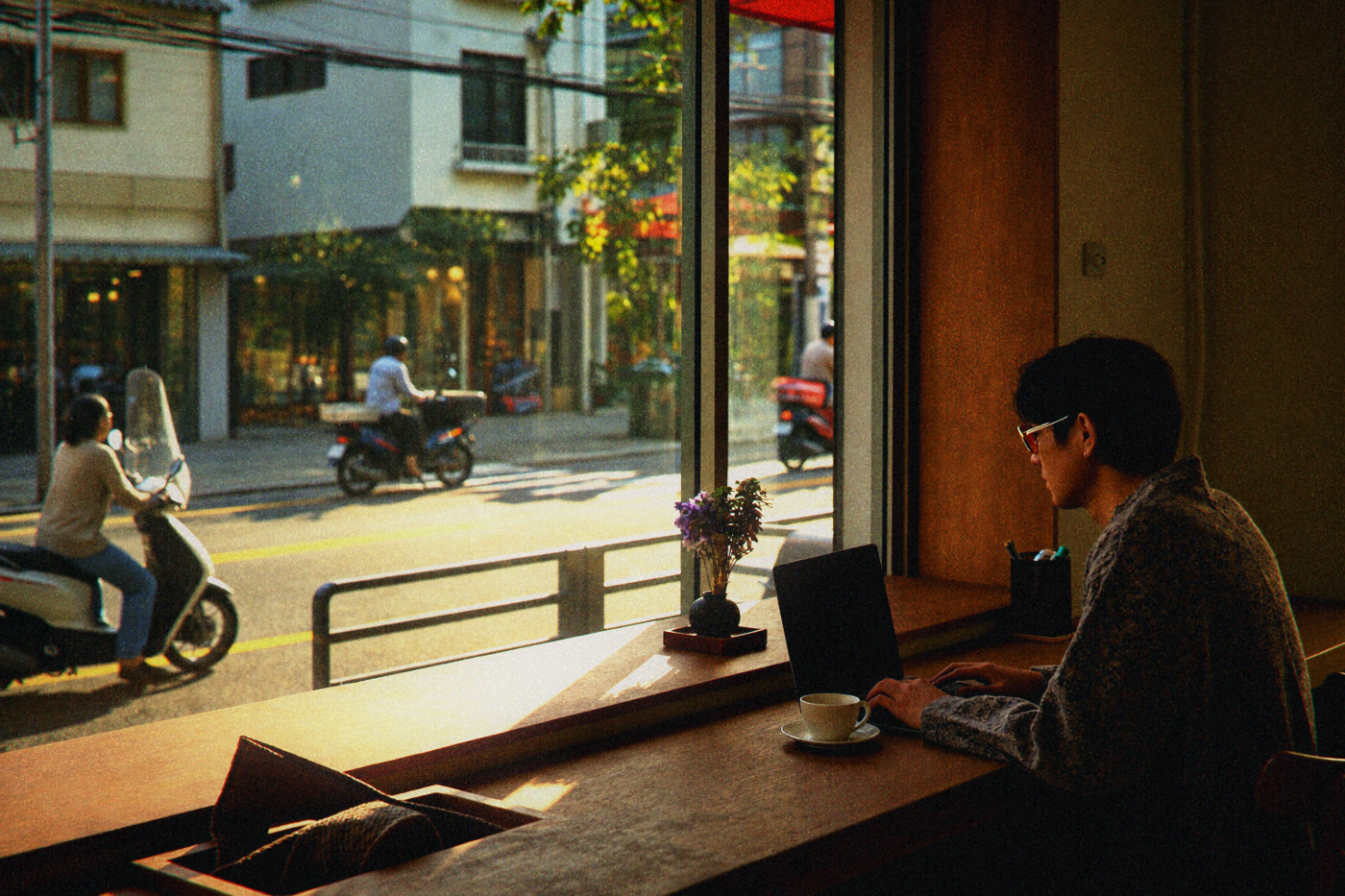 FIRST SIGHTWEBGLA window seat, wifi, and Taipei outside. · Color and grain by First Sight · Superia. · First Sight 色彩與顆粒調校 · Superia
The "hipster" district by Taipei standards. Zhongshan is where young creatives, designers, and digital nomads cluster. It has a younger, trendier energy than Daan. Rent is slightly lower (TWD 15,000 to 28,000), and the cafe culture is excellent. This is where the energy is if you care about community and vibes.
Nanjing Fuxing MRT station is the epicenter. The neighborhood has galleries, design shops, vintage stores, and that productive creative buzz.
Ximen (西門町)
If you want nightlife and youth culture, Ximen is where it happens. It's more chaotic than Daan or Zhongshan, with tons of foot traffic, street food, and a very "Taipei" feel. Rent is lower (TWD 12,000 to 22,000). It's less typical for remote workers setting up permanent bases, but some digital nomads love the energy.
Outside Taipei: Jiufen, Beitou, Keelung
If you want to escape the city energy but stay close, these neighborhoods north and east of Taipei offer lower rent (TWD 8,000 to 15,000), mountain scenery, and a slower pace. Internet is reliable. The downside: less nightlife, fewer English speakers, and a quieter social scene. This appeals to introverted workers and people prioritizing cost.
Community and Networking
You won't be alone in Taiwan. There's a growing digital nomad community, and in 2026, it's organized enough to matter.
The Taiwan Digital Nomad Association (TDNA) organizes Taiwan Digital Fest 2026, running May 1 through May 31 in Taiwan's East Coast (Taitung and Hualien). It's a month-long festival featuring workshops, coworking pop-ups, networking, and cultural experiences. If you're considering Taiwan as your base, registering for Digital Fest is a smart move. It costs around TWD 2,000 to 5,000 (USD 65 to 160) depending on which events you attend.
There are also Slack communities, Facebook groups dedicated to Taiwan expats and remote workers, and regular meetups in Taipei. Coworking spaces host regular social hours. Unlike some digital nomad destinations that feel transient and cliquey, Taiwan's remote work community is genuinely welcoming and collaborative.
The Things That Surprise Remote Workers
Taiwan is warm and humid much of the year (May through September is brutally hot). If you're coming from a temperate climate, the first summer requires adjustment.
Typhoon season is June through September. Offices may close, flights get delayed, but it's not a deal-breaker. It's just something to plan around.
English is less common than in Japan or South Korea. Many Taipei residents speak some English, but outside the city, don't assume it. Learning basic Mandarin sentences (or even just carrying a translation app) makes life significantly easier and is genuinely appreciated by locals.
Taiwan has excellent healthcare. The national health insurance system is affordable and comprehensive. If you qualify for a Gold Card, you get this automatically. If you're on a Digital Nomad Visa, you can purchase private health insurance for around TWD 200 to 400 per month (USD 6 to 13).
Public transit is excellent and costs next to nothing. A monthly EasyCard pass (prepaid transit card) costs around TWD 1,280 (USD 40) for unlimited MRT travel. Grab a card on day one.
Practical Steps: Your Application Timeline
If you're serious about the Digital Nomad Visa, here's the real timeline.
You need to gather proof of income (last two years of tax returns, bank statements, or a letter from your employer stating your salary), a valid passport with at least six months remaining, a criminal background check from your home country, and a plan on where you'll live in Taiwan.
Processing typically takes 2 to 4 weeks. You can apply at a Taiwan representative office in your home country, or some people fly to Taiwan on a tourist visa and apply while there. Once approved, you receive your Digital Nomad Visa and ARC (Alien Residence Certificate).
The whole process is more administrative than difficult. Taiwan's immigration system is bureaucratic but fair.
Is Taiwan Right for You?
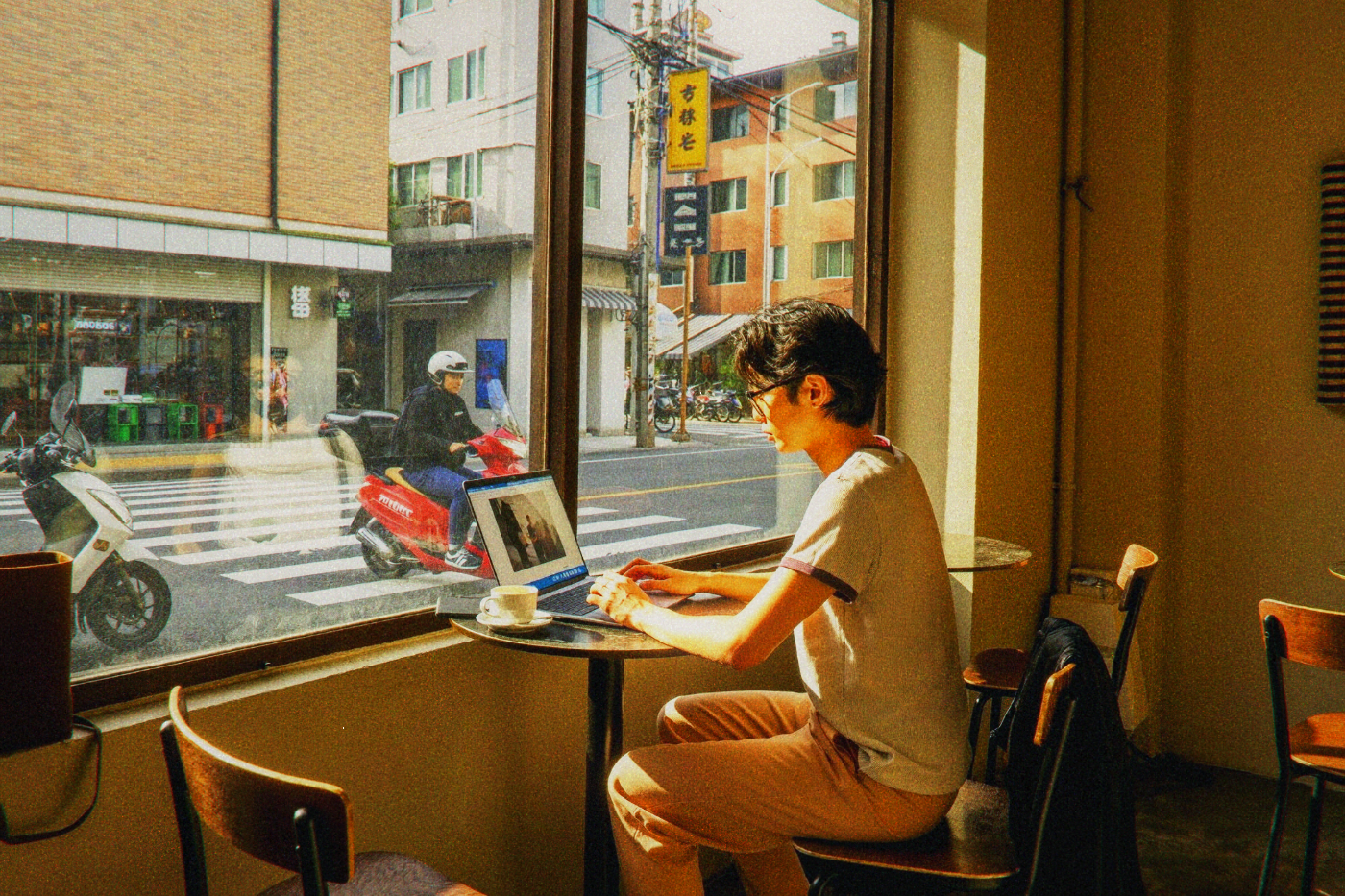 FIRST SIGHTWEBGLA window seat, wifi, and Taipei outside. · Color and grain by First Sight · Superia. · First Sight 色彩與顆粒調校 · Superia
Taiwan works best if you're looking for a place to settle (not just pass through), you value excellent infrastructure and cost-effectiveness, and you're willing to engage with the culture beyond tourism. The vibe here is quieter than Thailand or Vietnam. People come to build a life, not just pass through.
The visa options are flexible enough to test-drive it. The Digital Nomad Visa lets you commit for six months and see how it feels. The cost of living won't bankrupt you. The internet will never let you down.
And when you're sitting at that cafe in Taipei at 8 PM on a Tuesday, watching the city move around you at the right pace, with good coffee and stable wifi, you'll understand why an increasing number of remote workers aren't just passing through Taiwan. They're staying.
Frequently Asked
Some links in this article are affiliate links. If you purchase through them,OQUA may earn a small commission at no extra cost to you. This helps support our editorial work. We only link to products and services we genuinely reference in our writing.
Comments (0)
Loading comments...