
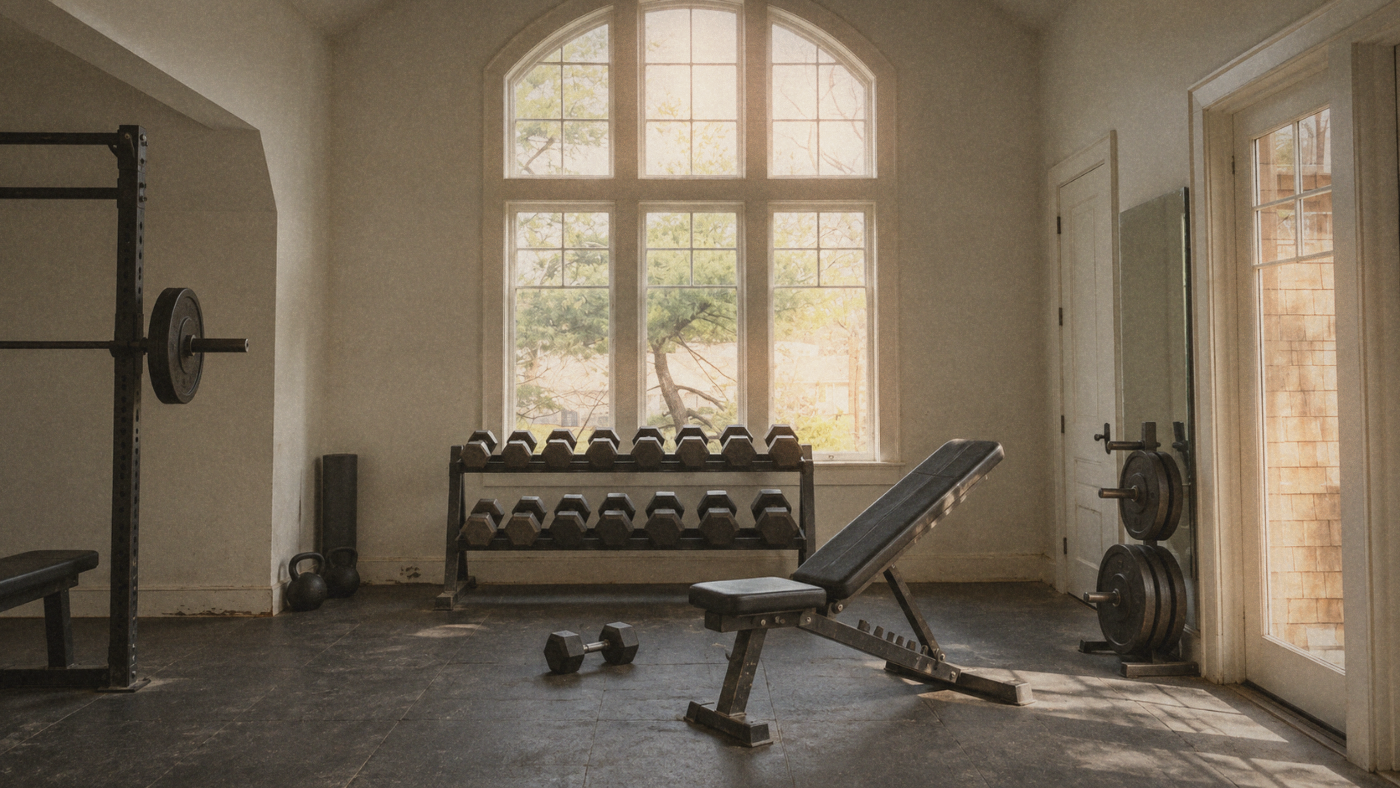
You don't feel it happening. At 30, you had enough muscle that declining 3% a year seemed theoretical, a problem for later. By 40, the same 3% per year starts adding up. A flight of stairs feels a little heavier. Carrying groceries up four floors requires a different kind of pause. By 60, that annual 3% accelerates to maybe 8%, and now it's not theoretical anymore. It's physical. It's the difference between living independently and needing help with basic tasks.
This is sarcopenia. Age-related muscle loss. It happens to everyone. The average person loses muscle invisibly, predictably, and almost entirely preventably, if they start before they need to.
The good news comes from research that landed in February 2026. A study in JAMA Network Open tracked 3,200 women between 63 and 99 years old. The women with the highest grip strength had a 33% lower risk of death from any cause. Those who could stand up from a chair fastest had a 37% lower death risk. Not lower risk of falls or fractures, though grip strength predicts both. Lower risk of dying, period. Muscle strength, it turns out, is one of the most reliable markers of how long and how well you'll live.
You don't need a 300-pound deadlift. You don't need visible abs. You need functional strength. The kind that keeps you independent, that lets you lift your own groceries at 70, that makes the everyday physical demands of living manageable without recruiting help. Building that now, after 40, is not vanity. It's infrastructure.
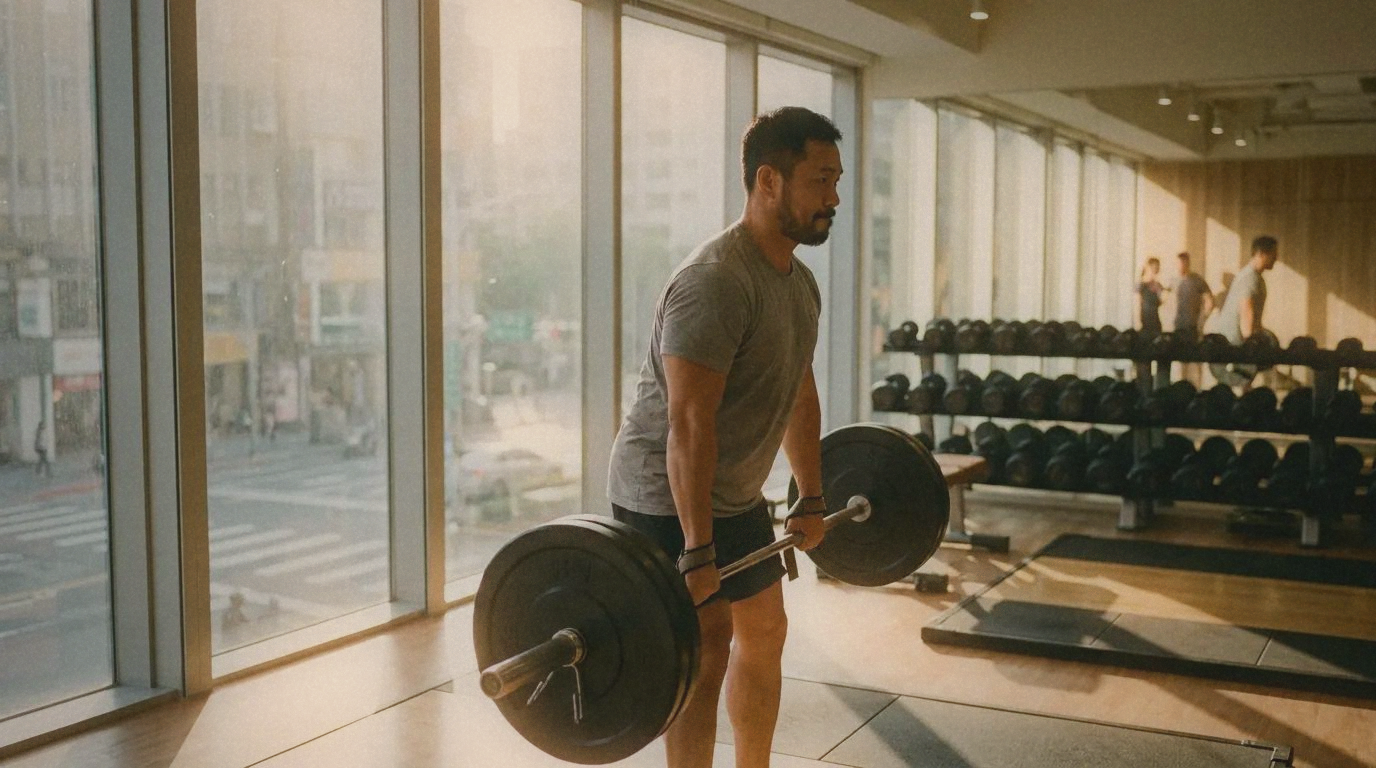
 FIRST SIGHTWEBGLStrength training doesn't need to be complicated. The deadlift works more muscles at once than almost any other movement. · Color and grain by First Sight · Portra 400. · First Sight 色彩與顆粒調校 · Portra 400
Why muscle matters after 40
Most people know they're supposed to stay active. The standard advice is 150 minutes a week of aerobic exercise, so most people walk, bike, or run. Aerobic exercise is fine. It's good for the heart. But it does almost nothing for muscle. You can run 10 miles a week and still lose 3% of your muscle annually. The muscle doesn't care about your cardiovascular fitness.
Muscle responds to resistance. Loading. Weight. The specific stimulus of trying to move something heavy.
Here's what changes after 40. Your body needs a bigger stimulus to build or maintain muscle. At 25, a casual weightlifting session might maintain muscle tissue. At 45, you need more intensity, more consistency, more intention. This is not harder. It's just different. It's also urgent, because by 60, roughly 30% of people develop some degree of sarcopenia. By 80, that number hits 50%.
The mortality data makes the urgency clear. In a study of healthy men aged 50 to 65, a 7.7% increase in resting metabolic rate came from adding resistance training. Your body burns more calories at rest, just existing. That metabolic boost compounds across years. More muscle means more fuel consumption, which means you stay leaner without trying harder. But more importantly, more muscle means better glucose control, stronger bones, better balance, lower inflammation. Muscle is not decorative. It's a metabolic organ.
The WHO recommendation is straightforward: 40 to 60 minutes per week of muscle-strengthening work, at least twice a week. That's not per day. That's total per week. It's less time than most people spend on their phones per day. The question is not whether you have time. It's whether you've decided it matters.
The minimum effective dose
You don't need to become a bodybuilder. You don't need complicated periodization or six-day gym weeks. The research on strength training in older adults consistently shows that intensity matters more than volume. Three focused, moderately hard sessions per week beats five easy sessions every time.
Here's what minimum looks like: compound movements (squats, deadlifts, rows, pressing motions), moderate weight (around 65 to 80% of your one-rep max), done for 8 to 12 reps, two to three times per week, with 48 hours of recovery between sessions.
The compound movements matter because they're efficient. A barbell squat works your legs, core, stabilizer muscles, cardiovascular system, and nervous system all at once. You can get a meaningful strength stimulus in 30 to 40 minutes of actual lifting, not including warm-up. Once or twice a week, that's 1 to 1.5 hours of total time investment per week.
Bone density improves measurably with moderate-intensity resistance training (65 to 80% of one-rep max), performed three days a week, targeting the spine and hip. The improvement is particularly important for people with osteoporosis risk or a history of fractures. A 2025 meta-analysis found that regular resistance training improved femoral neck and lumbar spine bone mineral density by 1 to 3% annually. Compare that to doing nothing, which loses 0.5 to 1% per year. The gap compounds. By 70, it's the difference between a fracture that heals and a fracture that changes your life.
Some research suggests the optimal cardiovascular benefit from strength training comes around 60 minutes per week, distributed across two to three sessions. Resistance training raises heart rate, improves arterial function, and lowers resting blood pressure. You don't need separate cardio if you're lifting with intensity and short rest periods. Your heart gets trained alongside your muscles.
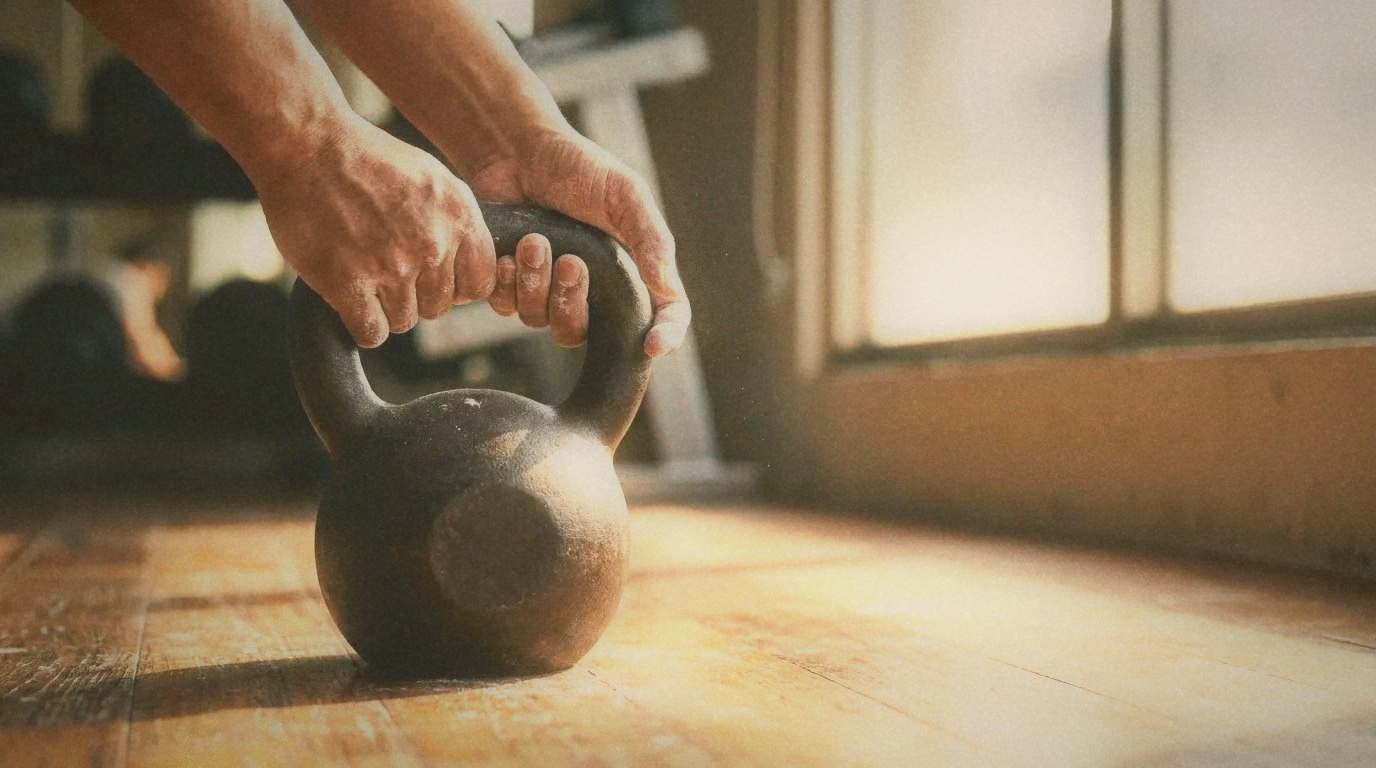 FIRST SIGHTWEBGLThe grip tells the story. Every time you pick up weight, your hands, forearms, and core work together. · Color and grain by First Sight · Portra 400. · First Sight 色彩與顆粒調校 · Portra 400
How to start if you've never done this
If your only exercise has been walking or running, this is not as complicated as the gym culture makes it seem. You don't need a coach right away, though one helps. You don't need to be strong already. You need to be willing to learn.
Start with bodyweight. Bodyweight squats, push-ups against a wall or counter (lower the bar by going to an incline), step-ups on stairs. Spend a week or two getting the movement pattern comfortable. Your nervous system needs to remember how to coordinate muscles. Once the movement feels natural, add weight. A dumbbell. A barbell. A sandbag. A bag of rice. The external load doesn't matter. The stimulus does.
The second week of training is usually harder than the first because soreness peaks around 48 hours post-exercise. This is not damage. It's adaptation. It passes. If you're genuinely concerned, start lighter. Two sets of 10 squats is better than one set of 15 if it means you'll actually go back for a second session.
A practical starting point: pick three to four movements. Squat (legs). Row or chest press (upper body pull and push). Deadlift or hip hinge (posterior chain). Core work (planks, carries, something simple). Learn the movement. Add a little weight each week. This is not complicated. It's boring, which is perfect.
Form matters, but perfect form is not a prerequisite for starting. Good-enough form that's consistent is better than perfect form that you only use twice. As you get stronger, form improves naturally because your body learns the path of least resistance. If you're genuinely worried about safety, one session with a coach who watches your form is money well spent. Most gyms offer this. The investment is about NT$1,500 to 3,000 for two or three sessions.
Taiwan gym options and home training
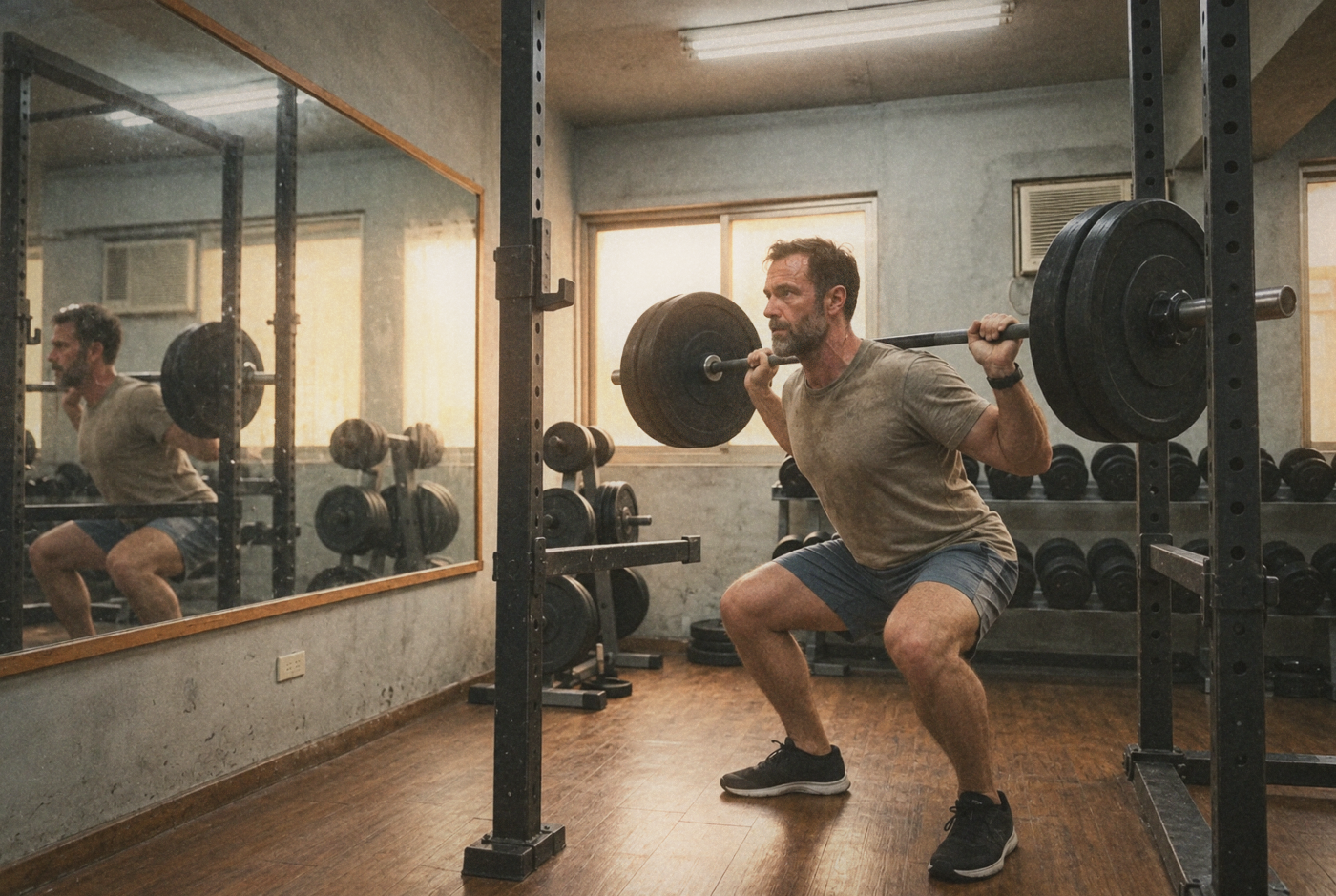 FIRST SIGHTWEBGLA lifter practices a barbell squat in a gym. · Color and grain by First Sight · Portra 400. · First Sight 色彩與顆粒調校 · Portra 400
Taipei is actually ideal for this because access to equipment is cheap. The 運動中心 (municipal gyms) are in every district, open 6am to 10pm, with a rate of NT$50 per hour or NT$799 to 1,500 for a monthly pass. Zhongshan 運動中心 is at No. 2, Lane 44, Section 2, Zhongshan North Road. Wanhua 運動中心 is open the same hours. Xinyi 運動中心 is at 100 Songqin Street, Xinyi District. All three have weight equipment, racks, barbells, the full setup.
If you prefer a commercial gym, World Gym has 117 locations across Taiwan. Sign-up is NT$2,888, monthly membership around NT$1,588. Fitness Factory operates 77 locations at similar pricing. These tend to be slightly nicer, with more space and newer equipment, but the municipal gyms are completely adequate if you're just starting. Don't let the environment intimidate you. Most people in there are not competing. They're just trying not to lose muscle.
If you can't or won't go to a gym, home training works too. The investment is minimal. Adjustable dumbbells from Decathlon Taiwan (19 stores, including one in Neihu, Taipei) run NT$1,000 to 3,000 depending on the weight. A pull-up bar costs NT$300 to 500. A simple barbell set from Decathlon runs NT$3,000 to 5,000. You can train everything you need with dumbbells and a pull-up bar.
The constraint of home training is that you need discipline. You need to actually do the session without a gym environment cueing you. Most people who start with good intentions at home drift after two months. This is not a character failing. It's just how human behavior works around friction. If there's friction (you have to drive somewhere), you're more likely to do it because you made the commitment when you left the house. If there's no friction (the weights are in your living room), you can always do it tomorrow. And tomorrow becomes never.
If you choose home training, pick a specific time. Same time every Monday, Wednesday, Friday. Mark it on your calendar. This is not optional.
The mistake everyone makes
The most common mistake is doing too much too soon. You feel motivated on day one. You do a full-body workout, you're sore for three days, and by day four you're discouraged. So you skip the session. Then you skip the next one. By day 10, you've convinced yourself you're not a "gym person."
You're not a gym person yet. After three months of consistency, you will be. Until then, you're building a habit, and habits are built through boredom, not excitement. Do less. Two sets per movement. 30 minutes of total time. This is enough to get a stimulus, not enough to trash yourself for recovery.
The second mistake is waiting until strength matters to start training. The data is clear: muscle is built faster when you're younger, and muscle is harder to rebuild after you lose it. If you're 45 and you haven't trained, the time to start is now. If you're 60, it's more urgent, but the science still says you can add meaningful strength within 12 weeks. But it's always easier to maintain than to rebuild.
The third mistake is thinking that doing light cardio counts. Forty-five minutes on a stationary bike at low intensity does almost nothing for muscle. It helps your heart, it's better than nothing, but it's not strength training. Strength training needs to feel hard. You should be breathing hard. Your muscles should feel fatigued. If you can easily carry on a full conversation, you're not at sufficient intensity.
Common questions
Will I get bulky? Women especially ask this. No. Muscle tissue is actually quite small. A pound of muscle takes up less space than a pound of fat. You'll look leaner if anything. You'll wear clothes better. The fear of "getting bulky" is overblown. You'd need years of consistent training plus caloric surplus to build bulk. That's not what happens when you're training to stay strong.
How long until I see results? Neurological adaptations happen within the first two to three weeks (you get stronger without adding muscle). Visible muscle gains take 8 to 12 weeks if you're consistent and eating enough protein. Don't expect to look different after one month. Do expect to feel different. Carrying things will feel easier. Walking stairs will feel easier. Your sleep might improve. That comes faster than the visible stuff.
Can I do this if I have arthritis? Modified, yes. Lower range of motion, higher reps, lighter weight, longer recovery. This is where a coach helps, because they can adjust movements to your specific limitations. Strength training can actually reduce arthritis pain if done correctly, because stronger muscles stabilize joints better.
Do I need to eat more protein? After 40, yes, roughly 1.2 to 1.6 grams per kilogram of body weight per day. For a 70-kilogram person, that's roughly 84 to 112 grams. A chicken breast has 30 grams, a cup of Greek yogurt has 15 to 20 grams, an egg has 6 grams. You don't need supplements. You need to be slightly more intentional about including protein at each meal.
What if I'm already 50 and out of shape? The research on older adults shows that strength gains from training are age-dependent but not age-prevented. A 60-year-old who's never trained will see remarkable improvements in the first 8 weeks. Not the same as a 25-year-old, but substantial. The time to start is always now.
Three-month protocol
Week 1–2: Movement patterns. Bodyweight versions of your main movements. Squat, push-up, row (using a resistance band or light dumbbell), step-up, plank. Two sets each, three times per week. Focus on feeling the movement, not on being hard.
Week 3–6: Adding load. Add 5 to 10 pounds to your starting movements. Still aiming for 8 to 12 reps. Three sessions per week, 48 hours apart. Total time per session: 35 to 40 minutes. You should feel worked when you're done, but not destroyed.
Week 7–12: Progressive overload. Every week, add either one more rep or a little more weight. Small, consistent increases. You're not trying to be a weightlifter. You're trying to get noticeably stronger than you were 12 weeks ago. By week 12, carrying things around your apartment should feel noticeably easier.
Why this matters now
The research from 2026 is the clearest statement we have: muscle strength is not about vanity or performance. The question is mortality. Whether you stay independent at 70 or become dependent. Whether climbing a flight of stairs is normal or requires planning.
You know the feeling. You watch someone older than you struggle with something physical that's trivial for you. You think: that won't be me. And then you keep living the same way. The research is saying: it actually could be you, unless you change now. The change is not dramatic. Two to three hours per week, moderate weight, consistency. That's the difference between "I could use help" and "I'm fine."
Start where you are. A municipal gym in your neighborhood. Dumbbells in your apartment. A park with a bench for step-ups. The equipment doesn't matter. The consistency does. Three months from now, you'll feel different. A year from now, you'll be stronger than people five years younger than you who didn't do this.
Your 70-year-old self is being built right now. By you. Today.
Frequently Asked
Some links in this article are affiliate links. If you purchase through them,OQUA may earn a small commission at no extra cost to you. This helps support our editorial work. We only link to products and services we genuinely reference in our writing.
Comments (0)
Loading comments...