
This itinerary is installable. One tap puts all 3 days on your calendar, each linking back to this guide.
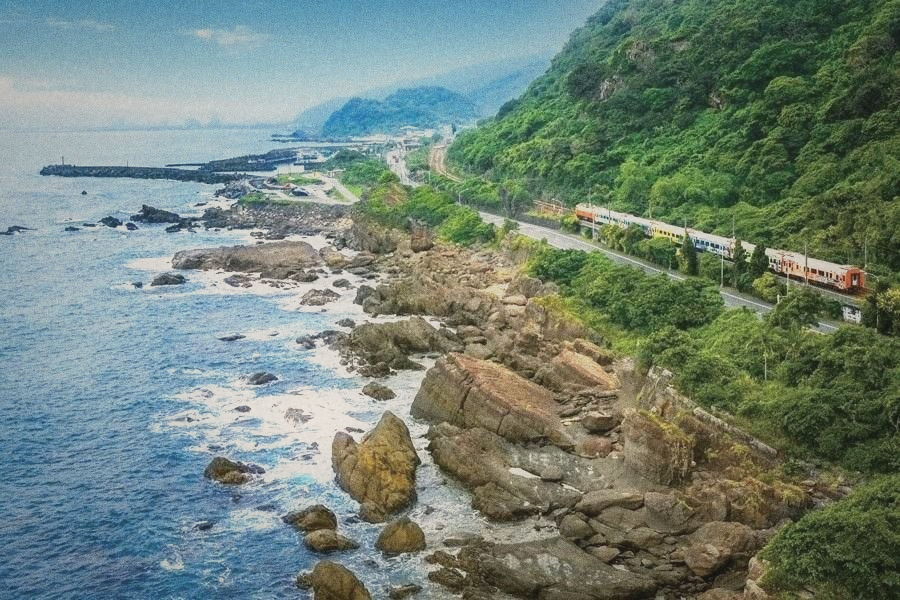
Install this week →Three and a half hours on a Puyuma Express from Taipei, and then the train rounds a bend past Hualien and the Pacific appears on the left side of the car. Blue, enormous, close. The mountains drop straight into it. Nobody on the train looks up from their phone. They've seen it before. You haven't, or maybe you have, but this time you're not passing through. You're getting off.
Taitung is 350 kilometers from Taipei, which sounds like nothing, but the mountains and coastline make it feel like crossing into a different country. The train takes three and a half hours if you booked early enough for a Puyuma or Taroko Express (NT$783, and those tickets sell out two weeks ahead, so mark your calendar). The flight from Songshan takes 50 to 65 minutes on Mandarin Airlines or UNI Air, runs NT$1,200 to 2,500, and drops you into one of the smallest airports in Taiwan, where the baggage carousel has maybe four suitcases on it and the taxi drivers are waiting outside because there's nowhere else to wait.
What you're arriving into is the least-developed coast on the main island. The population density is the lowest in Taiwan. The traffic is the lightest. The rice fields are the most photographed, and the hot springs are the least crowded. Everything here operates at a pace that feels almost confrontational if you've been living in Taipei, where even crossing the street feels like a competitive event.
Three days is enough to see the important things and slow down enough to actually register them. Here's how I'd spend them.
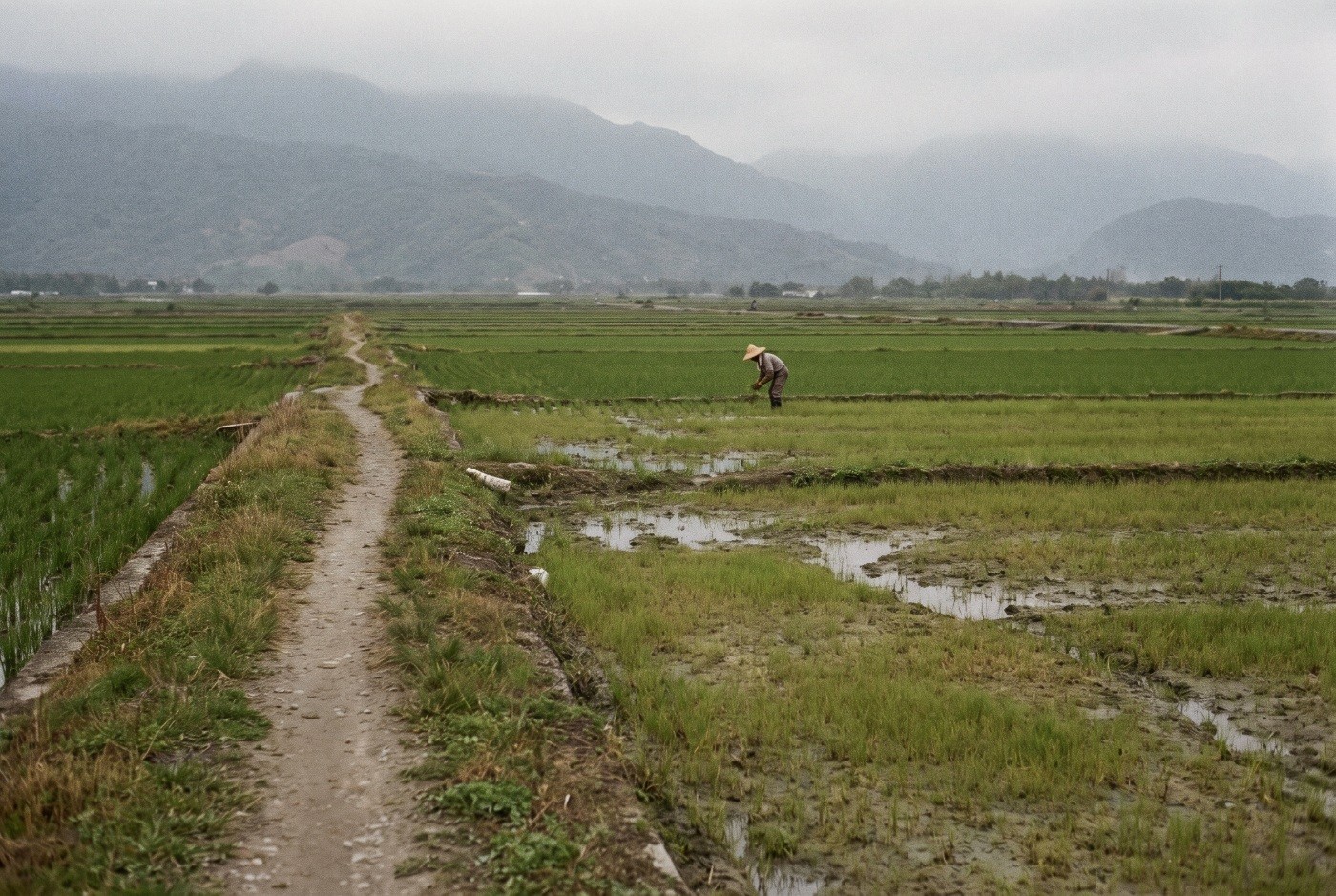
 FIRST SIGHTWEBGLIllustration: A farmer working among rice paddies. · Color and grain by First Sight · Superia. · First Sight 色彩與顆粒調校 · Superia
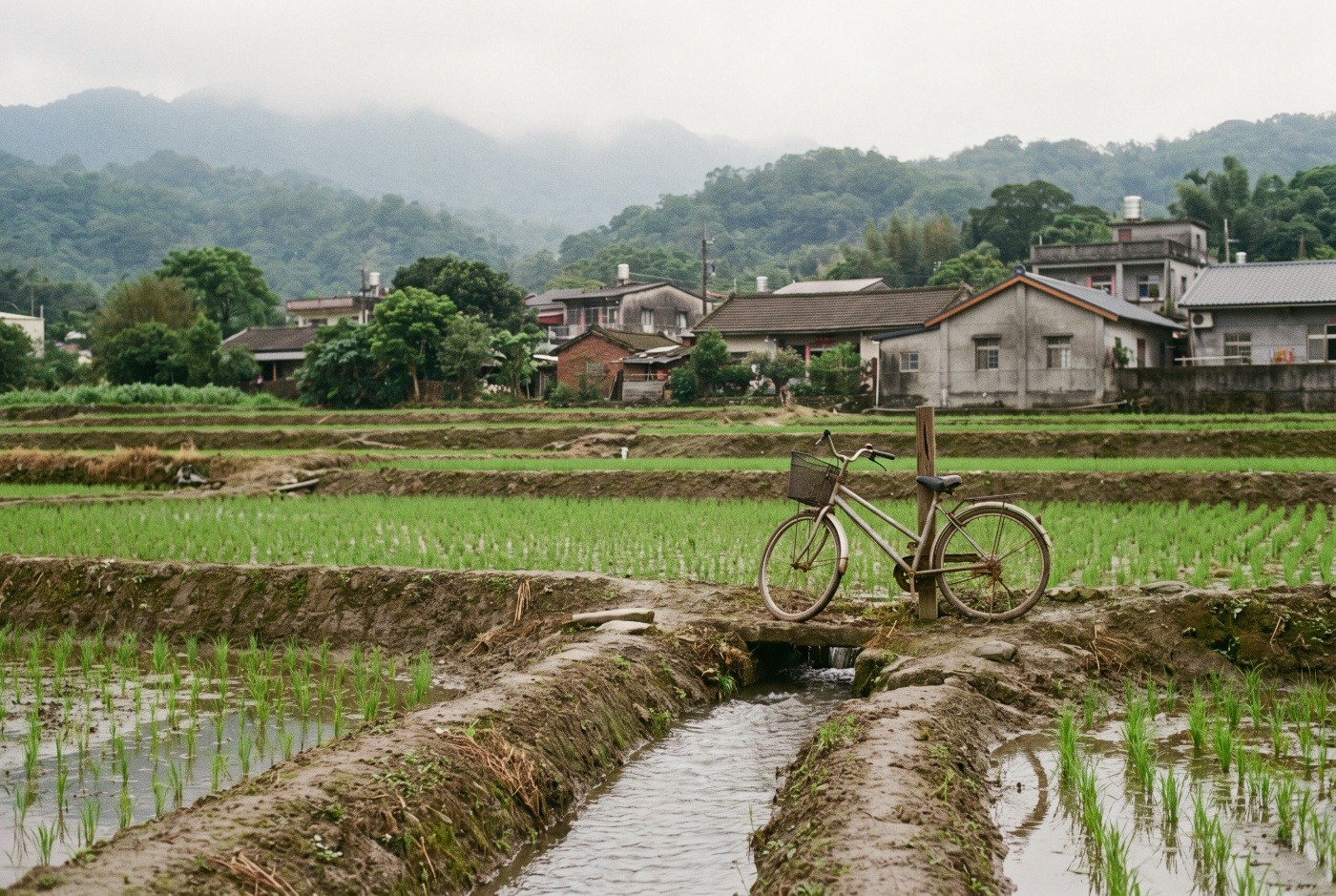 FIRST SIGHTWEBGLIllustration: A bicycle beside an irrigation channel. · Color and grain by First Sight · Superia. · First Sight 色彩與顆粒調校 · Superia
Day 1: Chishang and the Rice Fields
Take the early Puyuma out of Taipei. The 6:20am departure gets you to Taitung by around 10am, which leaves the whole day. From Taitung station, a local train north to Chishang takes about 45 minutes, and that ride alone is worth it. The train is old and unhurried, the windows are big, and the valley opens up around you like a bowl.
Chishang is a town of about 8,000 people that produces arguably the best rice in Taiwan. It also produces one of the most photographed roads in the country, which is a strange claim for a place this quiet.
Mr. Brown Avenue (伯朗大道) is a 2.2-kilometer car-free road that cuts straight through rice paddies with nothing on either side except rice, sky, and the Coastal Mountain Range in the distance. No power lines along most of the stretch. No buildings. Just a flat road through green (or gold, depending on when you visit). The Takeshi Kaneshiro Tree stands at one end, a single camphor tree that became famous because the actor stood next to it in an airline commercial in 2013. The tree is more interesting than that story suggests. It's alone in the middle of a field, and something about a lone tree in a flat landscape hits a nerve that no commercial can explain.
Rent a bike near the station. Every other shop rents them. The figure-eight cycling route around town takes two to three hours at a comfortable pace with stops, and "comfortable pace with stops" is the only way to do this. I made the mistake once of trying to ride it quickly because I wanted to get to the next thing. There is no next thing. The riding is the thing.
Lunch is a bento box. This is not negotiable. Chishang bento is famous across Taiwan, and there are two places to get it right by the station. Quan Mei Hang (全美行) is the no-frills original, NT$60 to 80 for a box of rice, pork, pickled vegetables, and an egg that's been stewed until it's the color of mahogany. The Wutao Museum (悟饕池上飯包文化故事館) is the more touristy option. They have a retired locomotive out front where people eat their bentos on the train seats, which sounds gimmicky but is actually kind of great. Their boxes run NT$80 to 100. Either way, you're eating rice that was grown in the fields you just rode through, and that makes a NT$80 lunch taste like more than NT$80.
Spend the late afternoon back in the paddies. The light changes completely after 4pm. The shadows get long, the mountains turn purple, and the tourists thin out because most of them came on a day trip and their bus is leaving. This is the best hour. I sat on the edge of a field path and ate a second bento (nobody said you can't have two) and watched the light go orange.
Stay in Taitung city tonight. The Gaya Hotel (璽賓行旅) is a solid four-star option, four minutes on foot from Tiehua Village, rooms from about NT$3,500 to 5,500. If you're on a budget, On My Way Hostel has dorms starting around NT$400 to 500.
Day 2: The Coast
Highway 11 runs north from Taitung city along the Pacific coast, and it is one of the best drives in Taiwan. You need wheels for today. Rent a car (NT$1,500 to 2,500 per day, most flexible) or a scooter (NT$400 to 1,200 per day, you'll need an international driving permit). I'd recommend a car if you have a license. The distances are real, and the coast road has sections where the wind coming off the Pacific can push a scooter sideways.
Start early. Head north.
Sanxiantai (三仙台) is about an hour north on Highway 11, and it's the kind of place that shows up on every Taiwan tourism poster for good reason. An eight-arch pedestrian bridge, maybe 300 meters long, connects the coast to a small volcanic island. The bridge is graceful in a way that engineering rarely is. It rises and falls with the rock formations like it grew there.
You can walk just the bridge and back in 20 minutes, or do the full island loop, which is 4.3 kilometers and takes an hour and a half to two hours over rocky coastal trail. The rocks are volcanic, pocked and sharp, and the waves hit the north side of the island with serious force. Bring water. There's no shade on the island trail except for a few pavilions.
Sanxiantai is also the first place on Taiwan's main island to see the sunrise each morning. People come at 5am for this. I didn't, because I'm not that kind of traveler, but I respect the commitment.
Dulan (都蘭) is about 30 minutes south of Sanxiantai, back toward Taitung, and it has a completely different energy. If Sanxiantai is geology and scale, Dulan is culture and drift. The town sits on Highway 11 and feels like it was assembled by people who came for a week and stayed for a decade. Surfers, artists, a few expats, and the Amis indigenous community whose land this has always been.
The Dulan Sugar Factory (都蘭糖廠) was built in the 1930s during the Japanese colonial period, closed decades ago, and has been repurposed into an arts and culture park. Galleries in old processing buildings, studios where people are actually working, not performing for tourists. The Saturday night market here has live music and food that feels less like a night market and more like someone's backyard party that got slightly out of hand.
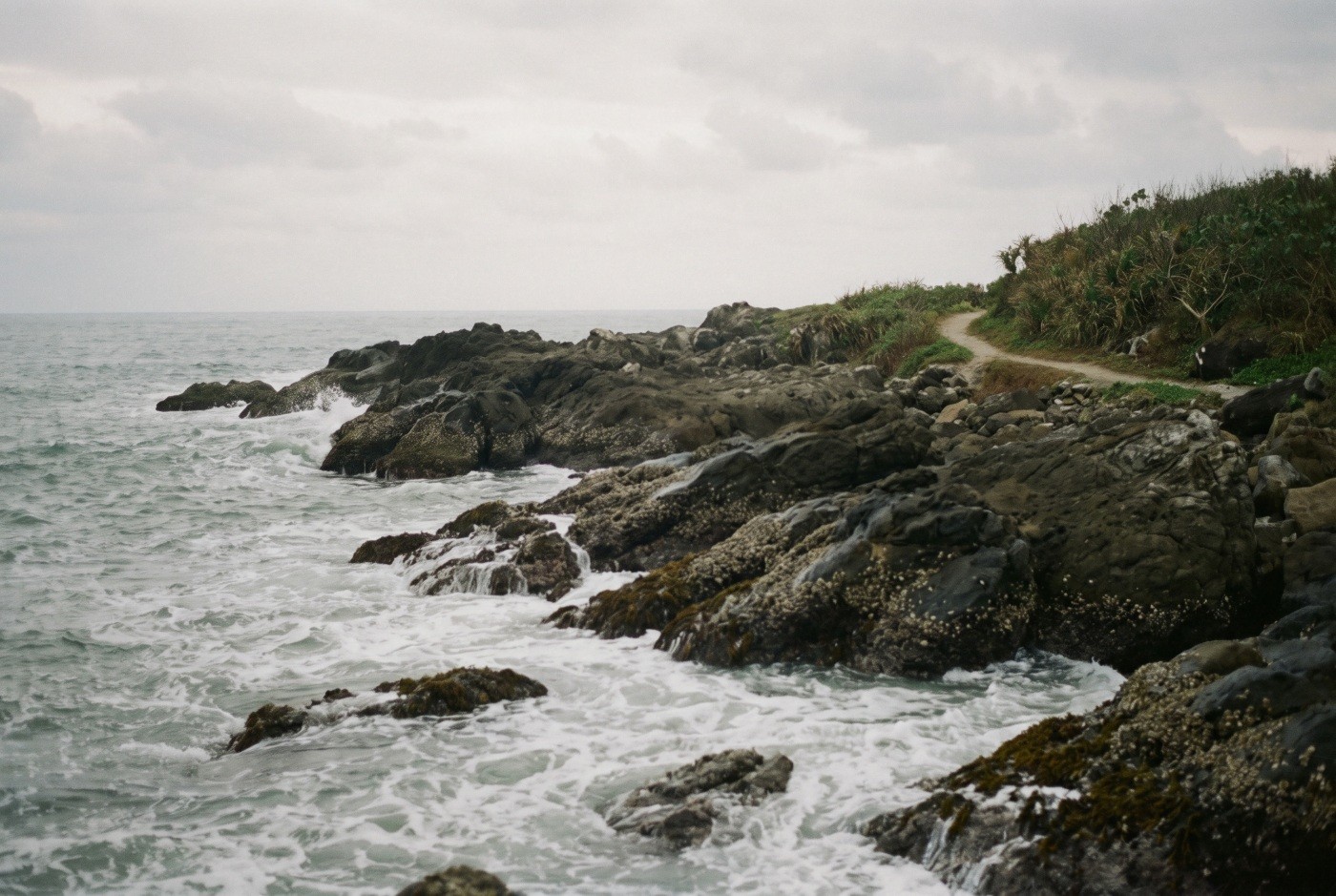 FIRST SIGHTWEBGLIllustration: Waves breaking along a rocky shore. · Color and grain by First Sight · Superia. · First Sight 色彩與顆粒調校 · Superia
If you drink beer, Highway 11 Craft Beer is a bar worth finding. It's small, the beer is local, and the vibe is the kind of casual that Taipei bars spend a lot of money trying to manufacture.
Dinner tonight should be indigenous food. MiBaNai (米巴奈) in Taitung city is the best indigenous restaurant I've eaten at in eastern Taiwan. Stir-fried venison, roast salt fish, betel-flower salad. The flavors are not what you're used to if your reference point is Taipei food. They're bolder, more herbal, with a smokiness that comes from cooking traditions that predate everything else on this island by thousands of years. Or try Xiang Luo Lei (響羅雷) in Likavung village for Puyuma-style Abai, salted fish rice, and fried muntjac.
Day 3: Hot Springs, Then Taitung City
The last day is the slowest, which is on purpose.
Zhiben Hot Springs (知本溫泉) is 20 minutes southwest of Taitung city, tucked into a valley where the Zhiben River comes out of the mountains. The water here is sodium bicarbonate, what's locally called "beauty spring" because it makes your skin feel like you just applied an expensive moisturizer. The effect is not imagined. Sodium bicarbonate softens water and lowers surface tension, which genuinely leaves skin feeling smoother. It's chemistry, not marketing.
Toyugi Hot Spring Resorts and Spa is the best mid-range option. Rooms run NT$2,500 to 4,500 per night, and even if you don't stay overnight, you can use the pools. Get there in the morning, before 10am if possible. The pools are outdoor, set against the mountain, and in the early hours the steam rises into cool air while birds are doing whatever birds do in subtropical forests. It's quiet. Genuinely quiet, not "quiet for Taiwan" quiet.
Afternoon, head back to Taitung city for the parts most people skip.
Tiehua Village (鐵花村) is a former railway warehouse at No. 26, Lane 135, Xinsheng Road that's been converted into a music and arts venue. Wednesday through Saturday, 8 to 10pm, there are live performances. Local bands, singer-songwriters, occasionally something experimental. The space is outdoors, strung with hand-painted hot air balloon lanterns that glow at night. It's the kind of place that would be unbearably trendy in Taipei but feels genuine here because the audience is mostly locals who came on foot.
If it's Thursday, Friday, or Saturday, walk over to the night market on Zhengqi Road (正氣路) for your last meal. The stone-slab grilled meat is the thing to find. Thin slices of pork and beef cooked on heated stone slabs at your table, the fat sizzling and smoking, the kind of interactive eating that turns dinner into an activity. Oyster noodles are good. The crispy stinky tofu is better than it has any right to be.
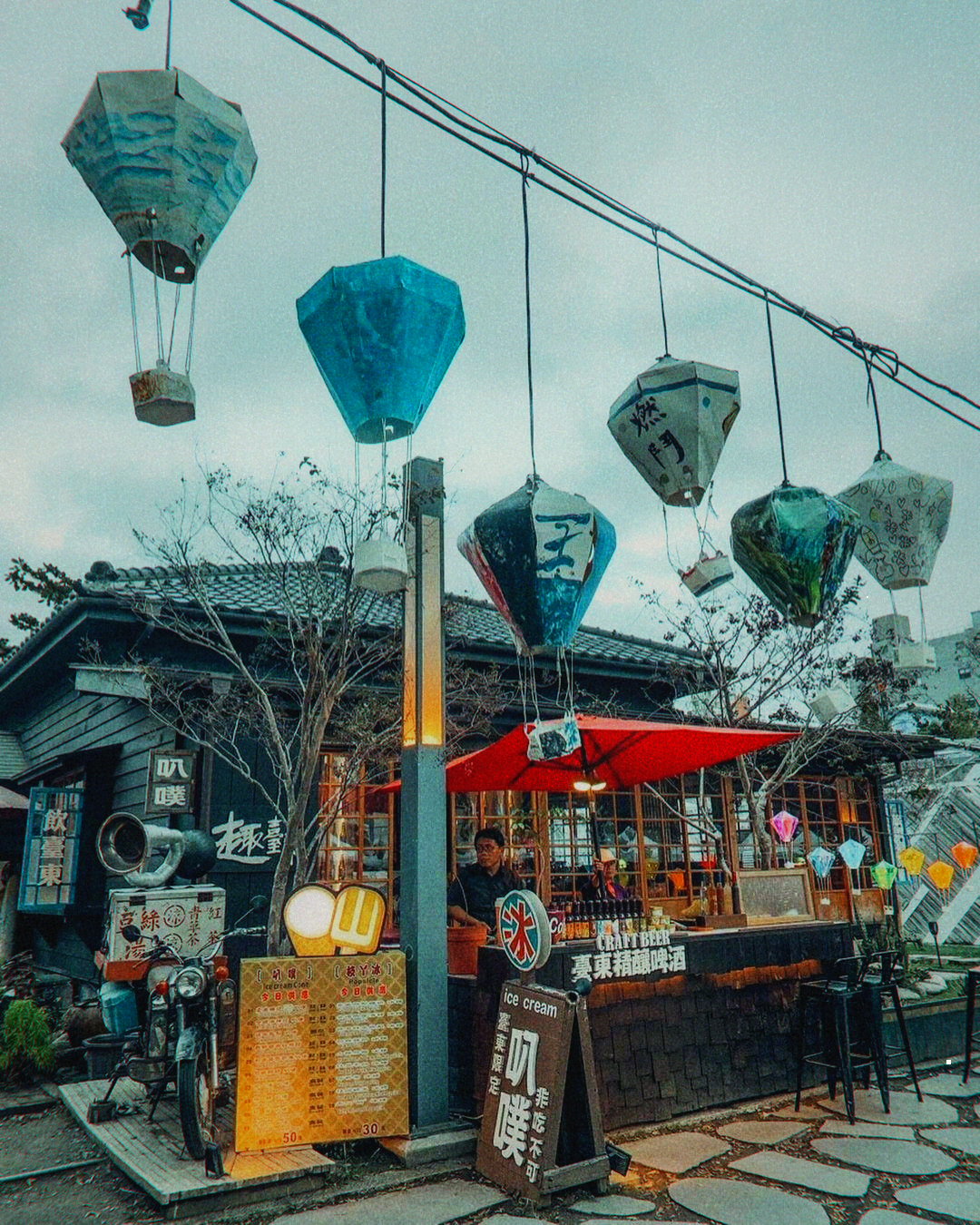 FIRST SIGHTWEBGLTiehua Village on a Saturday night. The lanterns are hand-painted, the music is live, and nobody is checking their phone. · Color and grain by First Sight · Superia. · First Sight 色彩與顆粒調校 · Superia
Practical Notes
Best season: October and November. The rice in Chishang goes gold, the typhoons have stopped, the temperature drops to a comfortable 22 to 28 degrees, and the coast is at its clearest. Avoid July through September unless you enjoy rearranging your plans around typhoon warnings.
Getting around: A rental car is the most flexible option (NT$1,500 to 2,500 per day from agencies near the station). Scooters work too (NT$400 to 1,200 per day) but you'll need an international driving permit, and the coast road is windy in both senses of the word. Day 1 can be done by train and bicycle. Days 2 and 3 need a vehicle.
Budget for three days: Figure roughly NT$2,000 to 3,000 for transport (train from Taipei plus two days of car rental), NT$3,500 to 11,000 for accommodation depending on your taste, and NT$500 to 1,000 per day for food. Taitung is noticeably cheaper than Taipei for almost everything.
Frequently Asked
Some links in this article are affiliate links. If you purchase through them,OQUA may earn a small commission at no extra cost to you. This helps support our editorial work. We only link to products and services we genuinely reference in our writing.
Comments (0)
Loading comments...