
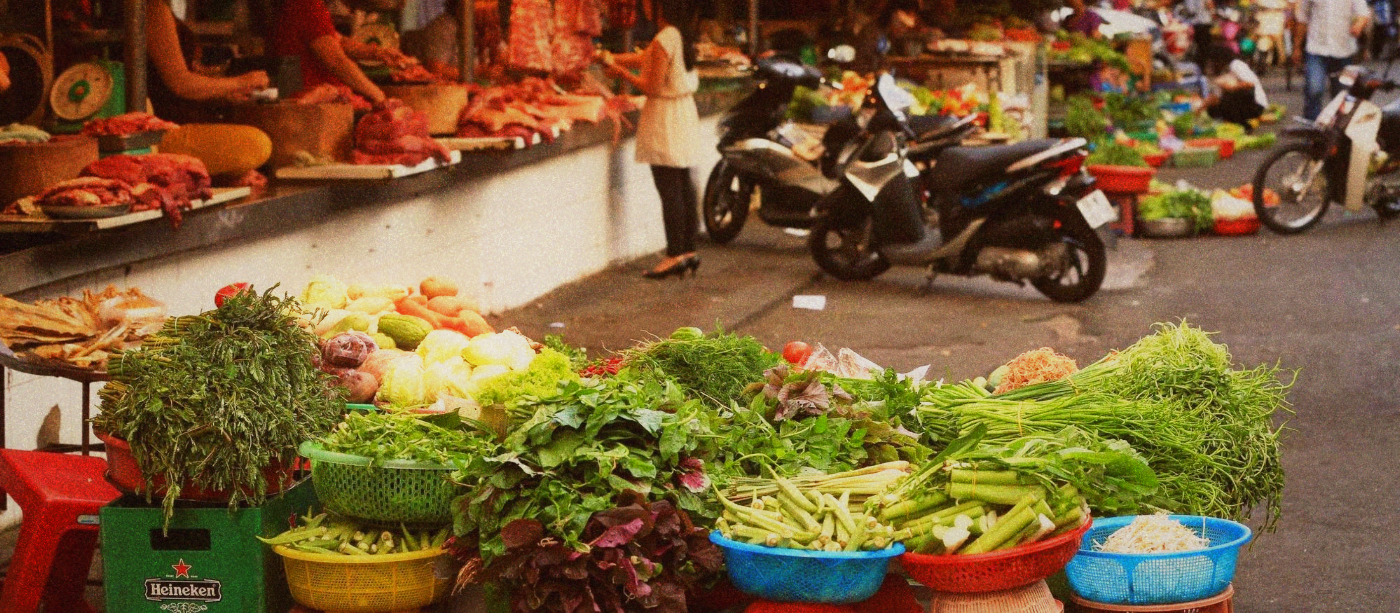
The vendor at Shuanglian Market is arranging daikon radish into a tower. 6:47am, and already the stall smells like earth and morning water, the floor slick with melted ice. A woman in a pink apron cuts a piece and holds it up to a customer's nose. "Fresh. This morning from Yilan." The customer nods. In twenty seconds, the entire stack of radish has moved from the stall to her shopping bag.
This is the texture of eating well in Taiwan. Not elaborate. Not documented on Instagram. Just a vendor who knows when her produce was picked, a customer who knows how to taste for ripeness, and a transaction that takes the amount of time a conversation takes, because the two people know each other, or if they don't, they're following a script written by fifty years of Taipei mornings.
Taiwan has a food problem and a food solution at the same time. Two in five people skip meals habitually. One in four eat out fourteen or more times a week. Only 31% of the food Taiwanese people eat is grown here. And yet, the actual experience of eating well in Taiwan works better than it has any right to.
It's not because of a revolutionary diet system or a celebrity chef or an app that tracks your nutrients. It's because the infrastructure is built on small, consecutive decisions that add up to something coherent. A wet market that knows your face. A rice cooker that's been running since this morning. A 自助餐 stand where you can eat a full meal for 100 NT, including vegetables. These aren't glamorous things. They're the opposite of glamorous. But they're how Taiwan built a food culture that assumes people have real lives, irregular schedules, and limited time, and still want to eat well.
The conversation that changed how Taiwan eats
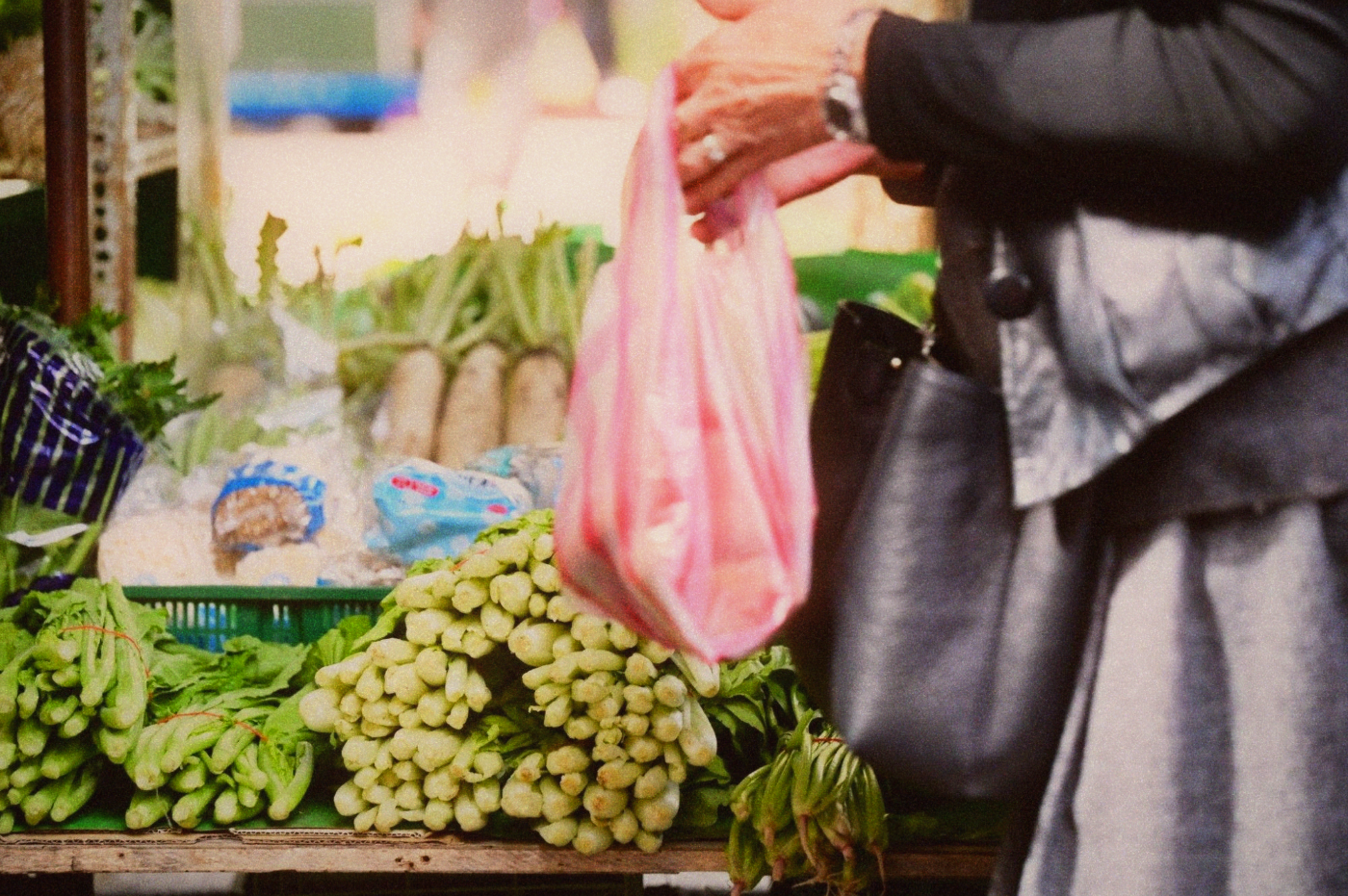
 FIRST SIGHTWEBGLThe wet market morning. The ritual is always the same: walk, look, ask, taste, decide, carry home. · Color and grain by First Sight · Gold 200. · First Sight 色彩與顆粒調校 · Gold 200
"吃飽了沒?" means "Have you eaten yet?" but it doesn't really mean have you eaten. It means: I'm thinking about you. Are you doing okay? It's a greeting that contains a whole philosophy. In a culture where eating well is linked to wellbeing the same way sleep is linked to health, the question isn't small talk. It's an expression of care.
The practical consequence of this is that eating in Taiwan, even without trying, becomes a constant negotiation toward adequacy. Food isn't positioned as entertainment or self-expression. It's infrastructure. It's the thing you do three times a day to stay capable, to stay present, to stay with the people around you. The culture doesn't celebrate the person who eats a salad at their desk. It worries about them.
This might seem quaint, but it has concrete implications. When food is treated as daily infrastructure rather than lifestyle optimization, the decisions change. You don't need the perfect meal. You need a meal that works, that costs what you can afford, that you can get without planning seven days in advance. Taiwan's food landscape is organized around this premise in a way most places aren't.
The wet market as democracy
Shuanglian Market on a Tuesday morning is crowded with people in their seventies, people in their twenties with backpacks, retirees, people who look like they came straight from a night shift somewhere. No one is performative. No one is buying for a photo. They're buying because their family eats tonight, or because the bitter melon looks better this week than last week.
The market is at 198 Minsheng West Road, Datong District, and it's open 7am to 2:30pm every day. Vendors know what's in season. They know which daikon is sweeter this month. They know you'll want slightly firmer bok choy for stir-fry and softer bok choy for soup, and if you ask, they'll tell you which is which. They also know the price will be lower at 1:30pm if there's leftover stock, because they're not trying to make a mythology around their vegetables. They're trying to sell them.
This is the opposite of the farmer's market mythology, the one where everything costs twice as much and the vendor tells you a twenty-minute story about his heirloom tomato genetics. Taiwan's wet markets assume you want vegetables because you need to eat tonight, not because you're philosophically aligned with small-scale agriculture.
The vegetable prices float. A head of lettuce at Shuanglian is 20 NT in March, 30 NT in July. The vendor doesn't pretend this isn't happening. "Too hot, expensive now," they tell you. And you either buy or you don't. You also notice that the vendor, without being asked, will sometimes slip you an extra vegetable or two, not as a performance of generosity but as the casual acknowledgment that today you're a regular, and if you come back tomorrow, they want you to do that.
There are three major wet markets in central Taipei. Shuanglian (Datong), Dongmen (Zhongzheng), and Shilin (Shilin) is the largest. They're not quaint. The floors are wet and slippery. The lighting is fluorescent. The sounds are constant negotiations. An elderly woman is showing the difference between two brands of dried shrimp to another vendor. Someone's phone is playing music from a stall two vendors over. The produce smells like earth and the people smell like morning. If you've only eaten supermarket vegetables, the wet market experience is initially disorienting. After two visits, you can't go back.
Rice: which is more than rice
In Taiwan, rice isn't a staple. It's the infrastructure. The rice cooker plugged in since this morning, steam rising from the top, the rice inside settling into the shape of the pot. It's on someone's counter right now in a million homes, and it's been on since 7am, or since last night, or since whenever rice needed to be ready when someone came home hungry.
Taiwan grows ninety-three percent Japonica rice, called Ponglai rice locally, smooth-grained and sticky, the kind that holds together. It's the rice that tastes like rice, not the long-grain stuff that separates into individual grains. The other seven percent of Taiwan's rice production is Zai-lai rice, used for rice noodles and turnip cakes, and glutinous rice for zongzi and tangyuan and mochi, the ceremony foods.
Ponglai rice has been Taiwan's default since the 1950s. It's not trendy. It's not the grain equivalent of an artisanal coffee beans. It's a rice that was chosen decades ago because it grows well in Taiwan's climate and it tastes good and people like it. The fact that you can buy excellent rice anywhere for under 50 NT a pound means that the baseline of eating well in Taiwan includes having good rice at home. It's not premium. It's default.
The rice cooker is a technology that most of the world doesn't really understand. It's not a status symbol and it's not fancy. It's a cylindrical pot with a heating element, and in Taiwan it's considered the solution to the eating problem. You put rice and water in the cooker, turn it on, and for the next thirty minutes, you don't have to think about it. When it clicks off, the rice is done. And then it keeps the rice warm, so when you get home at 6:30pm from a job that kept you later than expected, the rice is still there, still warm, still ready to combine with whatever vegetables or leftover protein you can find in the refrigerator.
The rice cooker is what makes the 自助餐 philosophy possible. If you have rice at home, you don't need to buy it at a restaurant. What you do need is the vegetables, the proteins, the days when you're too tired to plan. So a stand that sells you a disposable box of rice with choices of protein and vegetable side dishes for 85 to 150 NT is not a low-quality option. It's the infrastructure acknowledging that some days you're not cooking, and that's fine, and we have you covered.
The self-serve restaurant ecosystem
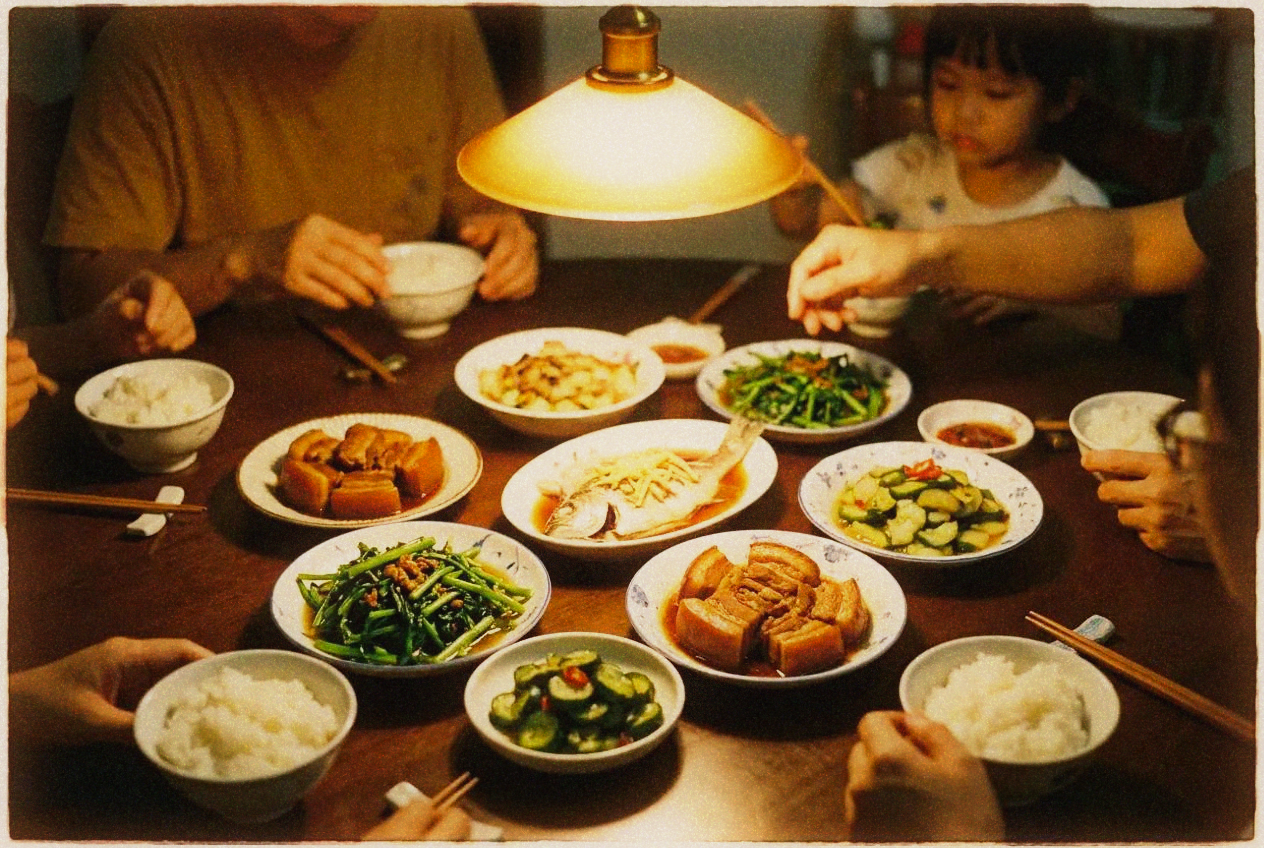 FIRST SIGHTWEBGLA Taiwanese home table: rice, vegetables, fish, everything in small portions, everything shared. This is the system. · Color and grain by First Sight · Gold 200. · First Sight 色彩與顆粒調校 · Gold 200
The 自助餐 stands are a particular kind of brilliance. Walk into one in the afternoon or early evening, and you'll see stainless steel trays of food: braised pork leg, stir-fried greens, eggs, a few dishes that change day to day. You take a tray, point at what you want, and the person at the counter assembles your meal. It costs 85 to 150 NT depending on what you choose, which is less than the cost of a Starbucks coffee. You eat at a small plastic table or take it home.
The meal is not gourmet. The lighting is bright and unromantic. The plates are disposable. The rice is there because the rice cooker makes it cheap and available, so you buy the vegetables and protein instead. And because this system exists at the scale it does in Taiwan, you don't have to plan ahead, you don't have to leave the neighborhood, and you don't have to feel bad about not cooking. The food isn't a celebration. It's a solution. It assumes you have a body that needs to eat, and you have maybe 200 NT in your pocket and fifteen minutes of time.
This model exists because Taiwan understood a problem early: that pretending everyone has time to cook three meals a day from scratch is a form of violence against people who work actual jobs. So instead of asking people to cook, the infrastructure asks: what is the minimum viable meal that tastes good and costs almost nothing?
The answer is: vegetables, protein, rice, and salt. Cook it well enough that it tastes like someone cared. Sell it cheap enough that price is not the barrier. Make it available at the neighborhood level so people don't have to travel. And let people eat it in fifteen minutes or take it home. That's the 自助餐 philosophy, and it's a better solution to the eating problem than most wellness cultures have offered.
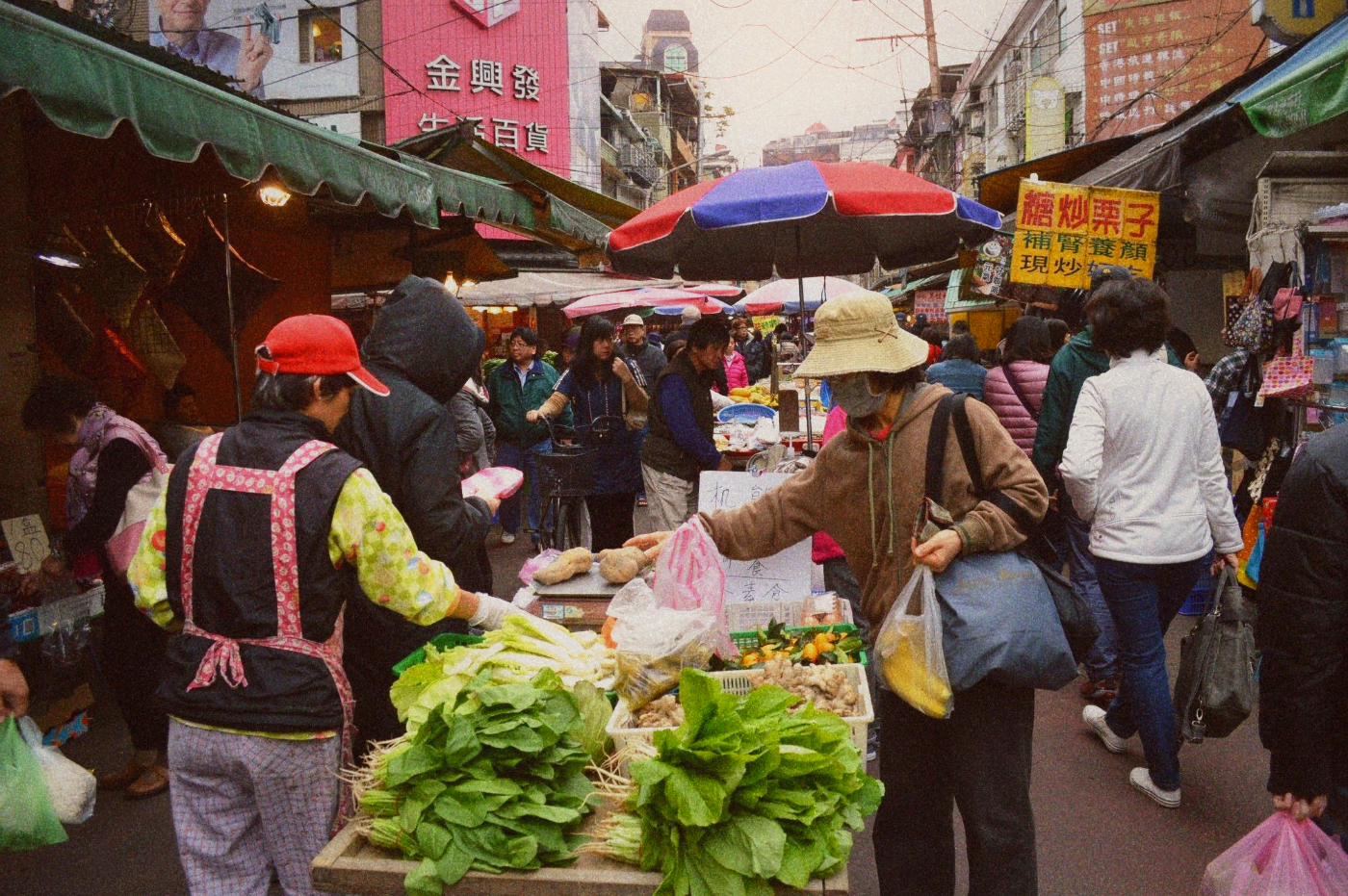 FIRST SIGHTWEBGLThe morning lineup. Same person behind the counter, same prices, different vegetables. It's not optimization. It's maintenance. · Color and grain by First Sight · Gold 200. · First Sight 色彩與顆粒調校 · Gold 200
Night markets: pleasure versus nutrition
Night markets are where Taiwan's food culture gets confusing, because they're positioned as both a daily necessity and a form of entertainment. Shilin Night Market has over 500 stalls and roughly 15,000 visitors per night. People walk through at 10pm eating pepper pork buns from Raohe and bags of popcorn chicken, and they treat it as a form of recreation, a cultural experience, something to tell tourists about.
But most of the people there are eating because they're hungry and they're in the neighborhood and the food is available. The night market is not a special occasion. It's the food infrastructure staying open late, because Taipei works late and people eat when they're hungry, regardless of what the clock says.
This is where the daily eating culture and the celebration eating culture collide. The night market has excellent food. The dumplings are small and hot and cheaper than they have any right to be. The stinky tofu smells like every warning you've heard about it and tastes nothing like the smell. The grilled squid is salty and tender. But eating dinner at the night market at 10pm and going to sleep at midnight is a different problem than stopping by at 7pm for a snack.
Taipei's night markets are concentrated in a few areas. Shilin (Taipei's largest), Raohe (in Nanjing, famous for pepper pork buns), Ningxia (Datong District, famous for taro balls at Liu Yu Zai), and Tonghua (Songshan, with four stalls that have Michelin Bib Gourmand recognition). Each has a different rhythm. Shilin is tourism and density. Raohe is smaller and more workable. Ningxia is neighborhood people getting dinner.
The food at night markets is often better than what you'd cook at home, and it costs less. The question that matters isn't whether to eat there. It's whether eating late in the evening is compatible with sleeping well, and the honest answer is usually no. A better garlic-fried squid at 10pm is still food that your digestive system is processing while you're trying to sleep. The night market works best as an earlier meal or a snack, not as a dinner.
The fermented foods secret
Taiwanese food includes many fermented elements that most people don't think about as fermented. Soy sauce is in almost everything. Fermented black beans go into dozens of dishes. Yilan has a tradition of fermented bean curd that arrives mild or spicy, creamy, capable of elevating rice on even the flattest morning. These are not foods that require special handling or a wellness mindset. They're just foods that have been in Taiwanese cooking forever because fermentation was a way to preserve things before refrigeration existed.
The practical point is that if you're eating Taiwanese food made the way it's usually made, you're already eating a significant amount of fermented foods without trying. You're not shopping for "probiotics" at an health food store. You're just eating stir-fried vegetables made with fermented black beans and soy sauce.
The fermented element also changes how food tastes and how your body processes it. Food that's been fermented partially breaks down the proteins, making them easier to digest. The flavor is deeper. The salt is doing work, not just sitting there. And because Taiwanese food uses fermented elements consistently, the daily food culture includes all these benefits as a baseline.
This is different from wellness cultures that treat fermented foods as a specialized category requiring special attention. Taiwan just uses them because they taste good and they've always been available. The modern science caught up with the tradition about twenty years ago, confirming that fermented foods are genuinely good for digestion. But Taiwan had already known this for four hundred years.
Tea as a meal component
In most places, tea is either a beverage or a caffeine mechanism. In Taiwan, tea is part of the meal. You eat and then you drink tea, or you drink tea while eating the heavier parts of the meal. Not a rule or a formal thing. It's just how the food is structured.
The tea is usually whatever is cheap and available: a jasmine tea, a oolong from the convenience store, a cup of hot water. The point is not the quality of the tea or the connoisseurship of tea culture. The point is that after eating, especially after a meal with salty or greasy components, the tea washes the palate and settles the stomach. It's a small gesture at the end of the meal that says: we're done now, the food is processed, let's transition to what's next.
This is a different relationship with tea than most Western food writing presents. It's not lifestyle, not status, not a thing to spend three hours learning about. It's a small cup of something warm that makes the meal feel complete and makes digestion a little easier. And because it's built into the meal experience this consistently, most people don't have to think about it. They just reach for tea because that's what comes next.
The eating well equation in Taiwan
Eating well in Taiwan has less to do with discipline or effort than with having reasonable infrastructure and showing up to it consistently.
If you have access to a wet market, you have vegetables that are in season, that taste good, that cost what they should cost. If you have a rice cooker, you have the foundation of a meal that takes two minutes of effort. If you know where the nearest 自助餐 stand is, you have a backup meal that costs 100 NT and includes protein and vegetables. If you drink tea after the meal, your digestion is slightly easier.
These are not optimization moves. They're the opposite. They're accepting that eating is something you do three times a day, that it should not require constant effort, and that the culture has already designed a system that works for people who are busy and tired and hungry.
The challenge isn't eating well. The challenge is remembering that eating well is something that happens over weeks, not something that's optimized on a Tuesday afternoon. It's the difference between a philosophy and a diet. A philosophy is what you do when no one is watching, what you do because it's built into the infrastructure so deeply that it requires more effort not to do it than to do it.
Taiwan built that infrastructure seventy years ago, without thinking about it as infrastructure. It's in the wet market conversation. It's in the rice cooker click. It's in the 自助餐 counter. It's in the tea that comes after the meal. It's in the question, "吃飽了沒?" that contains the whole thing.
Frequently Asked
Some links in this article are affiliate links. If you purchase through them,OQUA may earn a small commission at no extra cost to you. This helps support our editorial work. We only link to products and services we genuinely reference in our writing.
Comments (0)
Loading comments...