
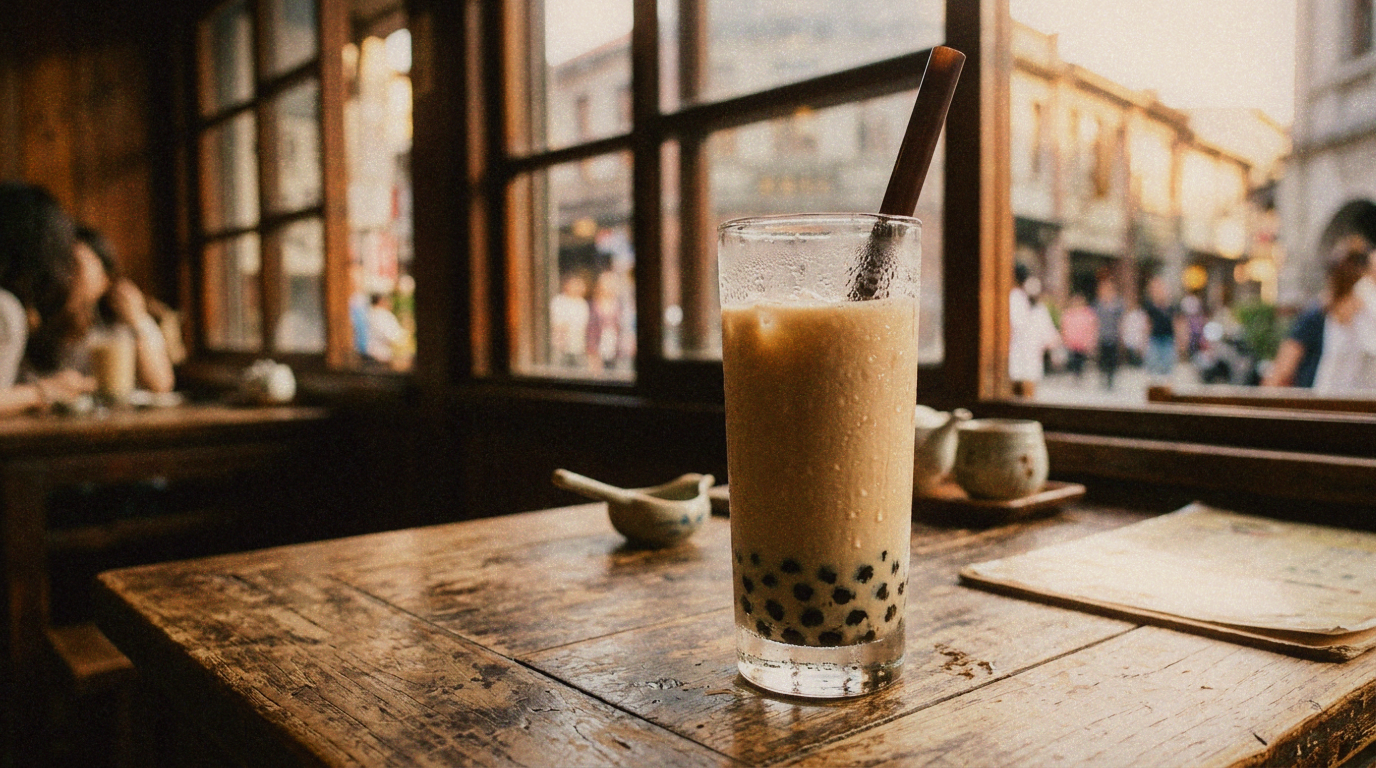
There is a drink that started in a Taiwanese teahouse and ended up on every continent, and most of the people drinking it have no idea it came from here. Bubble tea, boba, pearl milk tea, whatever your city calls it, was invented in Taiwan in the 1980s, and in the decades since it has become one of the island's most successful cultural exports, quietly outrunning the movies and the semiconductors in the one arena that touches people daily. To understand it properly you have to come back to the source, where the drink is not a novelty but a habit.
Walk any Taiwanese street and you are rarely more than a block from a tea stand. They sit between the convenience stores and the scooter repair shops, glowing and busy, staffed by teenagers who can build forty drinks an hour from memory. Ordering is a reflex here, folded into the walk home from work or the wait between classes. The drink you queue twenty minutes for abroad is, in Taiwan, the most ordinary thing in the world, and that ordinariness is the whole point.
Where it actually started
The honest answer is that two teahouses claim it, and a court spent years declining to choose between them. The better-documented story belongs to Chun Shui Tang in Taichung, where in the early 1980s the founder, Liu Han-chieh, began serving tea cold and shaken after seeing iced coffee in Japan. Shaking tea over ice gave it a frothy head and a lighter body, and it turned a hot, ceremonial drink into something you could gulp in the heat.
The pearls came a few years later. As the often-told account goes, at a staff meeting in 1987 a product manager named Lin Hsiu-hui tipped a Taiwanese tapioca dessert into her iced tea for fun, and the table drank the accident empty. Down in Tainan, the Hanlin Tea Room tells a parallel story of dropping white tapioca balls that looked like pearls into milk tea in 1986, later swapping them for the black pearls we know. The two chains eventually sued each other over the origin. After roughly a decade the courts effectively ruled that nobody could own the idea, which is its own kind of answer: the drink belongs to Taiwan, not to a company.
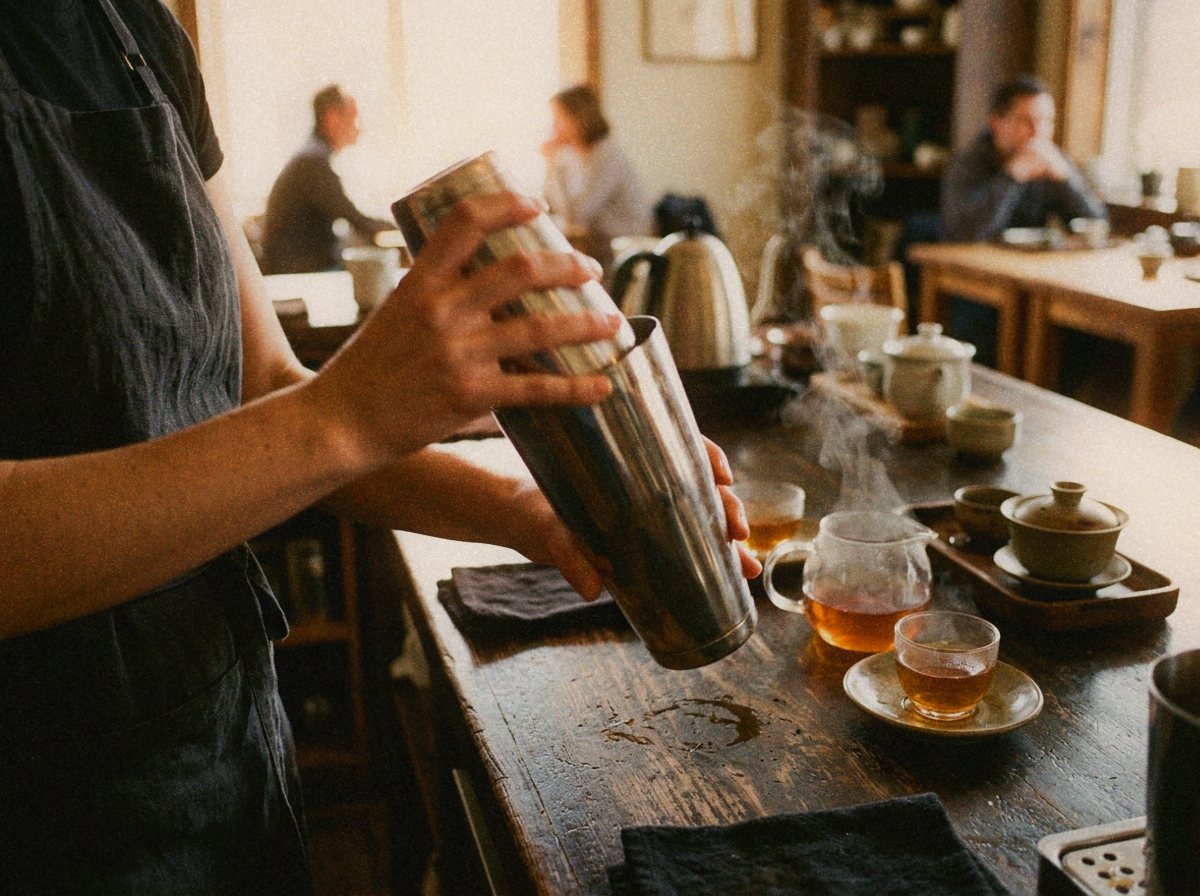
 FIRST SIGHTWEBGLBefore the pearls, there was the shake. Chilling and frothing hot tea over ice is the move that made bubble tea possible. · Color and grain by First Sight · Gold 200. · First Sight 色彩與顆粒調校 · Gold 200
That shake still matters. It is why a good bubble tea has a soft collar of foam and a rounded, aerated texture instead of tasting like tea poured over ice. Order at an old-school teahouse and you can still watch someone build it by hand in a metal shaker, the same motion that started all of this, before the drink was a franchise and a flavour of ice cream.
What the pearls really are
The pearls are not fruit and they are not gelatine. They are tapioca, made from the starch of the cassava root, rolled into little spheres and boiled until they turn glossy and translucent. Taiwanese call the texture QQ, a word that means springy and chewy at once, with a resistance that pushes back gently against your teeth. It is the single most important thing about the drink and the hardest to get right.
Good pearls are cooked fresh, in small batches, and thrown out after a few hours because they harden as they cool. A stand that cares will have a pot on the go all afternoon and pearls that are warm, soft, and faintly sweet from a soak in sugar syrup. A stand that does not will give you a clump of hard, flavourless beads at the bottom of the cup. Once you have had the good version, you cannot unlearn the difference.
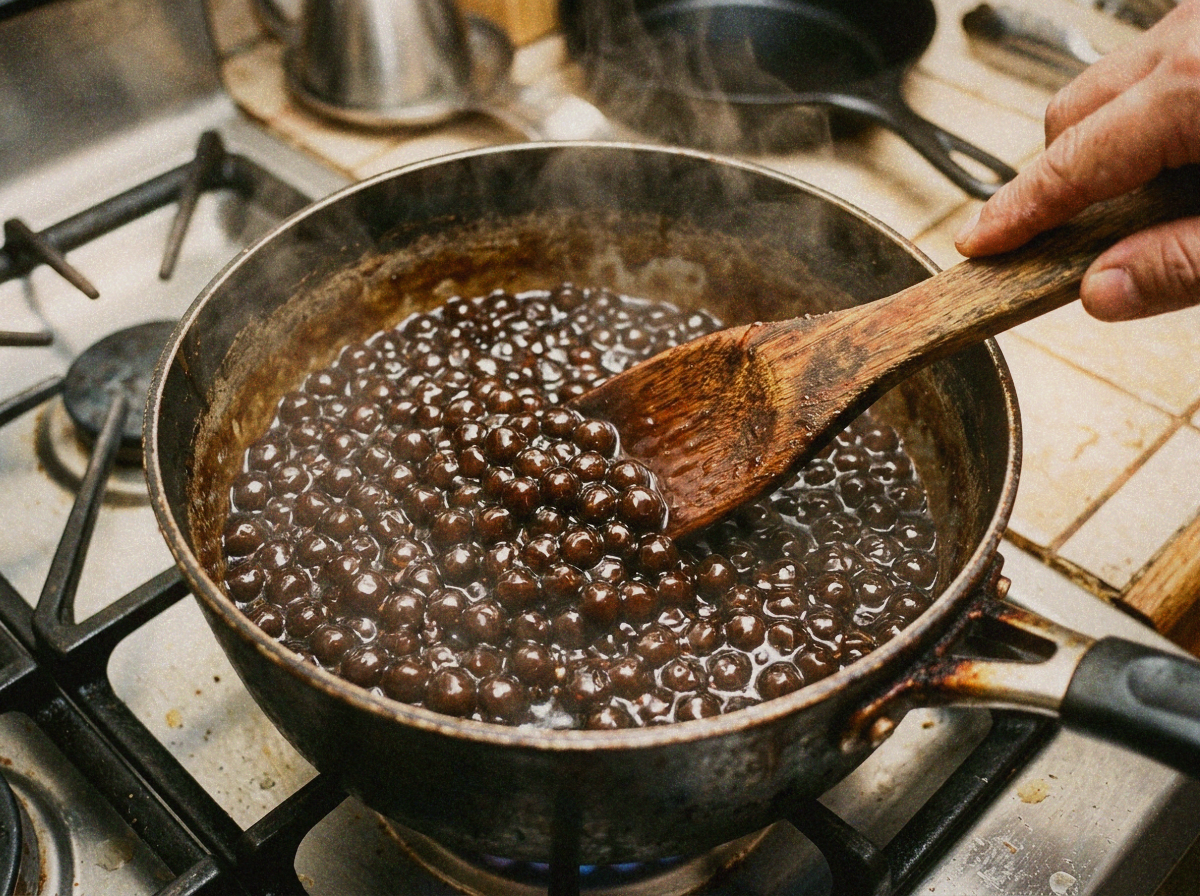 FIRST SIGHTWEBGLFresh tapioca pearls, cooked in small batches and soaked in syrup. They harden as they cool, which is why the good stands never let a pot sit. · Color and grain by First Sight · Gold 200. · First Sight 色彩與顆粒調校 · Gold 200
The names are a small geography lesson in themselves. 'Bubble tea' originally referred to the bubbles of foam from the shaking, not the pearls, though most English speakers now assume it means the tapioca. 'Boba', the word that took over in the United States, comes from a nineties slang term for the larger pearls. In Taiwan you will mostly just ask for the drink by name and let the size sort itself out.
The drinks that matter
The original, and still the one to judge a stand by, is pearl milk tea: black tea, milk, sugar, pearls. Traditionally the milk was powdered creamer, which is why the classic version tastes the way it does, nostalgic and a little synthetic in a way many Taiwanese genuinely prefer. Ask for fresh milk instead and you get a cleaner, richer drink that has become the modern default.
From there the menu fans out. There is winter melon tea, dark and caramel-sweet; taro milk with its lilac colour and root-vegetable roundness; oolong and green tea bases for people who want the leaf to show through; and fruit teas loaded with passionfruit or lemon for the summer. The rule of thumb is that a stand which makes a serious pearl milk tea usually makes everything else well too.
The drink that went viral, brown sugar milk, deserves its own line. Around 2018 stands began caramelising brown sugar syrup and streaking it up the inside of a clear cup before adding pearls and cold fresh milk, no tea at all. It photographs beautifully and tastes like a cold, chewy dessert. Purists roll their eyes; everyone drinks it anyway.
How to order like a local
The part that separates a tourist from a regular is not the flavour, it is the customisation. Every drink is built to order along two axes, sugar and ice, and locals rattle them off without thinking. Getting this right is the difference between a drink you tolerate and one that fits you.
Sugar runs from full, down through less (about seventy percent), half, a slight amount, to none. Most people who drink bubble tea often settle around half or slight sugar, because full sugar on a classic pearl milk tea is genuinely a lot. If you are unsure, half sugar is the safe, adult default.
Ice works the same way: normal, less, barely any, none, and at many stands you can ask for it warm or hot in winter. Less ice means less dilution and more actual tea, which is why regulars often order barely any ice even in summer. And the toppings go well past pearls, into grass jelly, pudding, taro balls, and aiyu jelly, each with its own texture to play against the tea.
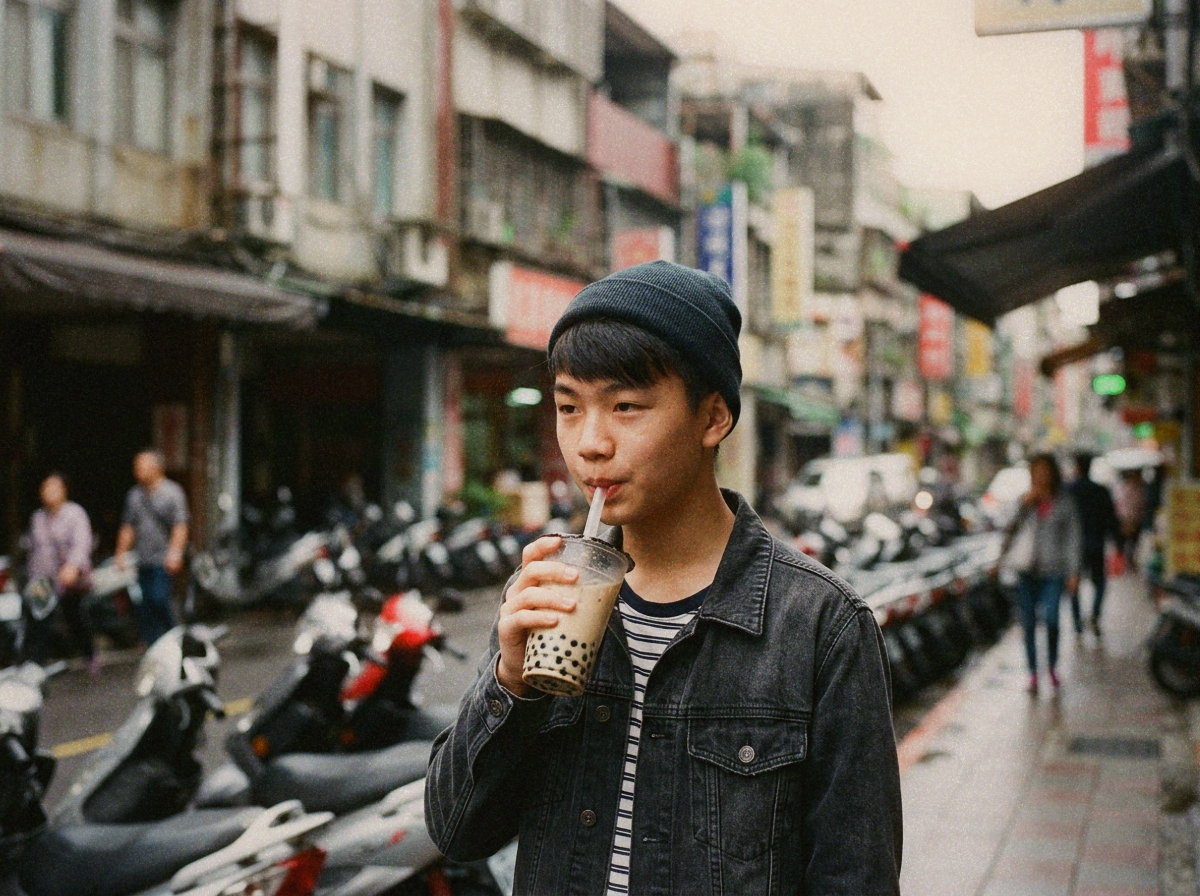 FIRST SIGHTWEBGLIn Taiwan the cup is sealed with a film, not a lid, so it can be shaken and carried. It is a small invention that helped the drink travel. · Color and grain by First Sight · Gold 200. · First Sight 色彩與顆粒調校 · Gold 200
That sealed film is worth noticing. Instead of a lid, Taiwanese stands press a printed plastic membrane over the cup with a machine, which you stab with a fat, pointed straw. It seals well enough to shake and to toss in a bag, and it is one of the quiet engineering reasons bubble tea travelled so well: it was designed, from early on, to be carried and drunk on the move.
Drinking it well
Bubble tea has a window. It is best in the first twenty or thirty minutes, while the pearls are still warm and soft and the ice has not yet melted the tea into water. Give it a proper shake or stir before the first sip so the sugar that has settled at the bottom comes back up. And do not save it for later in the fridge, because chilled pearls go hard and grainy, and no drink is worth eating a cup of gravel for.
None of this is precious. Bubble tea is a cheap, cheerful, slightly ridiculous drink, and Taiwan likes it that way. But it is also a small masterpiece of texture and habit, invented here, refined here, and handed to the world without much fuss. The next time you order one, wherever you are, know that somewhere on this island a teenager is building the same drink for the hundredth time today, from memory, half sugar, less ice.
Comments (0)
Loading comments...