
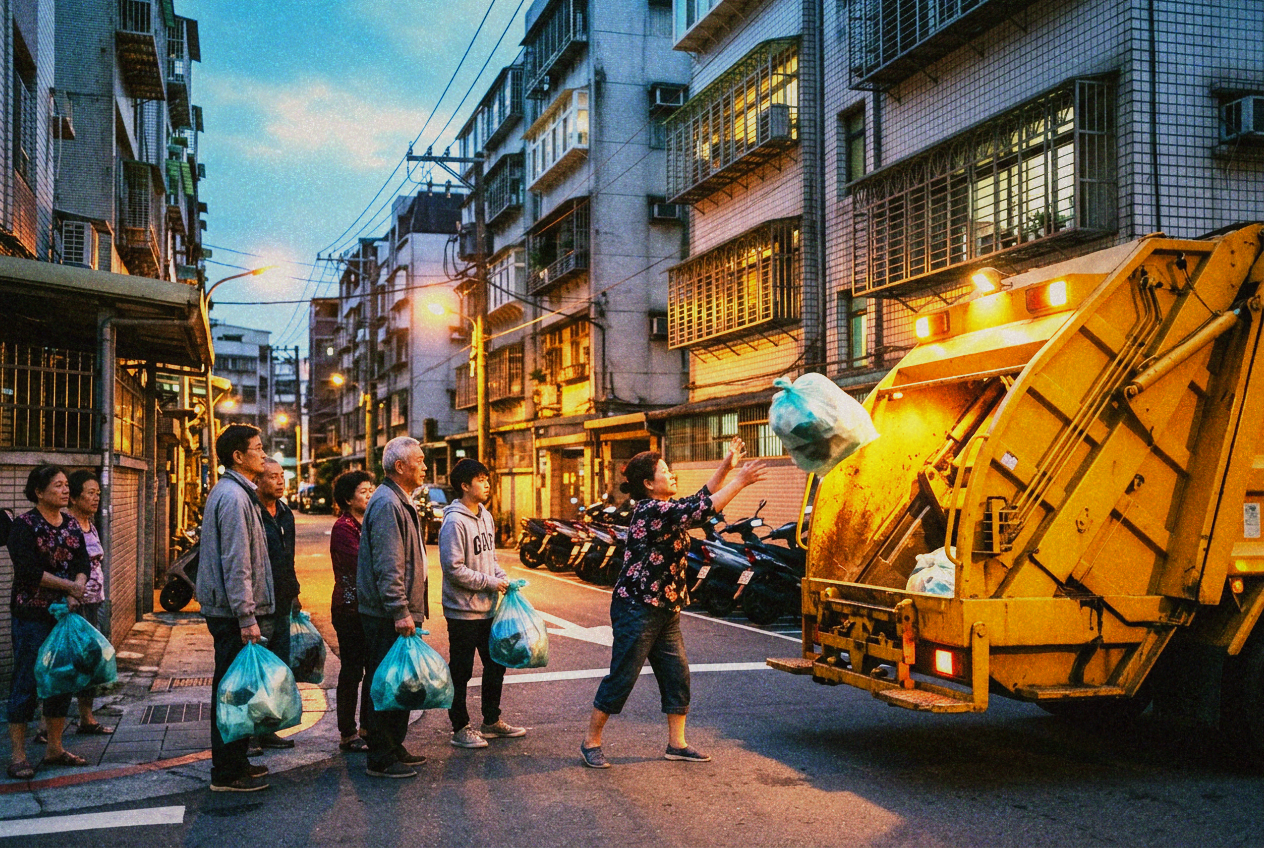
Somewhere around seven in the evening, a piece of piano music that Beethoven wrote for a woman nobody can identify begins playing from a truck, and an entire neighbourhood stands up. People appear in doorways holding bags. Someone runs down five flights in slippers. A man pauses his phone call. In Taipei, "Fur Elise" is not a piece of classical music. It is a deadline.
This is the part of living here that no one prepares you for. Taipei has one of the highest household recycling rates in the world, and it achieved that by making garbage collection slightly inconvenient for everyone, on purpose. There is no chute. In most buildings, there is no bin room. Your rubbish stays in your apartment until the truck comes to your corner, and then you carry it down and hand it over in person. Once you understand the logic, the whole thing becomes weirdly satisfying. Until then, it is the single most confusing part of settling into this city.
The music is the schedule
Two songs run the country. "Fur Elise" and "A Maiden's Prayer," a Polish salon piece by Tekla Badarzewska. Northern Taiwan leans toward Beethoven, the south toward the Maiden. The origin is delightfully mundane: in the late 1960s Taipei imported a batch of sealed German garbage trucks that happened to come with a music box built in, and nobody ever saw a reason to change it. Visitors from the United States or Australia sometimes hear it and expect ice cream, which is its own small tragedy.
Trucks run five days a week. There is no collection on Wednesday or Sunday, which means Tuesday and Saturday nights are when your kitchen bin is fullest and your resolve is weakest. Each truck follows a fixed route with fixed stops, arriving at your corner within roughly the same five-minute window every night. Learn your stop and your time and the rest of this article becomes easy. The city's environmental department publishes the routes, and several free apps track the trucks and push you a notification before yours arrives. Install one on your first week. It is the difference between a system and a nightly panic.
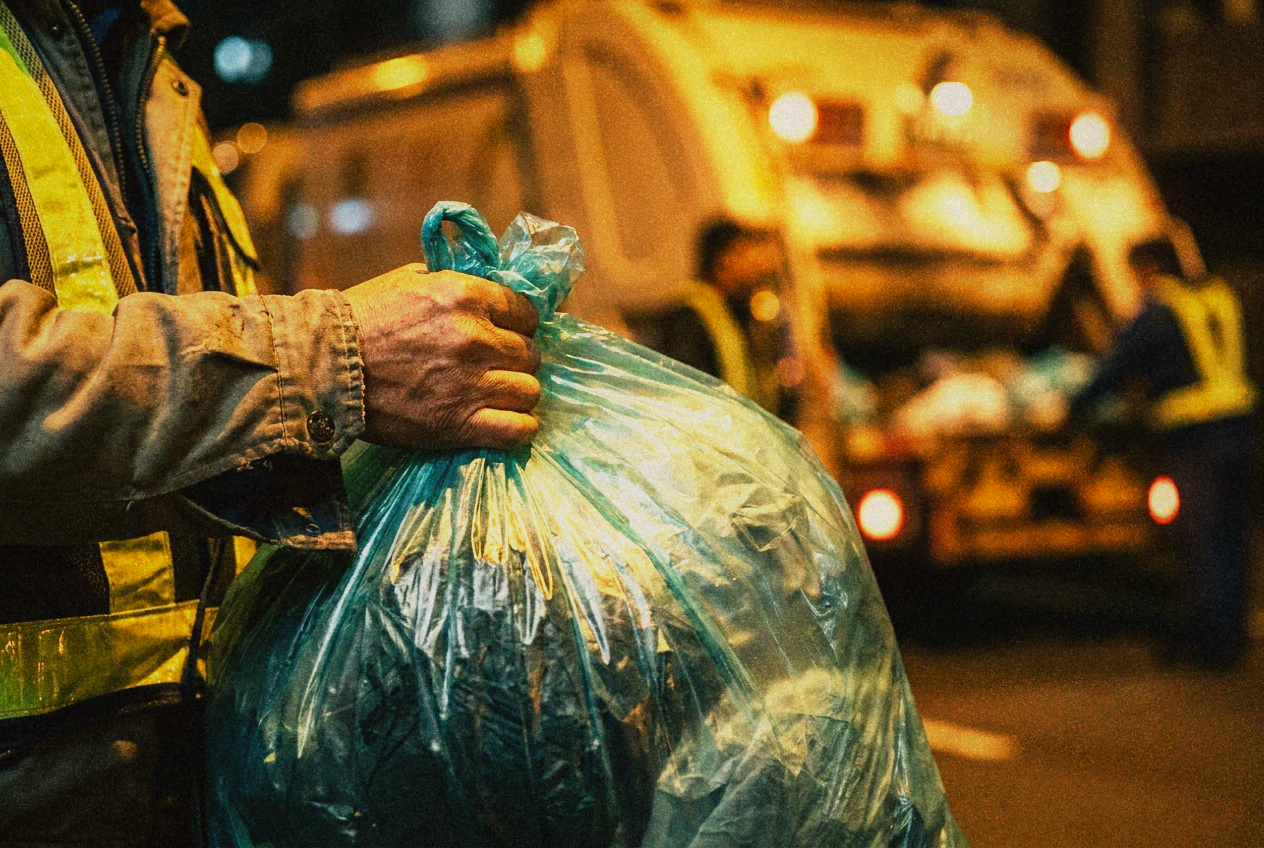
 FIRST SIGHTWEBGLThe truck stops for two or three minutes. Everybody knows this, which is why nobody walks. · Color and grain by First Sight · Gold 200. · First Sight 色彩與顆粒調校 · Gold 200
You are not buying bags, you are paying the fee
Here is the part that trips up every newcomer. You cannot use a regular bin liner for general rubbish. General waste has to go out in the city's official blue-green bag, and the price of that bag is your garbage tax. Taipei charges by volume rather than by household, a system called 隨袋徵收, pay-as-you-throw. Buy the bag, and your disposal is paid for.
They come in seven sizes, from a tiny 3-litre up to a 120-litre monster, with 14 and 25 litres being the household default. The cost works out to roughly NT$0.36 to NT$0.68 per litre depending on size, so a typical small bag runs a few NT dollars. You buy them at any convenience store, supermarket, or hypermarket, usually at the counter rather than the shelf, sold in rolls.
The genius of this is what it does to behaviour. When every extra bag has a price and recycling is free, the incentive reorganises your whole kitchen. You start flattening boxes. You start rinsing bottles. Not out of virtue, but because you would rather not buy another bag.
The three-second sort at the truck
Two vehicles usually arrive together. The yellow truck takes general rubbish in official bags only. Behind it comes the recycling truck, staffed by workers standing over open crates, and this is where the actual sorting happens. You hand over paper here, plastics there, glass into the bin that makes a noise you will come to enjoy. Cans, cartons, batteries, small electronics, styrofoam, and clothing all have a home. If you are unsure, hold the item up. Someone will point.
Recycling goes out free of charge, in any bag you like, and you take your own bag home with you afterwards. This is the detail people miss for months: only general waste needs the official bag.
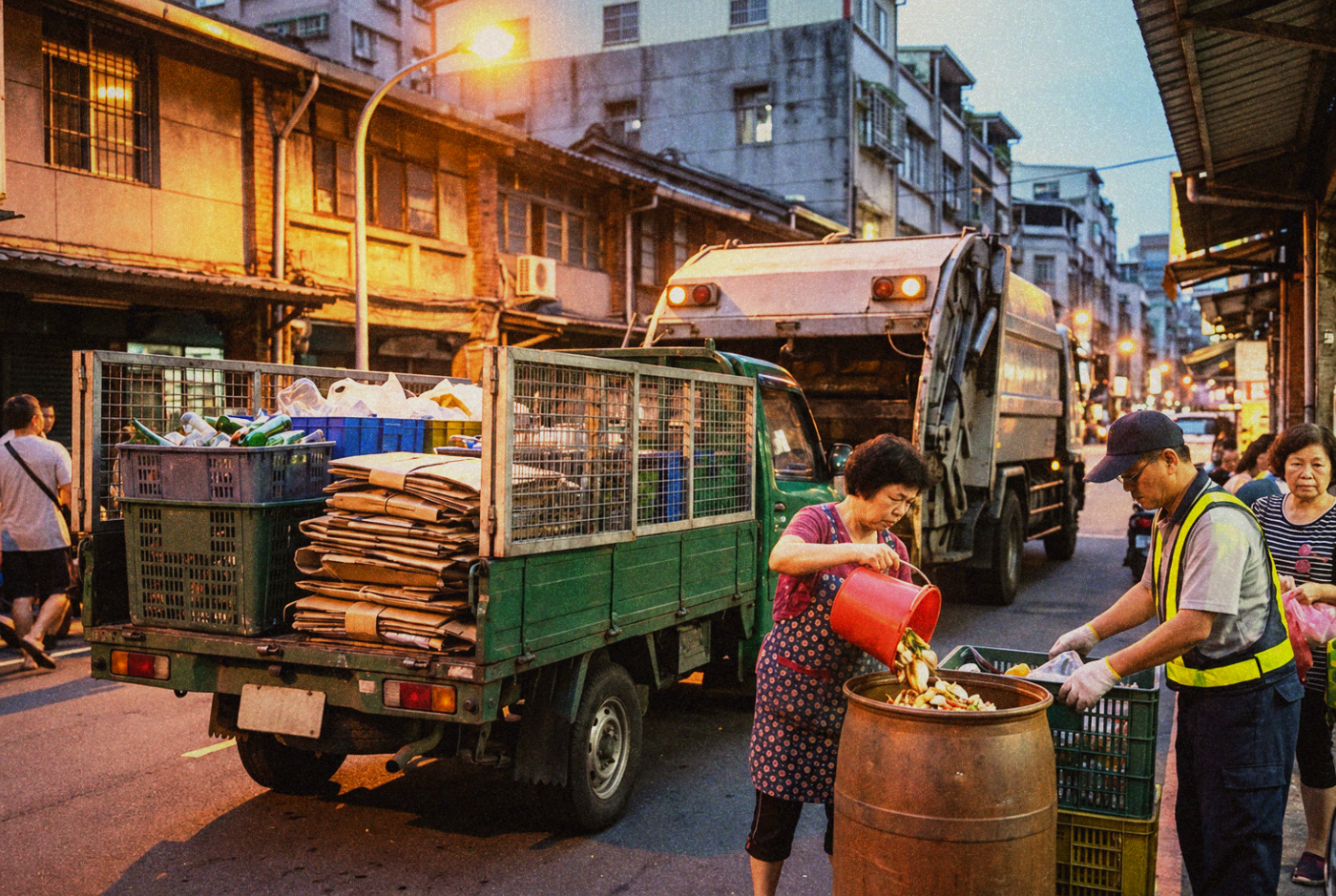 FIRST SIGHTWEBGLThe recycling truck is where the system actually earns its numbers. It is free, so use it aggressively. · Color and grain by First Sight · Gold 200. · First Sight 色彩與顆粒調校 · Gold 200
The 2026 food-waste change
Food scraps, 廚餘, used to be split into two buckets: cooked waste for pig feed and raw waste for compost. Everybody found this confusing, and plenty of people got it wrong. From 1 January 2026 that distinction is gone for households. One bucket, everything together.
The rules that replaced it are simpler but stricter. Drain the liquid before you tip it. Soup, tea, and the water sitting at the bottom of the bucket should go down your sink, not into the barrel. And nothing that is not food goes in: no plastic bags, no disposable chopsticks, no bones-in-a-bag shortcuts. Mixing rubbish into the food-waste barrel, or dumping food waste into general rubbish, can draw a fine of up to NT$6,000. In practice the workers will simply refuse a bucket that looks wrong, which is more embarrassing than expensive.
Get a small lidded bucket for the kitchen counter, empty it every collection night, rinse it, and the whole thing stays civilised. Skip a couple of nights in August and you will learn why people do not skip nights in August.
If your building has a management desk
Many newer buildings and most serviced apartments have a 管理室, a management office, and this changes everything. Buildings with 24-hour management often collect rubbish and recycling internally and hand it to the truck on your behalf, which means you can throw things out whenever you want. Some let you leave bags in a designated basement room, some take them at the desk.
If you are apartment-hunting, this is worth asking about directly, in the same breath as water pressure and window direction. A building with rubbish handling is a building where you never once have to run downstairs in the rain at 19:42.
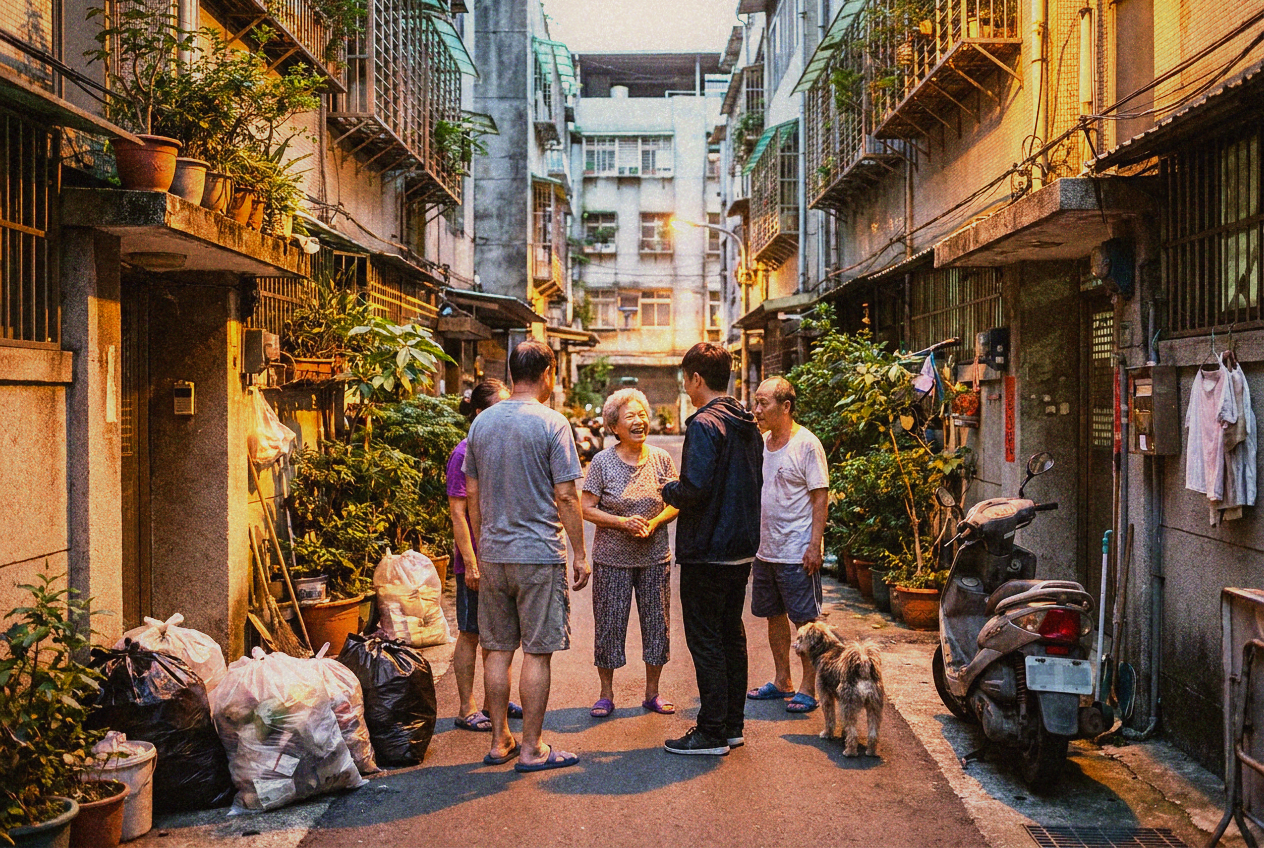 FIRST SIGHTWEBGLThe corner at seven is where you actually meet the people who live around you. · Color and grain by First Sight · Gold 200. · First Sight 色彩與顆粒調校 · Gold 200
The mistakes that actually cost you
Buying non-official bags because they were cheaper: the truck will refuse them, and it is a fineable offence. Leaving a bag outside your door or on the pavement, which is what 垃圾不落地, "trash does not touch the ground," exists to prevent, and which neighbours report. Throwing recyclables in the paid bag, which is legal but means you are paying to destroy something the city would have taken for free. And putting out a large piece of furniture without booking a collection, which you can arrange with your district cleaning team at no charge, usually with a few days' notice.
Nobody gets this perfect in month one. What surprises most people is how quickly it stops feeling like a chore. You will find yourself at the corner on a Tuesday in your slippers, holding a small bag, nodding at the same three neighbours you see every night, waiting for a dead Austrian composer to tell you it is time. And then you will go back upstairs. It is a strange little ritual, and it works.
Comments (0)
Loading comments...