
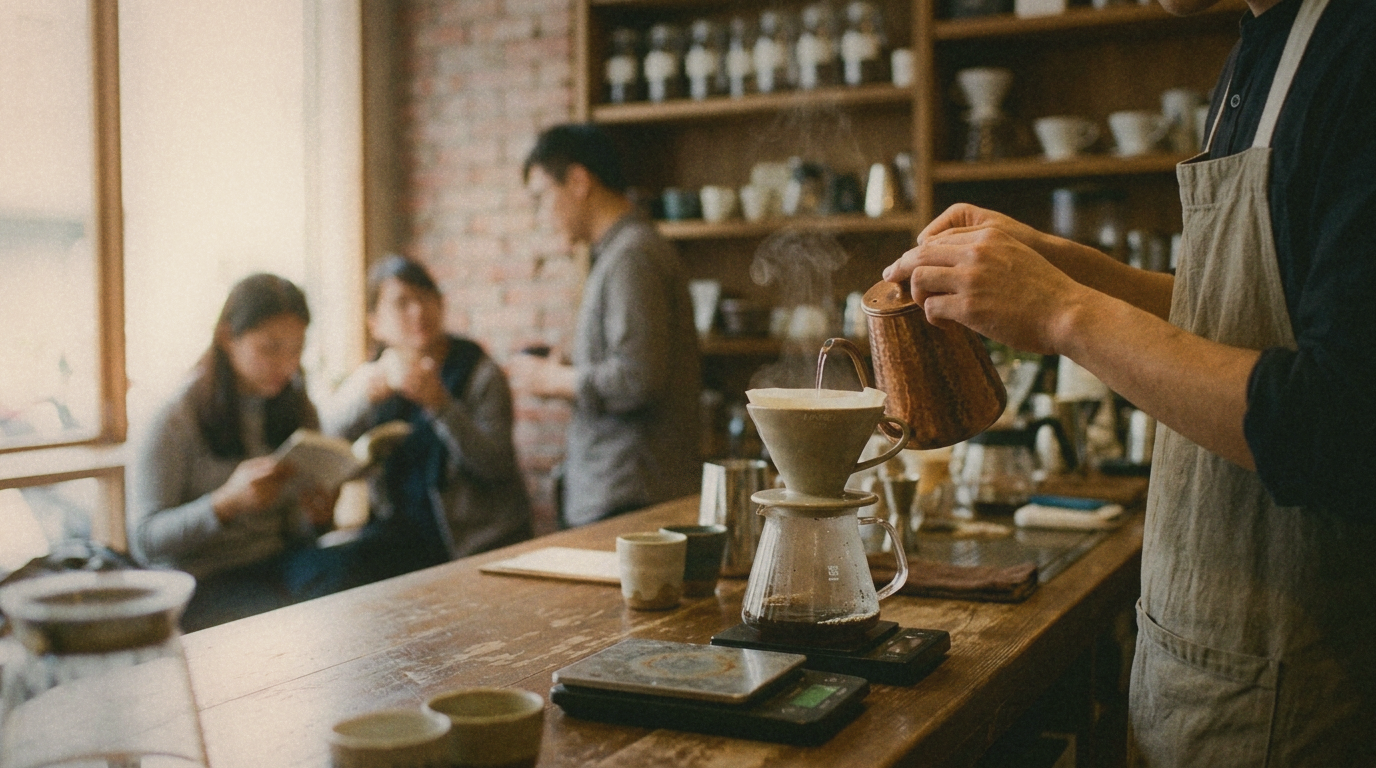
Taiwan is a tea island, and everyone knows it. What catches visitors off guard is how seriously it takes coffee. Walk almost any Taipei neighbourhood and you will pass a hand-drip bar tucked under an apartment block, a roastery the size of a living room, a convenience store pulling espresso for the price of a snack, and a café where someone has been nursing a single cup and a laptop since mid-morning. Somewhere in the last twenty years, quietly and without much fanfare, Taiwan turned into one of the best places in Asia to drink coffee.
What makes it unusual is that the island does the whole arc. It grows coffee, roasts it, sends baristas to place at world championships, and drinks a great deal of it. Most coffee-loving cities import every bean and simply brew well. Taiwan has coffee coming down off its own mountains, a competition scene that punches far above the island's size, and a café habit so woven into daily life that settling in for two hours over one drink is not merely tolerated, it is the point.
From colonial curiosity to island crop
Coffee is not new here, even if the current obsession feels modern. A British trader is usually credited with bringing plants to the north in the 1880s, but it was under Japanese rule, in the first decades of the twentieth century, that coffee became a real crop. Plantations went in across the hills of Chiayi and Yunlin, and beans were shipped back to Japan as a colonial luxury. Then war came, the economy turned to survival, and the coffee trees were mostly forgotten for two generations.
The revival has a surprising origin. After the deadly 921 earthquake of 1999 flattened much of central Taiwan, farmers in Gukeng, in Yunlin, replanted their damaged slopes with coffee as a way to rebuild. The gamble worked. Gukeng became shorthand for Taiwanese-grown coffee, a domestic tourism draw, and the seed of a wider movement. Growers in Alishan, Nantou and the south followed, and within a decade Taiwan had gone from importing all of its coffee to quietly producing some of the most expensive beans in the world.
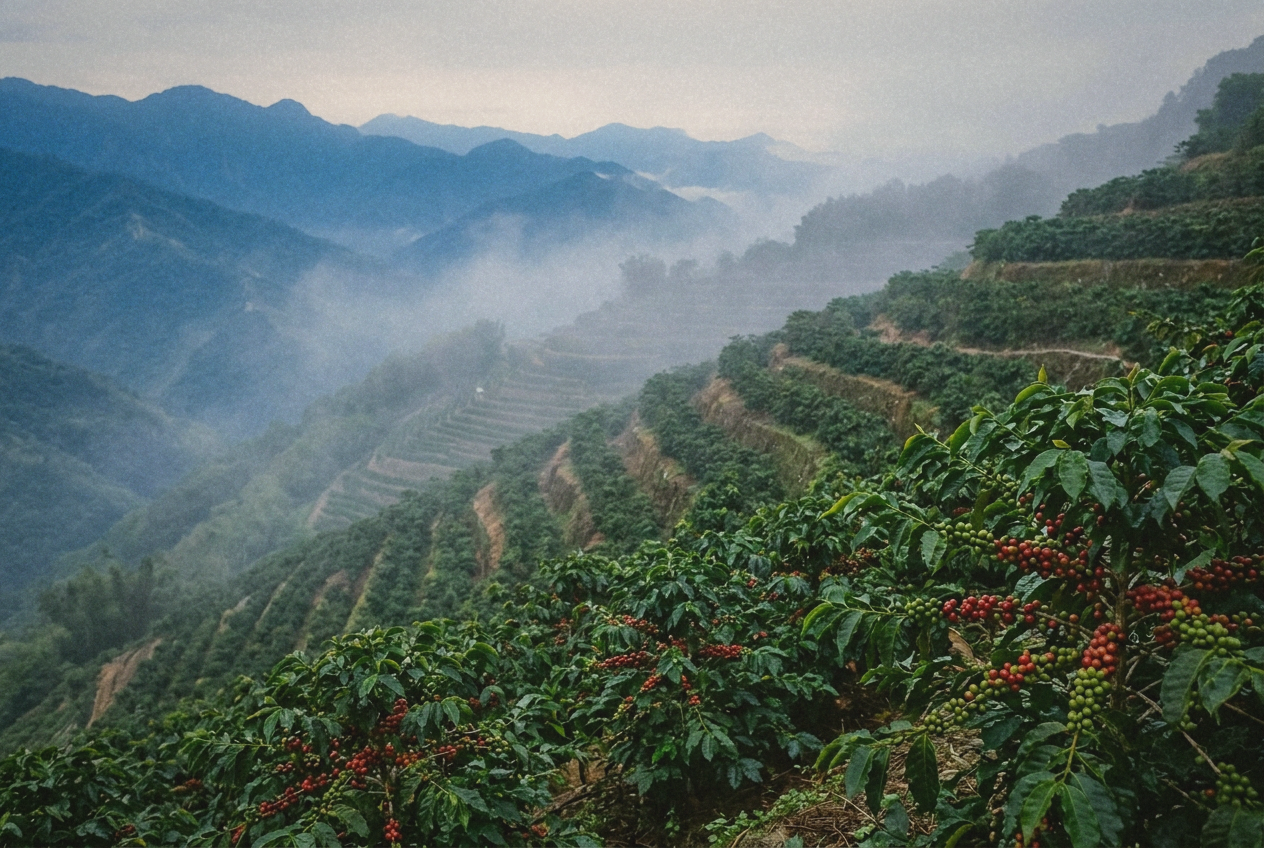
 FIRST SIGHTWEBGLCoffee terraces in the central mountains, where cool nights and mist shape the cup as much as they shape Taiwan's famous oolong. · Color and grain by First Sight · Portra 400. · First Sight 色彩與顆粒調校 · Portra 400
The bean that grows on the mountain
Taiwanese coffee is a high-mountain crop. The best of it grows between roughly a thousand and thirteen hundred metres, on the same slopes that produce the island's famous oolong, and the cool nights and frequent mist do for coffee cherries what they do for tea leaves. Most of it is washed or naturally processed in small batches, and the flavour tends toward the gentle end of the spectrum, soft acidity, notes of sugarcane and stone fruit, a clean and rounded cup rather than a loud one.
It is also genuinely expensive, and it helps to know why before you balk at the menu. Farms are tiny, the terrain is steep, almost everything is picked and sorted by hand, and labour in Taiwan is not cheap. A pour-over of single-origin Alishan can cost more than a full lunch. You are not paying for a brand, you are paying for a few hundred kilograms of coffee grown on a mountain that mostly grows tea. Order it once, slowly, and treat it as the local speciality it is.
A café on every corner
If the mountains are the romance, the cafés are the daily reality, and there are a lot of them. Taipei in particular is saturated with independent coffee shops, often one per lane, each with its own character, its regulars, and its unspoken rules. Many are small, quiet, and built for staying. You order, you find a seat, and you are welcome to read, work, or do nothing at all for hours. The café as a second living room is a genuinely Taiwanese idea, and it is one of the most pleasant things about the city.
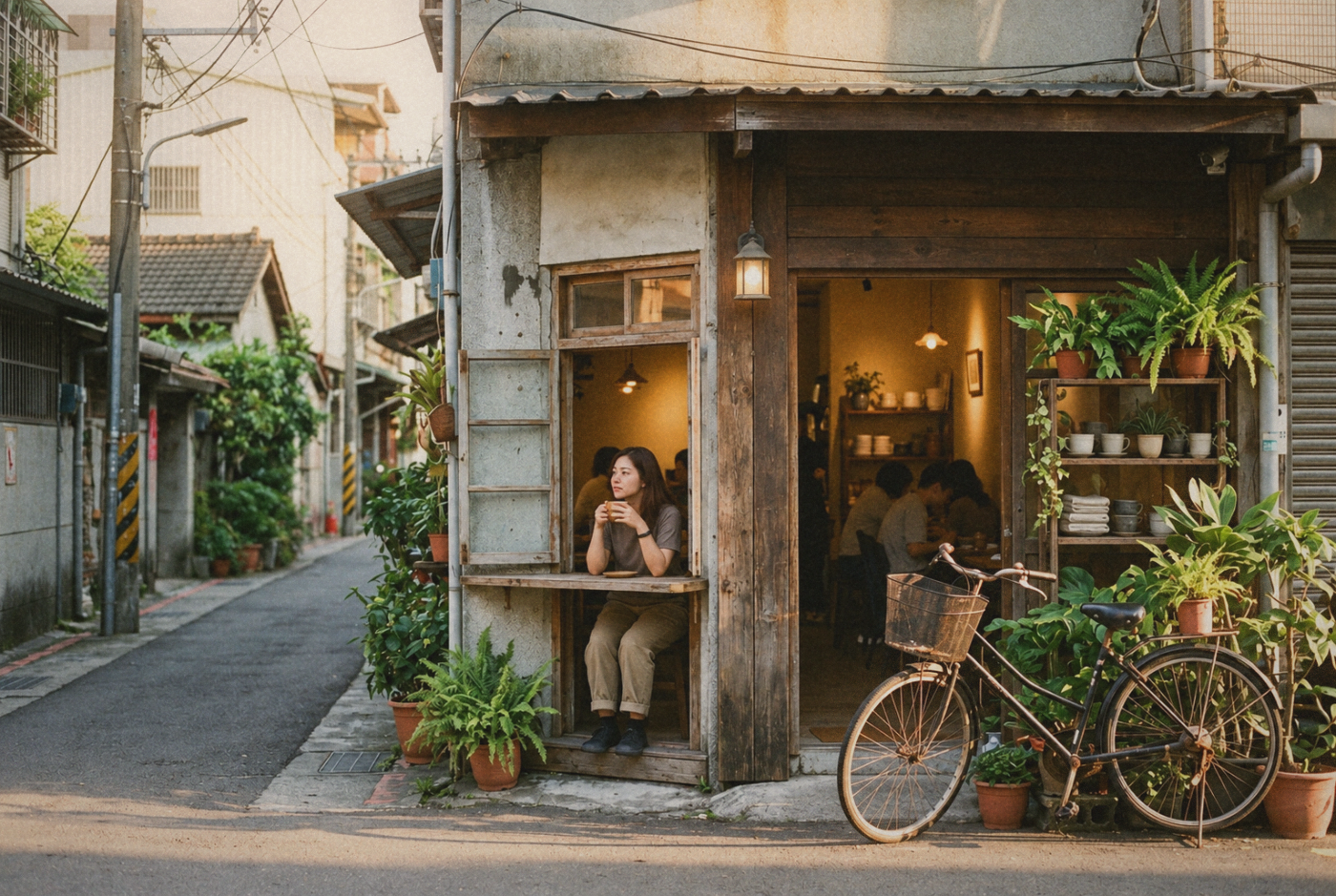 FIRST SIGHTWEBGLA neighbourhood café in the late afternoon, the kind of small, quiet room that Taipei builds by the hundred. · Color and grain by First Sight · Portra 400. · First Sight 色彩與顆粒調校 · Portra 400
Not all of it is artisanal, and that is part of the charm. The convenience-store chains changed everyday coffee first. A 7-Eleven CityCafe or a FamilyMart cup is decent, cheap, and everywhere, and it is what most people actually drink on a workday morning. Above that sit the homegrown chains, Louisa and Cama and their cousins, then the specialty independents, then the competition-grade roasters. The ladder from a thirty-five dollar convenience cup to a two-hundred dollar hand pour is short and easy to climb, and locals move up and down it without snobbery.
The slow ritual of hand-poured coffee
The heart of the specialty scene is the hand pour, shou chong in Chinese, a small ceremony you will see performed at counters all over the island. The barista weighs the beans, grinds them fresh, and pours hot water in slow spirals over a paper filter while a timer runs. Some of the older cafés still use the siphon, a theatrical glass contraption over a flame that looks like a chemistry experiment and tastes clean and bright. Either way, the message is the same, this cup is worth a few minutes of attention.
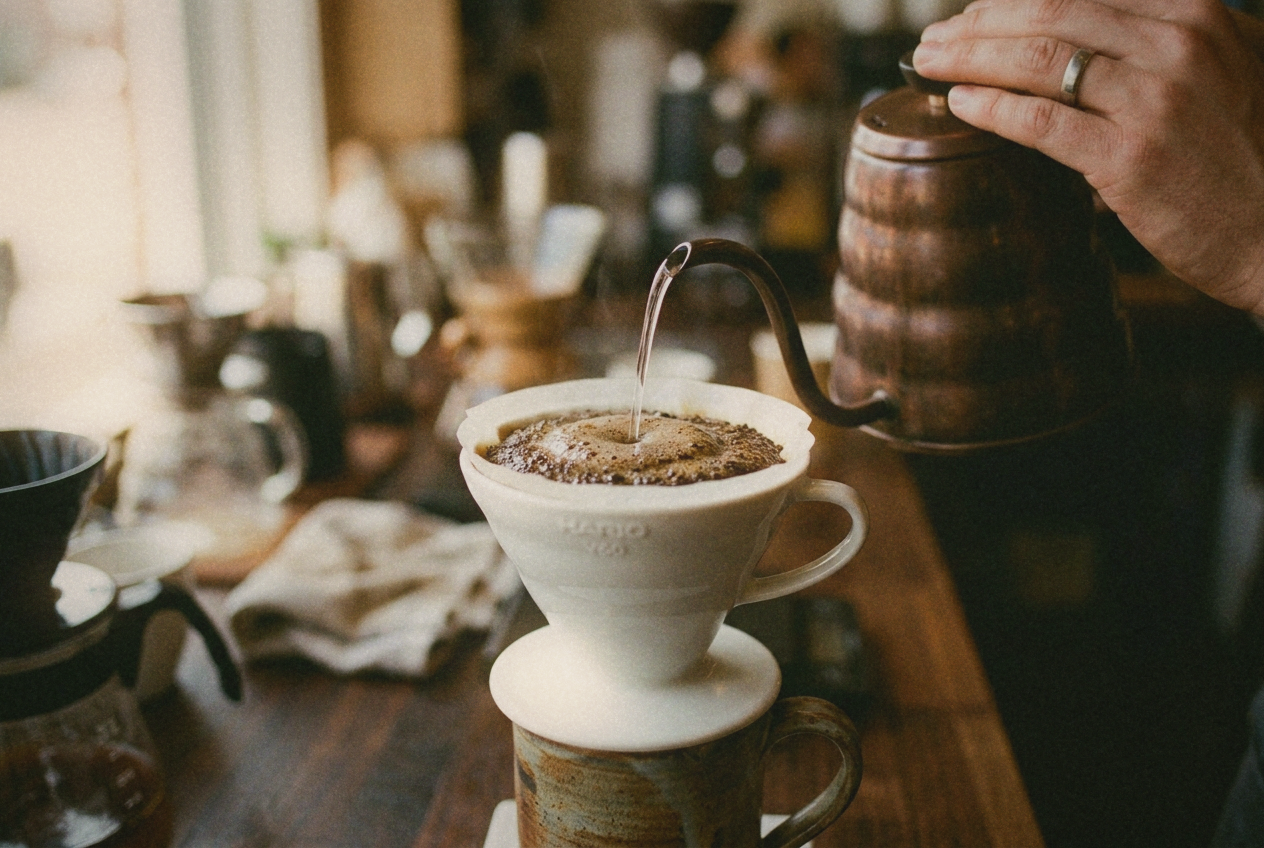 FIRST SIGHTWEBGLThe hand pour: fresh grind, slow spirals of water, a timer running. A few minutes of attention for a single cup. · Color and grain by First Sight · Portra 400. · First Sight 色彩與顆粒調校 · Portra 400
That patience is the thread that connects Taiwanese coffee to Taiwanese tea, and to a wider habit of taking small daily pleasures seriously. Nobody is rushing you, and nobody is rushing the coffee. A good hand-drip bar in Taipei is one of the quietest, most focused places in a loud city, and sitting at the counter watching a careful pour is a small reset in the middle of a day.
How to order, and what to say
Ordering is easy once you know a few words. Shou chong is a hand-poured single origin, meishi is an Americano, na tie is a latte, and ka bu is a cappuccino. Ask for it bing for iced or re for hot. Oat milk, yanmai nai, is now standard almost everywhere. Sizes are usually just medium and large. Most independents take cards and mobile payment, but keep a little cash for the smallest places, and your EasyCard will cover the convenience-store cups.
How to drink coffee like a local
To drink coffee like a local, do a few simple things. Skip the international chains and walk into the independent with three tables and a serious-looking grinder. Try an island-grown bean at least once, and ask the person behind the counter where it is from, because they will almost always want to tell you. Mornings and early afternoons are the sweet spot, since many small cafés close early. Respect the seat, buy a second drink if you stay half the day, and lower your voice to match the room. The reward for all of this is a version of coffee culture that still feels personal.
Taiwan did not set out to become a coffee country, and maybe that is why it is such a good one. The beans grew out of an earthquake recovery, the cafés grew out of a love of lingering, and the whole thing runs on attention rather than hype. Come for the tea, by all means. But leave some mornings for the coffee, and for the small, unhurried ritual of watching someone make you a single, careful cup.
Comments (0)
Loading comments...