
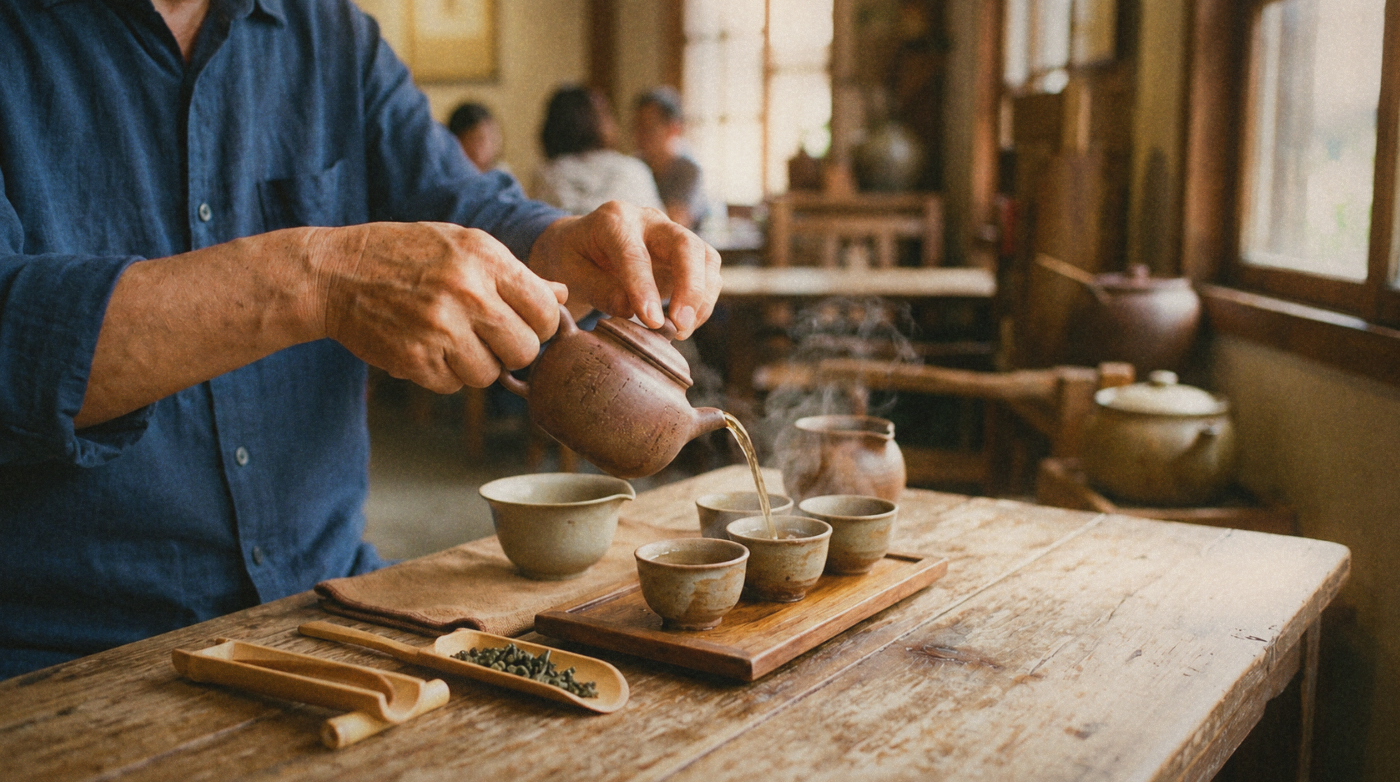
I used to think tea was the thing you drank when you had run out of reasons to drink coffee. Then I spent an afternoon in a small shop in Taipei where a man in his sixties spent twenty minutes making me four tiny cups of oolong, said almost nothing, and completely rearranged what I thought a cup of tea could be. The tea came from a mountain I had never heard of. It tasted like butter and orchids and warm stone, and it changed four times as the pot was refilled. I left slightly stunned, and I have been chasing that feeling ever since.
Taiwan is one of the great tea islands, and yet its tea is oddly underrated abroad — overshadowed by China's history and Japan's matcha aesthetics. That is a shame, because Taiwanese oolong is, by a lot of measures, the most refined tea in the world, and the culture around it is unusually welcoming. You do not need special training to enjoy it. You need a little patience, a small pot, and someone to point you at the right leaves. This is that pointer.
Why a small island makes such extraordinary tea
Tea likes what Taiwan has in abundance: altitude, mist, and dramatic swings between warm days and cold nights. Above a thousand metres the bushes grow slowly, the leaves thicken, and the plant concentrates sugars and aromatics to protect itself from the cold. Slower growth, better leaf. This is why 高山茶 (gāoshān chá), high mountain tea, commands the prices it does — the best gardens sit on steep slopes in Nantou, Chiayi and Taitung, some above two thousand metres, wrapped in cloud for half the day.
The other half of the story is craft. Oolong is only partially oxidised, which puts it somewhere between green tea and black tea, and the exact degree is a decision made by hand, in real time, by people reading the weather and the leaf. A single batch can take a day and a night of withering, resting, rolling and roasting. Taiwan kept these skills alive when a lot of places industrialised them away, and you can taste the difference in the cup.
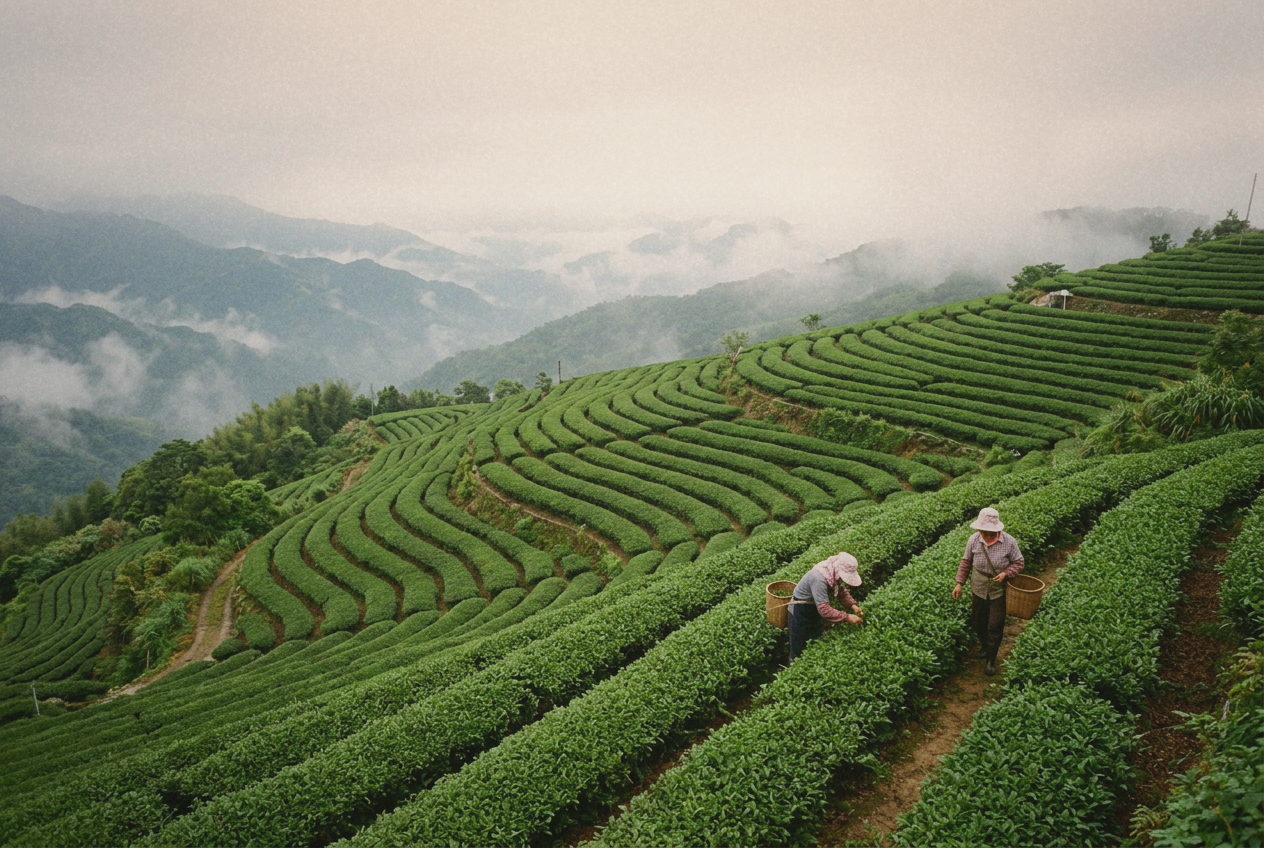
 FIRST SIGHTWEBGLAbove a thousand metres the plant grows slowly and the leaf thickens. Mist does half the farming. · Color and grain by First Sight · Portra 400. · First Sight 色彩與顆粒調校 · Portra 400
The oolong spectrum, from green and floral to dark and roasted
If you remember only one thing, remember that 'oolong' is a range, not a flavour. At the light end sits 高山烏龍, high mountain oolong — barely oxidised, pale gold, tasting of cream, fresh flowers and green stone-fruit. It is the one most people fall in love with first.
From there it darkens. 凍頂烏龍 (Dòngdǐng), from a hill in Nantou, is the classic medium roast — rounder, nuttier, a little toasty. 鐵觀音 (Tiěguānyīn) is roasted further, into caramel and roasted-grain territory. And then there is 東方美人 (Dōngfāng Měirén), Oriental Beauty, a heavily oxidised summer tea whose leaves are deliberately bitten by tiny leafhoppers, which triggers a honeyed, ripe-fruit sweetness you would swear had sugar in it. It doesn't.
There is also 包種 (Bāozhǒng), the lightest of the lot, grown near Pinglin just outside Taipei — floral, almost green, and a lovely gateway if high mountain feels too precious. None of this needs memorising. Order two you cannot pronounce, notice which one you keep reaching for, and follow that thread. That is the entire method.
Gongfu brewing, demystified
The small-pot, many-cups ritual you see in tea shops has a name — 工夫茶 (gōngfu chá), roughly 'tea made with skill and time' — and it looks more intimidating than it is. The idea is simple: use a lot of leaf in a small pot, and brew it many times for short steeps rather than once for a long one. You are not making a mug of tea. You are making the same leaves give you six or seven different cups, each one a little different as they open up.
A basic round goes like this. Warm the pot with hot water and tip it out. Fill it about a third full of leaf — more than feels reasonable. Pour just-off-boil water over it, and for the first infusion count only ten to twenty seconds before pouring everything out into a little sharing jug, then into the cups. Add five or ten seconds to each later steep. Good oolong will keep going for five, six, seven rounds, and the middle infusions are often the best.
The point of the tiny cups is not preciousness. It is that a small cup keeps the tea hot and concentrated and makes you slow down and actually taste it. You will notice the tea change under you — floral, then sweeter, then mineral — in a way a big mug flattens completely. That noticing is the whole pleasure.
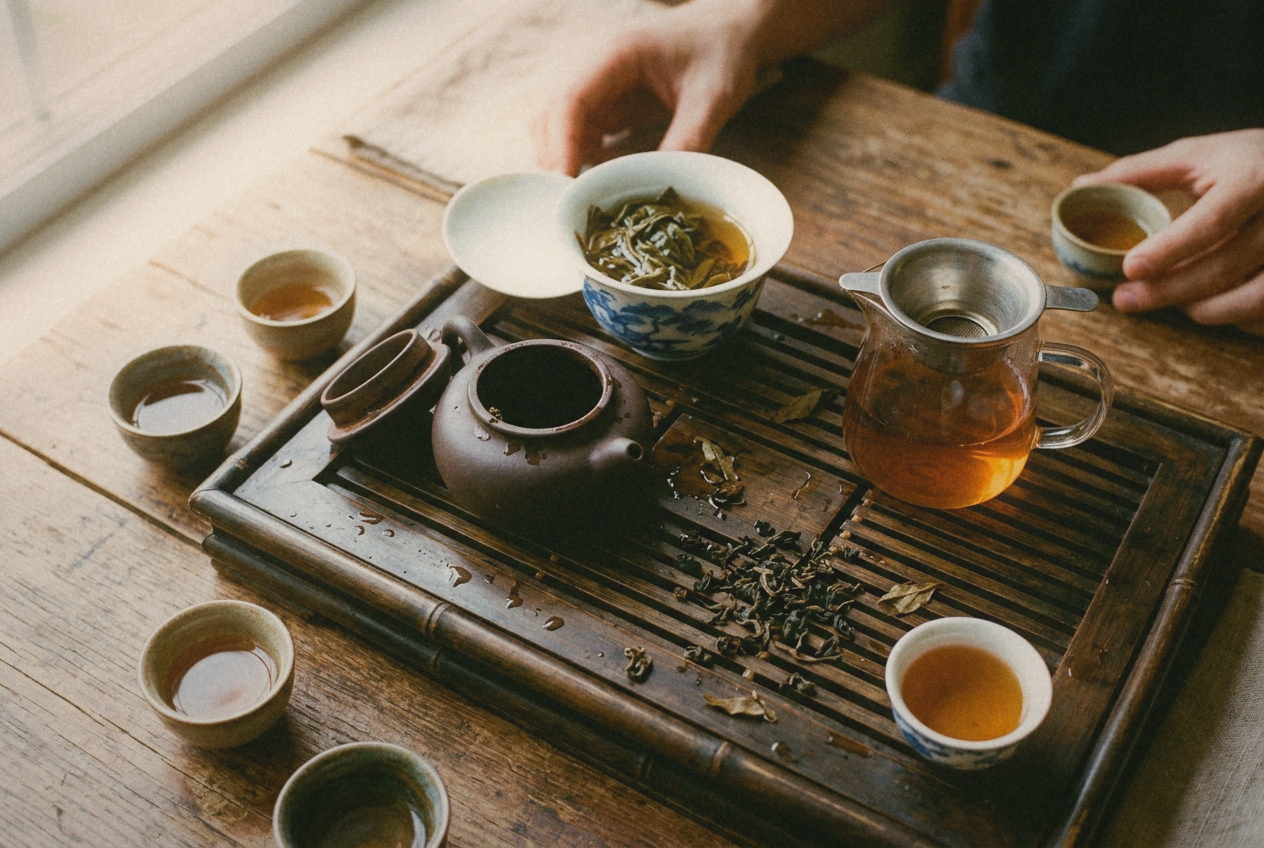 FIRST SIGHTWEBGLMore leaf than feels reasonable, a small pot, and many short steeps. That is most of the technique. · Color and grain by First Sight · Portra 400. · First Sight 色彩與顆粒調校 · Portra 400
Where to actually drink it, and where to buy the leaves
The postcard answer is 貓空 (Maokong), the tea hill above Taipei's zoo, reachable by a gondola that swings up over the gardens. The teahouses at the top let you brew your own pot at a table with a mountain view and a plate of tea-smoked snacks, and yes it is touristy, and yes it is still genuinely lovely on a clear evening. Go late afternoon and stay for the lights coming on across the basin.
For something closer to the source, 坪林 (Pinglin) is a small tea town forty minutes from the city, quiet and green and built entirely around Baozhong, with a good little tea museum and shops where the person selling you leaves grew them. If you want to buy tea to take home, this is a better bet than the airport — as is any neighbourhood 茶行 (chá háng), the old-style tea shops where they will happily brew you a cup of something before you commit.
One tip that will save you money and disappointment: buy small. Fifty or seventy-five grams of a very good tea costs little and lasts a surprisingly long time at a leaf-per-brew rate. You are better off with a small bag of excellent high mountain oolong than a large tin of something forgettable, and the good shops will let you smell and taste before you choose.
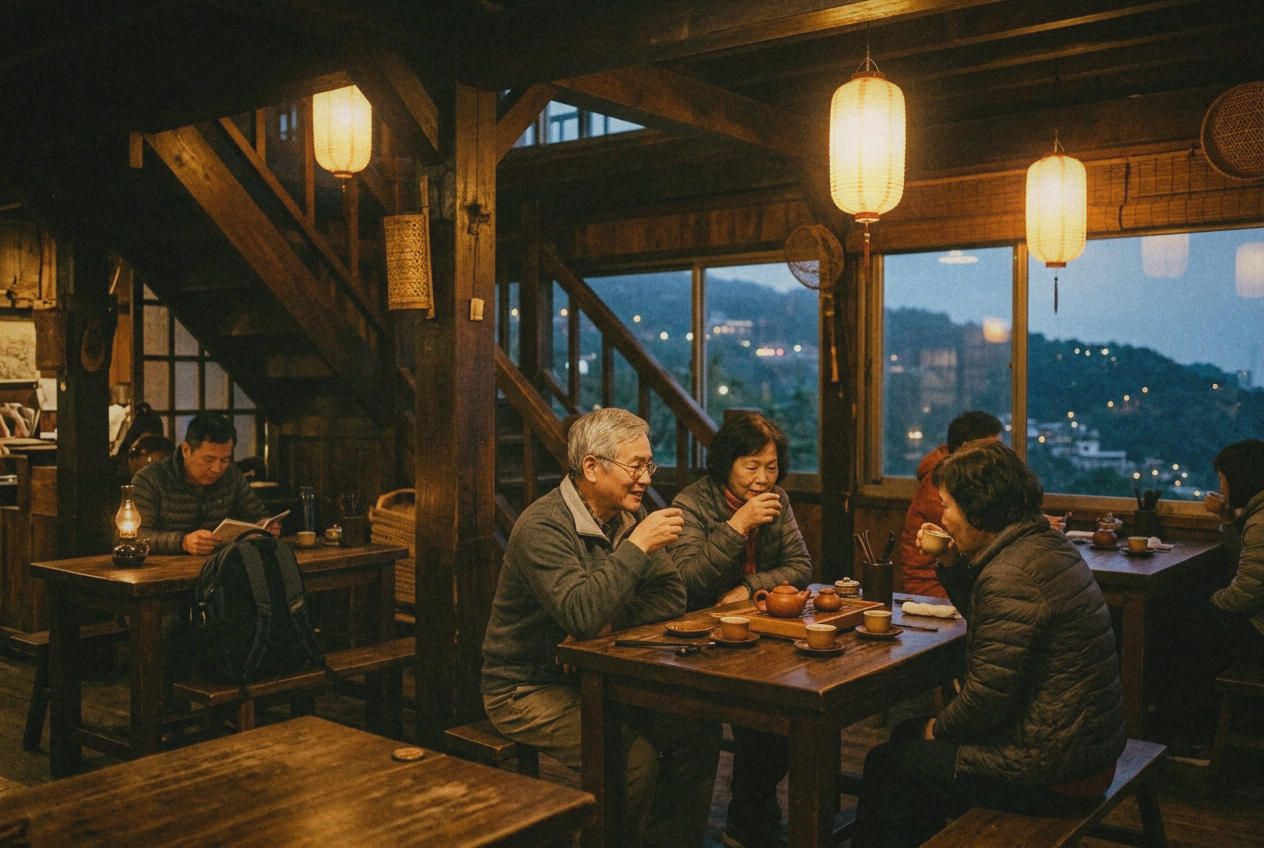 FIRST SIGHTWEBGLThe actual product is an hour spent doing one thing, with your phone face down. · Color and grain by First Sight · Portra 400. · First Sight 色彩與顆粒調校 · Portra 400
The etiquette, kept light
Tea culture in Taiwan is warm, not stiff, and nobody expects a visitor to know the rules. Still, a few small things read as gracious. If someone pours for you, a light tap of two fingers on the table is the quiet way to say thank you without interrupting the conversation. Let the person hosting control the pot; brewing is their pleasure, not a chore to take off their hands. And take the first sip before you add anything — most of these teas are meant to be drunk clean, and putting milk or sugar into a high mountain oolong is a small tragedy.
Beyond that, the only real rule is attention. The whole point of sitting down to tea like this is that it asks you to be somewhere for an hour, doing one thing, with your phone face down. In a city that runs as fast as Taipei, that is not a small thing to be offered. It is arguably the actual product.
Bringing it home, without buying a single gadget
You do not need a clay pot and a bamboo tray to drink well. A small teapot, or even a sturdy mug and a strainer, will get you most of the way. Use more leaf than feels right, water just off the boil, and short steeps — pour the tea off the leaves rather than letting it sit and turn bitter. Re-steep the same leaves two or three more times over the afternoon. That is ninety percent of the ritual for none of the equipment.
The deeper thing you are importing is not a technique but a pace. Taiwanese tea culture is, underneath the leaves and the pots, a quiet argument that some pleasures only show up when you stop rushing them. Make a small pot properly on a slow morning, notice it change between cups, and you will understand why a whole island decided this was worth doing carefully. Then go find a mountain you have never heard of, and start there.
Comments (0)
Loading comments...