
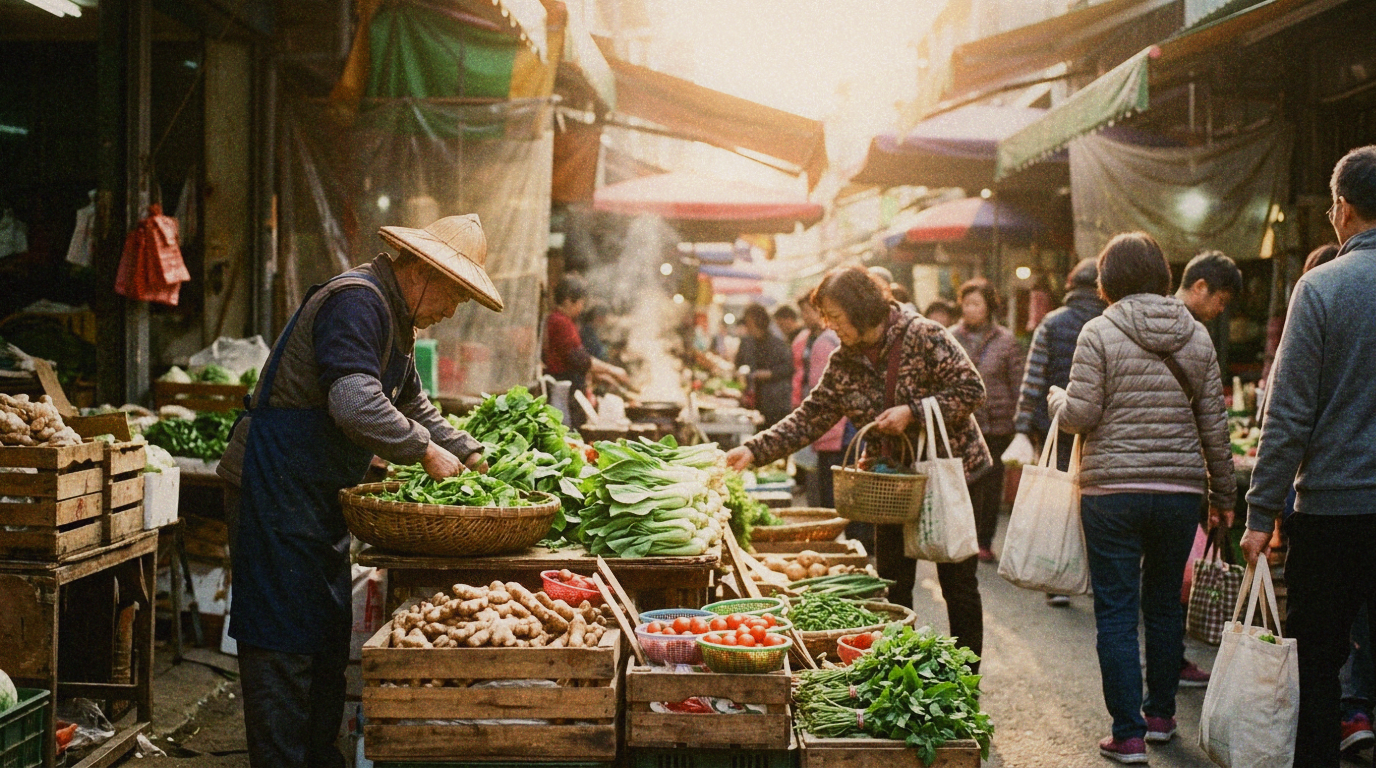
The market is already awake when you arrive. It is barely past six, the sky is the colour of weak tea, and the alley is loud in a way a supermarket never is: the thwack of a cleaver through bone, a vendor calling out today's price for water spinach, the hiss of a wok two stalls down frying breakfast for the people who run the place. This is the 菜市場, the traditional morning market, and for most of Taiwan it is still where the day's food actually comes from.
There is a version of Taiwan you can see from a hotel window: the glowing convenience stores, the delivery scooters, the supermarket trays wrapped tight in plastic. And then there is the version that has run on the same rhythm for generations, one that opens before dawn and is mostly packed up by lunch. If you want to understand how the island eats, you skip the supermarket and go to the market instead. Here is how to shop one like you belong there.
What a 菜市場 actually is
First, some untangling, because Taiwan has three different things that English all calls a market. The night market (夜市) is the famous one: street food, games, crowds, a night out. The supermarket (超市) is what it sounds like. The traditional market, the 菜市場, is the third and the oldest. It is a daytime market, often half-covered by a patchwork of awnings or tucked into the ground floor of an old building, where dozens of small independent vendors sell raw ingredients. Vegetables, fruit, pork, chicken, fish, tofu, eggs, noodles, dried goods, flowers, and, because this is Taiwan, a few stalls cooking breakfast for everyone else.
Each stall is its own tiny business, usually run by the same family for years or decades. The woman who sells you greens is the person who chose them at the wholesale market at four in the morning. There is no head office, no loyalty card, no supplier three countries away. The whole place is a network of specialists standing an arm's length apart, and the quality is the vendor's own name on the line. That is the part a supermarket cannot copy.
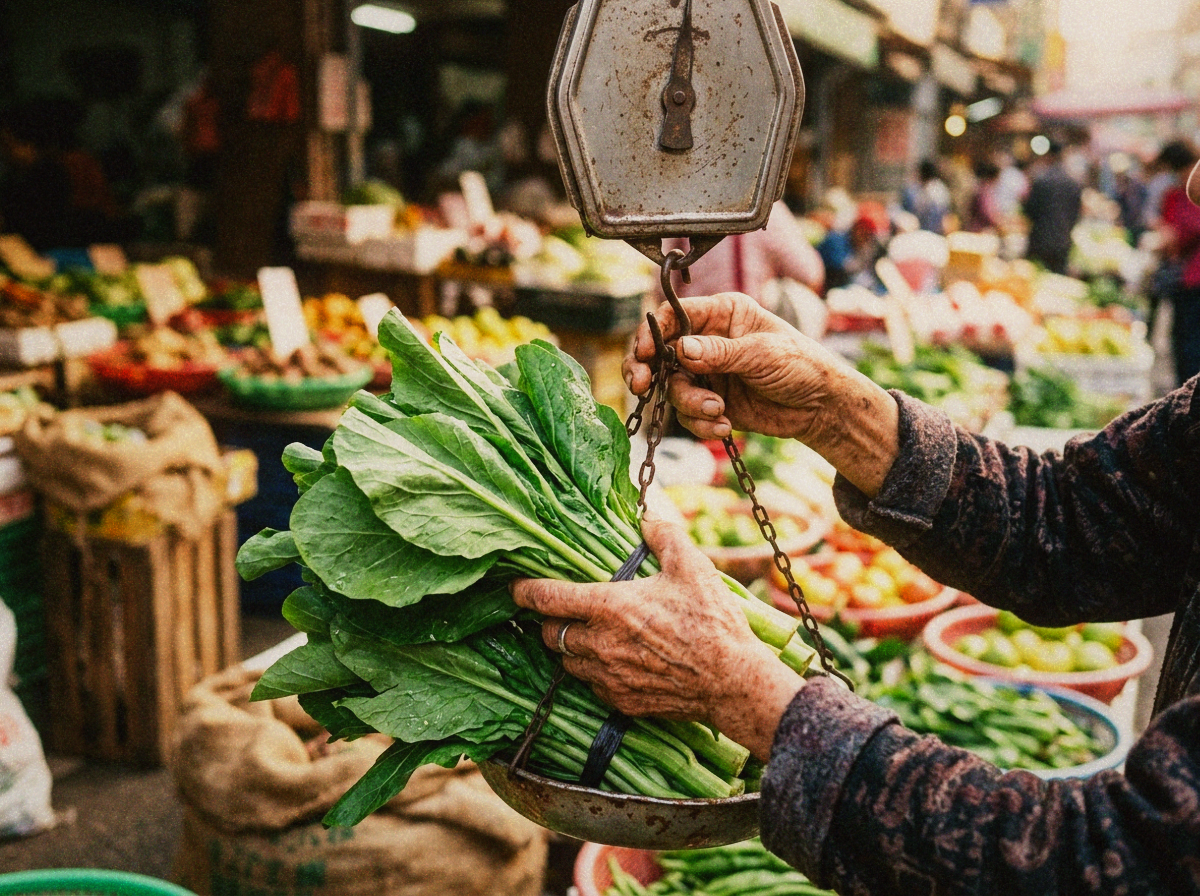
 FIRST SIGHTWEBGLEvery stall is a specialist. The person selling you vegetables is usually the one who picked them at the wholesale market before dawn. · Color and grain by First Sight · Gold 200. · First Sight 色彩與顆粒調校 · Gold 200
How to read the market
A traditional market looks like chaos and is actually deeply organised, just not with signs. It sorts itself by category and by mess. The wet end, where the English name wet market comes from, is the meat and the seafood, with its hosing-down and its ice and its cleavers. The dry end is produce, tofu, eggs, dried mushrooms, noodles and pantry goods. Cooked food and breakfast stalls cluster near the entrances and the edges, where the smell can do the marketing.
Walk the whole thing once before you buy anything. This is the single best piece of advice for a first-timer. Prices and quality shift from stall to stall; the same tomatoes can be noticeably cheaper thirty seconds deeper in, and the stall with a line of local grandmothers is telling you exactly where to go. The market rewards the second lap. On the first one, you are only learning the room.
What to buy, and when
The market's real advantage is seasonality. Because vendors buy fresh each morning and turn it over the same day, what is piled highest and cheapest is simply what is best right now. In late summer you will see bitter melon, bamboo shoots, water spinach, edamame, mangoes and wax apples; in winter, strawberries, white radish and the leafy greens that love the cool. You do not need to know the calendar. You just buy what there is a lot of. The market is the calendar.
Beyond produce, a few things are worth seeking out on purpose. Fresh tofu and soy milk from a tofu stall taste almost nothing like the packaged kind. Eggs are often sold loose, sometimes still warm, and you choose them yourself. The pork was butchered that morning, and if you can describe the dish, the vendor will cut for it: thin slices for a stir-fry, a hunk for braising, bones for soup. Fishmongers will clean and fillet what you buy without being asked twice. And the noodle stall sells fresh rice noodles and hand-cut wheat noodles by weight, in quantities a supermarket would never bother with.
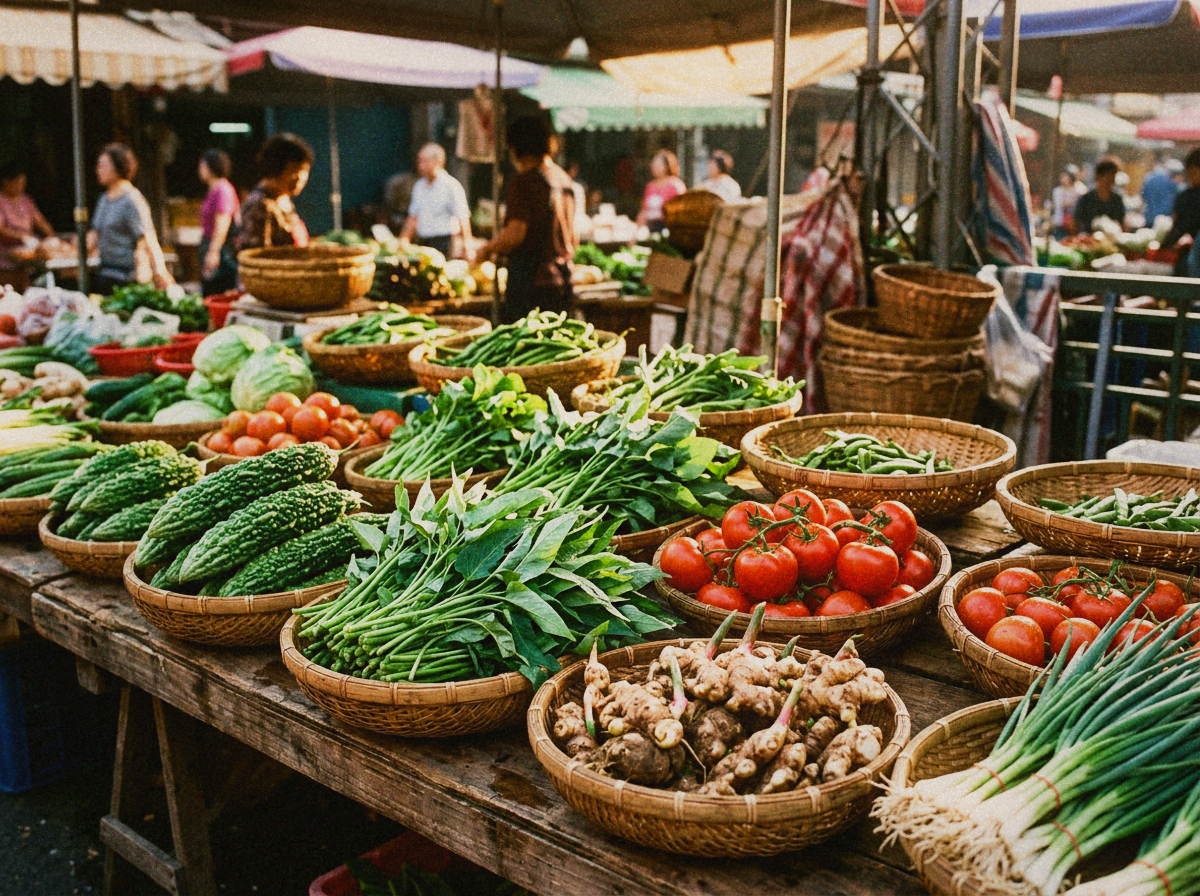 FIRST SIGHTWEBGLWhatever is piled highest and cheapest is simply what is in season. In a traditional market, the produce is the calendar. · Color and grain by First Sight · Gold 200. · First Sight 色彩與顆粒調校 · Gold 200
You do not need to know what is in season. In a traditional market, whatever is best is simply whatever there is the most of.
The unwritten rules
Markets have etiquette, and most of it is common sense sped up. Know roughly what you want before you reach the front of a busy stall; mornings move fast and dithering holds up the line. Point rather than handle: for produce, and especially for anything the vendor has taken pride in arranging, let them pick it up unless they have invited you to choose. Ask how do I cook this freely, because vendors love the question and the answer is often better than any recipe. Have your cash ready. And if you find a stall you like, go back to it, because becoming a regular, a 熟客, is the whole game. Regulars get the better cuts, the honest do not buy that today, buy this, and the extra stalk of spring onion tossed in for free.
One gentle myth to retire: the traditional market is not really a place to haggle. This is not a tourist bazaar, and hard bargaining over a bundle of greens will mostly earn you a strange look. Prices are already thin and mostly set by the going rate that day. What you can do is buy in real quantity, or become a familiar face, and let the discount come to you as a rounding-down or a little extra in the bag. Relationship, not negotiation, is the currency here.
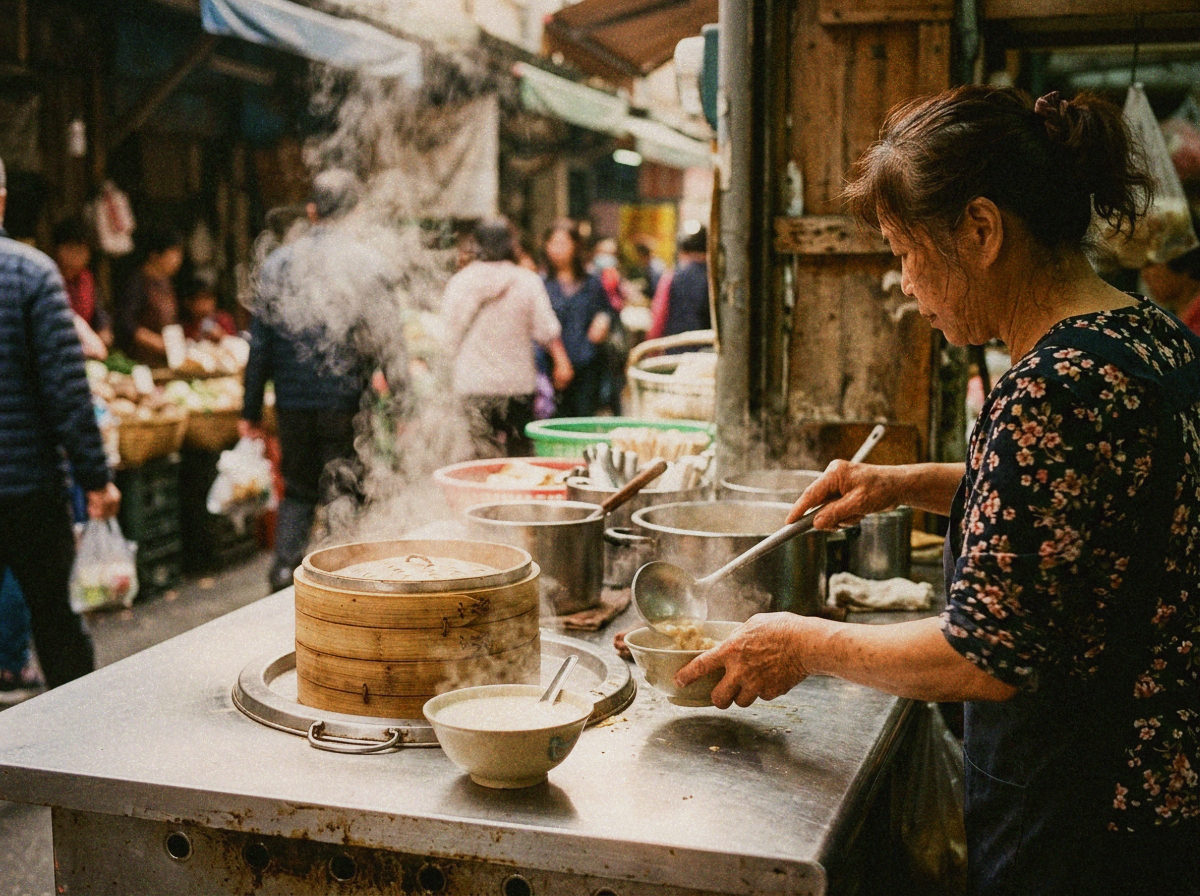 FIRST SIGHTWEBGLThe people who run the market need breakfast too. The food stalls at the edges are often the best, and cheapest, meal you will eat all day. · Color and grain by First Sight · Gold 200. · First Sight 色彩與顆粒調校 · Gold 200
Breakfast is part of the deal
No one shops a Taiwanese market on an empty stomach for long, because the market feeds you while you are there. Tucked among the stalls you will find someone frying radish cake on a flat-top, a tower of steamers full of fresh 包子 and 饅頭, a wok turning out fried rice, warm soy milk with 燒餅 and 油條, or a bowl of noodles eaten standing at a plastic counter. This food is aimed at the vendors and the early crowd, which means it is unpretentious, extremely cheap, and often better than the sit-down places nearby. Buy your vegetables, then eat. It is the correct order.
Why the market still wins
It would be easy to write the traditional market off as nostalgia, a thing the delivery apps will eventually finish off. But it keeps not dying, and the reasons are practical rather than sentimental. The food is fresher because it has not sat in a distribution centre. It is often cheaper because there is no chain taking a margin. It creates less packaging, because you carry your own bag and buy exactly what you need. And it is a place where you are known, where buying dinner is a dozen tiny human exchanges instead of a self-checkout beep. In a country that modernised as fast as any on earth, the survival of the morning market is not an accident. It is a choice people keep making, one small purchase at a time.
So set an alarm you will resent, go while the light is still low, and walk the whole thing once before you buy. Bring cash and a bag and an empty stomach. Ask the woman with the best-looking greens what she would cook tonight. The market has been answering that question for a very long time, and it is happy to answer it for you too.
Comments (0)
Loading comments...