
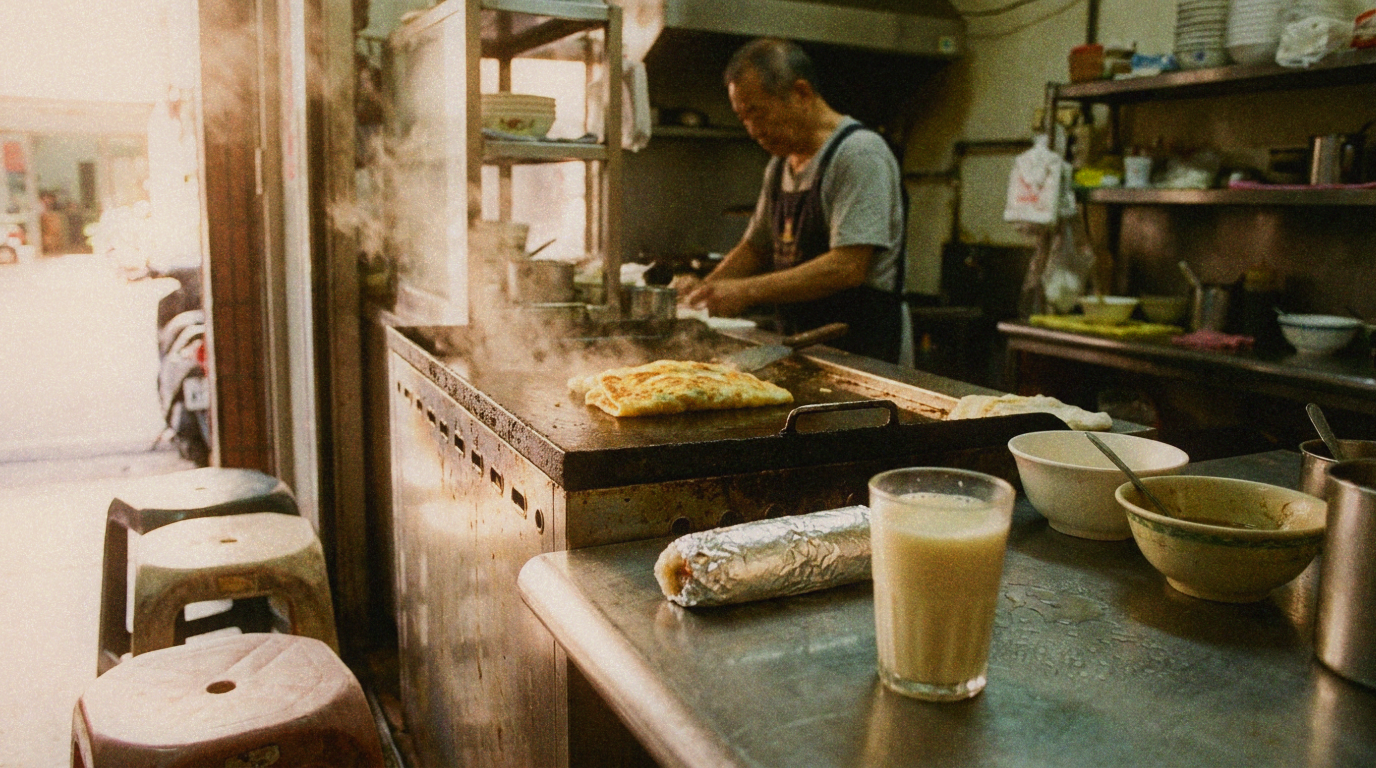
In most of the world, breakfast is something you make. In Taiwan, it's something you go out and get. Within a few minutes' walk of almost any front door, a griddle is already hot, a vat of soy milk is already warm, and someone is already cracking an egg onto a crepe that will be folded, cut, bagged, and in your hand before you've finished deciding what else you want. Breakfast here isn't a chore you perform half-asleep at your own counter. It's a small daily errand into the life of your neighbourhood.
The Taiwanese breakfast shop — the 早餐店 — is one of those everyday institutions that visitors fall for immediately and locals barely think about, precisely because it's everywhere. It's fast without being industrial, cheap without being sad, and social in a low-key way that most grab-and-go food culture gave up long ago. Some shops have been run by the same family for thirty years; others are franchises three months old. Both can be excellent. This is a field guide to eating at them well — what to order, how to order it, and why so many people here would rather queue for four minutes than pour their own cereal.
Two kinds of morning shop
There are, loosely, two families. The first is the classic soy milk house (豆漿店): old-school, often family-run, frequently open before dawn for the market crowd and the night-shift crowd heading home. This is the domain of hand-pulled dough — you tiao (the fried cruller), shao bing (a flaky sesame flatbread), turnip cake, sticky rice rolls, and soy milk ladled by the bowl. The air smells of hot oil and toasted sesame, and the good ones have a queue that never quite disappears.
The second is the griddle shop — brighter, a little more modern, the kind with a laminated photo menu and a flat-top the size of a door. This is where the egg crepe reigns, alongside toasted sandwiches, burgers, iron-plate noodles, and enormous cups of iced milk tea. Many trade under franchise names — you'll start to recognise the same cheerful signage on every second block — but the cooking still happens in front of you, to order, in minutes.
What the two families share is the rhythm, and the rhythm is the real product. Orders are called out, not written down. The regular ahead of you says three syllables and receives, without further discussion, the exact thing they receive every day. The whole transaction — order, cook, wrap, pay — often takes under three minutes, and yet nobody seems to be hurrying. Once you learn the beats, joining in feels less like ordering and more like stepping into a dance that was already going when you arrived.
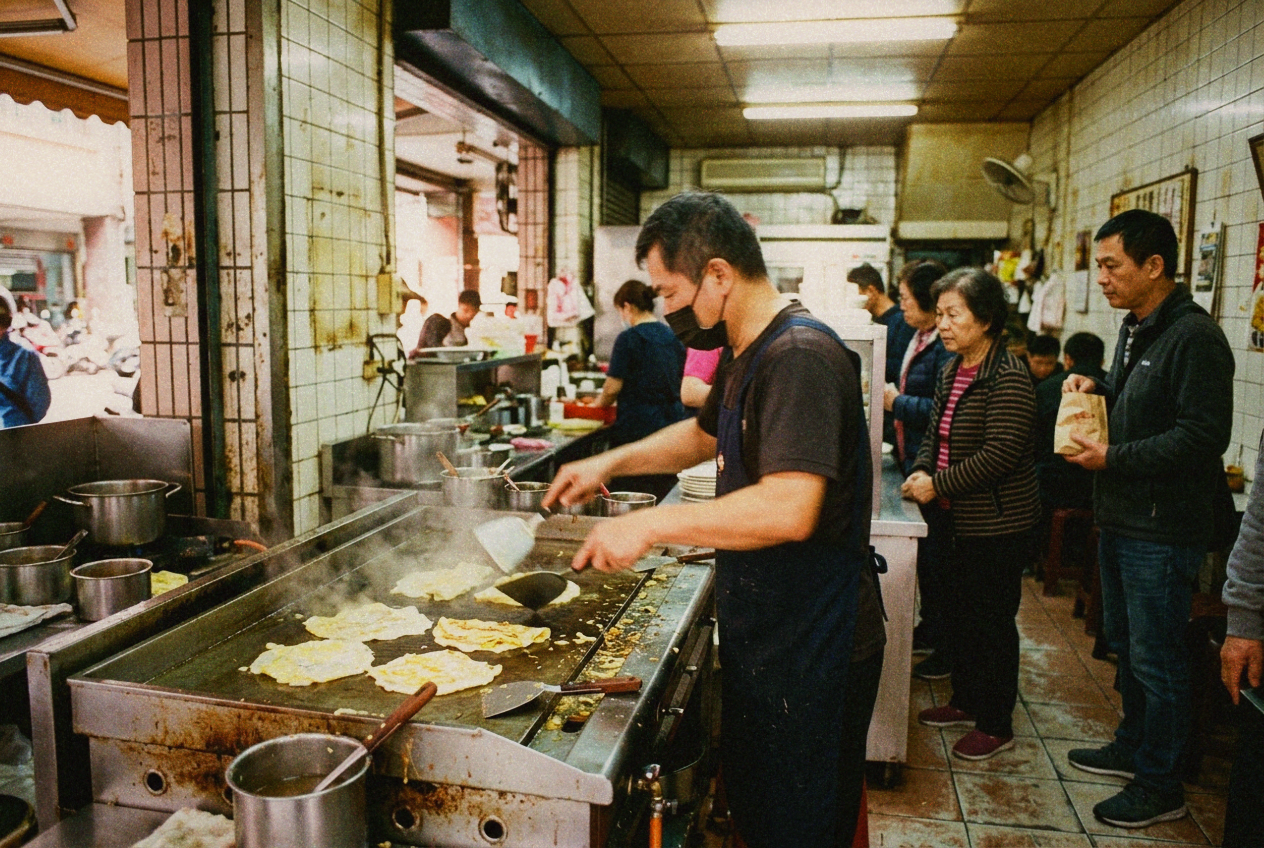
 FIRST SIGHTWEBGLThe flat-top is the heart of the griddle shop. Everything is cooked to order, and the queue is part of the design. · Color and grain by First Sight · Gold 200. · First Sight 色彩與顆粒調校 · Gold 200
Fast without being industrial, cheap without being sad — and social in a way most grab-and-go food gave up long ago.
The cast of characters
You could eat at a different breakfast shop every morning for a month and never run out of combinations, but a handful of dishes form the backbone. Learn these and you can walk into any shop in the country and order with confidence.
Dan bing (蛋餅) is where most people start, and for good reason. A thin wheat batter is spread across the griddle, an egg cracked over it, the two pressed together, then rolled and sliced into segments you eat with a tiny wooden fork. Plain is wonderful. From there you build: cheese, corn, sweetcorn and tuna, pork floss, a hash brown tucked inside, basil, bacon. The traditional move is to dip a piece into warm soy milk before eating — the savoury-sweet contrast is the whole reason the two are sold side by side. If you order one thing on your first visit, order this.
Fan tuan (飯糰) is Taiwan's original breakfast burrito, invented long before anyone thought to call anything a breakfast burrito. Warm glutinous rice is pressed flat on a cloth, scattered with pork floss and pickled mustard stem, wrapped tightly around a length of you tiao for crunch, then squeezed into a dense, warm cylinder you eat with your hands. Purple-rice versions are common and slightly sweeter. It looks modest and is deceptively filling — a single fan tuan will carry most people comfortably to lunch.
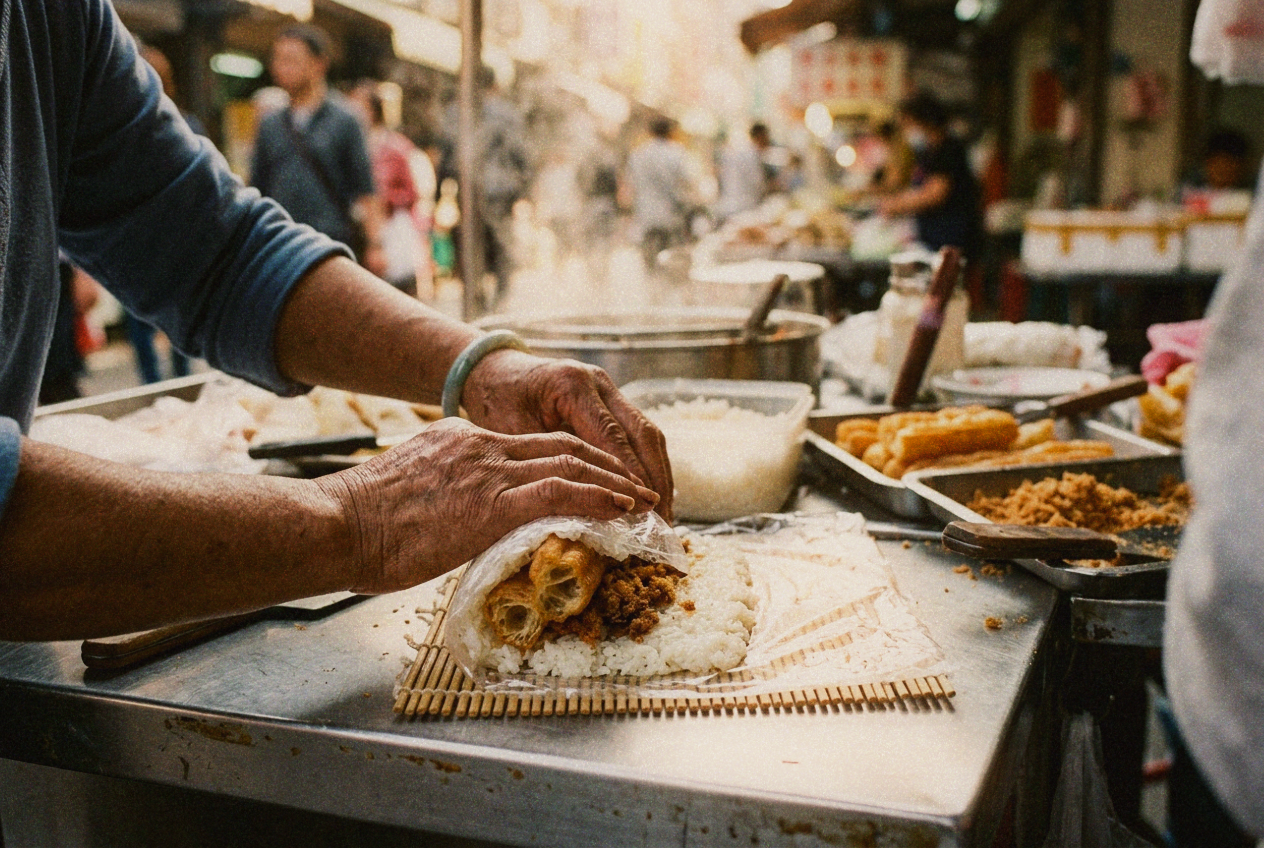 FIRST SIGHTWEBGLA fan tuan is built in about fifteen seconds: rice, pork floss, pickles, a cruller for crunch, then squeezed tight. · Color and grain by First Sight · Gold 200. · First Sight 色彩與顆粒調校 · Gold 200
Soy milk (豆漿) is the drink the whole tradition is named after, and it comes two ways. Sweet soy milk, served warm, is the gentle default — thinner and less sugary than the cartoned kind, made fresh that morning. But savoury soy milk (鹹豆漿) is the quiet masterpiece, and the dish most likely to convert a sceptic. Hot fresh soy milk is poured from a height over a splash of vinegar in the bowl, so it curdles on contact into soft, silken clouds. It's then loaded with dried shrimp, pickled greens, chopped you tiao, scallions, a little soy, and a drop of sesame or chilli oil. It arrives looking like a bowl of soup and eats like something between soup and the softest tofu you've had. Order it once.
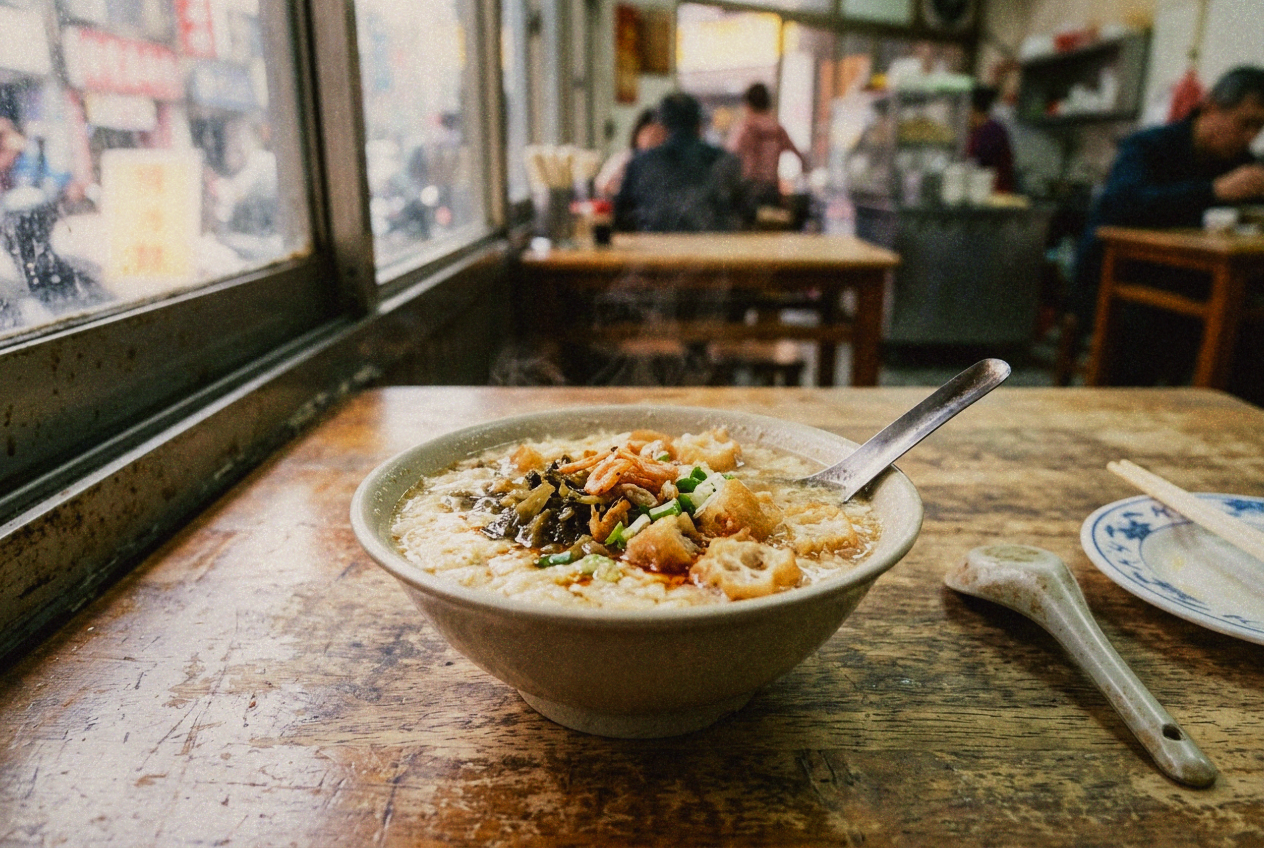 FIRST SIGHTWEBGLSavoury soy milk (鹹豆漿): hot soy milk curdled with vinegar, then loaded with cruller, dried shrimp, pickles and scallion. · Color and grain by First Sight · Gold 200. · First Sight 色彩與顆粒調校 · Gold 200
Shao bing you tiao (燒餅油條) is the signature pairing of the soy milk house: a flaky, many-layered sesame flatbread split open and stuffed with a whole crisp cruller, so you get shatter and chew in the same bite. Ask them to tuck an egg or a scallion omelette inside and you have the platonic ideal of a breakfast that costs about the same as a coffee.
Beyond the headliners, keep an eye out for luobo gao (蘿蔔糕), pan-fried radish cake with crisp edges and a soft centre; tie ban mian (鐵板麵), springy noodles cooked on the flat-top in black pepper or mushroom sauce; and dan bing's cousin, the humble egg-and-cheese toast. And whatever you order, consider the drink locals swear by on a hot morning: da bing nai (大冰奶), an oversized cup of strong iced milk tea that is somehow exactly right at 7am.
How to order like a regular
A few small habits separate the visitor from the regular, and none require much Mandarin. Most shops are cash-first and fast, so have coins ready before you reach the front. Decide whether you're eating in or taking away — 內用 (nèi yòng) or 外帶 (wài dài) — because it changes how they pack it; most people say 外帶 out of pure habit. Soy milk defaults to sweet, so ask for 無糖 (wú táng) if you want it unsweetened, or 鹹豆漿 for the savoury bowl. If a dish can take chilli, they'll ask, or you can say 要辣 (yào là) for yes.
The most important rule is not to overthink it. Point at the menu, hold up fingers for quantity, smile, say the name of the thing as best you can. The staff have heard every accent and every level of Mandarin, and behind the brisk pace they are, almost universally, just trying to feed you and send you on your way happy. Getting your order slightly wrong once is how you become a regular — by the third visit they'll have started your usual before you've said a word.
The new guard
The tradition isn't frozen in amber. Over the last few years a wave of younger owners has been quietly reinventing the breakfast shop — sourdough dan bing, soy milk from a single named producer, cleaner and calmer interiors, eggs and greens from farms they can point to on a map — while keeping the two things that made the original great: the griddle, and the speed. Some lean into design; some just quietly source better. The best of them prove a point OQUA keeps returning to: the goal is rarely to escape everyday food and replace it with something fancier. It's to make the everyday version a little better without losing what made it worth loving. A three-minute breakfast, done with more care, is still a three-minute breakfast.
Why it might be the best meal of the day
Part of the answer is simply the food — hot, savoury, satisfying, and endlessly variable for the price of a coffee. But part of it is the shape the ritual gives your morning. You leave the house before you're fully awake. You walk a little. You trade a few words with someone who is genuinely glad to see you, and you eat something warm that a person made in front of you, for you, minutes ago. It's a small thing, repeated every single day, and it quietly insists that your morning is worth doing properly.
That insistence isn't nothing. A good day is mostly built from ordinary mornings handled well, and the breakfast shop is one of the gentlest, cheapest, most reliable ways Taiwan has found to handle one. You don't have to live here to borrow the idea: somewhere near you, something warm is being made by someone who'd be glad to see you. Going to get it is a better start than most.
Comments (0)
Loading comments...