
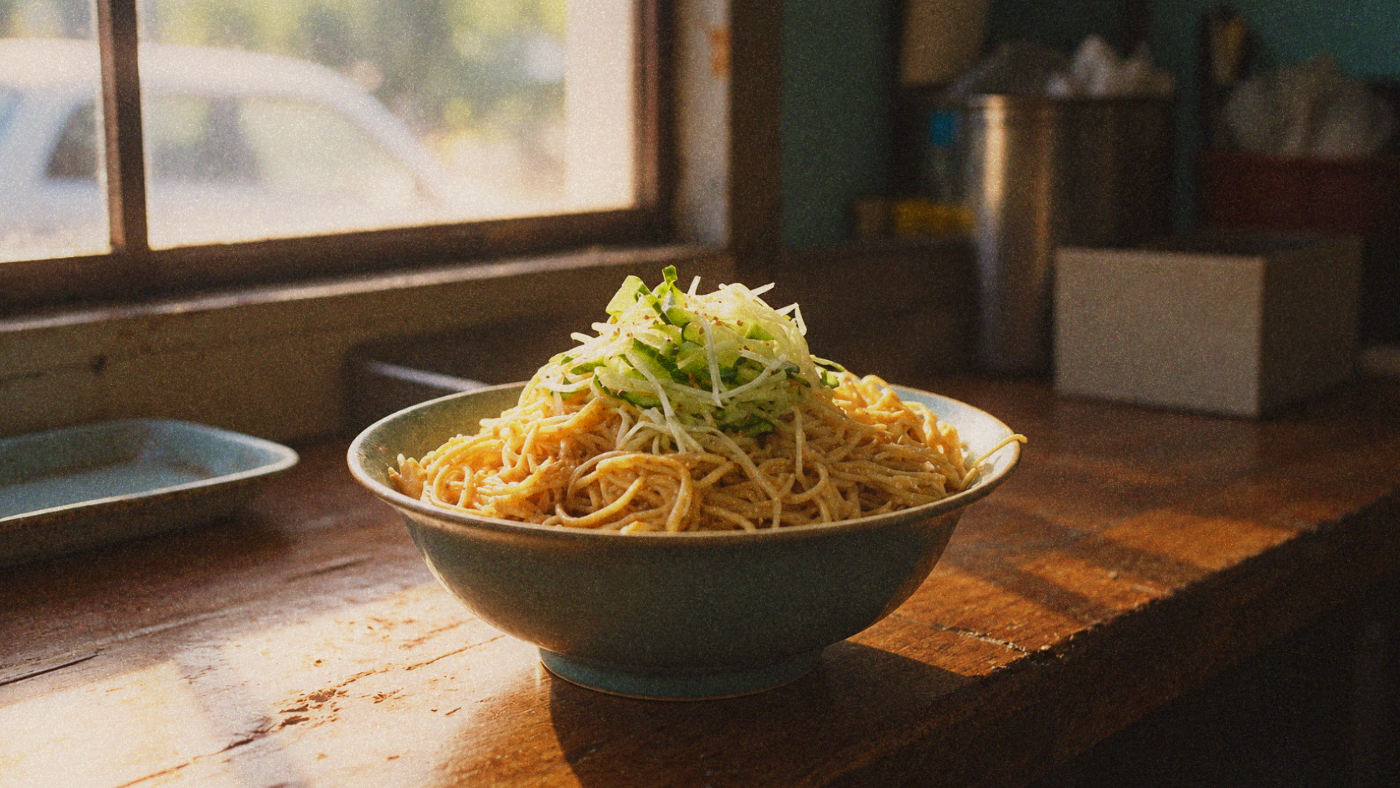
By late July, Taipei stops being a city that eats hot food. Not officially, and not completely, but you can watch it happen. The beef noodle place that had a queue in February has three tables free at one o'clock. The breakfast shop switches its busiest item from hot soy milk to iced. And somewhere on your street, a shop that sells almost nothing but cold noodles has a line out the door at 11:40 in the morning, made up entirely of people who did not need to look at a menu.
This is the part of Taiwanese food culture that visitors tend to miss, because it does not photograph as well as a night market and it has no signature restaurant. Cold-season eating here is not a trend or a diet. It is an old, practical answer to a specific problem: what do you eat when it is 35 degrees with 80% humidity and the thought of broth makes you tired. Taiwan has been answering that question for a long time, and the answers are cheap, fast, and better than they need to be.
What follows is how the season actually works: the noodle at the centre of it, the drinks that go with it, and the small set of habits that make a Taipei summer survivable at the table.
涼麵: the dish the season is built around
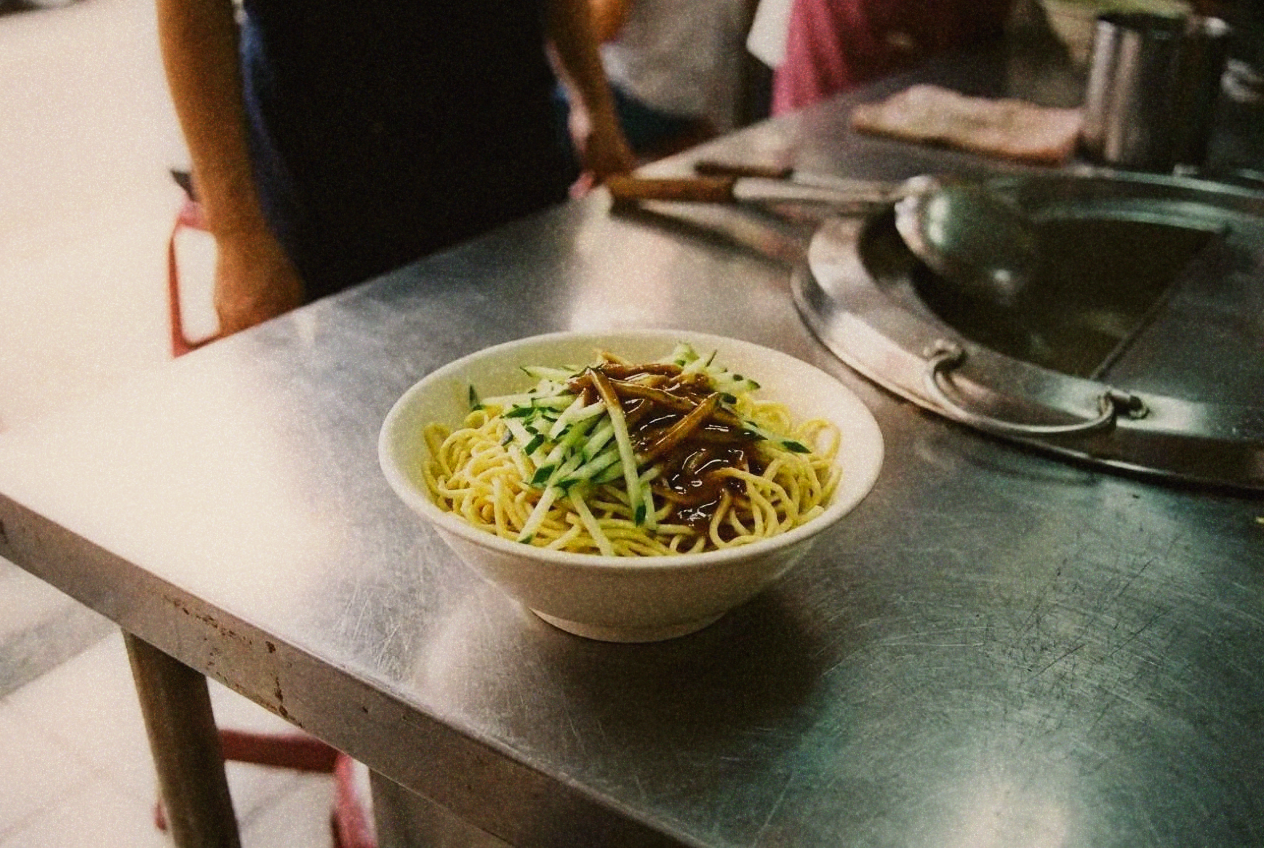
 FIRST SIGHTWEBGLThe standard build: 油麵, sesame sauce, shredded cucumber. Three components, no garnish, no explanation. Most shops in Taipei are competing on the sauce alone. · Color and grain by First Sight · Gold 200. · First Sight 色彩與顆粒調校 · Gold 200
Taiwanese 涼麵 is not the same animal as Japanese hiyashi chuka or Sichuan 涼麵, and the difference matters. The base is 油麵, the yellow alkaline wheat noodle, boiled and then cooled so it stays springy rather than soft. Over it goes 麻醬, a sesame sauce cut with soy and vinegar and usually a little garlic. On top, shredded cucumber. That is the whole dish. No protein, no egg, no scattering of herbs.
Because the composition is fixed, every shop in Taipei is effectively competing on one variable: the sauce. Some grind their own sesame. Some build the base with Chinese medicinal herbs simmered into the paste, which gives it a rounder, slightly bitter depth. Some lean sweet, some lean sour, some add a red-oil chilli layer. Regulars are loyal to a specific bowl the way people elsewhere are loyal to a coffee roaster, and they will tell you, unprompted and at length, that the shop two blocks over has gone downhill.
The useful add-ons are the soups. Most 涼麵 shops sell a short list of them — 味噌湯, 蛋花湯, sometimes 貢丸湯 — and the pairing of a cold bowl with a small hot soup is the standard order, not a contradiction. If you are eating at a shop with a 綜合 or 什錦 option, that usually means noodles plus a side of shredded chicken or 皮蛋, which is worth the extra thirty dollars on a day when you want the meal to hold.
Where the good bowls are
The best-known shops in Taipei are old. 陳家涼麵 has been running for close to fifty years, 福德涼麵 for more than thirty, 張春涼麵 for a comparable stretch. Longevity is the whole signal here: a shop selling a three-ingredient dish cannot survive four decades on anything except the sauce being genuinely better than the shop down the road. Several of these open early and close when the day's noodles are gone, which in high summer can be well before evening.
At the other end, the dish has been picked up by restaurants with no connection to the old shops at all. 貓下去, open since 2009 and more or less the origin point of the modern Taiwanese bistro, serves a cold noodle built on chilled egg noodles with a sesame-and-red-oil sauce. It costs several times what a neighbourhood bowl does. It is also a different proposition — a restaurant dish that happens to be cold, rather than a working lunch.
The drinks: 青草茶, 冬瓜茶, 仙草
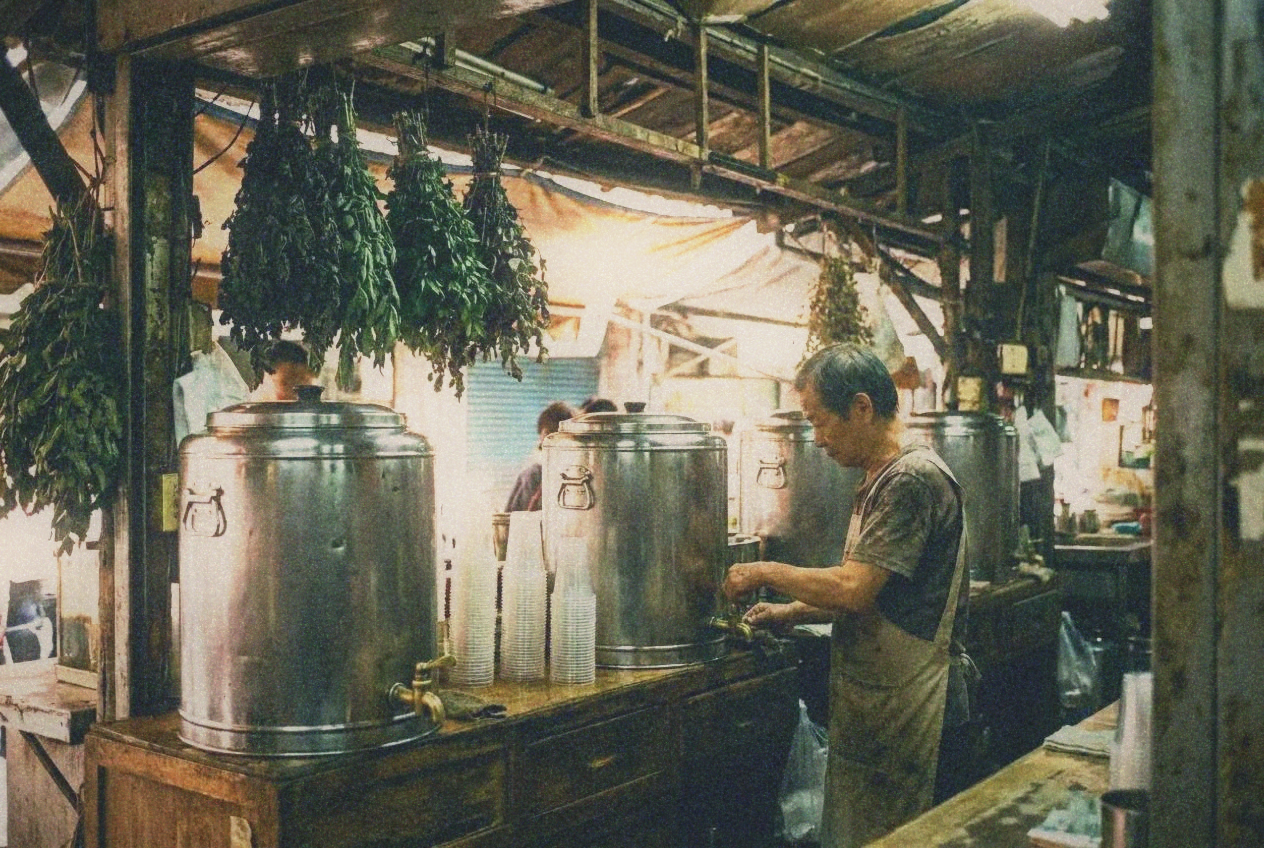 FIRST SIGHTWEBGLHerbal tea stalls run on the same logic as the noodle shops: one thing, done for decades, sold by the cup. Many are attached to a 青草店 that has been on the same corner far longer than anything around it. · Color and grain by First Sight · Gold 200. · First Sight 色彩與顆粒調校 · Gold 200
The drink half of the season is older than the noodle half. 青草茶 is a dark, bitter, faintly medicinal herbal tea brewed from a mix of local plants — 咸豐草 and 魚腥草 among them — and it is sometimes called 百草茶 for the obvious reason. It is sold from steel urns at markets, from small storefront herb shops, and increasingly in bottles at every supermarket. The traditional framing is that it clears heat and 退火, that vague and useful Taiwanese concept covering everything from a sore throat to too many fried things and not enough sleep.
Next to it you will usually find two milder options. 仙草茶 is made from dried 仙草 alone rather than a herb blend, which makes it rounder and much easier to drink cold. 冬瓜茶, brewed from slabs of candied winter melon, is the sweet one, and the one children get. If 青草茶 is too much on a first attempt — and for a lot of people it is — 冬瓜茶 cut with lemon is the standard on-ramp.
One practical caution, because it is widely repeated in Taiwan and worth knowing rather than discovering. 青草茶 is strongly cooling in the traditional framework, and Taiwanese doctors routinely advise that pregnant women, women who are menstruating, people with a cold-deficient stomach who get diarrhoea easily, and anyone with chronic kidney disease should go easy on it or skip it. It is a herbal preparation, not a soft drink, and the volume people put away in August is not trivial. If any of that applies to you, 冬瓜茶 and 仙草茶 carry none of the same warnings.
What the season looks like at home
The domestic version of all this is mostly about not turning on the stove. Traditional markets shift their displays in July: more 涼拌 vegetables, more 皮蛋豆腐, more cucumber and 小黃瓜 in bulk, more of the pre-cooked cold dishes you can buy by weight and eat straight from the bag. The 滷味 stall near the market will sell you the same braised items cold, which is how most people actually eat them in August.
The simplest home 涼麵 is not really a recipe. Buy fresh 油麵 from the market, boil briefly, rinse under cold water until the noodles are properly cold rather than lukewarm — this is the step people skip and the one that decides the dish — drain hard, and dress with sesame paste loosened with soy, vinegar, a little sugar, and a spoonful of the noodle water. Cucumber on top. It takes about eight minutes and costs perhaps NT$25 a serving.
The other domestic staple is 仙草 or 愛玉 as dessert, both sold ready-made in market tubs, both requiring nothing more than ice, a little syrup, and lemon in the case of 愛玉. Neither needs heat, both keep for days, and both do the thing a summer dessert is supposed to do, which is finish the meal without adding to it.
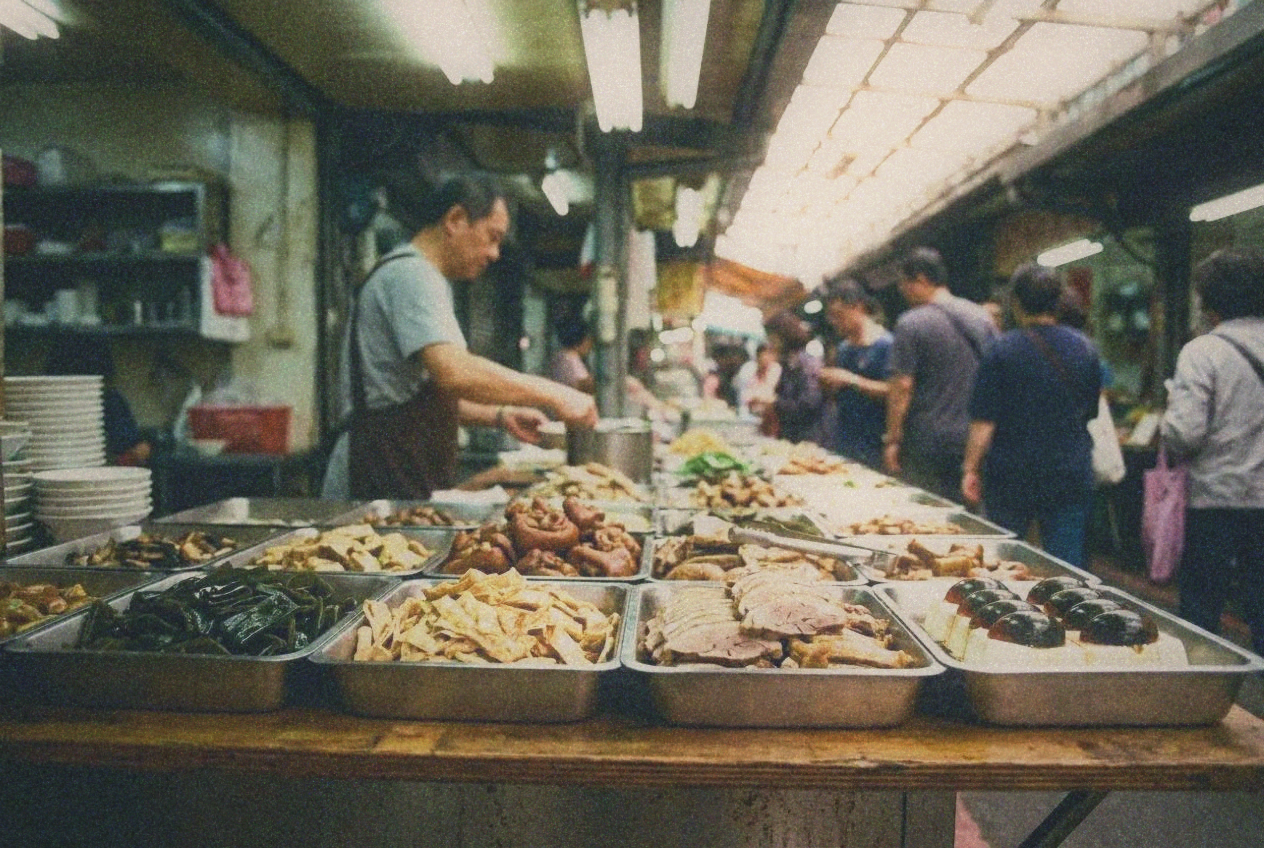 FIRST SIGHTWEBGLJuly markets rearrange themselves around cold food. Pre-dressed vegetables, 皮蛋豆腐, cold 滷味, sold by weight. Most Taipei households eat this way through the worst of the summer. · Color and grain by First Sight · Gold 200. · First Sight 色彩與顆粒調校 · Gold 200
None of this is a hardship cuisine. That is the part worth holding onto. A city with this much heat could have settled for eating less and complaining more, and instead it built a parallel summer menu that is quicker, cheaper, and in several cases better than the food it replaces. The 涼麵 shop with a queue at 11:40 is not a compromise. It is the point.
Comments (0)
Loading comments...