
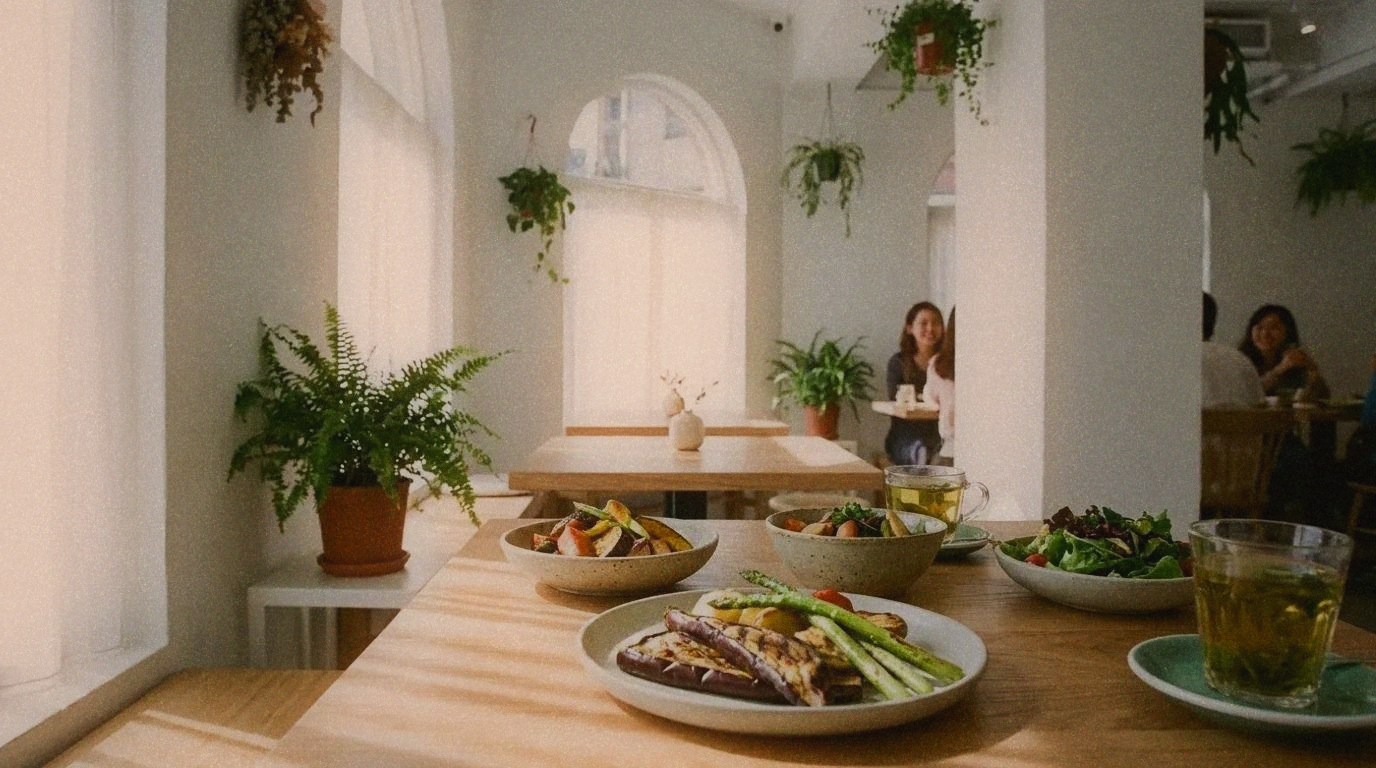
The lunch rush at a 素食自助餐 on Fuxing South Road looks like any other Taipei buffet line. Office workers in lanyards, a couple of construction guys, an older woman with a red market bag. You grab a metal tray, load up from maybe forty dishes behind the glass, and the cashier weighs it. NT$80 to NT$130 for a full plate of braised tofu, stir-fried greens, sesame noodles, a mushroom thing you can't identify but tastes better than it looks. Rice, soup, and a sweet red bean dessert are free if you eat in. Nobody here is making a statement about veganism. They're just eating lunch. And lunch is good.
That's the thing about Taipei and vegetarian food. The infrastructure was here long before the trend. Taiwan has roughly 6,000 vegetarian restaurants, the world's strictest food labeling laws for vegetarian products, and a population where about 13 to 14% identify as vegetarian and over 40% eat flexitarian. The reasons are mostly Buddhist, not Instagram. And the result is a city where you can eat without meat for a week and never repeat a restaurant, never feel deprived, and spend less than you would eating beef noodles.
What follows is a working guide. Not a ranked list. Restaurants organized by what kind of eating you're looking for, with real addresses and prices, plus the practical stuff that most guides skip: how to read the labels, what to say when you order, and where the hidden animal ingredients are.
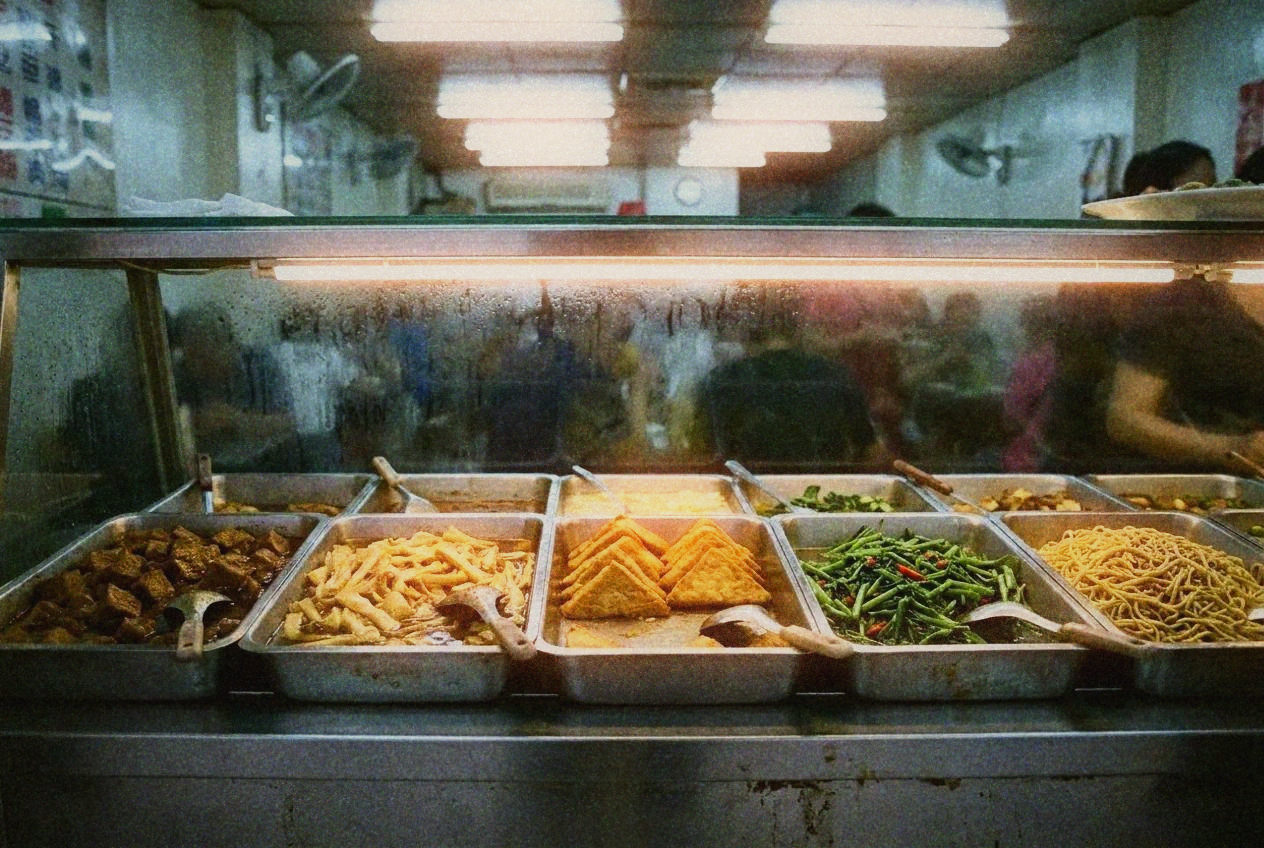
 FIRST SIGHTWEBGLThe 素食自助餐 lunch line. Forty-odd dishes, pay by weight, NT$80 to NT$130 for a full tray. This is still the cheapest and most common way to eat vegetarian in Taipei. · Color and grain by First Sight · Gold 200. · First Sight 色彩與顆粒調校 · Gold 200
The buffet tradition: where Taipei's vegetarian story starts
Before there were smoothie bowls and cashew cheese, there were 素食自助餐. Buddhist vegetarian buffets. They've been in every Taipei neighborhood for decades, and they're still the backbone of daily vegetarian eating in this city.
The format is simple. You walk in, grab a tray or a takeaway box, and pile it with whatever you want from a long counter of prepared dishes. The cashier weighs it and charges you. A typical meal runs NT$80 to NT$130, occasionally pushing NT$200 if you really load up on the mock meats. Rice, soup, and usually some kind of dessert are unlimited if you eat in.
The food is Taiwanese home cooking without the meat. Braised bamboo shoots. Stir-fried water spinach with garlic. Ma po tofu with mushroom instead of pork. Seaweed rolls. Deep-fried taro balls. Sesame oil noodles. The quality varies, which is true of any buffet anywhere, but a good one is genuinely good. The spot matters more than the concept.
Minder Vegetarian (明德素食園) is the chain that gets recommended most, with locations in Q Square near Taipei Main Station, plus branches in several malls. It's cleaner and more organized than your average neighborhood buffet, with a wider selection. Two full plates and a soup will run you under NT$280. If you're new to the format, start here.
But don't sleep on the neighborhood ones. Every MRT station area has at least one 素食自助餐 within walking distance. They don't have English menus. They don't have websites. They do have food that somebody's been making since before you were born, and the aunties running the counter will help you if you point and smile.
The dim sum palaces: when you want a proper meal
Two restaurants in Taipei took traditional Chinese dim sum and rebuilt it entirely without meat, and both are worth a dedicated trip.
養心茶樓 (Yang Shin Vegetarian) sits on the second floor above Nozomi Bakery, right next to Songjiang Nanjing MRT, Exit 8. It opened in 2013 as Taipei's first vegetarian dim sum restaurant and quickly became one of the city's most popular vegetarian spots for good reason. The dim sum menu has over 30 items, priced between NT$68 and NT$180. The vegetarian xiaolongbao are the signature, and they're legitimately good, not "good for vegetarian" but actually good. The skin is thin, the filling has the right texture, and there's a broth inside that somehow works without pork. Pan-fried turnip cakes (NT$68) and the steamed rice noodle rolls with loofah and lily bulbs (NT$98) are both worth ordering. Every guest pays NT$40 for a pot of tea, which feels like a tax until you realize the tea is solid and refillable.
Open daily 11:30am to 9:30pm. Reservations recommended, especially weekends. Address: 松江路128號2樓, Zhongshan District.
小蔬杭 (Xiao Shu Hang) takes the Shanghai/Jiangzhe approach. The name is a play on 蘇杭 (Suzhou and Hangzhou), the heartland of that cuisine, and the restaurant is a vegetarian offshoot of the respected Suhung chain. Located on the second floor at Roosevelt Road Section 4, No. 85, near NTU in the Gongguan neighborhood, it serves Shanghainese dim sum and stir-fries without any meat, fish, or eggs. Average spend is about NT$400 per person. The hand-rolled dumplings (NT$88 to NT$108) and the stir-fried selections (NT$168 to NT$208) are where the kitchen shows off. They operate on a lunch and dinner schedule: 11:30am to 2:30pm, then 5:30pm to 9pm. Last orders at 2pm and 8:20pm respectively.
Open daily. Address: 羅斯福路四段85號2樓, Da'an District. Phone: (02) 2363-7288.
Sichuan heat, vegetarian style
祥和蔬食 (Serenity) is the vegetarian restaurant that convinced Michelin. It earned Bib Gourmand recognition four consecutive years, from 2018 through 2021, the only vegetarian restaurant in Taiwan to achieve that. Two chefs run the kitchen: one specializes in vegetarian technique, the other in Sichuan flavoring. The result is food with actual heat and depth, not the timid seasoning that some vegetarian places default to.
The signature is the basil-scented crispy "tripe," which is actually deep-fried king oyster mushroom strips. It sounds like a compromise. It isn't. The texture is right, the basil fragrance is strong, and the Sichuan pepper gives it that numbing bite. Dishes run roughly NT$200 to NT$400. Portions are meant for sharing.
Two locations. The original Zhenjiang branch is at 鎮江街1巷1號, Zhongzheng District, behind the Sheraton. Hours: 11am to 2pm, 5pm to 9pm. The Qingcheng branch is at 南京東路三段303巷7弄7號, Songshan District, about 10 minutes from Nanjing Fuxing MRT Exit 7.
The new wave: plant-based, not Buddhist
A different kind of vegetarian restaurant started showing up in Taipei around 2015. Western-influenced, design-conscious, built for people who eat plant-based by choice rather than religion. The food is different, the vibe is different, and honestly, the prices are different too.
Ooh Cha Cha is usually cited as the original. It opened near Guting MRT and now has a second location near Technology Building Station (和平東路二段118巷4-1號, Da'an District). The menu is all-vegan: smoothie bowls, grain bowls with organic ingredients, sandwiches on house-made bread, and a full page of raw desserts. A meal runs about NT$350 to NT$450 per person. The Tech branch has Hooch, a bar downstairs that stays open until midnight, which makes it one of the few vegan-friendly late-night options in the city. Open daily 10am to 10pm.
Plants sits in a quiet lane off Fuxing South Road in Da'an, at Lane 253, Section 1. Everything is vegan, gluten-free, and refined-sugar-free. Energy bowls, raw dishes cooked below 45 degrees to preserve nutrients, soups. The space is small and popular during brunch hours, so reservations help. Two dishes and drinks will cost about NT$500 per person. The portions aren't huge for the price, which is a common comment. What you're getting is ingredient quality. The pumpkin soup alone is worth the trip if that matters to you.
Miacucina is the most accessible of the bunch. Italian-leaning vegetarian with locations in Zhongxiao Fuxing, Xinyi, Nanxi, Shilin, and Neihu. The menu covers pizza, pasta, sandwiches, and brunch plates. Not strictly vegan (some items have dairy and eggs), but vegan options are marked on the menu. It's a solid choice when you're eating with someone who wants something familiar, and the pizza is genuinely good. Multiple locations, all near MRT stations.
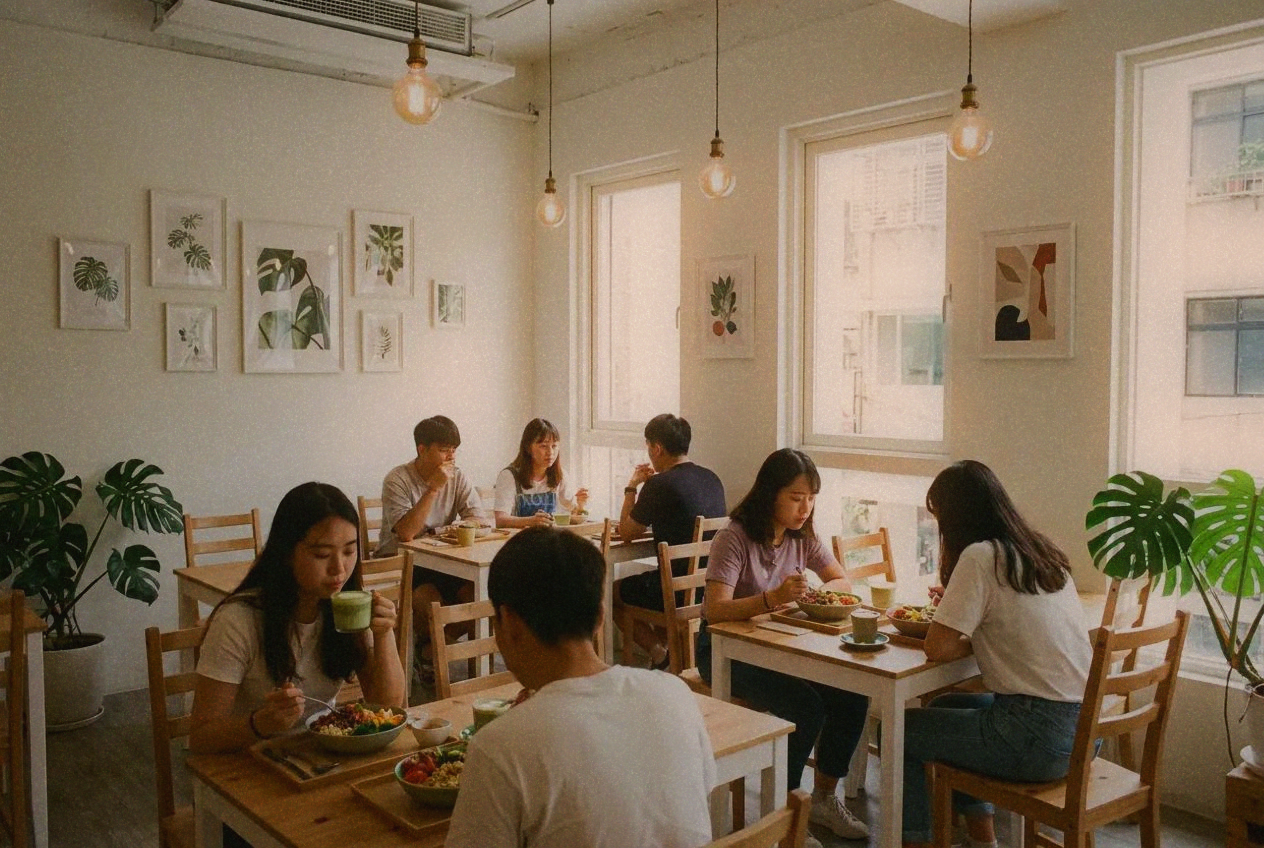 FIRST SIGHTWEBGLThe new generation of Taipei's vegetarian restaurants looks nothing like the Buddhist buffets. Same city, different universe. Both are worth your time. · Color and grain by First Sight · Gold 200. · First Sight 色彩與顆粒調校 · Gold 200
The noodle option: fast, cheap, customizable
Vege Creek (蔬河) is the answer when you want something quick and vegan without thinking too hard about it. The concept is build-your-own noodle bowls. You walk up to a wall of vegetables displayed vertically in bundles, pick what you want, choose your noodle type, and the kitchen cooks it in a shared broth. Individual vegetable bundles cost NT$35 each, noodles are NT$20. A decent bowl ends up around NT$120 to NT$160. They also do braised 滷味 dishes.
The flagship is on Yanji Street in Da'an, near Sun Yat-sen Memorial Hall, but they've expanded to about nine locations across Taipei and Taichung, including one inside Taipei 101's food court. It's all vegan, no ambiguity. Good for solo lunches, easy for people who don't read Chinese menus since you can just point at the vegetables.
What you need to know before you order
Taiwan has the world's strictest vegetarian food labeling system. Every packaged product sold as vegetarian must carry one of five legal classifications:
全素 / 純素 means fully vegan. No animal products, no alliums (garlic, onion, chives, scallions, leeks). This is the strictest category and aligns with traditional Buddhist dietary rules.
蛋素 means ovo-vegetarian: vegan plus eggs.
奶素 means lacto-vegetarian: vegan plus dairy.
蛋奶素 means lacto-ovo vegetarian: vegan plus both eggs and dairy. This is the most common label you'll see.
植物五辛素 means plant-based with alliums. This is closest to the Western definition of vegan or vegetarian, since it allows garlic and onion, which the Buddhist categories exclude.
At restaurants, the labeling is less formal but still usually present. Most vegetarian restaurants will tell you which category they follow. If you're strictly vegan, saying "我吃全素" (wǒ chī quánsù) makes it clear. For Western-style vegetarian where you're fine with garlic and onion, "我吃素,可以吃五辛" (wǒ chī sù, kěyǐ chī wǔxīn) works.
The hidden ingredients to watch for, especially at non-vegetarian restaurants that offer "vegetarian" options: oyster sauce (蠔油) in stir-fried vegetables, fish sauce in soup bases, lard in fried rice, chicken powder in broths, and bonito flakes in Japanese-influenced dishes. These are the ones that trip up vegetarians in Taiwan most often. At dedicated vegetarian restaurants, you won't encounter them. At regular restaurants offering vegetarian dishes, it's worth asking "有用蠔油嗎?" (yǒu yòng háoyóu ma, do you use oyster sauce?) because the answer is often yes.
The phrases that actually help
You don't need much Chinese to eat vegetarian in Taipei, but a few phrases change the experience completely.
我吃素 (wǒ chī sù) means "I eat vegetarian." This is the single most useful sentence. Say it when you sit down, say it when you order, say it at night markets. People understand immediately and will help you navigate.
全素 (quánsù) means strict vegan, no eggs, no dairy, no alliums. 蛋奶素 (dànnǎisù) means you eat eggs and dairy. Most Taiwanese vegetarian food falls into one of these two categories.
這個有肉嗎? (zhège yǒu ròu ma) means "Does this have meat?" Useful at night markets and non-vegetarian restaurants.
不要蔥蒜 (bùyào cōng suàn) means "No scallions or garlic." Only relevant if you follow the Buddhist dietary rules. Most Western vegetarians and vegans are fine with alliums.
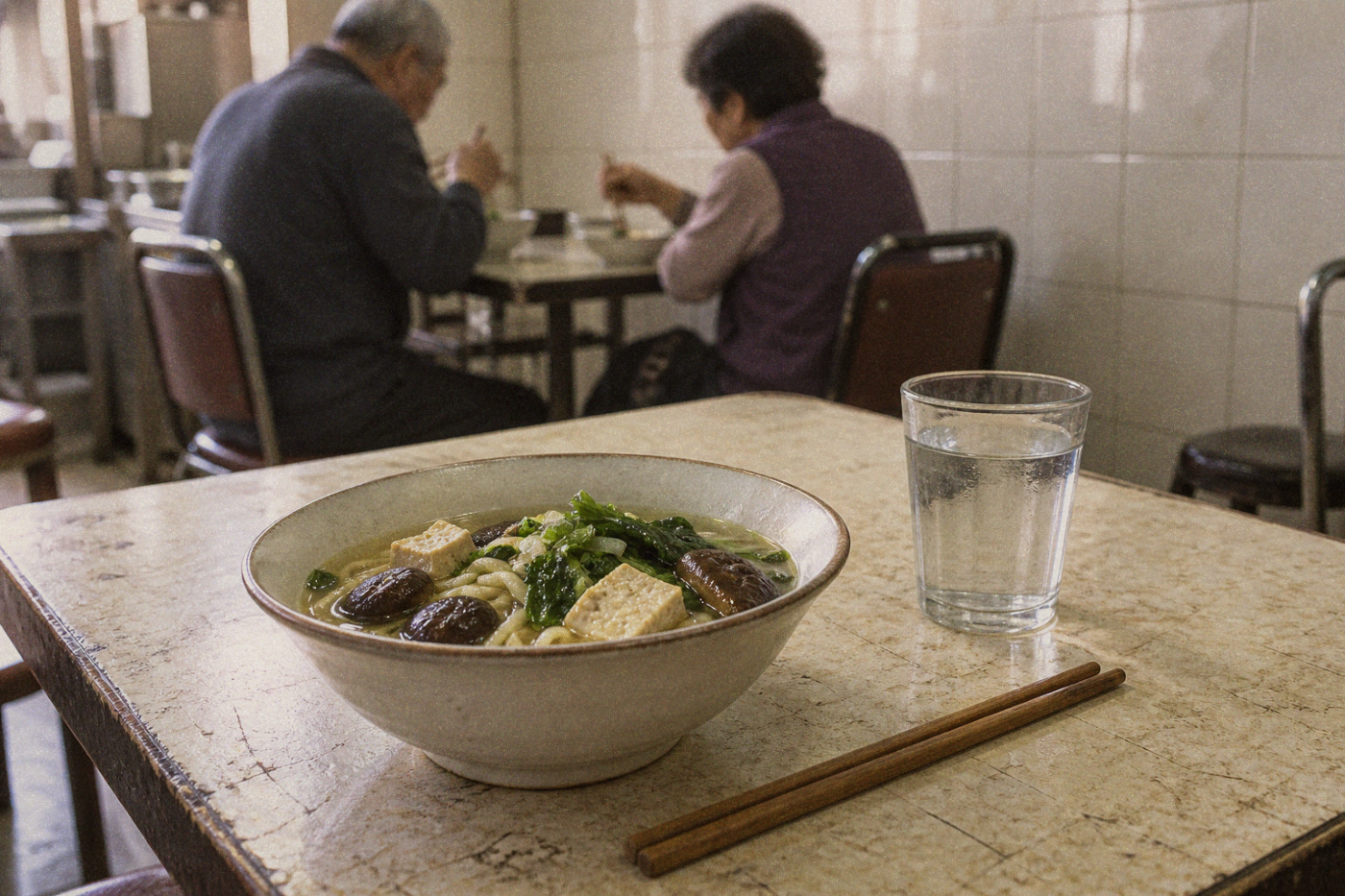 FIRST SIGHTWEBGLVegetarian noodles with tofu, mushrooms and greens at a neighborhood eatery. · Color and grain by First Sight · Gold 200. · First Sight 色彩與顆粒調校 · Gold 200
A few more places worth knowing
Loving Hut is a global vegan chain that started in Taiwan, and the Taipei branches are better than you'd expect from a chain. Cheap, fast, fully vegan. Multiple locations.
春天素食 (Spring Natural) on Fuxing South Road has a vegetarian hot pot buffet that's popular for groups. All-you-can-eat format, NT$500 to NT$700 range, with a hot pot base and a buffet counter of vegetables, mushrooms, tofu, and noodles.
果然匯 (Fruitful Food) in Zhongxiao Sogo and other locations offers a more upscale buffet experience. Higher price point (NT$600+) but significantly more variety than the neighborhood buffets, including Western and Japanese-inspired dishes alongside Chinese and Taiwanese options.
For convenience store survival: 7-Eleven and FamilyMart both carry onigiri, sandwiches, and bento boxes labeled 素 or 蛋奶素. The selection is small but it exists, and at 2am when nothing else is open, a vegetarian onigiri and a soy milk from the fridge is a perfectly decent snack.
FAQ
Is Taipei actually easy for vegetarians? Genuinely yes. Easier than Tokyo, easier than Seoul, easier than most cities in Southeast Asia. The Buddhist vegetarian infrastructure means there's a baseline of options everywhere, not just in trendy neighborhoods. The labeling system means you can trust what things say on the package.
What about night markets? Mixed. Most night market stalls are not vegetarian, but many markets have a dedicated vegetarian stall or two. Raohe, Shilin, and Ningxia all have vegetarian options if you look for them. The key phrase is "有素的嗎?" (yǒu sù de ma, do you have anything vegetarian?). Grilled corn, fruit, some tofu stalls, and sweet potato are safe bets without asking.
Can I get enough protein eating vegetarian here? Tofu, tempeh, edamame, and mock meats (made from soy protein, wheat gluten, or konjac) are everywhere. The traditional Buddhist buffets typically have three to five protein-rich options on any given day. Protein is not the problem. Variety is not the problem. The only challenge is if you're strictly vegan and avoiding alliums, which limits some sauces.
Are mock meats any good? Some are excellent. Taiwan has been making mock duck, mock chicken, and mock fish for decades, and the texture work is genuinely impressive. The mock goose at Buddhist restaurants is a classic. Others are rubbery and over-processed. Trial and error, same as anything.
What if I'm gluten-free AND vegetarian? Harder but doable. Wheat gluten (麵筋, miànjīn) is in a lot of mock meats and traditional vegetarian dishes. Ooh Cha Cha and Plants both do gluten-free explicitly. At buffets, stick to the rice, vegetables, and tofu dishes and skip anything that looks like mock meat.
Do vegetarian restaurants serve alcohol? Traditional Buddhist ones generally don't. The modern plant-based restaurants usually do. Ooh Cha Cha's Hooch bar is specifically a vegan bar. Miacucina serves wine and beer.
Comments (0)
Loading comments...