
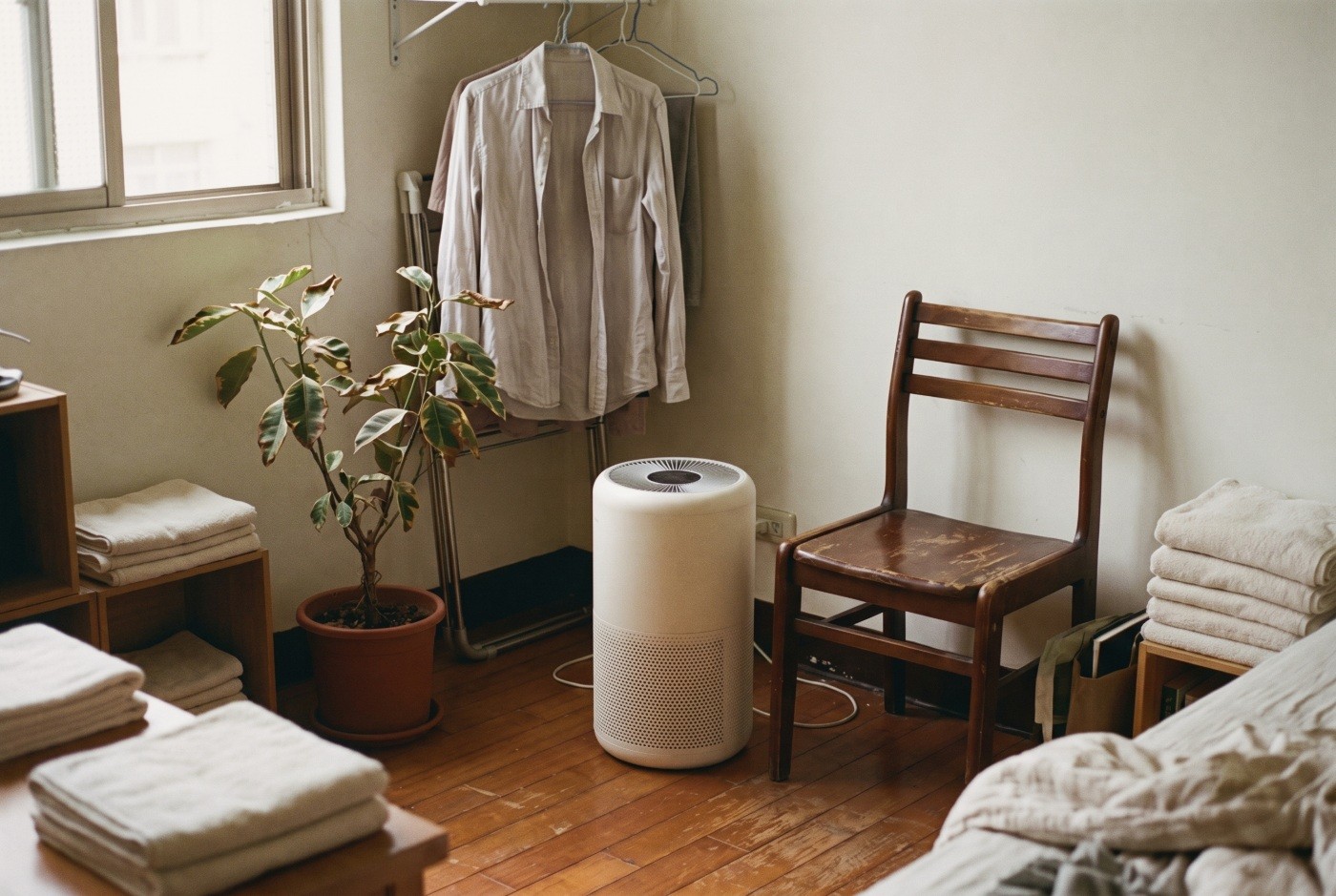
I bought my first air purifier in January 2024, three days after moving into a sixth-floor apartment in Zhonghe. The building faced a four-lane road. Every morning I'd wipe down the windowsill and find a thin grey film on my fingers. The AQI app said 85, which is technically "moderate," but the dust on that windowsill was saying something else.
The purifier was a Xiaomi Mi 4 Lite, the cheapest thing on momo that had decent reviews. NT$3,495. I set it up in the bedroom, turned it on, and within twenty minutes the built-in sensor went from orange to green. I stood there watching it like it was doing something miraculous. It wasn't. It was just a fan pulling air through a filter. But after two years of testing five different machines across two apartments, I've learned that the gap between a good purifier and a bad purchase usually comes down to three boring things: room size math, filter replacement costs, and whether you'll actually keep it running.
This is what I know now, after spending more money than I'd like to admit on machines that blow clean air.
!An air purifier running in a bright Taipei apartment living room, window slightly open The Zhonghe apartment, sixth floor, road-facing window. The grey film showed up every morning until the purifier started running overnight.
The one number that matters: CADR
CADR stands for Clean Air Delivery Rate. It measures how many cubic meters of air a purifier can filter per hour. Every other spec, the fancy ionizers, the app connectivity, the sleep mode, is secondary to this.
The formula for Taiwan apartments is simple. Take your room size in ping, multiply by roughly 8 to get cubic meters, then multiply by 5 (you want the air cycled about five times per hour for good filtration). A 10-ping living room needs a CADR of around 400 m3/h. A 5-ping bedroom needs about 200 m3/h.
Most manufacturers list an "applicable area" in ping on the box. Treat that number with suspicion. It's usually calculated at a lower air exchange rate than what you actually want in a city with Taiwan's pollution levels. Buy one size up from what the box suggests. If the box says 12 ping, put it in your 8 to 10 ping room. You'll get faster cycling and the machine won't have to run at full blast, which means less noise.
What I've tested, and what the money actually gets you
I'll go through these from least expensive to most expensive, because price is the first filter most people use, and honestly, the cheaper machines do a better job than you'd expect.
 FIRST SIGHTWEBGLClean air, quietly working in the corner. · Color and grain by First Sight · Gold 200. · First Sight 色彩與顆粒調校 · Gold 200
Xiaomi Smart Air Purifier 4 Lite (NT$3,495)
This is the entry point that makes sense. CADR of 360 m3/h, which handles up to about 10 ping. The filter lasts 6 to 12 months depending on your air quality, and replacements run about NT$600 to 800. It connects to the Mi Home app so you can check air quality readings and schedule it remotely. The build quality feels like what it costs, lightweight plastic, a bit loud on the highest setting. But the filtration itself is solid. H13 HEPA. For a bedroom or a small studio, this is the one I recommend to friends who ask.
Xiaomi Smart Air Purifier 4 (NT$4,995)
The step up. CADR jumps to 400 m3/h, which gives you real coverage for a living room. Same app, same filter type, better airflow design. Filter replacements are around NT$800 to 1,000 and last up to 12 months. This was my first "main room" purifier and it ran for 18 months before I replaced it with something quieter. The noise on medium is noticeable if you're a light sleeper, but for daytime living room use, it disappears into the background.
Honeywell HPA-100APTW (roughly NT$3,900 to 4,990)
Honeywell has been making air purifiers longer than most of these companies have existed. The HPA-100 is a no-frills workhorse. CADR around 170 m3/h, so it's a bedroom machine, but it's built like it'll last a decade. No app, no smart features. You press a button, it runs. Filter replacements are about NT$1,200 to 1,500 every 12 months. If you don't care about checking air quality scores on your phone, this is honest, reliable equipment.
Panasonic F-P40LH (NT$8,490)
Panasonic's nanoe technology adds an ion-based deodorizing layer on top of standard HEPA filtration. I tested this in a kitchen-adjacent living area, the kind of open floor plan where cooking smells drift everywhere, and the odor reduction was genuinely noticeable compared to the Xiaomi. CADR around 300 m3/h, suitable for about 8 to 10 ping. The machine runs quieter than anything else at this price point. Filter replacements are roughly NT$1,500 to 2,000 once a year. If cooking odors are your main complaint, this is worth the premium over Xiaomi.
Sharp FP-S90T Purefit (NT$17,400 to 21,900)
Sharp's Plasmacluster technology has a cult following in Japan, and the Purefit is their current flagship for Taiwan. CADR of 609 m3/h, which covers up to 27 ping. That's an entire apartment. The design is genuinely beautiful, a slim rectangular column that looks more like furniture than appliance. I tested this in a friend's 20-ping open-plan space in Neihu, and it brought PM2.5 readings from 45 down to single digits in about 40 minutes. Filter replacement runs roughly NT$2,000 to 2,500 annually. The price is steep but the coverage means you might only need one machine for your whole apartment instead of two smaller ones.
Dyson Purifier Cool TP07 (roughly NT$19,900)
The Dyson doubles as a fan, which in Taiwan is not a gimmick. You get HEPA H13 filtration plus activated carbon for gases and odors, wrapped in Dyson's bladeless fan design. CADR isn't Dyson's strongest suit at around 290 m3/h, so it's best for rooms up to about 8 ping. The real-time air quality display on the machine is useful and the app gives detailed breakdowns of PM2.5, PM10, VOCs, and NO2. Filter replacements cost NT$2,000 to 4,000 depending on model, and they recommend annual changes. Here's my honest take: the purification performance per dollar is worse than the Xiaomi or Sharp. You're paying for the fan function, the design, and the display. If those things matter to you, it's a good machine. If you just want clean air, there are better deals.
!Close-up of an air purifier display panel showing green air quality readings Real-time PM2.5 readings on the Dyson's display. Satisfying to watch, but not strictly necessary. The Xiaomi gives you the same data through the app for a fifth of the price.
 FIRST SIGHTWEBGLClean air, quietly working in the corner. · Color and grain by First Sight · Gold 200. · First Sight 色彩與顆粒調校 · Gold 200
I spent NT$19,900 on the Dyson because I wanted a fan and a purifier in one machine without two appliances cluttering a 12-ping apartment. If space isn't your constraint, buy the Xiaomi 4 and a separate fan. You'll save NT$13,000 and get better air filtration.
The cost nobody talks about: filters
The purchase price is maybe half the story. Filters are the running cost, and over three years they can equal or exceed the price of the machine itself.
[taiwan-card] Xiaomi 4 Lite | NT$3,495 machine | Filter: NT$600 to 800/year. Three-year total: roughly NT$5,300 to 5,900. The cheapest to own by a wide margin. Xiaomi 4 | NT$4,995 machine | Filter: NT$800 to 1,000/year. Three-year total: roughly NT$7,400 to 7,995. Still excellent value for living room coverage. Panasonic F-P40LH | NT$8,490 machine | Filter: NT$1,500 to 2,000/year. Three-year total: roughly NT$13,000 to 14,490. The quiet, odor-fighting option. Sharp FP-S90T | NT$17,400 to 21,900 machine | Filter: NT$2,000 to 2,500/year. Three-year total: roughly NT$23,400 to 29,400. Covers a whole apartment, so potentially replaces two smaller units. Dyson TP07 | NT$19,900 machine | Filter: NT$2,000 to 4,000/year. Three-year total: roughly NT$25,900 to 31,900. Premium brand, moderate CADR. Fan included. LG PuriCare 360 (AS651DWH0) | NT$9,200 to 22,900 machine | Filter: NT$1,500 to 2,500/year. Three-year total varies widely by model. Strong CADR, 360-degree intake.
When you actually need one (and when you don't)
Taiwan's air quality follows a very predictable calendar. October through March is the bad season, especially in central and southern Taiwan. The northeast monsoon pushes pollution south, the Central Mountain Range traps it, and cities like Kaohsiung, Tainan, and the Yunlin-Chiayi corridor regularly hit AQI 100 or above. Taipei gets it less severely, but still sees spikes during temperature inversions in winter.
If you live in Taipei or northern Taiwan and your apartment doesn't face a main road, you might get by with opening windows on green-AQI days and running a purifier only during winter pollution events. If you live in Kaohsiung or Taichung, a purifier is closer to essential equipment from November through February.
The other year-round case: if you live near a busy road, a construction site, or a temple that burns incense regularly. I moved from the road-facing Zhonghe apartment to a lane-side place in Yonghe, and the difference in how quickly my purifier filter darkened was dramatic. Location matters at least as much as season.
My setup, for what it's worth
In my current 15-ping apartment in Yonghe, I run the Xiaomi 4 in the bedroom at night (auto mode, quiet enough to sleep through) and the Panasonic in the living area during cooking and on bad-air days. Total investment: roughly NT$13,500 for both machines. Annual filter cost: about NT$2,300. That's less than NT$200 a month for noticeably cleaner air.
If I were starting over with a single machine for a typical Taiwan apartment, 8 to 15 ping, I'd buy the Xiaomi Smart Air Purifier 4 at NT$4,995. It covers enough space, the filters are cheap, the app works, and the air quality sensor is accurate. Put the NT$15,000 you saved over a Dyson toward a dehumidifier instead. In Taiwan, humidity is a bigger daily problem than air quality for most of the year.
 FIRST SIGHTWEBGLClean air, quietly working in the corner. · Color and grain by First Sight · Gold 200. · First Sight 色彩與顆粒調校 · Gold 200
!Air purifier placed in a minimalist apartment corner near a window with plants Current setup in Yonghe. The Xiaomi runs in the bedroom, the Panasonic in the main living area. Two machines, two different jobs, under NT$14,000 total.
Quick buying checklist
Before you hand over your credit card on momo at 2am, check these five things. CADR matches your room size (ping times 40 to 50 for the quick math). The filter type is H13 HEPA or better. Replacement filters are available on Taiwan retail sites and you know the annual cost. The noise level on medium is below 45 dB if it's going in a bedroom. And the machine physically fits where you want to put it, because some of these are bigger than they look in photos.
FAQ
What CADR do I need for my apartment? Multiply your room size in ping by about 40 to 50. A 10-ping room needs 400 to 500 m3/h. Most people undersize. Go bigger if you can afford it; the machine will run quieter at lower speeds to achieve the same result.
Are ionizer features worth it? Panasonic's nanoe and Sharp's Plasmacluster have some evidence for reducing odors and certain airborne pathogens. They're not substitutes for HEPA filtration, they're add-ons. If you're choosing between a machine with ionizer but lower CADR versus one with higher CADR and no ionizer, pick the higher CADR.
How often do I really need to change the filter? Manufacturer recommendations are 6 to 12 months, but in Taiwan's environment, especially during pollution season or if you're near a road, 6 to 8 months is more realistic for optimal performance. Don't wait until the filter indicator light turns on. By that point you've been breathing through a clogged filter for weeks.
Can I run my purifier with windows open? You can, but it's working against itself. The machine is cleaning air that's being replaced by unfiltered outdoor air. On green AQI days, open windows and turn off the purifier. On orange or red days, close everything and let the machine do its job.
Is the Dyson worth the price premium? For pure air purification value, no. The Xiaomi 4 filters air faster at one-quarter the cost. The Dyson is worth it if you also need a fan and you value the design and display. In a small apartment where every appliance competes for floor space, combining fan and purifier into one unit has real practical value.
Should I get a purifier or a dehumidifier first? In Taiwan, probably a dehumidifier. Humidity above 70% causes mold, dust mite proliferation, and musty smells that no purifier can fix. Get humidity under control first, then add a purifier if your AQI or road-facing situation demands it. Many people need both.
Comments (0)
Loading comments...