
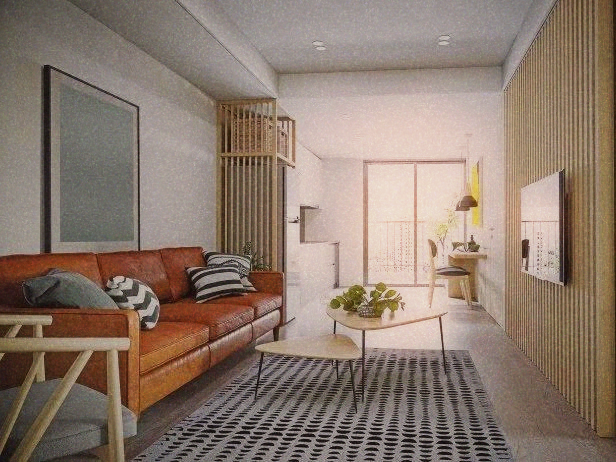
The average Taipei apartment is 10–15 ping. That's 33–50 square meters. In most cities, that would be called a studio. In Taipei, it's called life.
The problem isn't the size. It's that most people treat a small space like a large space that went wrong, cramming in full-size furniture, filling every surface, fighting the apartment instead of working with it. The best small apartments in Taipei don't feel small. They feel intentional. They feel designed.
This guide is for anyone renting or owning an apartment in the 8–15 ping range who wants to stop compromising and start designing. It covers what to buy, where to buy it, how to arrange it, and, crucially, what not to buy. Because every object you bring in takes space from something better.
The three rules of small space living
Before buying a single piece of furniture, internalize these three principles. Everything else follows from them.
Rule 1: Every object earns its space. In a 10-ping apartment, there is no room for objects that serve only one purpose. Your dining table should also be your desk. Your storage bench should also be seating. If an object can't justify the floor space it occupies with at least two functions, it doesn't belong. This isn't minimalism as aesthetic, it's math. Every square meter is finite. Every object is a trade-off.
Rule 2: Vertical, not horizontal. Floor space is finite. Wall space is abundant. Mount your TV. Use floating shelves instead of bookcases. Install a pegboard in the kitchen. Hang your bike. Every item you move from floor to wall recovers 0.3–0.5 ping of living space. This is the single most effective transformation you can make. A 10-ping apartment with floor-level furniture feels cramped. The same apartment with vertical storage feels twice as large.
Rule 3: Light is square footage. A dark apartment feels 30% smaller than an identical light one. This isn't subjective, light changes how your brain processes space. Never block a window. Use sheer curtains, not blackout. Paint walls white or very light gray. Add one large mirror opposite the window, it doubles the perceived depth of the room. If your apartment gets direct sun (facing east or south), you can afford slightly darker accent walls. If it faces north (like many Taipei apartments), keep everything light.
Beyond these three: embrace your apartment's constraints rather than fighting them. A 10-ping apartment that accepts its size and leans into intimacy is more livable than a 15-ping apartment stretched thin trying to be four rooms at once.
Room by room: the practical guide
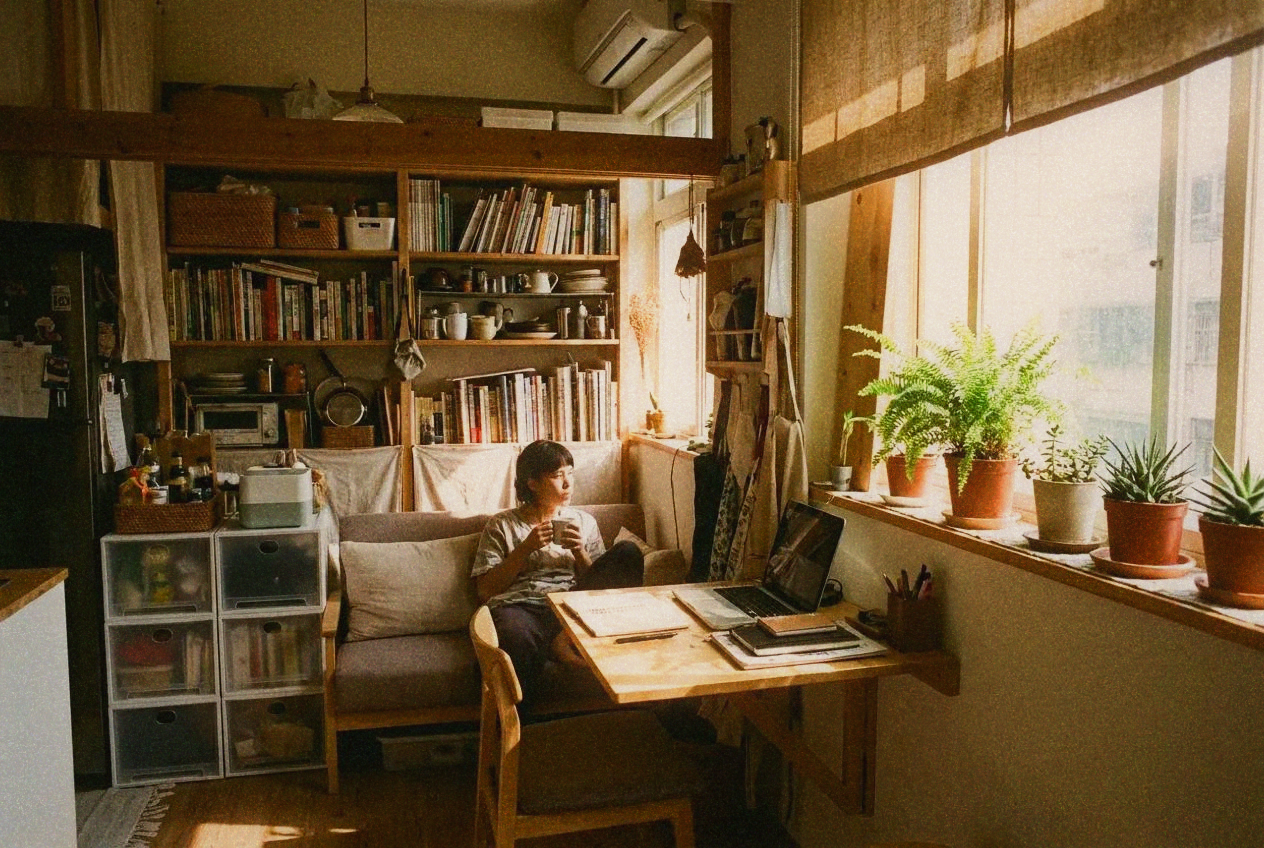
 FIRST SIGHTWEBGLTen ping, well used: a fold-down desk, vertical shelving, and plants that earn their windowsill space. · Color and grain by First Sight · Gold 200. · First Sight 色彩與顆粒調校 · Gold 200
The entrance (玄關)
Taipei apartments rarely have a proper entryway. Create one anyway. This is the one place where first impressions matter, both for guests and for your own mental model of the space.
A slim shoe cabinet (15cm deep, the width of your door) mounted on the wall is the solution. IKEA Trones (NT$499 each, roughly 17cm deep, 51cm tall) is the standard. Buy two and stack them, or buy one and pair it with a wall-mounted shelf above. You get storage without stealing floor space. Add a small tray on top for keys and wallet. A single hook (not five) for your bag. A small mat for wet shoes (in Taiwan's humid climate, this is essential).
The entrance sets the tone. When it's clean and organized, the rest of the apartment feels organized too. When it's chaotic (shoes everywhere, bags piled), the whole space feels small.
The living area
This is your largest open space. It probably has a window. This is where you'll spend the most time, and where poor decisions create the most suffering.
Sofa: Do not buy a full-size sofa for a 10-ping apartment. A 2-seater (130–150cm wide) is the maximum. Better yet, consider alternatives: - Japanese zaisu (和室椅): A floor chair that can be folded and stored. Cost: NT$500–1,500. If you entertain rarely, this is better than a permanent sofa. - Daybed: Converts to sleeping for guests. Brands like IKEA Hauga (NT$4,999) give you a sofa by day, guest bed by night. - Floor cushions (坐墊): Buy 3–4 quality floor cushions (NT$300–800 each). More flexible than a sofa, easier to store, feels cozier.
Table: If you need to eat and work at the same surface (likely), choose carefully. - Folding wall-mounted table: IKEA Norberg (NT$1,299) mounts on the wall and folds down when needed. Folds up to show wall space when not in use. Best for eating + desk work. Downside: thin, wobbles slightly, but adequate for most uses. - Round pedestal table: If you want a permanent table, round is critical. Round tables have no corners that catch your hip when you squeeze past. A 60–70cm diameter round table takes less visual space than a rectangular one. - Shelf with drop-leaf: For maximum flexibility, a shelf with a hinged top converts from shelf to dining surface. Less common but worth searching for on Pinkoi or Shopee.
TV: Mount it. Do not buy a TV stand. A TV stand wastes 0.5 ping minimum and adds visual clutter. A wall bracket costs NT$500 and takes 20 minutes with a drill (or call a handyman for NT$1,000–1,500). This is non-negotiable for small spaces.
Lighting: Ceiling lights in Taipei apartments are often poor. Add: - One large floor lamp in the corner (NT$1,200–2,500) for soft ambient light. - One desk lamp above your table area (NT$300–800). - Dimmable bulbs for everything (this changes perceived space dramatically).
The kitchen
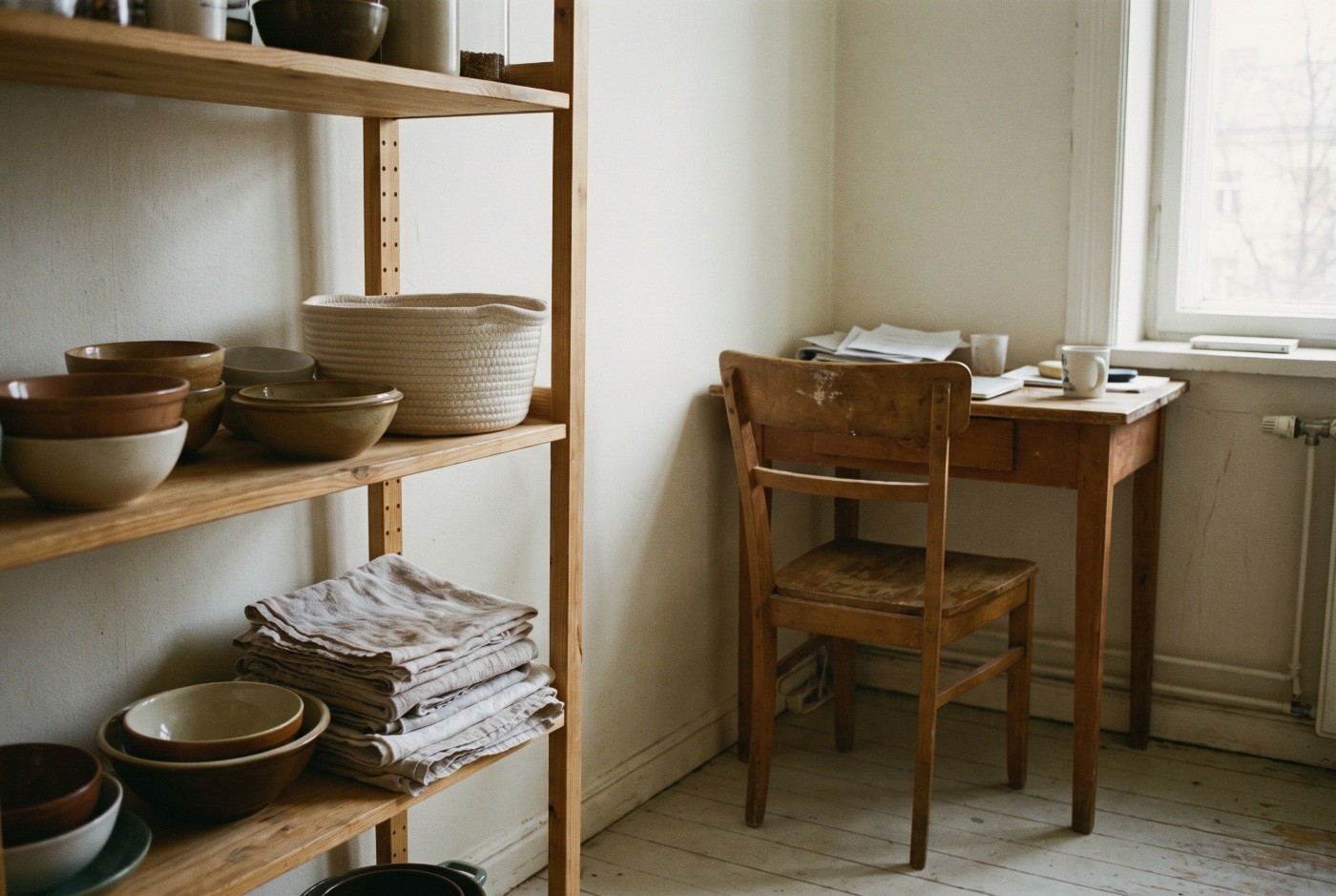 FIRST SIGHTWEBGLIllustration: Everyday bowls and linens on open shelves. · Color and grain by First Sight · Portra 400. · First Sight 色彩與顆粒調校 · Portra 400
Taipei kitchens are notoriously tiny, often just a stove, sink, and one small counter. Accept it and optimize.
Pegboard wall: Install a 60x80cm pegboard (B&Q NT$300–500) on the wall above your counter. Hang pots, utensils, cutting boards. This replaces an entire drawer unit and opens up under-counter space for other storage. Pro tip: Use a pegboard instead of a shelf, it looks intentional rather than cluttered, and you only hang what you actually use.
Magnetic knife strip: NT$200, mounts on the wall, replaces a knife block. Frees up counter space and looks clean.
Over-sink cutting board: A cutting board that spans your sink (NT$300–600) doubles your prep surface instantly. This is the single best kitchen investment for small apartments.
Under-shelf baskets: Wire baskets that clip under existing shelves create a second layer of storage (NT$150 each at Daiso or B&Q). If you have two shelves, add baskets under the upper shelf. Suddenly you have 3–4 functional shelves instead of two.
Vertical utensil storage: Wall-mounted magnetic strips or hanging rails (NT$200–500) for knives, scissors, and cooking utensils. Gets everything off the counter.
Container systems: For rice, flour, and dry goods, buy uniform clear containers (Daiso NT$49–99 each). Clear is essential, you can see when you're running low. Uniform size stacks and fits neatly.
The bedroom
Your bedroom is your other personal territory. It probably has one window and a bed. Make both work.
Bed frame with storage: In a 10-ping apartment, the space under the bed is your closet. Choose wisely: - IKEA Malm with drawers (NT$7,999–10,000): Solid, draws last for years, provides 4–6 drawers of storage. - Bed with hydraulic lift storage (available at Nitori NT$5,000–8,000): The whole platform lifts up, revealing one large storage chamber underneath. - Platform bed + vacuum compression bags: Cheaper option (platform bed NT$3,000–5,000 + bags NT$200 for a 10-pack). Less convenient but functional.
No nightstands. Use a wall-mounted shelf (15cm deep) at pillow height instead. Holds your phone, a book, and a glass of water without consuming floor space. IKEA Lack shelves (NT$200 per shelf) are the standard. Mount two, one on each side of the bed if possible.
Closet system: - If you have a built-in closet: Add a second hanging rod at waist height (buy a tension rod, NT$200–500). This doubles your hanging capacity. - If you have no closet: A garment rack (NT$500–800, available everywhere) against one wall is more space-efficient than any freestanding wardrobe. Top it with a shallow shelf for folded items. - Drawer alternatives: Stacked clear plastic drawers (Daiso NT$99 per drawer) let you see contents without opening. Stack 4–5 for a complete dresser without the footprint.
Lighting: Bedside lighting is critical for mood and functionality. Avoid overhead lights (harsh). Instead: - One wall-mounted reading light (NT$500–1,200) on each side of the bed. - One small accent lamp in the corner (creates depth, makes the room feel larger).
The bathroom
Bathrooms in Taipei are simultaneously tiny and incredibly humid. Storage is essential.
Over-toilet shelving: The most wasted space in a Taipei bathroom. A simple shelving unit (NT$600–1,200, available at B&Q or IKEA) adds 3–4 shelves. Suddenly you have storage for towels, toiletries, and cleaning supplies that were cluttering your living space.
Suction-cup organizers: No drilling required (essential if you're renting). NT$100–200 per unit. Get 2–3 for shampoo, razors, toothbrushes, soap, everything off the counter. In Taipei's humidity, suction cups last 6–12 months before losing grip. Budget for replacing them annually.
Retractable clothesline: Mounted wall-to-wall in the bathroom (NT$200). Essential because most Taipei apartments don't have a proper balcony dryer. This solves the humidity + drying clothes problem elegantly.
Mirror cabinet: If you have wall space above your sink, a medicine cabinet mirror (NT$800–1,500) provides storage and makes the bathroom feel larger.
Hanging organizer: A fabric hanging organizer behind the bathroom door (NT$150–300) holds cleaning supplies, hair tools, and other items vertically.
Where to buy: the Taipei guide
IKEA Xinzhuang (新莊店): Best for functional furniture. The new location (opened 2024) has improved the experience. Critically: check out their small-space showroom apartment, it's worth studying. Bus or drive; the MRT doesn't reach the new location directly, but there are shuttle services.
IKEA Daan Dunnan (敦北店): Older, smaller location, but MRT-accessible (Zhongshan station, 10-minute walk). Good for picking up single items without committing to the trip to Xinzhuang.
Nitori (宜得利): Japanese home goods, often better quality than IKEA for the same price. The storage solutions (especially the modular shelf systems) are excellent for small spaces. Multiple locations: Taipei 101, Taipei Station area, Nanjing East Road.
B&Q (特力屋): Hardware, pegboards, brackets, paint, curtain rods, everything for DIY elements. Multiple locations in Taipei. Go here for anything you need to drill or install.
Muji (無印良品): High-end minimalist storage. Their acrylic organizers and stacking shelves are genuinely excellent for small spaces. Furniture is overpriced for what it is, but the storage solutions (boxes, drawer dividers, vertical organizers) are worth it. Taipei Station, Taipei 101, multiple mall locations.
Daiso (大創): Everything is NT$49. Storage boxes, organizers, kitchen accessories, even furniture basics. Don't underestimate this store, most of your small storage needs can be solved here for under NT$2,000 total.
Pinkoi (台灣設計平台): Online marketplace for higher-end, locally designed pieces. More expensive, but more beautiful and often better-designed for Taiwanese spaces than imported furniture. Shipping is fast (1–3 days in Taipei). Good for shelves, storage boxes, and accent pieces.
Shopee and Momo: Online, fast shipping, huge selection, variable quality. Read reviews carefully. Good for specialty items like pegboards, hanging organizers, and wall brackets. Prices are often 20–30% lower than physical stores.
The 10-ping renovation budget
You can transform a typical Taipei rental for under NT$15,000. Here's a realistic breakdown:
- Wall-mounted shoe cabinet (x2): NT$1,000
- Floating shelves (x3): NT$1,500
- Pegboard + hooks: NT$800
- Magnetic knife strip: NT$200
- Under-shelf baskets (x4): NT$600
- Over-toilet shelving unit: NT$800
- Wall-mounted folding table: NT$1,300
- TV wall mount: NT$500
- Large mirror (for perceiving space): NT$1,500
- Sheer curtains (2 windows): NT$1,200
- Storage boxes (various, Daiso): NT$500
- Garment rack or closet rod: NT$500
- Under-bed storage bags/drawers: NT$800
- Wall-mounted shelves for bedroom: NT$400
- Small lamp/lighting improvements: NT$600
Total: approximately NT$11,500–13,500 for a complete renovation.
If you can paint (landlord permitting): add NT$2,000 for professional paint (white or very light gray).
This budget assumes you keep your existing bed, sofa, and tables. If those need replacement, budget an additional NT$15,000–25,000.
Dealing with humidity and ventilation
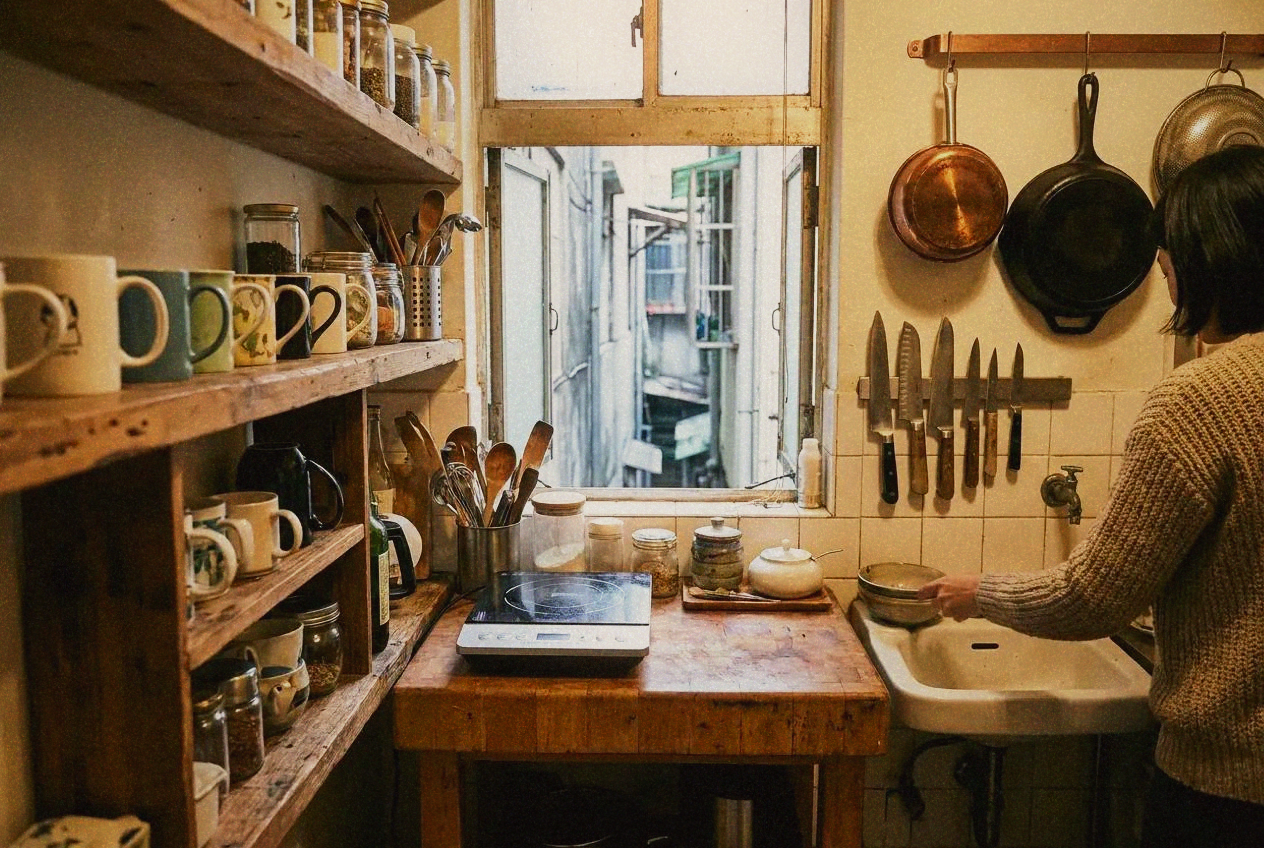 FIRST SIGHTWEBGLA Taipei kitchen in ten ping: magnetic knife rack, hanging pots, and every centimeter earning its keep. · Color and grain by First Sight · Gold 200. · First Sight 色彩與顆粒調校 · Gold 200
Taipei apartments are humid. A poorly ventilated 10-ping apartment becomes suffocating in summer.
- Open windows early morning (5–7am) when outside air is cooler and less humid. The temperature differential helps pull moisture out.
- Use a dehumidifier (NT$3,000–6,000) in the bedroom overnight, especially in spring and early summer. The moisture you eliminate overnight prevents mildew growth.
- Avoid dark corners (mold loves them). Light and airflow are your tools here.
- Install the retractable clothesline in the bathroom and use it. Wet laundry drying indoors increases humidity significantly, dry outside or over the clothesline with ventilation.
The psychology of small space living
A well-designed 10-ping apartment feels larger than a poorly-designed 15-ping apartment. The feeling of spaciousness comes from: - Vertical storage (walls feel less cluttered) - Light (perceived space increases) - Intentional arrangement (nothing feels random) - Multiple functions per object (mind registers fewer total objects)
Psychologically, you thrive when your space feels designed for you, not imposed on you. Even in a small apartment, this is possible.
Frequently Asked
Some links in this article are affiliate links. If you purchase through them,OQUA may earn a small commission at no extra cost to you. This helps support our editorial work. We only link to products and services we genuinely reference in our writing.
Comments (0)
Loading comments...