
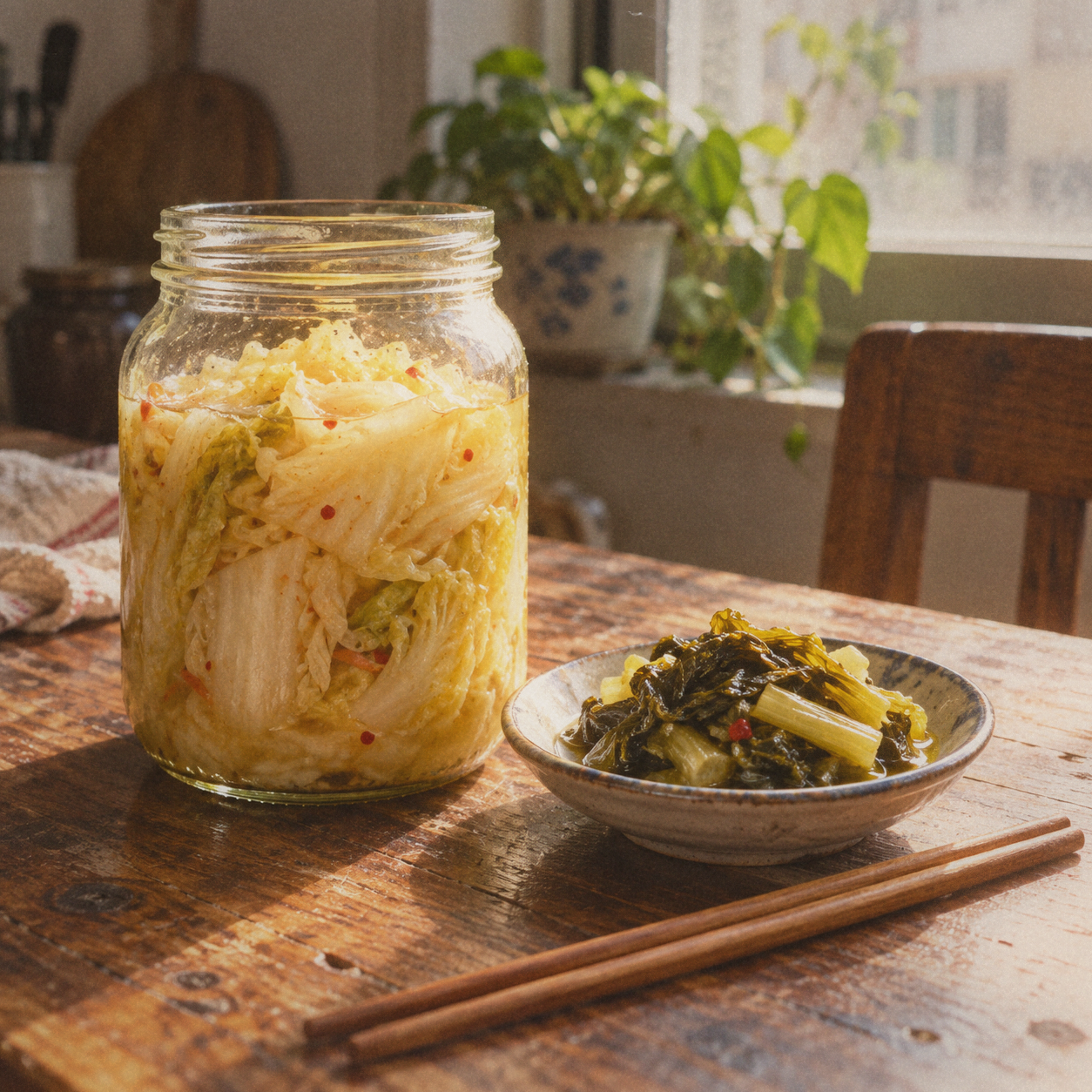
Five-thirty on a Saturday morning at Dongmen Market, and a woman in her seventies is spooning pickled mustard greens into a plastic bag for a customer who hasn't said a word. She doesn't need to. He points at the barrel, she fills the bag, he hands her NT$30. The greens have been sitting in brine for weeks, lacto-fermenting in a ceramic vessel behind the stall, and they smell exactly the way fermented things smell: sharp, sour, alive. The customer will eat them with his breakfast congee alongside a thumbnail of 豆腐乳 from a glass jar that's been in his fridge for a month. He is, without thinking about it at all, doing more for his gut microbiome before 7am than most probiotic supplements do in a week.
I used to be the supplement person. A bottle of NT$1,200 probiotics in my medicine cabinet, one capsule every morning with water, a vague sense that I was doing something responsible. Then I read the Stanford study. Then I read it more carefully. And then I started paying attention to what was already on the table at every Taiwanese meal I'd ever eaten.
The thing about fermented food in Taiwan is that it's not a trend or a wellness strategy. It's just how people eat. 酸菜 with your noodle soup. 豆腐乳 with your porridge. Miso in the morning. 醬油 on everything. The fermented food infrastructure is already built into daily life here. You don't have to seek it out. You just have to notice it.
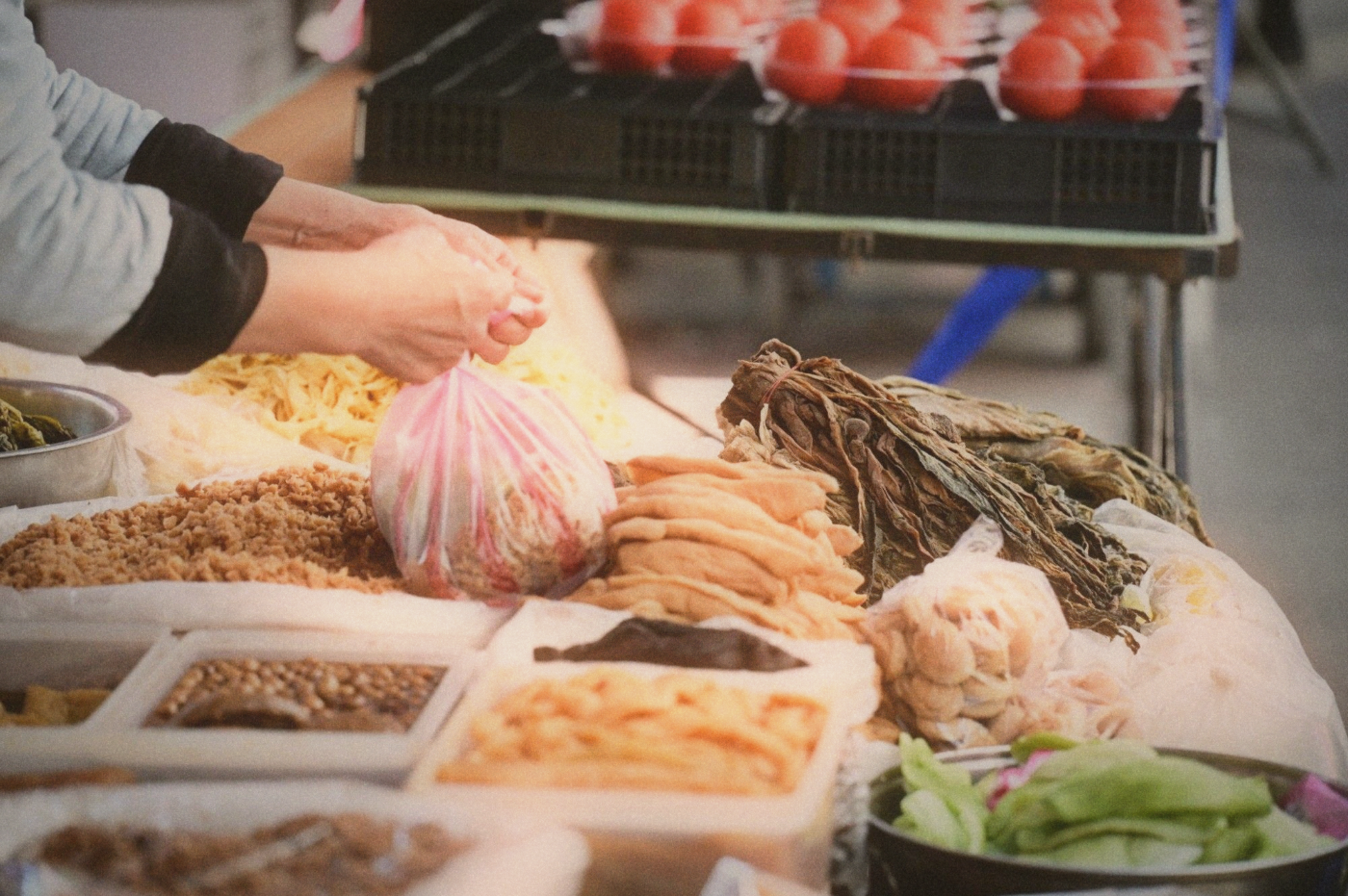
 FIRST SIGHTWEBGLDongmen Market, Taipei. The pickled vegetable vendors don't advertise gut health benefits. They don't need to. · Color and grain by First Sight · Portra 400. · First Sight 色彩與顆粒調校 · Portra 400
What the Stanford study actually found (and what gets oversimplified)
In 2021, researchers at Stanford published a study in Cell that changed how nutritionists talk about the microbiome. The headline version went something like: "Fermented foods increase gut diversity and reduce inflammation." That part is true. But the details matter, and they're more interesting than the headline.
The study enrolled 36 healthy adults and split them into two groups. One group ate a high-fiber diet. The other ate a diet rich in fermented foods: yogurt, kefir, kimchi, fermented vegetables, kombucha. The fermented food group ramped up to six servings per day (not per week, as some articles report, though daily is more than most people need for maintenance). Over 10 weeks, the fermented food group showed increased microbial diversity and reduced levels of 19 inflammatory proteins, including interleukin-6.
The surprise: the high-fiber group, which everyone expected to win, didn't show universal anti-inflammatory benefits. Only participants who already had high microbial diversity benefited from fiber. People with low diversity saw their immune systems actually rev up, not calm down. This suggests something counterintuitive: if your gut is already depleted, adding fiber alone might not be enough. You might need to rebuild diversity first, and fermented foods appear to do that.
But there's a nuance that almost never gets quoted. The new bacteria that showed up in participants' guts mostly didn't come from the fermented foods themselves. The researchers couldn't match them to the species in the yogurt or kimchi. Where they came from is still unknown. The fermented foods seemed to create conditions for diversity to flourish, rather than directly seeding it. Think of it less like planting specific trees and more like enriching soil so whatever seeds are already there can finally grow.
And one more thing: this was 36 people. Predominantly white, female, well-educated, average age around 51. It's a proof-of-concept, not a prescription. The findings are genuinely exciting, but the supplement industry ran with them faster than the science warranted.
Why supplements are mostly wasted money
The global probiotic supplement market is worth over $65 billion. For most healthy people, most of that is unnecessary.
A typical probiotic capsule contains one to five bacterial strains. A single serving of traditionally fermented kimchi can contain over 200 different strains. The diversity gap alone is enormous. Your gut ecosystem doesn't need a monoculture delivered in a gelatin capsule. It needs variety, and no supplement on the market comes close to what a diverse diet of fermented foods provides.
Then there's the survival problem. Most probiotic capsules lose 60 to 90 percent of their viable bacteria to stomach acid before anything reaches the intestine. The bacteria in fermented foods have already survived an acidic environment. They're adapted to it. They arrive in your gut pre-tested, embedded in a matrix of fiber, organic acids, and partially broken down compounds that serve as fuel. A probiotic capsule delivers bacteria without food. Fermented food delivers bacteria with the entire ecosystem they need to establish themselves.
Cost is the final argument. A month of decent probiotics runs NT$500 to NT$1,500 in Taiwan. A jar of 豆腐乳 costs NT$30 to 60 and lasts two weeks. A bowl of miso soup from a breakfast set costs NT$150. You could eat fermented food three times a day for a month for less than one bottle of capsules.
I'm not saying supplements are useless. After a round of antibiotics, a targeted probiotic with well-researched strains (Lactobacillus rhamnosus GG, Saccharomyces boulardii) makes sense. If you have a diagnosed condition like IBS or IBD, your gastroenterologist might recommend specific strains. But for daily maintenance? Eat the food. It's cheaper, more diverse, and more enjoyable.
What your gut actually does (the honest version)
The microbiome is legitimately important. About 2kg of microorganisms live in your digestive tract, and they do real work. But some of the popular claims get stretched beyond what the science supports, and the honest version is interesting enough on its own.
Your gut produces roughly 90 percent of your body's total serotonin. This is a real number from peer-reviewed research, but what it means is more complicated than "eat fermented food and feel happy." Gut serotonin primarily regulates intestinal motility, not mood. It doesn't cross the blood-brain barrier. Your brain produces its own serotonin separately. The gut and brain do communicate through the vagus nerve, and the relationship between gut health and mental health is real. But it's indirect. The Instagram version, that fermented food directly boosts your mood chemicals, skips about four steps.
What's better established: roughly 70 percent of your immune cells live in gut-associated lymphoid tissue. Your bacteria help train those immune cells to distinguish between threats and normal substances. A diverse microbiome correlates with better immune tolerance, meaning fewer allergies, fewer autoimmune overreactions. A depleted microbiome correlates with the opposite.
Your bacteria also ferment dietary fiber into short-chain fatty acids like butyrate, which strengthen the intestinal lining and reduce systemic inflammation. This is probably the most important practical pathway: diverse bacteria, fed with diverse fermented and fibrous foods, produce compounds that keep your gut barrier intact and your inflammation low. When that barrier weakens ("leaky gut" in popular language, "intestinal permeability" in clinical terms), bacterial byproducts cross into the bloodstream and trigger widespread inflammation that links to everything from joint pain to brain fog.
The bottom line: your microbiome matters a lot, but it's an ecosystem, not a vending machine. You can't insert one capsule and expect one output. You feed it consistently, diversely, over weeks and months, and the whole system gradually strengthens.
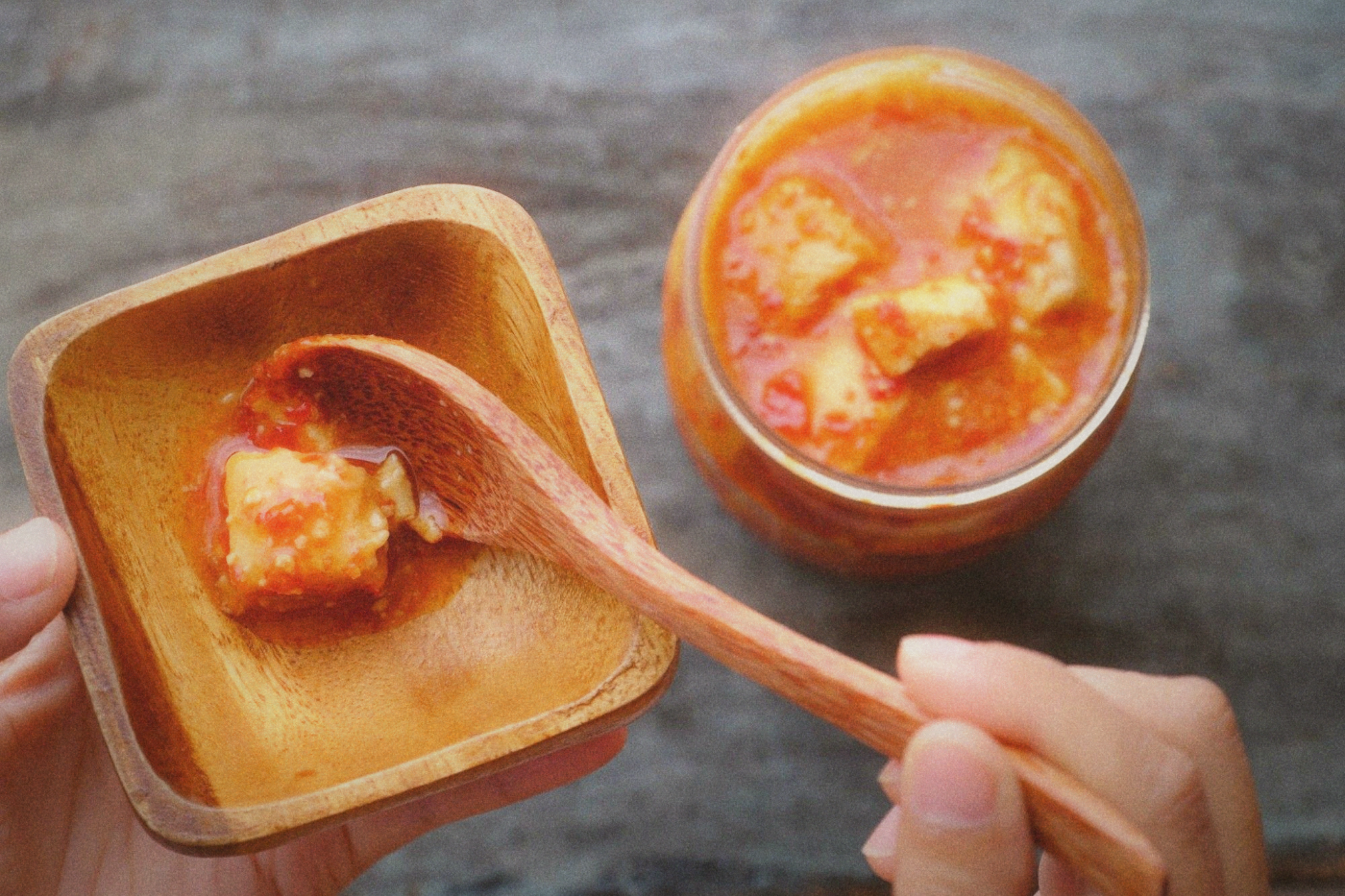 FIRST SIGHTWEBGL豆腐乳. One jar, NT$30 to 60, lasts two weeks. A thumbnail-sized piece with morning congee is one of the most efficient fermented servings you can get. · Color and grain by First Sight · Portra 400. · First Sight 色彩與顆粒調校 · Portra 400
Taiwan's fermented food map
Taiwan's fermentation traditions run deeper than most people realize, drawing from Fujianese, Hakka, Japanese, and indigenous foodways. What makes this place unusual is that fermented foods aren't a specialty category. They're woven into everyday meals so thoroughly that most people don't register them as "health food."
A useful distinction before we start: some fermented foods contain live bacteria when you eat them. Others were fermented during production but are then cooked, which kills the live organisms while preserving the fermentation byproducts (amino acids, organic acids, flavour compounds). Both have value, but they work differently. The live stuff seeds your gut directly. The cooked stuff provides nutrients and compounds your existing bacteria can use. I'll flag which is which.
The ones that are alive when you eat them
臭豆腐 (stinky tofu), steamed or cold. The deep-fried version at night markets is good but the frying kills most live bacteria. The steamed version (蒸臭豆腐) keeps internal temperatures below 65 degrees Celsius, preserving live Lactobacillus, Bifidobacterium, and dozens of other strains that developed during weeks of brine fermentation. If you can find 冷臭豆腐, served cold, that's the most microbiologically intact version. 臭老闆 at Nanjichang Night Market in Taipei (No. 6, Lane 313, Section 2, Zhonghua Road, Zhongzheng District) is a Michelin Bib Gourmand recipient specializing in steamed stinky tofu in bamboo baskets. For the full pilgrimage, Shenkeng Old Street (深坑老街, New Taipei City) is an entire street dedicated to tofu, with dozens of vendors doing fried, steamed, grilled, and hot pot versions. A portion runs NT$35 to 70.
Yes, it smells. Your nose adjusts by the third bite. The taste is salty, funky, complex, and not at all what the smell promises.
酸菜 and other pickled vegetables. The fermented mustard greens served alongside your 牛肉麵 aren't garnish. They're live lacto-ferments containing Lactobacillus plantarum, one of the most studied beneficial strains. Pickled bamboo shoots (筍乾) and pickled cabbage follow the same principle. These are served at room temperature or briefly heated, usually still biologically active. Ask for extra 酸菜 with any noodle soup. It's usually free or NT$20 to 30 for a side portion. You're already eating this. Now you know why it matters.
Hakka preserved greens (客家福菜) deserve a separate mention. These go through multiple stages: first salted, then fermented as 酸菜, then sun-dried, torn into strips, packed into glass bottles, and sealed for four to six months of further fermentation. The result is intensely flavoured and microbiologically complex. Hakka restaurants in Taipei serve them in soups (福菜肉片湯) and stir-fries. Miaoli County is the production heartland if you want to buy directly.
Korean kimchi (韓式泡菜). Korean restaurants are everywhere in Taiwan, and traditionally fermented kimchi (2+ weeks, containing Lactobacillus brevis and Leuconostoc citreum) is served as free banchan at most of them. One thing to watch if you're buying at a supermarket: check that it's refrigerated and preferably unpasteurized. Shelf-stable kimchi in room-temperature jars has been heat-treated. The bacteria are dead. Refrigerated is alive. Korean specialty supermarkets have the best selection. NT$60 to 150 per jar.
Unsweetened yogurt. Western, but Taiwan does it well. Costco sells large tubs of unsweetened Greek yogurt for about NT$150 per kilogram, which works out to NT$15 to 20 per serving. That's cheaper than any probiotic capsule and genuinely contains live cultures (Lactobacillus bulgaricus, Streptococcus thermophilus). Skip the sweetened and fruit-flavored versions. Sugar feeds the wrong bacteria.
Miso (味噌), if you don't boil it. One crucial detail that most home cooks get wrong: boiling water kills miso's live cultures. The proper technique is to heat water to about 70 degrees, then stir in the miso paste. Most Japanese breakfast sets at restaurants handle this correctly. Instant miso packets (NT$30 to 50 at convenience stores) typically use powdered miso that's been heat-processed, so the convenience is there but the live cultures aren't. For cooking at home, buy refrigerated miso paste at 全聯 or 家樂福 (NT$80 to 200 per tub) and add it to warm, not boiling, broth.
The ones that are fermented but cooked (still valuable, different mechanism)
豆腐乳 (fermented tofu). The small red or white cubes in a glass jar. Soybeans fermented in brine with Mucor or Aspergillus cultures, aged for weeks to months. Deeply umami, intensely salty, a thumbnail-sized piece goes a long way. You eat it at room temperature with congee, which means the cultures may still be partially active. One jar costs NT$30 to 80 and lasts 10 to 15 bowls of porridge, making it roughly NT$3 to 5 per serving. 江記豆腐乳 (Jiang Ji, operating since 1965) is a well-known Taiwanese brand available at most supermarkets. Look for glass jars over plastic, and multiple fermentation dates on the label indicating longer, more traditional processing.
Naturally brewed soy sauce (釀造醬油). Not all soy sauce is fermented. Cheap versions are chemically hydrolyzed in hours, producing a similar taste but none of the metabolites from actual fermentation. Look for 釀造醬油 on the label. Traditional Taiwanese soy sauce uses black soybeans and rice bran (not wheat, unlike Japanese-style), fermented for six months or longer. Brands to look for: 萬家香 (Wan Ja Shan), 金蘭 (Kimlan) traditional series, or artisan brands from 西螺 (Xiluo), which is Taiwan's soy sauce capital. The naturally brewed version costs about twice as much (NT$80 to 150 per bottle) but a bottle lasts months, and the flavour difference is noticeable. You will cook with this, so the live cultures question is moot, but the fermentation byproducts (glutamates, organic acids, bioactive peptides) have independent value.
豆瓣醬 (doubanjiang/fermented chili bean paste). Genuinely fermented, but commercial versions like 明德 are pasteurized for shelf stability, and you cook with it at high temperatures anyway. Still a fermented food in the traditional sense, and the fermentation byproducts contribute flavour and nutrition. Just don't count it as a source of live probiotics.
豆豉 (fermented black beans). Black soybeans, koji-fermented, salted, aged for months. Deep umami, used in small quantities as a seasoning. 豆豉苦瓜 (bitter melon with black beans) and 豉汁蒸排骨 (steamed spareribs with black beans) are classic Taiwanese dishes. Again, cooked, so no live cultures, but the fermentation profile adds nutrients beyond flavour.
紅糟 (red yeast rice paste). Fermented with Monascus purpureus, which produces monacolin K, a compound that lowers LDL cholesterol and is chemically identical to the drug lovastatin. Used as a marinade for 紅糟肉 (a Fujian-Taiwanese classic of marinated deep-fried pork) and as a braising colour/flavour agent. Available at traditional Chinese medicine shops and some supermarkets. This one straddles the line between food and functional medicine.
Rice wine and 小米酒. Taiwanese 米酒 and the indigenous millet wine (小米酒) are both fermentation products. The millet wine is the oldest alcoholic beverage in Taiwan, central to harvest festivals among Atayal, Puyuma, and other tribes. Cloudy, slightly sweet, brewed rather than distilled. When used in cooking (麻油雞, 燒酒雞), the alcohol mostly evaporates but the B vitamins and organic acids from fermentation remain.
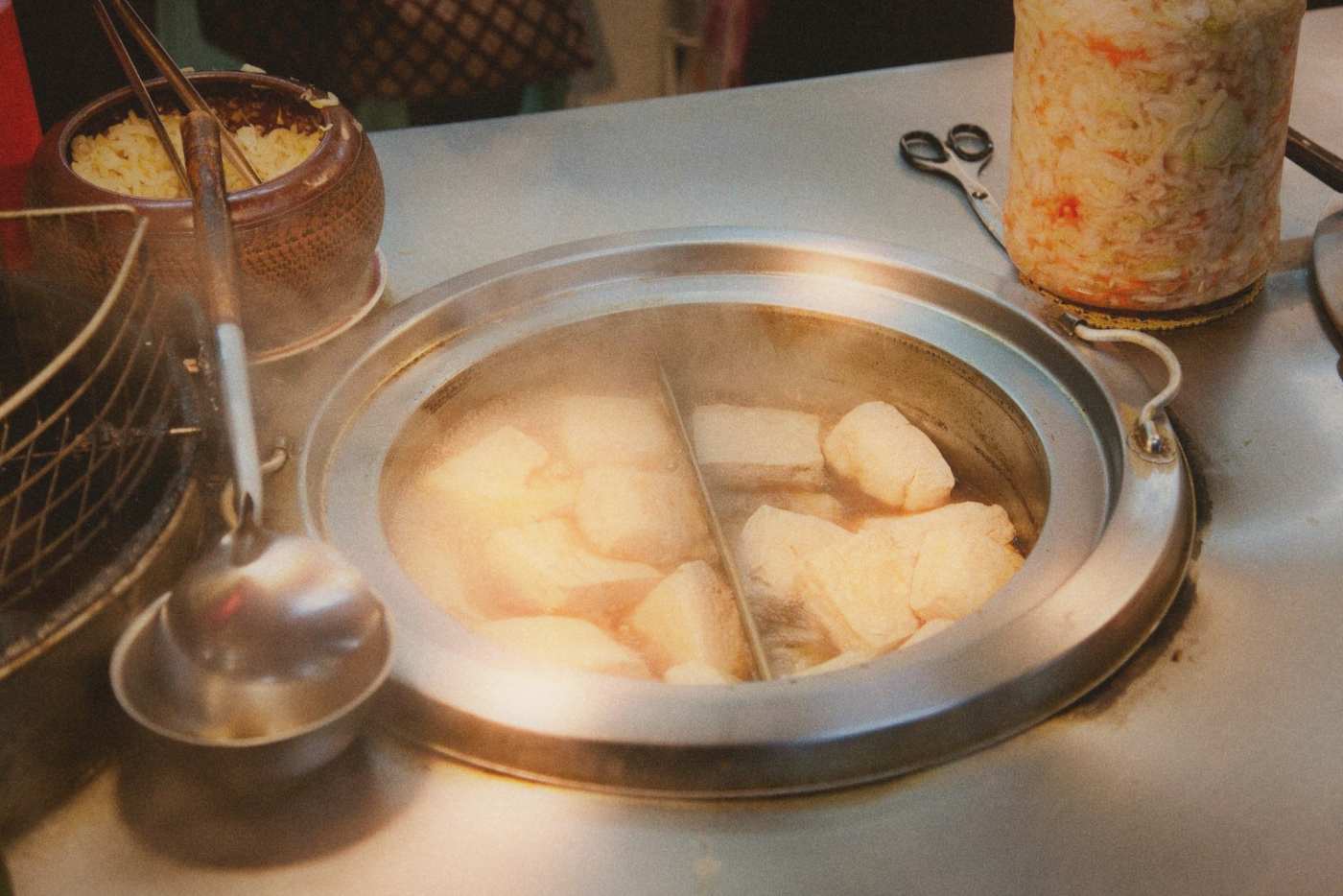 FIRST SIGHTWEBGLSteamed stinky tofu at Nanjichang Night Market. The steam keeps interior temperatures below 65 degrees Celsius, preserving live bacteria that deep-frying destroys. · Color and grain by First Sight · Portra 400. · First Sight 色彩與顆粒調校 · Portra 400
A realistic week of eating fermented food in Taiwan
The Stanford study used six servings per day as its protocol. That's a research design, not a lifestyle recommendation. A more practical target for daily life: aim for one or two servings of fermented food per day, which puts you at seven to fourteen per week. In Taiwan, this takes zero special effort if you're paying attention.
A serving is roughly 100 grams, about one bowl of miso soup, one side of pickled vegetables, one small portion of stinky tofu, or a thumbnail of 豆腐乳.
Here's what a week might look like without changing your routine much. Breakfast: 豆腐乳 with congee two or three mornings. Lunch: any noodle soup with extra 酸菜 on the side. Dinner: miso soup from a Japanese set twice a week, or kimchi from a Korean meal. One night market visit for steamed stinky tofu. Yogurt as a snack or dessert a couple of times. That's easily eight to ten servings without buying a single supplement or visiting a specialty shop.
If you're new to fermented foods, start slower. One serving every other day for the first week or two. Your gut bacteria will adjust, and the adjustment sometimes involves temporary bloating and gas. This is a normal sign that new microbial communities are establishing themselves, not a sign that something is wrong. It usually settles within two to three weeks.
Two practical tips. First, diversity matters more than quantity. Miso, kimchi, 酸菜, yogurt, and 豆腐乳 each contribute different bacterial strains. Eating five servings of yogurt is less valuable than eating one serving each of five different fermented foods. Second, buy from the refrigerated section. Room temperature shelf-stable fermented products have typically been heat-treated, which kills live cultures. If you want living bacteria, cold chain is the signal.
Where to buy
Traditional markets (菜市場) for 豆腐乳 (better variety, fresher, often from small-batch producers), 酸菜 and pickled vegetables (sold from barrels, you can ask how long it's been fermenting), and specialty items like 客家福菜. Dongmen Market near MRT Dongmen Station and Binjiang Market (濱江市場) near Songshan Airport are good starting points.
Supermarkets (全聯, 家樂福) for naturally brewed soy sauce (wider brand selection), refrigerated kimchi, unsweetened yogurt, miso paste, and 豆腐乳 from brands like 江記.
What to look for on labels. 冷藏 (refrigerated) is better than 常溫 (shelf-stable) for live cultures. 釀造 (naturally brewed) on soy sauce means real fermentation. Avoid added sugars and artificial sweeteners. On 豆腐乳, glass jars with listed fermentation dates generally indicate longer, more traditional processing than plastic containers.
Frequently Asked
Some links in this article are affiliate links. If you purchase through them,OQUA may earn a small commission at no extra cost to you. This helps support our editorial work. We only link to products and services we genuinely reference in our writing.
Comments (0)
Loading comments...