
This protocol is installable. One tap puts all 4 weeks on your calendar, each linking back to this guide.
Install this week →The most productive hour of your day is the one before anyone needs anything from you.
Every morning routine article starts with billionaires waking at 4am. This isn't that article. This is about designing a realistic 60-minute sequence that works for people who live in Taipei apartments, commute on the MRT, and can't afford to hire someone to prepare their meals.
The research is clear on one thing: the order of your first hour matters more than the content. Light before screens. Movement before sitting. Creation before consumption. Get the sequence right and the rest of the day has structure. Get it wrong and you spend the morning reacting to other people's priorities.
The sequence (and why this order)
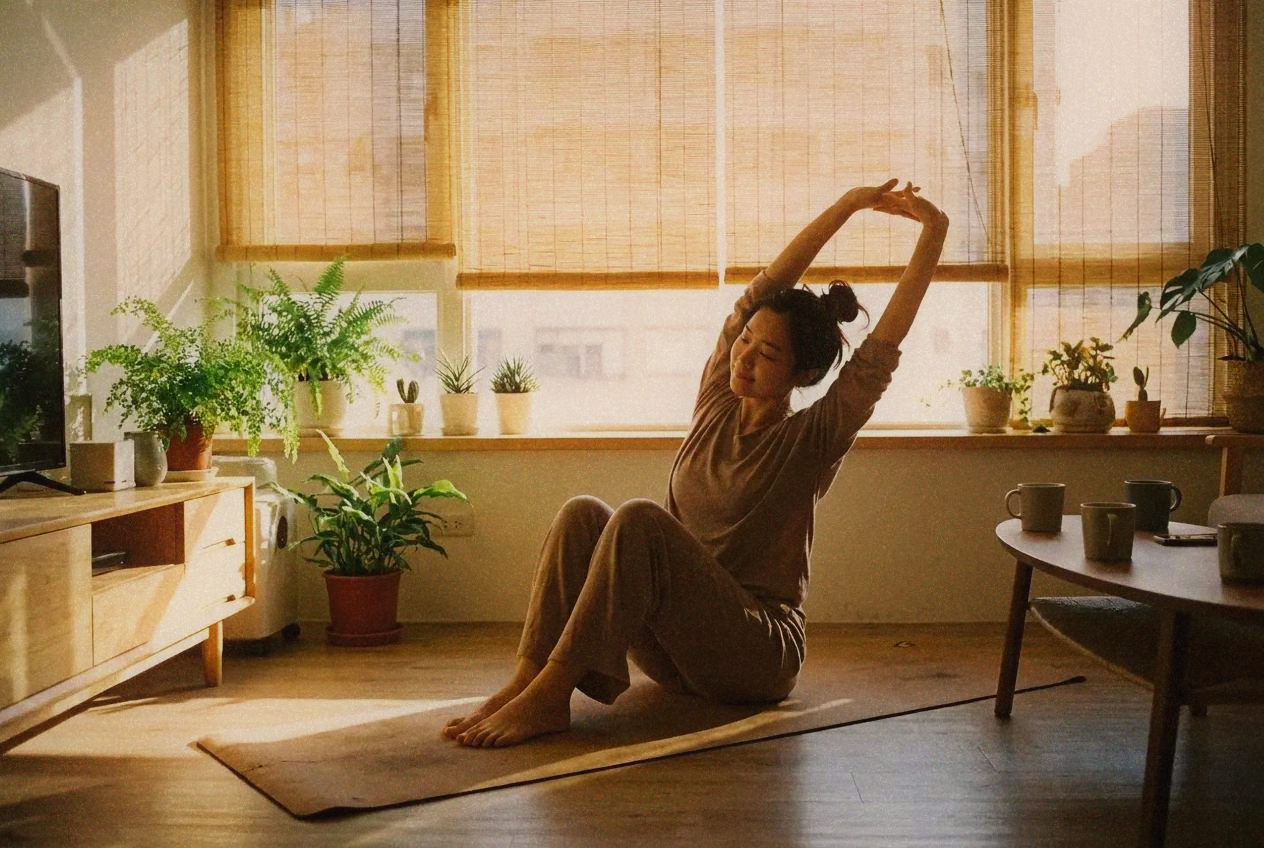
 FIRST SIGHTWEBGLMorning stretches in a Taipei apartment. The first ten minutes set the tone for everything after. · Color and grain by First Sight · Gold 200. · First Sight 色彩與顆粒調校 · Gold 200
Minutes 0–5: Light and water
Open the curtains immediately. Before checking your phone, before the bathroom, before anything, get natural light into your eyes. This resets your circadian clock and begins the cortisol-melatonin cycle that determines your energy for the next 16 hours.
Drink a glass of water. You've been dehydrating for 7–8 hours. Room temperature is fine. Skip the lemon water, the benefit is hydration, not the lemon.
In Taiwan: if your apartment faces west and gets no morning sun, walk to the balcony or step outside the building entrance. The light needs to be natural, not from a lamp. Five minutes is enough. If you're in an older building with deep shadows, or if you wake before sunrise (before roughly 5:30am in winter, 4:45am in summer), consider a light therapy lamp (10,000 lux, positioned about 16 inches from your face). This is not a luxury, it's necessary in certain living conditions, and the cost of one decent lamp (NT$1,500–3,000) is comparable to a single month of commuting inefficiency.
Minutes 5–15: Movement
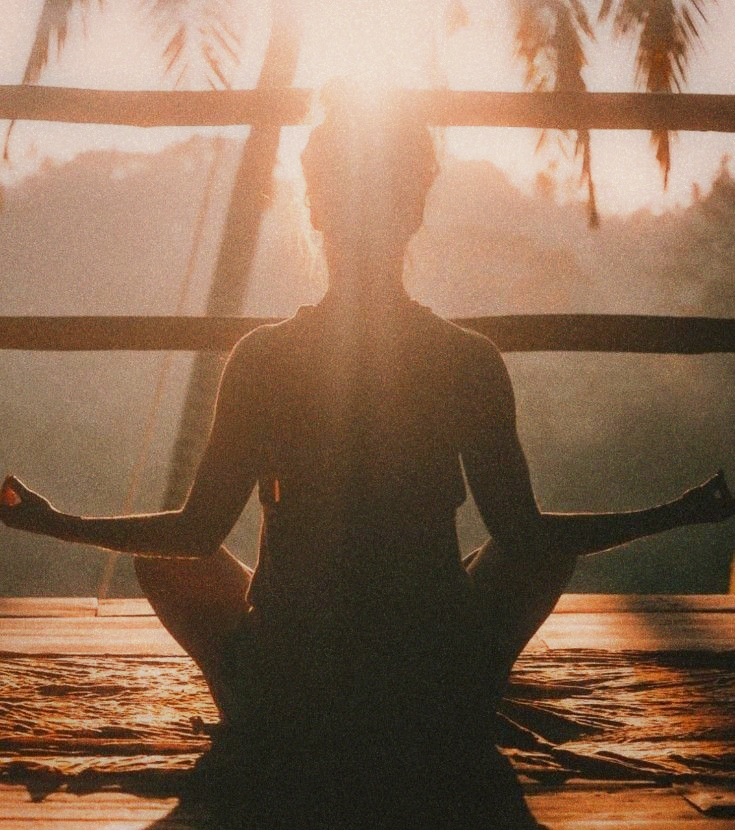 FIRST SIGHTWEBGLColor and grain by First Sight · Gold 200.First Sight 色彩與顆粒調校 · Gold 200
Not exercise, movement. The distinction matters. You're not training. You're telling your body it's time to be awake.
Option A: 10-minute walk outside. The research from Andrew Huberman's lab shows that outdoor morning light combined with movement produces the strongest circadian entrainment. This is the gold standard. In Taipei, this could mean walking to your local convenience store, walking around your neighborhood block, or, if you're near a park like Daan Forest Park or Nangang Software Park's loop, incorporating a park walk into your commute.
Option B: 10 minutes of stretching or yoga. Sun salutations are the classic morning sequence for a reason, they systematically move every major joint. If you live in a small apartment and space is limited, 10 minutes of bodyweight stretching (focus on hips, shoulders, spine) is sufficient.
Option C: Walking meditation. Ten minutes, half speed, feel your feet. Two birds with one stone. This works particularly well if you're both timing-constrained and anxious, the combination of movement and focus calms the nervous system before a stressful day.
Option D (Taiwan-specific): Tai chi. If you have access to a community tai chi class (many neighborhoods have them in parks at 6am), or if you know even a basic tai chi form, this is ideal. The movement is slow, meditative, and gives you both the circadian reset and the mental clarity of Option C without needing to walk outside in traffic.
The key: no screens during movement. No podcasts. No phone. Let the brain warm up without input. If you're bored, you're doing it right, boredom is when your brain shifts from reactive to generative mode.
Real example: A typical Taipei morning walk might be: walk to your neighborhood 便利店 (convenience store), 5 minutes there, 2 minutes inside to buy water or tea, 5 minutes back. Total: 12 minutes, incorporates light, movement, and hydration all at once. You've also bought your tea for later. This is more efficient than trying to squeeze in a separate 10-minute walk.
Minutes 15–25: Cold + hygiene
Shower. End the last 60 seconds on cold. We've written about this in detail, the dopamine increase from cold water exposure lasts 2–3 hours and significantly improves morning focus.
If you're not ready for cold showers, at least keep the water lukewarm, not hot. Hot showers raise core temperature and can make you drowsy. The coldness doesn't have to be extreme. Even 20°C water for 30 seconds produces measurable dopamine elevation. In Taipei during winter, your shower might already be cold enough.
Cold water progression: If you're new to this, don't jump straight to 60 seconds of full-body cold. Start with 10 seconds of cold on your feet and legs only. Next week, add 10 seconds on the torso. The third week, do your face (this produces the strongest vagal response, which is why it feels so powerful). By week four, you'll be ready for 30–60 seconds of full-body. This progressive approach works because your body adapts faster if given time.
Shower timing: Ideally, this 10-minute block includes both the shower and basic hygiene (brushing teeth, skincare). If your bathroom is cold and wet in winter, this might naturally be longer, that's fine. The cold water at the end is the critical element, not shaving two minutes off the total.
Minutes 25–40: Creation
The most important 15 minutes. Before you open email, before you check LINE, before you look at the news, create something. This is non-negotiable.
This can be: - Writing (journal, blog post, work document, even just three sentences about your day ahead) - Planning (today's three priorities, in order) - Designing (sketch, code, outline) - Practicing (instrument, language, skill) - Problem-solving (thinking through a decision without writing, but sustained focus for 15 minutes)
The neuroscience: your prefrontal cortex is most capable of original thought in the first 2–3 hours after waking, before it gets loaded with reactive tasks. Email, social media, and news are all reactive. Creation is proactive. Do the proactive work first.
Why this matters specifically in Taiwan: Taipei's work culture tends toward reactive busyness. You wake, check LINE messages from your team (because they worked until 11pm yesterday), and you're immediately in response mode. This 15-minute creation block is your opportunity to set your own direction before the organization's needs overwhelm your day. If you skip this, you'll spend the entire day executing other people's priorities.
What "creation" actually looks like: - Journaling: Write three pages, or write until you reach the end of a thought. The length doesn't matter; the continuity does. Most people who skip journaling say they don't know what to write, the solution is to write the sentence "I don't know what to write" and then keep writing for 14 more minutes. - Planning: Write your three most important tasks. Not ten tasks, three. For each, estimate the time. Then estimate it again and add 20%. This gives you a realistic morning because you won't hit all three, you'll hit one fully and partially complete the second. - Writing work: If you work in any role that involves written output (marketing, product, engineering, law), write your first meaningful output in this window. Email drafts don't count. An actual document, even 200 words, does. - Design/problem-solving: Sketch a UI change. Write pseudocode. Outline a proposal. Think through a conflict at work and what you actually want to say. This is the window where you're most creative.
The obstacle: The temptation here is to check your phone "just quickly." You won't. Once you open it, the algorithm will keep you for 7 minutes minimum. The solution is physical: put your phone in another room. Not silent mode. Another room. The friction of getting up to retrieve it is usually enough.
Minutes 40–55: Fuel
Breakfast. In Taiwan, this is easy, the morning food culture is the best in Asia. You have genuinely good options everywhere, not the sugar-laden cereal or drive-through breakfast of Western countries.
Best morning foods for sustained energy: - Protein first: eggs, tofu, congee with fish, milk (if you tolerate it) - Complex carbs: sweet potato, whole grain mantou, oats, brown rice - Fats: nuts (if there's time), or the natural fats in eggs/meat - Avoid: sugary milk tea, white bread toast with jam, pastries, anything that spikes blood sugar and crashes hard
Specific Taiwan breakfast options:
1. Dan bing with egg (蛋餅加蛋), NT$35–45, nearly perfect breakfast. The crepe has carbs, the egg adds protein, you can eat it in 5 minutes while walking to the MRT. Pair with soy milk (豆漿, NT$20) and you have a solid 50-gram-protein breakfast.
2. Congee with fish (清粥配魚, NT$50–70), lighter than it sounds, easier to digest than a heavy cooked breakfast. The fish adds protein, and you're absorbing nutrients from both the broth and the solids. This is particularly good if you're practicing intermittent fasting (see below), it's an easy meal to stop at if you choose.
3. Whole grain mantou with egg and cheese (全麥饅頭夾蛋起司, NT$40–50), not traditional but increasingly available at larger breakfast chains. The whole grain slows digestion compared to white bread, the egg and cheese add staying power.
4. Youtiao with soy milk (油條配豆漿, NT$25–35), technically a snack, but if you eat two youtiao and two large soy milks, you've had adequate breakfast. It's higher in fat/calories but the traditional choice for a reason.
5. Taiwanese breakfast set (早餐套餐, NT$60–80), many shops now offer complete sets: egg crepe + soy milk + toast/steamed bun. Convenient and balanced.
If you're doing intermittent fasting (16:8): Skip this block entirely. Instead, move your creation time to 30 minutes (25–55 minutes). Then shift your water/hygiene block up. The zero-calorie beverages (black coffee, unsweetened tea, water) do not break a fast, the caffeine is actually helpful for morning clarity.
The timing question: Eating breakfast within the 60-minute window is tight. If you're buying from a breakfast shop, do it on your walk (incorporate it into the movement block by walking to the shop). If you're making breakfast at home, prep the night before when possible (boil an egg, toast bread, leave it ready).
Minutes 55–60: Intention setting
Five minutes. Three questions: 1. What is the single most important thing I need to finish today? 2. What will I say no to today? (What task, meeting, or request will you decline or defer?) 3. How do I want to feel at the end of today?
Write the answers. Not on your phone, on paper, or in a dedicated notebook. The act of writing creates commitment that typing doesn't. This is not sentimental; it's neurological. Writing engages more motor cortex, more memory systems, and more emotional processing than typing.
The third question matters more than the first two: Most productivity systems focus obsessively on task completion. The research on wellbeing suggests that how you feel about your day matters more than what you accomplish. If your answer to question three is "I want to feel calm" or "I want to feel capable," that changes how you respond to obstacles during the day. If it's "I want to feel productive," you'll push harder but maybe sacrifice sleep. Be honest with yourself about what will make the day feel good, not just what will fill your to-do list.
Now open your phone. Now check email. Now reply to that LINE message from your boss. The reactive world begins, but you've already created, moved, and decided. The day has structure. Your priorities are set. You're not starting from zero.
What happens in the afternoon (and why the morning matters)
The research on decision fatigue suggests that every decision you make depletes your cognitive resources slightly. By afternoon, you're running on fumes, every choice (what to eat, which meeting to prioritize, how to respond to a difficult email) requires more effort. The morning routine works because it pre-decides several things: you moved your body, you created something, you set your three priorities. The afternoon doesn't need to figure these out.
This is why Taipei's typical pattern of working until 9pm doesn't work well. By 5pm, your decision-making capacity is 60% depleted. Working through 9pm means making major decisions in a cognitively impaired state. The morning routine can't fix this (that would require organizational change), but it can at least make sure your early morning, when you're capable, is used well.
What NOT to do in the morning
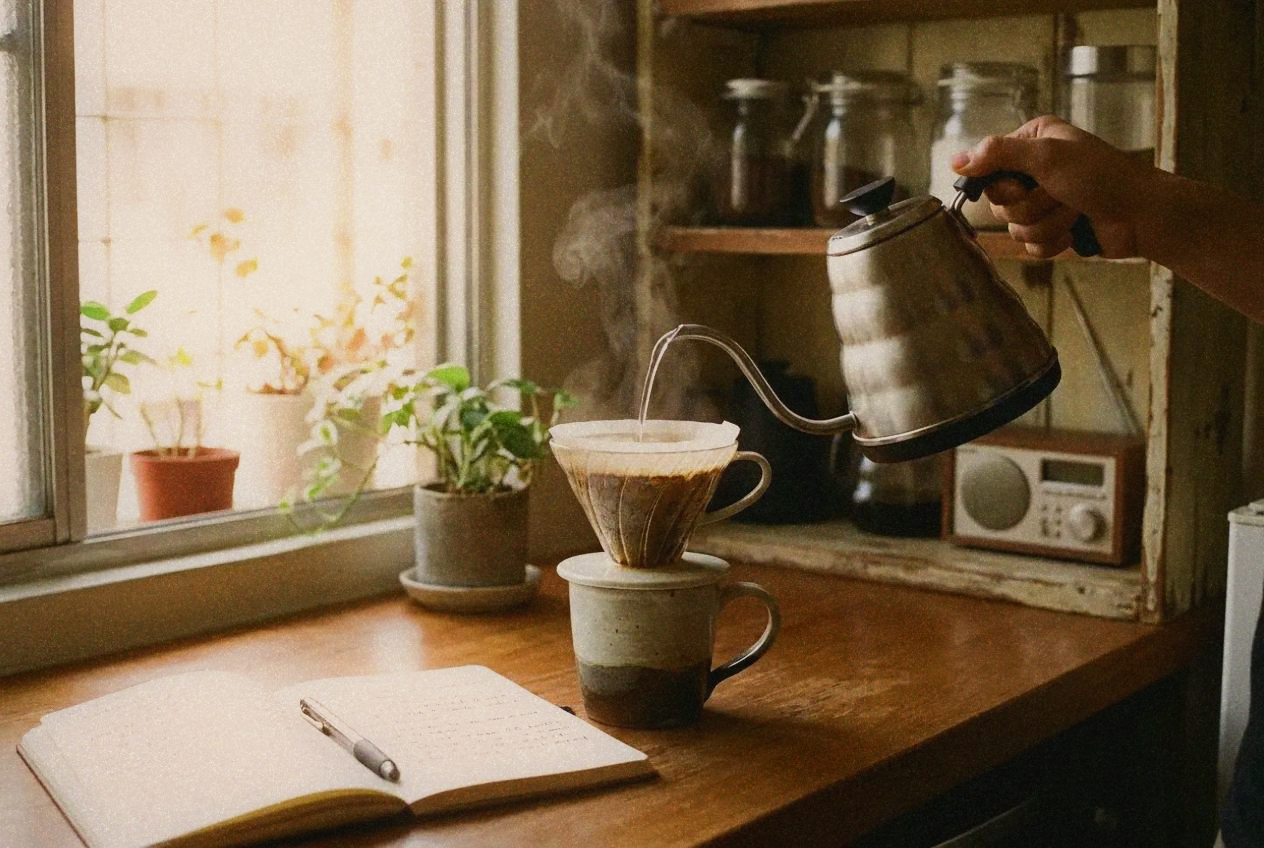 FIRST SIGHTWEBGLThe pour-over ritual: a small ceremony that marks the transition from waking up to actually starting. · Color and grain by First Sight · Gold 200. · First Sight 色彩與顆粒調校 · Gold 200
Don't check your phone first. The moment you open email or social media, you enter reactive mode. Other people's priorities become your priorities. The morning routine exists to establish YOUR priorities before the world imposes its own.
Don't extend it artificially. A 2-hour morning routine is a part-time job. Sixty minutes is the sweet spot, long enough to include all the important elements, short enough to sustain daily. If you're spending two hours on your morning routine, you're either doing it for the meditative experience (which is fine, but own that), or you're procrastinating on your actual day.
Don't optimize before habituating. Don't buy a cold plunge, a meditation cushion, a sunrise alarm clock, and a light therapy lamp all in the same week. Start with light + water + movement + creation. Add one element per week as each one becomes automatic.
Don't make it the same every day. The routine should have structure (same order), but the content can change. Monday's creation might be journaling; Wednesday might be planning; Friday might be sketching. Same routine, different flavor.
Seasonal adjustments
Taiwan's weather shifts dramatically, and your morning routine should shift with it.
Summer (May–September): You'll wake earlier naturally (sun rises by 5:15am). Use this. Your movement block gets easier because it's not dark. Your cold shower is actually cold without needing to make effort. The challenge is staying hydrated, increase your water intake, and consider swapping soy milk for a larger cold beverage in the fuel block.
Winter (November–March): Sun doesn't rise until 6:30am. If you wake at 6am, your first light is artificial (light lamp). Your cold shower requires actual courage. Your movement block happens in darkness. This is why many people's routines collapse in winter, the Taipei winter is short (only 3 months truly dark), but it's real. Solution: move your alarm earlier (5am instead of 6am) so you catch some actual dawn light. Or lean into indoor options, yoga, tai chi, or a home treadmill for the movement block.
Shoulder seasons: October and April are the easiest. Use these months to test new elements or refine your routine, knowing that summer and winter will stress-test whatever you build.
Weekend vs. weekday routines
You don't need a separate routine. But you can expand it.
Weekdays: Strict 60 minutes. You have work.
Weekends: Consider extending to 90 minutes. Same order, but add depth: 20 minutes of movement instead of 10 (a longer walk, a bike ride), 25 minutes of creation instead of 15 (deeper writing, more planning). This gives your brain the space to do longer-form thinking that weekdays don't allow.
Some links in this article are affiliate links. If you purchase through them,OQUA may earn a small commission at no extra cost to you. This helps support our editorial work. We only link to products and services we genuinely reference in our writing.
Comments (0)
Loading comments...