
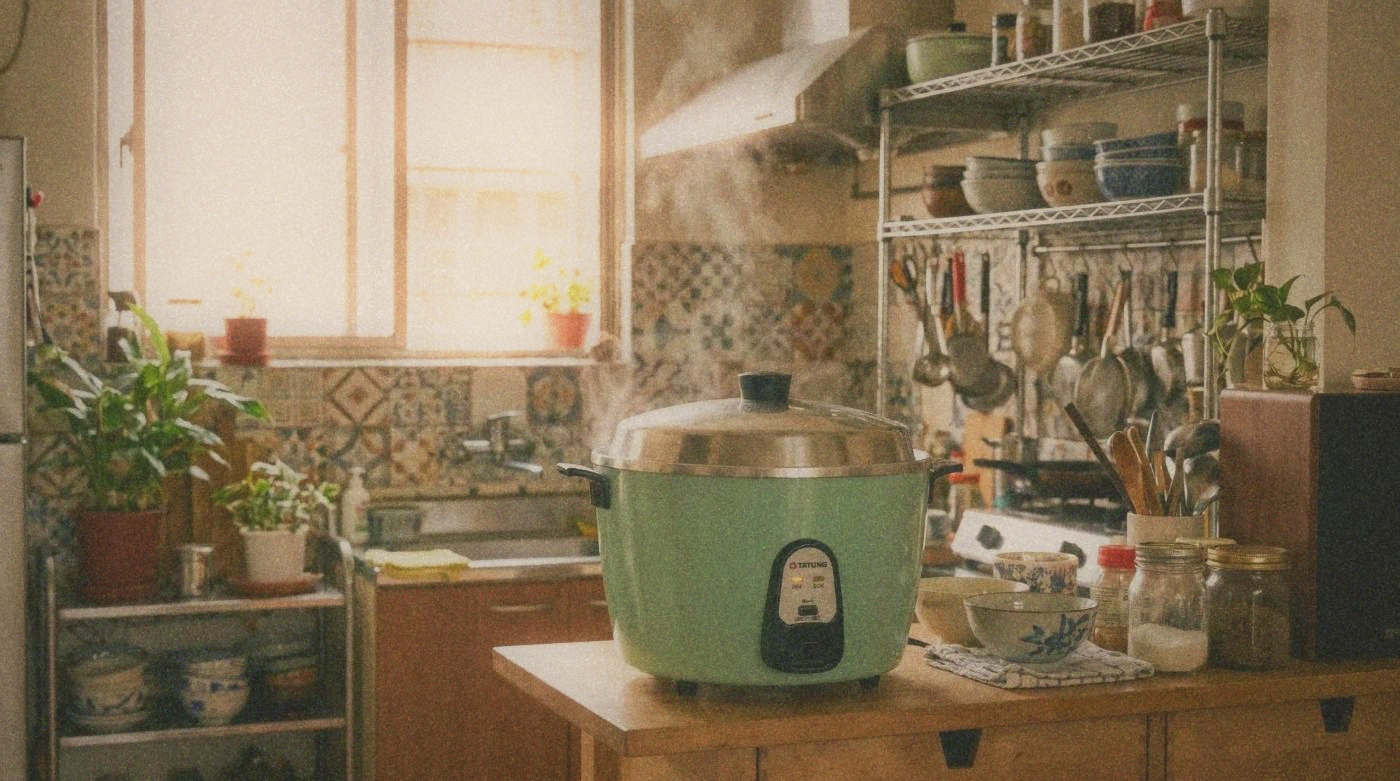
Here is a fact that tells you something about Taiwan: the most-used kitchen appliance in the country has exactly one button. On, and off. No digital display. No timer. No modes. The Tatung rice cooker has been in production since 1960, and the core design hasn't changed. The National Museum of Taiwan History has one in its permanent collection. Not because it's old. Because it's still in use.
Roughly 95% of Taiwanese households owned a Tatung at the brand's peak. The number has come down as Japanese rice cookers gained a foothold in the premium market, but the Tatung remains the default. Walk into any student dormitory, any first apartment, any grandmother's kitchen in Taiwan, and you'll find one. Usually red, sometimes green, always slightly banged up from years of daily use. It's the first thing a Taiwanese student packs when moving abroad. It's the appliance mothers once included in a daughter's dowry. And it does far more than cook rice.
A very brief history of how this happened
In 1960, Tatung released the TAC-6, which was essentially a copy of Toshiba's RC-6K steam cooker. Toshiba hadn't patented the design in Taiwan, and by 1963, over thirty manufacturers were making similar cookers. Tatung won the market for two reasons. First, its existing electric fan manufacturing gave it superior processing technology. Second, its collaboration with Toshiba gave it mass production advantages the smaller competitors couldn't match.
But the engineers also adapted the design for Taiwan's specific needs. They raised the maximum temperature to 230 degrees Celsius (Toshiba's topped out at 180) because Taiwanese households cooked multiple rice varieties, from indica to japonica, each with different water absorption. They added a steam vent hole to the lid because Taiwan's 110-volt power supply made the lid rattle more than Japan's 100-volt standard. In 1970, they added three grooves to the inner pot to improve heat transfer. Small, practical decisions that accumulated into market dominance.
By the mid-1970s, the Tatung was the primary cooking appliance in urban Taiwanese homes. It replaced charcoal, briquettes, and kerosene. It tracked Taiwan's urbanization: as families moved from rural kitchens with open flames to city apartments with electric outlets, the rice cooker moved with them.
What it actually is (not what you think)
The most common misunderstanding: people call it a rice cooker. It's actually a countertop steamer. The cooking principle is indirect heating. You put water in the outer pot. You put your food in the inner pot (or on a steaming rack above the inner pot). When you flip the switch, the outer water heats up, creating steam that cooks whatever is inside. When the outer water evaporates, the switch pops back up. That's it. The entire mechanism.
This means anything you can steam, simmer, or braise, you can make in a Tatung. Rice is just the beginning.
Beyond rice: What to actually cook
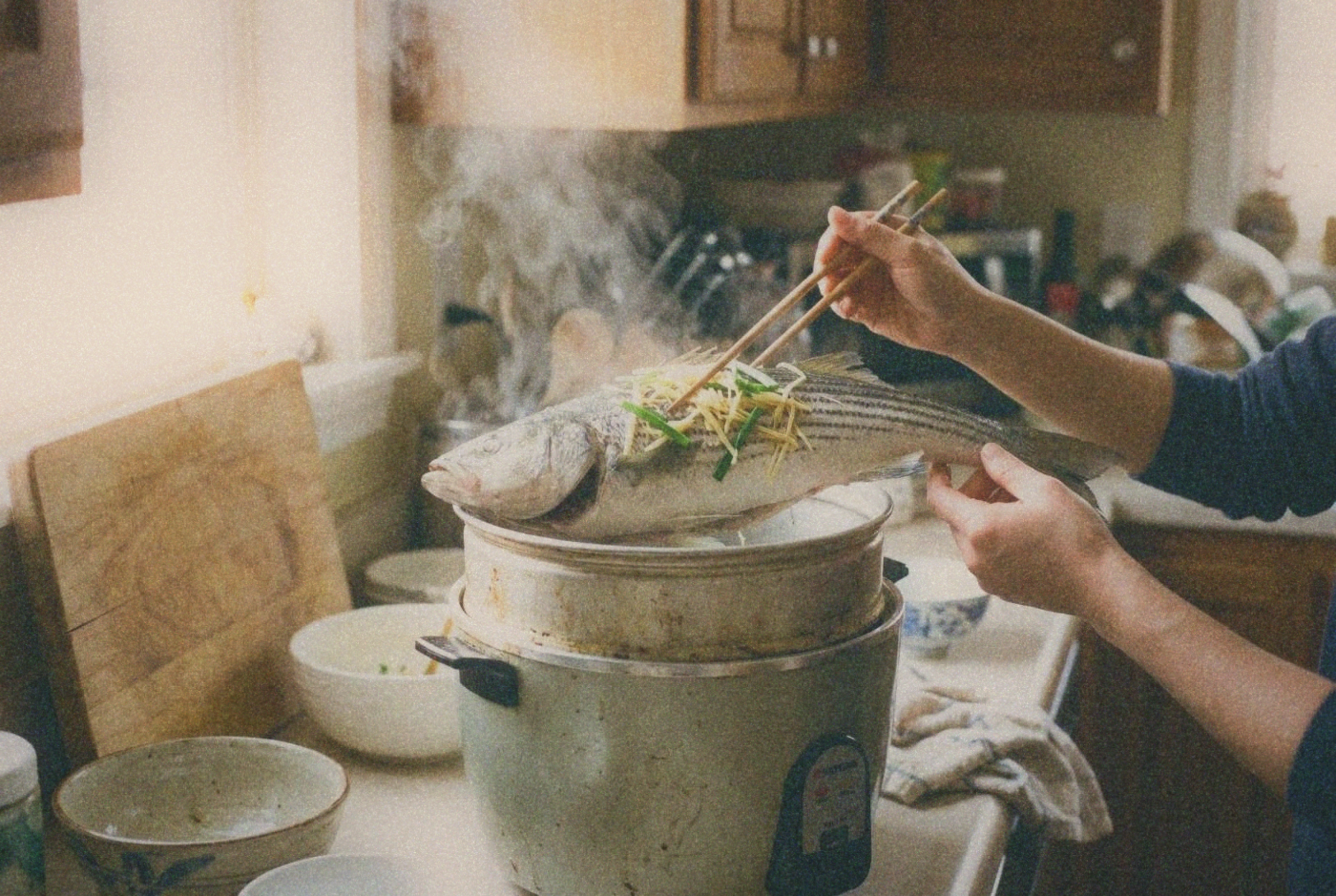
 FIRST SIGHTWEBGLWhole steamed fish with ginger and scallions being lifted from inside a Tatung rice cooker inner pot. home kitchen setting · Color and grain by First Sight · Gold 200. · First Sight 色彩與顆粒調校 · Gold 200
Congee (稀飯) One cup of rice to five cups of water for thick congee, or one cup to eight cups for the thinner version. One cup of water in the outer pot. When the switch pops, do not open the lid. Let it sit for 20 to 30 minutes. The residual heat finishes the cooking and gives you a texture you can't get by opening it early. Congee is what you eat when you're sick in Taiwan. Every Taiwanese person has a memory of their mother making this at midnight.
Steamed fish (蒸魚) Score the fish, lay ginger and scallion underneath and on top, splash with rice wine. One cup of water in the outer pot, roughly ten minutes of steaming. When the switch pops, scatter fresh scallion threads on top, drizzle sesame oil and soy sauce, cover and let it rest for two minutes. The fish comes out silky and fragrant. This was the first non-rice thing I learned to make in a Tatung, and it genuinely changed my perception of what the appliance could do.
Braised pork (滷肉) Pork belly, soy sauce, rice wine, rock sugar, fried shallots, five-spice powder. Two cups of water in the outer pot. This is the simplified version of 滷肉飯 that every Taiwanese college student has made in a dorm room at least once. It won't be as good as the street vendors who simmer theirs for three hours, but it will be surprisingly close, and you made it with one button.
"The Tatung philosophy is: give people a reliable, indestructible tool and let them figure out what to do with it. There are over 700 Tatung-specific recipes on icook.tw alone."
Steamed eggs (蒸蛋) One egg to 100ml of room-temperature water. Strain the mixture for smoothness. Outer pot water to the 8-mark on the measuring cup, roughly 15 minutes. The result should be silky, trembling, barely set. This is the Tatung recipe that separates people who understand the machine from people who just cook rice in it.
Soups and stews Pork rib soup, herbal chicken soup, beef noodle soup base. Two to three cups of water in the outer pot for hearty soups. You can run multiple steaming cycles for richer flavor. Put it on before you leave for work, and dinner is halfway done when you get home.
Cake Standard cake batter in the inner pot or a mold, one to two cups of outer water. Taiwanese bakers have been doing this since the 1960s. The steam produces a texture that's different from oven baking, denser and moister, which some people prefer.
Buying guide for foreigners in Taiwan
If you're living in Taiwan, buying a Tatung is straightforward. The decision tree is: size, material, and where to buy.
Size: 6-cup models for one or two people. 10 to 11-cup for families or anyone who wants to cook bigger batches. The 6-cup is enough for daily rice plus steaming a side dish. The 10-cup handles a full meal.
Material: Basic models with painted exteriors start around NT$2,500 to NT$3,000. Stainless steel accessories (inner pot, steaming rack) run NT$3,000 to NT$4,000. Full stainless steel models, where the inner pot, outer pot, and all accessories are SUS 304 stainless, cost NT$4,500 to NT$5,000. The stainless steel versions are easier to clean and more durable. If you're keeping it for years, go stainless.
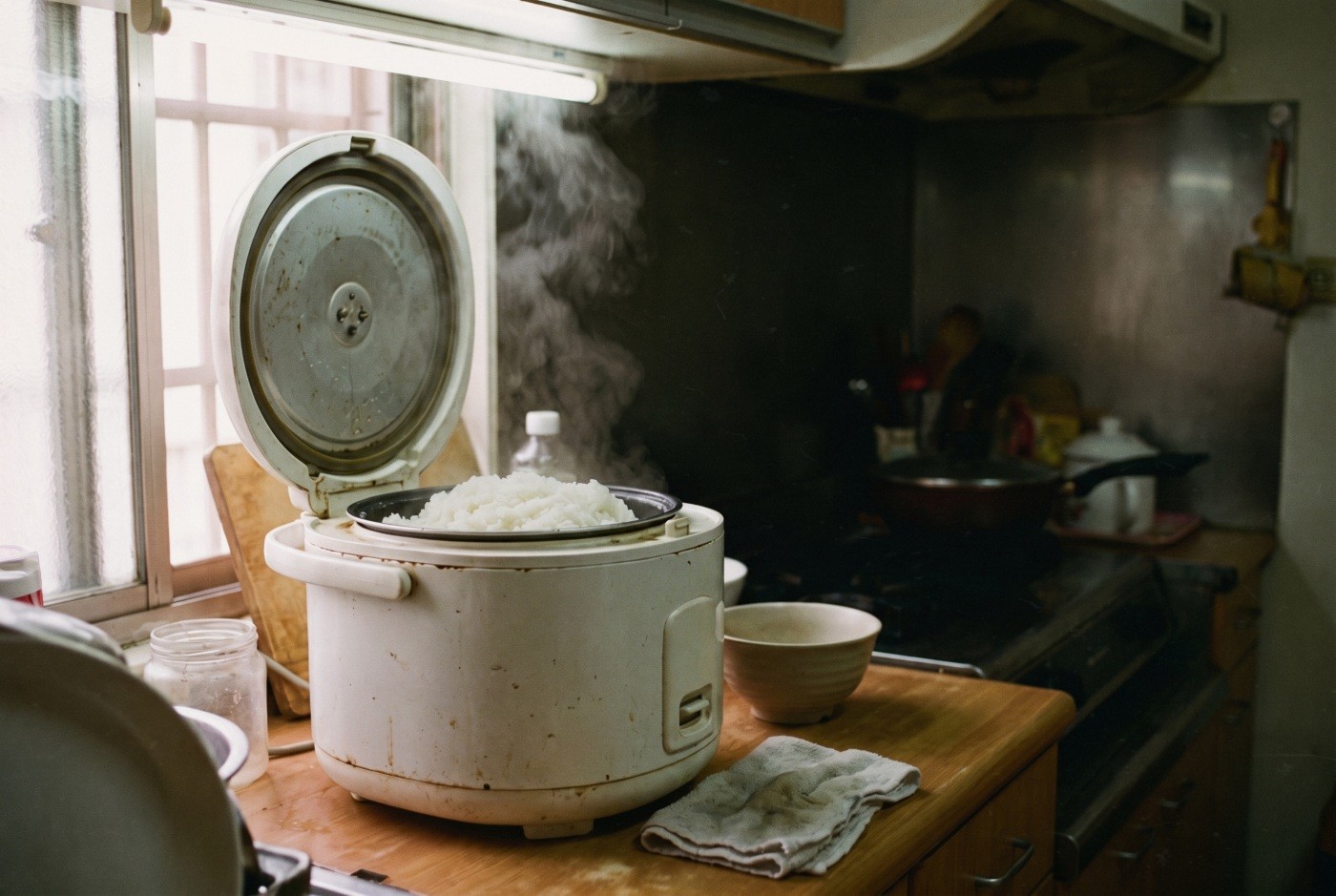 FIRST SIGHTWEBGLIllustration: Freshly cooked rice beside a kitchen window. · Color and grain by First Sight · Gold 200. · First Sight 色彩與顆粒調校 · Gold 200
Where to buy: - 燦坤 (Tsann Kuen / TK3C): Major electronics chain with hundreds of stores. Prices from about NT$2,990 for basic models. - 全國電子 (E-Life Mall): Another large chain, full Tatung range. - Online: momo購物網, PChome 24h, and Tatung's own store (etungo.com.tw) all carry the full range with delivery. Online prices are sometimes lower. - Costco carries select models, usually full stainless.
Voltage note: Taiwan uses 110V/60Hz, same as the US and Canada. Japan is 100V, which is close enough that Japanese appliances work fine in Taiwan. If you're from Europe, the UK, Australia, or most of Asia outside Japan and Taiwan, your home country uses 220 to 240V. A standard 110V Tatung will not work there without a step-down transformer rated at minimum 2,000W. Tatung makes dedicated 220V overseas models (look for model numbers ending in "V2" or "V4"), priced under NT$2,000 for the basic versions. If you're planning to take one home, buy the overseas voltage model. Do not try to use a 110V cooker on 220V power. The cooker draws 600 to 800 watts; on 220V, it would pull roughly 3,200 watts and be destroyed immediately.
Tatung versus Japanese rice cookers
This is the comparison everyone asks about, and the honest answer is: they're different tools for different philosophies.
A Tatung is a countertop steamer that happens to make good rice. A Zojirushi or Tiger is a rice-cooking machine that happens to have a few extra features. The Tatung uses indirect heating through a double-boiler setup. Japanese IH (induction heating) cookers heat the pot directly with electromagnetic induction, adjusting temperature and pressure dozens of times during a single cooking cycle.
For rice specifically, the Japanese cookers produce a noticeably better result. The grains are more evenly cooked, the texture more consistent, the bottom layer less likely to stick. A top-end Zojirushi uses alternating diagonal heating coils and multiple pressure settings to achieve rice that is, grain for grain, objectively superior. It costs NT$38,000.
For everything else, the Tatung wins, and it's not close. You can't braise pork belly in a Zojirushi. You can't steam a whole fish. You can't make soup. The Tatung does all of it with one button and no instruction manual. It also lasts 20 to 30 years with essentially nothing to break. Japanese cookers have electronic control boards and rubber seals that need replacement after 5 to 10 years.
Many Taiwanese households own both. The Tatung for steaming, stewing, reheating, and general cooking. The Japanese cooker specifically for rice. The Tatung is the workhorse. The Japanese cooker is the specialist. If you can only have one, the Tatung is the practical choice. If rice texture is your priority and budget isn't a concern, add a Japanese cooker for that specific job.
Why it matters beyond cooking
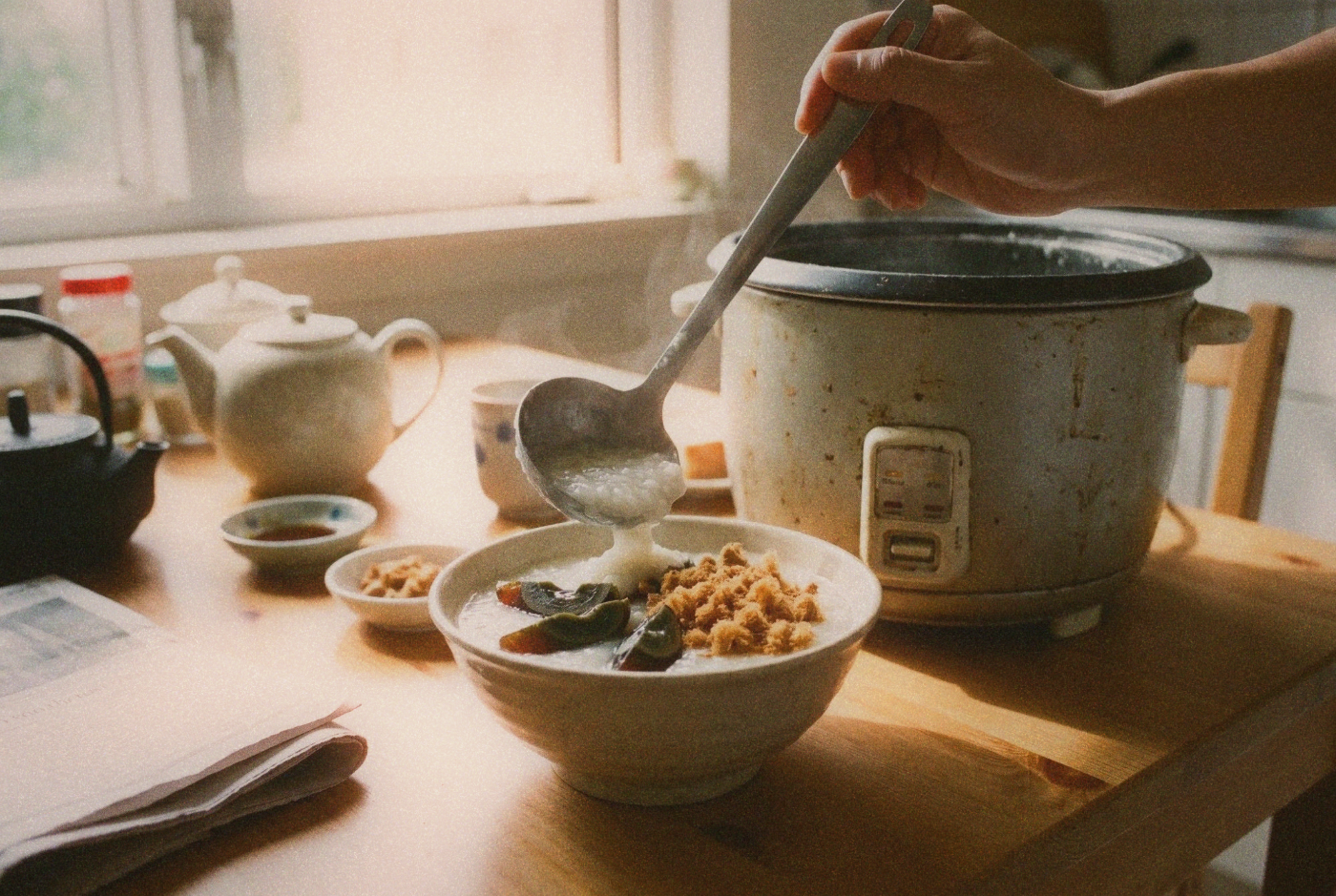 FIRST SIGHTWEBGLBowl of congee rice porridge with century egg and pork floss toppings being ladled from a rice cooker. breakfast table setting · Color and grain by First Sight · Gold 200. · First Sight 色彩與顆粒調校 · Gold 200
The Tatung rice cooker is one of those objects that contains a larger story. It arrived at the exact moment Taiwan was urbanizing, when millions of people were moving from rural homes with open kitchens to city apartments with electrical outlets and no ventilation for charcoal. It was affordable. It was simple enough for anyone to use. A child could operate it. A college student with no cooking experience could feed themselves. It became democratic infrastructure.
The emotional weight is real. Taiwanese people don't talk about their Tatung the way they talk about their iPhone or their car. They talk about it the way they talk about their kitchen table. It's just there. It's always been there. The one in your apartment might be the one your mother used for twenty years before giving it to you when you moved out. The dents on the side are from moving apartments three times. The slight discoloration on the lid is from ten thousand bowls of rice.
Cooking shows and food bloggers have made the Tatung fashionable recently, but the people who use it most aren't performing. They're making dinner. They're reheating leftovers. They're steaming sweet potatoes for a midnight snack. The Tatung's genius isn't that it cooks well. It's that it disappears into the rhythm of daily life so completely that you forget it's remarkable.
FAQ
Can I really make a full meal in just a rice cooker? Yes. Rice in the inner pot, steamed vegetables or fish on the rack above, soup in a bowl set on another rack. One switch, one cycle, three dishes. It's the standard dorm-room hack for Taiwanese students, and it works better than it has any right to.
Is the Tatung hard to clean? No. The inner pot washes like any pot. The outer pot just needs a wipe. If the stainless steel versions get water stains, a little white vinegar and baking soda handles it. There are no hidden crevices, no removable gaskets, nothing complicated.
Should I buy a Tatung as a souvenir? Only if you've checked the voltage. If your home country uses 110V (US, Canada, most of Central America), a standard Taiwan-market Tatung works perfectly. Otherwise, buy the overseas voltage model or plan to use a step-down transformer. The overseas models are available at Tatung's online store (etungo.com.tw).
What size should I get? 6-cup for solo living or couples. 10 to 11-cup for anything bigger, or if you want to cook in batches. The 10-cup is the most popular model in Taiwan for a reason: it handles daily rice and still has room for steaming something on top.
Is the Tatung better than an Instant Pot? Different tools. An Instant Pot is a pressure cooker with digital controls, better for things that need pressure (beans, tough cuts of meat, bone broth). A Tatung is a steamer, better for gentle cooking that preserves texture (fish, eggs, congee, rice). Many Taiwanese households have both. If forced to choose one: the Tatung, because its simplicity means you'll use it every day without thinking about it.
Comments (0)
Loading comments...