
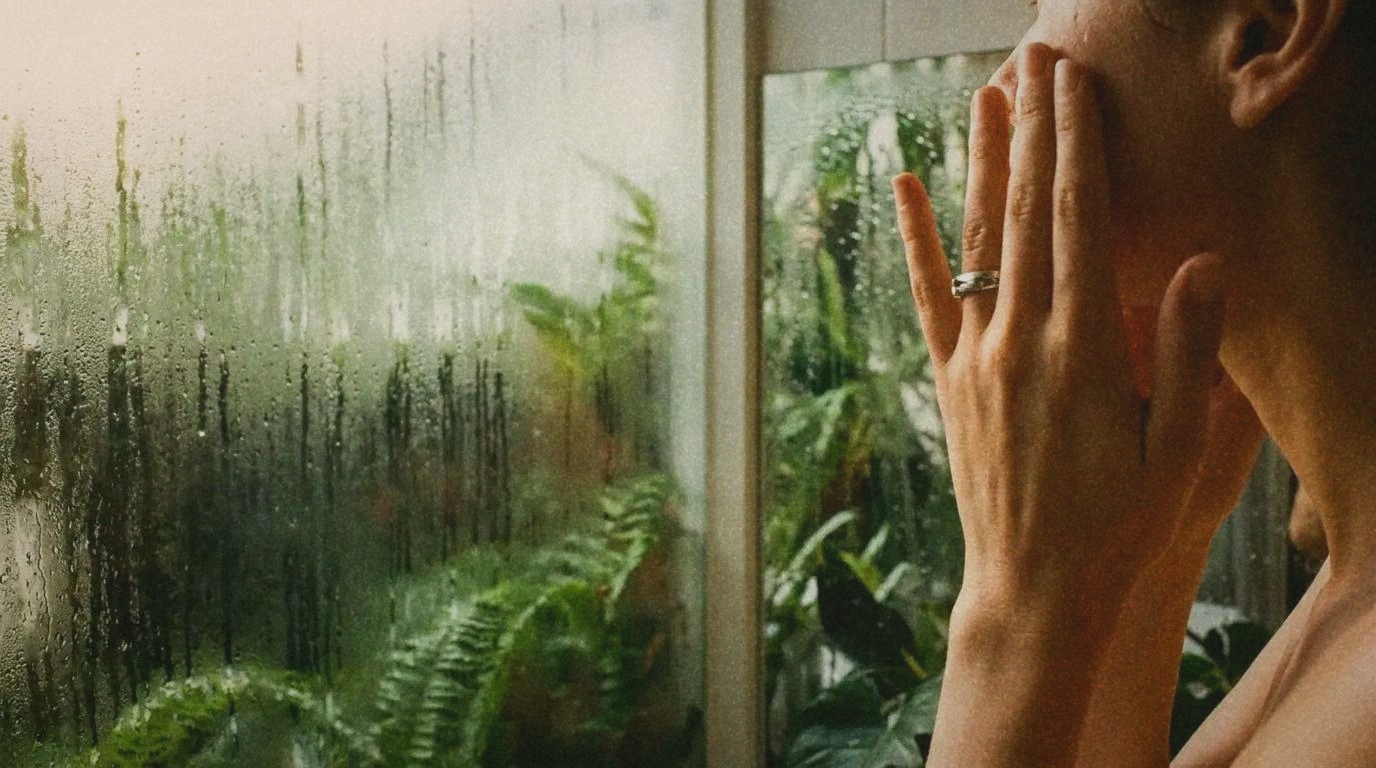
Three weeks after moving to Taipei, my forehead broke out in a way it hadn't since I was fifteen. Little clusters of closed comedones, mostly along the hairline, that no amount of my usual moisturizer would fix. That moisturizer, a thick ceramide cream I'd been faithful to for years in a dry climate, was part of the problem. I just didn't know it yet.
The friend who finally told me was blunt about it. She pointed at the cream on my bathroom shelf and said, "That's for winter in Canada. You live in a swamp now." Then she walked me to the nearest Cosmed, bought me a bottle of Hada Labo lotion and a tube of Biore sunscreen, and told me to throw out everything else. I didn't throw out everything else. But I rebuilt from scratch within a month, and my skin has never been better.
Taiwan's humidity runs between 73% and 85% for most of the year, peaking in summer when it can stay above 80% for weeks. The UV index regularly hits 11 to 13 from May through September, which is "extreme" on the international scale. If you moved here with a skincare routine designed for a temperate or dry climate, that routine is actively working against you. The heavy creams are trapping sweat and sebum. The gentle SPF 30 is not enough. And if you're not double cleansing at night, the combination of sunscreen, pollution, and humidity-driven oil production is sitting on your face while you sleep.
What follows is the routine I rebuilt, piece by piece, with products you can buy at any Cosmed or Watsons in Taiwan. Nothing fancy. Nothing expensive. Just what actually works when the air itself is wet.
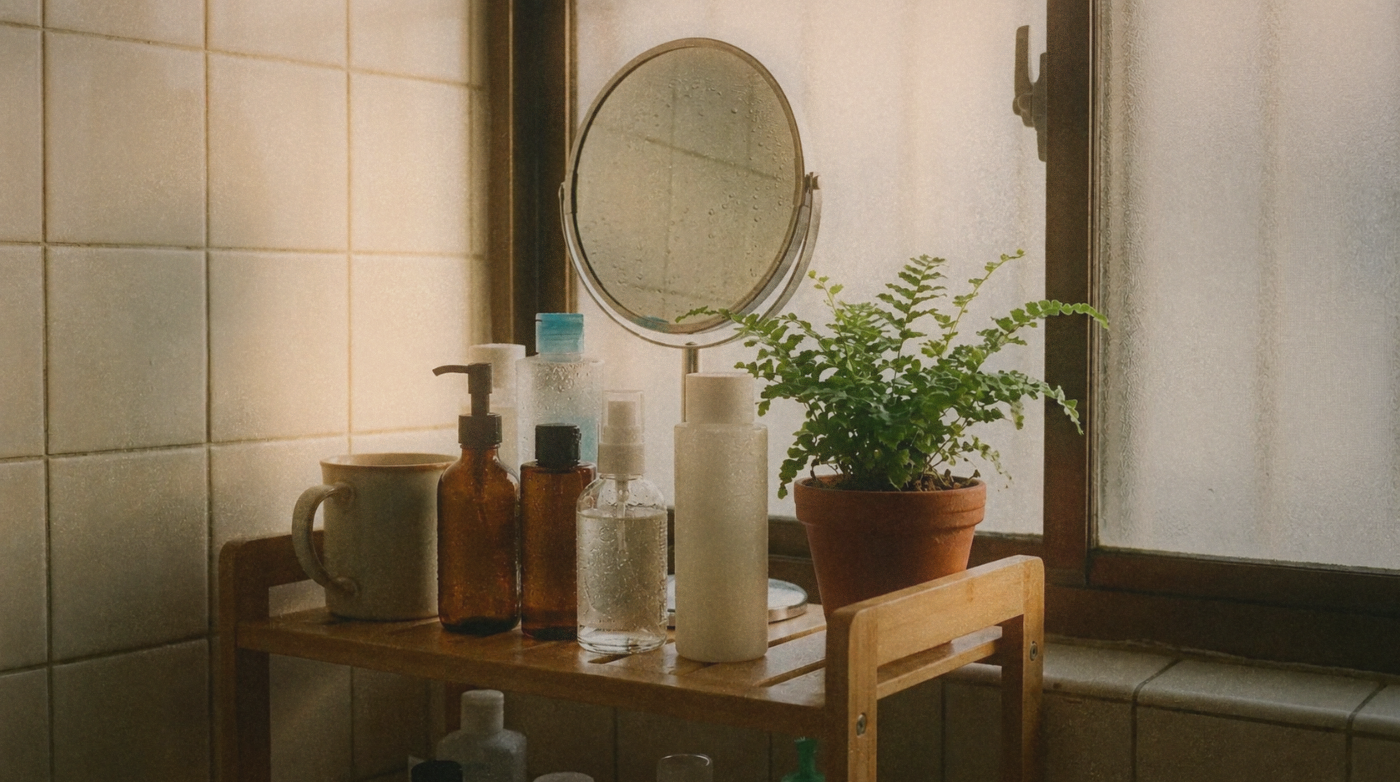
 FIRST SIGHTWEBGLA bathroom shelf in a Taipei apartment, rebuilt for humidity: lightweight lotions replace heavy creams. · Color and grain by First Sight · Portra 400. · First Sight 色彩與顆粒調校 · Portra 400
The humidity problem, specifically
Humidity changes your skin in ways that aren't immediately obvious. High ambient moisture means your skin's transepidermal water loss slows down. Sounds good, right? Less water leaving your skin should mean more hydration. But what also happens is that your sebaceous glands keep producing oil at the same rate, and now that oil has nowhere to go. It mixes with sweat and dead skin cells, and if your moisturizer is adding a heavy occlusive layer on top of all that, you've created a sealed environment where bacteria thrive. Clogged pores, texture, breakouts. The classic "my skin was fine before I moved here" experience.
The fix isn't to stop moisturizing. It's to switch from occlusive, cream-based hydration to water-based, humectant-driven hydration. In a humid environment, humectants like hyaluronic acid actually work better than they do in dry climates, because there's abundant moisture in the air for them to pull toward your skin. The climate does half the work for you. You just need to let it.
Morning routine: four steps, ten minutes
I resisted the idea of a "routine" for a long time. Routines sounded like something that required fifteen products and an Instagram account. But the version that works here is simple. Four steps in the morning, maybe ten minutes total.
Step 1: Water-based cleanser. Not a stripping foaming wash. A gentle, low-pH cleanser that removes overnight oil without destroying your moisture barrier. The Naruko Tea Tree Blemish Clear Wash (roughly NT$250 for 120ml at Cosmed) is a solid choice if you're oily or combination. If your skin runs dry even in humidity (it happens, especially with heavy AC use), the Hada Labo Gokujyun Foaming Wash (around NT$300) is gentler. In the morning, you don't need an oil cleanser. Water-based is enough.
Step 2: Hydrating toner/lotion. This is the step that changed everything for me. In Taiwan's skincare vocabulary, "lotion" often means a watery, hydrating toner, not a thick cream. The Hada Labo Gokujyun Lotion (roughly NT$350 to 440 for 170ml at Cosmed or Watsons) is the one everyone recommends, and everyone is right. It's a simple formula built around hyaluronic acid. Pat two to three layers onto damp skin. Your face should feel plump and hydrated without any heaviness. This replaces your thick moisturizer. In 80% humidity, this is enough hydration for most skin types.
Step 3: Lightweight moisturizer or gel. If you need more moisture on top of the hydrating toner, use a gel. Not a cream. The Dr. Wu Hyalucmplx Intensive Hydrating Gel (around NT$800 for 50ml) absorbs fast and doesn't leave a film. For a cheaper option, the Naruko Raw Jobs Tears Supercritical CO2 Pore Minimizing and Brightening Night Gelly (roughly NT$350 for 80g) works well despite its ridiculous name. On days when the humidity is truly brutal, above 80%, I skip this step entirely and go straight from toner to sunscreen.
Step 4: Sunscreen. Every single day. Non-negotiable. Taiwan's UV index doesn't drop below 6 even in winter, and from April through October it's regularly 8 to 13. The Biore UV Aqua Rich Watery Essence SPF50+ PA++++ (approximately NT$300 to 350 for 50g) is the standard recommendation for good reason. It's lightweight, leaves no white cast, absorbs in seconds, and costs less than a lunch set. Reapply every two to three hours if you're outdoors. If you're mostly inside and near windows, once in the morning is acceptable, but morning application is not optional.
 FIRST SIGHTWEBGLChoosing a lighter routine for humid days. · Color and grain by First Sight · Portra 400. · First Sight 色彩與顆粒調校 · Portra 400
Night routine: the double cleanse matters here
This is where Taiwan's specific combination of challenges converges. During the day, your face accumulates sunscreen (which is designed to stick), air pollution particulates (Taipei's PM2.5 levels are not terrible by Asian megacity standards, but they're not nothing), sebum, sweat, and whatever splattered onto you if you walked through a night market. A single water-based cleanser cannot remove all of that. This is why double cleansing exists, and in Taiwan, it's not an indulgence. It's maintenance.
First cleanse: oil or balm. An oil-based cleanser breaks down sunscreen, makeup, and sebum-bound pollution particles. Massage it onto dry skin for 30 to 60 seconds, then add water to emulsify. The Kose Softymo Speedy Cleansing Oil (around NT$250 to 300 at Watsons) is cheap and effective. If you prefer a balm texture, the Banila Co Clean It Zero (roughly NT$500 to 600) is widely available.
Second cleanse: water-based. Follow with the same gentle cleanser you use in the morning. This removes whatever the oil cleanser loosened and takes care of any water-soluble grime.
Hydrating toner. Same Hada Labo routine as morning. Pat onto damp skin.
Treatment (optional). This is where actives go, if you use them. Dr. Wu's Mandelic Acid Renewal Serum is the cult Taiwan product for a reason. The 18% concentration (approximately NT$800 to 1,000 for 15ml, or roughly NT$1,400 for 30ml) is strong enough to manage texture and closed comedones without the irritation of glycolic acid. Start with the 6% version if you're new to acids. Use two to three times per week, not daily, and not on the same night as other actives. Available at most Watsons and Cosmed locations.
Moisturizer or sleeping mask. At night, you can go slightly heavier than morning because you're in an air-conditioned bedroom (and if you're sleeping in Taiwan without AC in summer, that's a separate article). The Laneige Water Sleeping Mask (around NT$800 to 1,000 for 70ml at department store counters or online) works as both a moisturizer and an overnight treatment. Use it two to three nights a week. On other nights, your hydrating toner plus a light gel is enough.
The AC problem
Nobody talks about this enough. You walk outside in 82% humidity and your skin is slick with oil. You walk into an office or MRT station running at 24 degrees Celsius, and within fifteen minutes your skin feels tight and dry. Then you walk back outside and it's humid again. Your skin is doing a full climate transition multiple times a day.
The solution is to keep a hydrating mist in your bag. The Avene Thermal Spring Water (around NT$300 to 500 depending on size, available everywhere) or the cheaper option of decanting your Hada Labo lotion into a small spray bottle. A few spritzes in the office after coming in from outside helps your skin recalibrate without triggering more oil production. It sounds minor. It isn't.
Also, for those of us whose apartments run AC all night in summer: your bedroom air is drier than you think. This is the one situation where a slightly heavier night moisturizer makes sense, even in Taiwan. The sleeping mask on AC nights, the lighter gel on windows-open nights. Let the actual conditions of the room guide you.
Sheet masks: the Taiwan ritual
You cannot write about skincare in Taiwan without talking about sheet masks. Convenience stores sell them. Night market stalls sell them. There are entire floors of department stores dedicated to them. They are cheap, effective, and culturally embedded in a way that's hard to explain until you live here.
My Beauty Diary is the classic Taiwan sheet mask brand. A box of 8 masks runs roughly NT$250 to 400 at Cosmed or Watsons, depending on the variant. The Black Pearl Brightening Mask and the Hyaluronic Acid Moisturizing Mask are the reliable standards. Use them once or twice a week. Fifteen to twenty minutes, then pat in the remaining essence. Don't leave them on until they dry out, because at that point the sheet starts pulling moisture back out of your skin.
For a step up, Naruko's sheet masks (around NT$200 to 350 per box of 10) use Taiwanese botanical ingredients. The Narcissus Repairing Mask is the one that gets recommended by nearly every Taiwanese beauty blog, and it lives up to it.
The real trick is timing. Sheet masks after a night at a night market, when your skin has been through grease and smoke and humidity, feel genuinely restorative. They're also a good way to compensate after a long day in aggressive AC. Keep a box in the fridge. Cold sheet mask on a hot face is one of the small pleasures of living here.
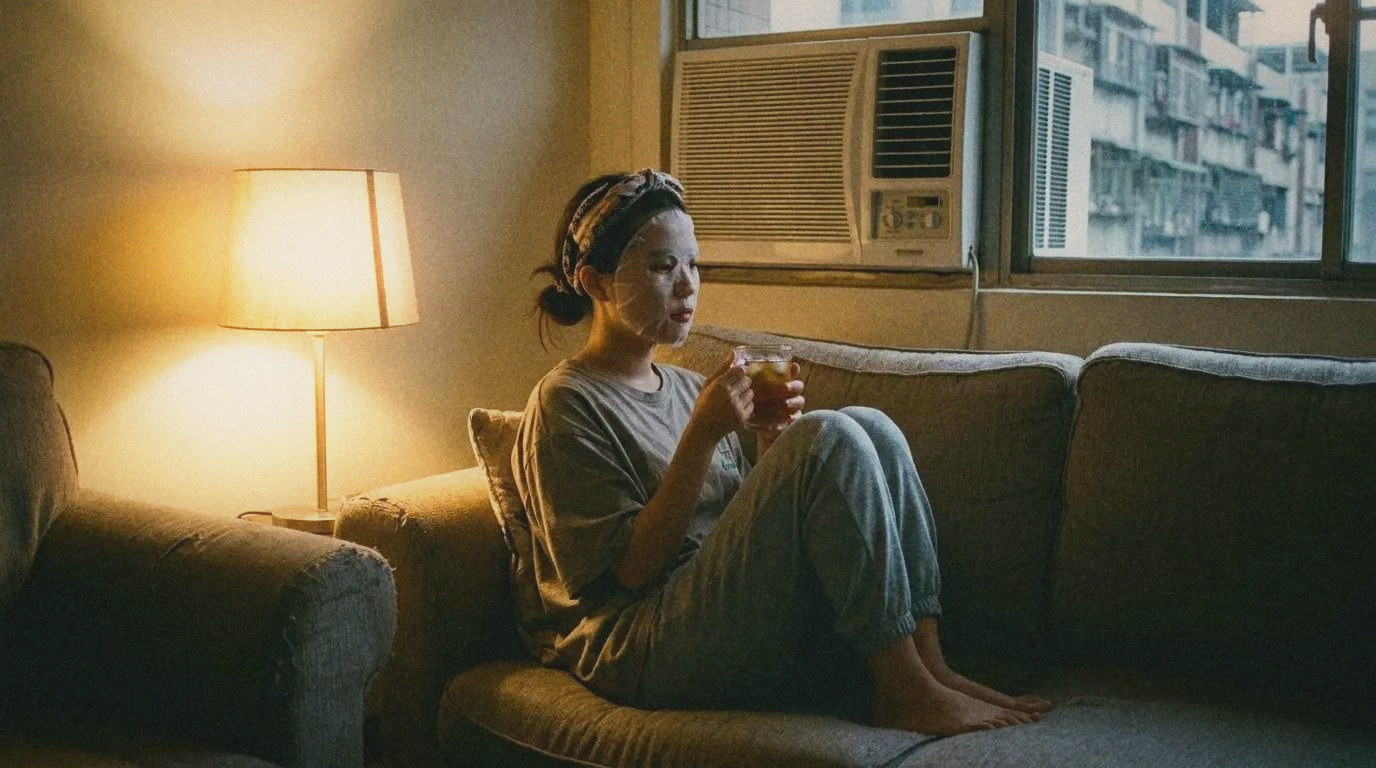 FIRST SIGHTWEBGLThe post-night-market sheet mask ritual: a cold mask from the fridge, a cold drink, and ten minutes of nothing. · Color and grain by First Sight · Portra 400. · First Sight 色彩與顆粒調校 · Portra 400
What not to do
I learned most of these the hard way.
Don't bring your heavy Western moisturizer and keep using it out of loyalty. Your CeraVe in the tub, your Clinique Moisture Surge, your whatever-thick-cream-you-love. They were perfect for where you lived before. In Taiwan's humidity, they're too much. Switch to gel or water-based formulas and save the cream for the brief winter dry spell, if it comes at all.
Don't skip sunscreen because it's cloudy. Taiwan's cloud cover blocks visible light but lets through a significant portion of UV radiation. You can absolutely get sun damage on an overcast Taipei day.
Don't wash your face more than twice a day thinking it'll control oil. It won't. It'll strip your barrier, which makes your skin produce more oil to compensate, which makes everything worse. Twice a day, gentle cleanser, that's it.
Don't assume your skin type is the same here as it was somewhere else. I was "dry" in California. In Taiwan, I'm "combination." Humidity changes the game. Start from zero and observe what your skin actually does here, not what it used to do somewhere else.
Where to shop
The budget breakdown
A complete humidity-adapted routine in Taiwan doesn't need to be expensive. Here's what a realistic setup costs.
Compare that to what many people spend on a single "luxury" moisturizer that's too heavy for this climate anyway. The effective products here are not the expensive ones. They're the ones that match the humidity.
Seasonal adjustments
Taiwan has seasons, and your skin notices. From June through September, the humidity is relentless and you can pare down to the simplest version of the routine: cleanser, hydrating toner, sunscreen. Maybe skip the gel moisturizer entirely on the most humid days.
October through February, especially in northern Taiwan, humidity drops to the low 70s and the northeast monsoon brings cooler, sometimes drier air. This is when you might add a lightweight emulsion on top of your toner, or switch your gel moisturizer for something slightly richer. It's also when your skin might feel that familiar dryness again. Don't overcorrect by going back to heavy creams. A single layer of light emulsion is usually enough.
March through May is transition season. Watch your skin and adjust weekly. Some days feel like summer. Some feel like winter. This is the time to have both a gel and a light emulsion on hand and choose based on the morning humidity reading.
FAQ
Do I really need to double cleanse every night? If you wore sunscreen (and you should be wearing sunscreen), yes. Oil-based cleanser first to break down the SPF, then water-based to clean the skin. Single-cleanse won't fully remove modern sunscreen formulas, especially waterproof ones. The leftover residue mixes with nighttime sebum and clogs pores.
Is expensive skincare better for humid climates? No. The most recommended products for Taiwan's humidity are drugstore staples. The Hada Labo Gokujyun Lotion is under NT$440. Biore UV Aqua Rich is around NT$300. Dr. Wu's products are mid-range. What matters is formula type (water-based, gel, lightweight), not price point.
My skin was clear before Taiwan. What happened? Probably a combination of increased sebum production from humidity, a moisturizer that's too heavy for the climate, and possibly not removing sunscreen thoroughly at night. Start with switching to a gel moisturizer and adding double cleansing. Most people see improvement within two to three weeks.
Can I use retinol in Taiwan? Yes, but be more careful about sun protection than you would be in a less sunny climate. Use retinol at night only, start with a low concentration, and be religious about SPF 50 sunscreen the next morning. The UV exposure here means any photosensitizing active requires extra diligence.
What about toner with alcohol? I've heard it controls oil. Alcohol-based toners strip your moisture barrier, which triggers rebound oil production within hours. It feels matte for thirty minutes and then makes things worse. Use an alcohol-free hydrating toner instead. Your skin will produce less oil when it's properly hydrated, not when it's stripped.
Is the water in Taiwan hard on skin? Taipei's water is relatively soft. In some southern cities, the water is slightly harder, which can leave a film and make cleansing less effective. If you notice your skin feeling tight or filmy after washing, a micellar water as a final cleansing step can help. But for most people in Taipei, this isn't a significant factor.
Comments (0)
Loading comments...