
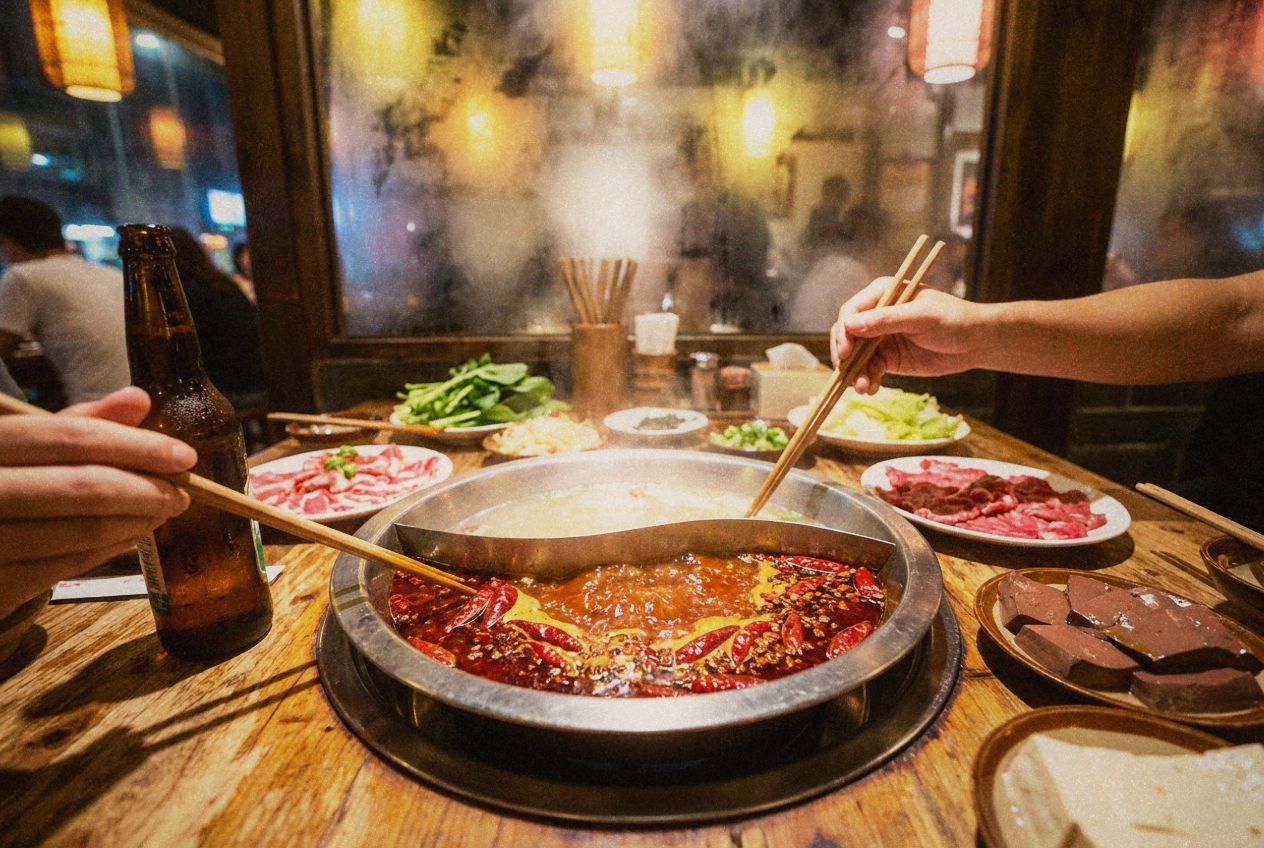
The window fogs up first. You notice it about ten minutes in, when the mala broth has been rolling long enough to fill the room with steam, and the glass between you and the scooters on the street goes soft and white. Someone has just dropped a whole plate of duck blood into the red side of the pot. The beer is cold. It is maybe eight degrees outside, which in Taipei feels colder than the number, and none of that matters anymore because you are inside, and there is a pot.
Hot pot is not one thing here. It is a whole grammar of eating, and Taipei speaks all its dialects. The mistake newcomers make is treating 火鍋 like a single restaurant category, the way you might treat "pizza." It is closer to "dinner." What you want depends entirely on who you are with, how cold it is, and how much of the night you plan to give away. So this is a guide by mood, not by ranking. Find the night you are having, and go.
The mala night with friends
This is the loud one. Four of you, a split 鴛鴦 pot with the numbing-spicy 麻辣 broth on one side and something gentle on the other, and a table that slowly disappears under plates. Mala hot pot is Sichuan by way of Taiwan, which means the 花椒 that makes your lips buzz has been dialed toward flavor rather than pure pain, and the star of the pot is not even the meat. It is the 鴨血, duck blood congealed into silky dark cubes, and the 豆腐, both of which soak up the broth and deliver it back to you in one soft, dangerous bite.
Go to 詹記 (Chan Ji) if you want the version everyone argues about. They have been at this since 1994, and their 果凍鴨血, "jelly duck blood," is genuinely the smoothest in the city. The 敦南 branch sits at 和平東路三段 60 號 in Da'an and stays open past midnight, which tells you what kind of restaurant it is. Pot bases run NT$380 to NT$620. Order the 美國安格斯牛小排 if the table is feeling rich, the 松阪豬 if it is feeling smart. For a slightly rowdier, later version, 麻神 near the 南京東路 and 光復北路 corner does a three-person base for NT$380 and just keeps the night going.
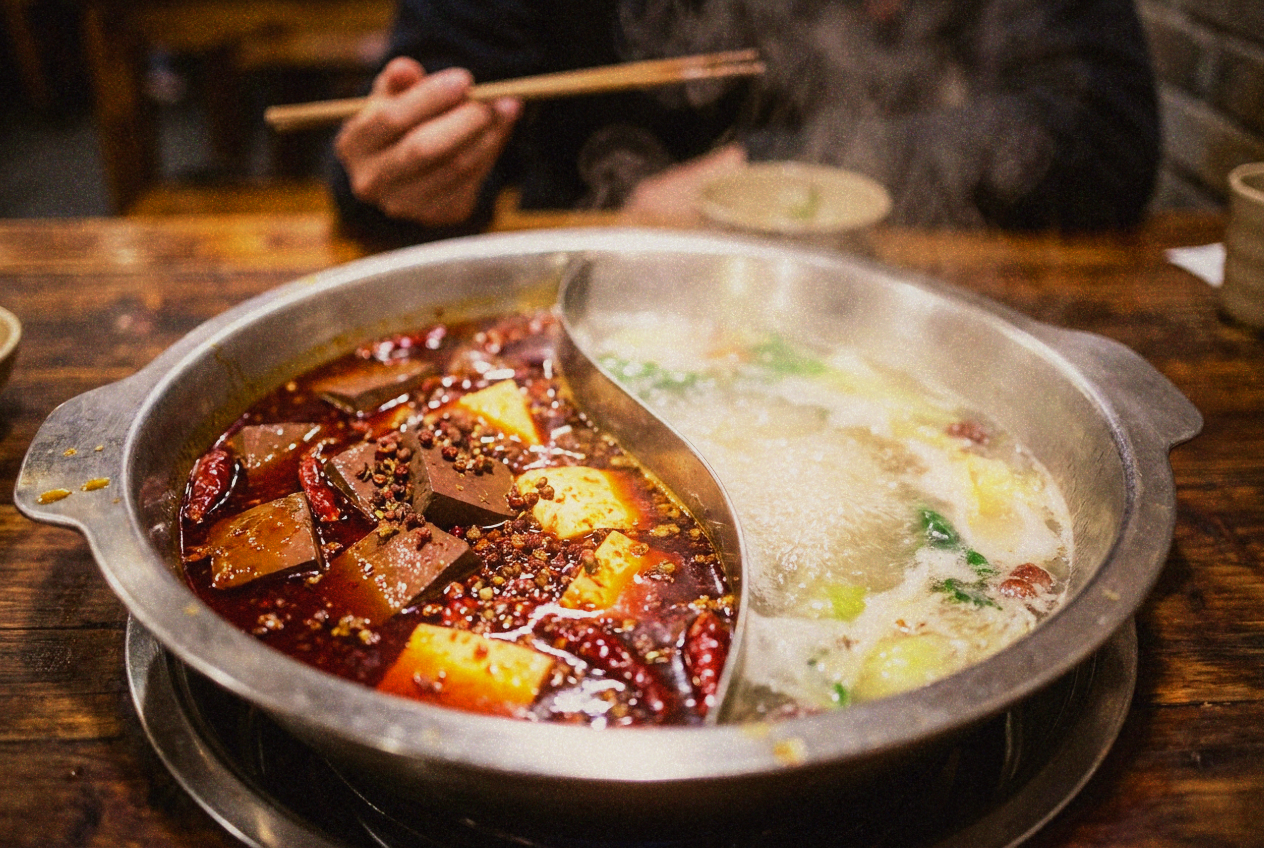
 FIRST SIGHTWEBGLThe mala half is the loud one, but the plain half is where the tofu and duck blood quietly do their best work. · Color and grain by First Sight · Gold 200. · First Sight 色彩與顆粒調校 · Gold 200
When it needs to be all-you-can-eat
Some nights are not about restraint. A birthday, a team that just shipped something, a group where two people are vegetarian and one only eats beef. This is what 吃到飽 was built for. 馬辣 is the name people reach for first, and the flagship 西門 branch on 西寧路 108 號 runs from 11:30 in the morning until two in the morning, which is a sentence that should tell you everything. Weekday lunch starts around NT$598 plus ten percent, dinner around NT$698 to NT$798. The move is not to eat the most expensive thing available. It is to eat a lot of the things that are annoying to prepare at home: fresh seafood, hand-sliced beef, and, at the end, an unreasonable amount of Häagen-Dazs from the freezer everyone pretends they are not going back to.
The trap of all-you-can-eat is filling up on the wrong things. Skip the fried snacks and the instant noodles until the very end. Your stomach has a budget. Spend it on meat and seafood, not on 王子麵.
The family sour-cabbage pot
This one is older and quieter, and it comes from the north. 酸菜白肉鍋 is a copper pot with a chimney up the middle, charcoal glowing inside it, and a broth turned cloudy and sour by fermented Napa cabbage. Thin-sliced pork belly goes in raw and comes out seconds later, and you dip it in a sauce built on 韭菜花 and fermented tofu that you mix yourself at the table. It tastes like winter and like somebody's 外婆, and it is the pot most likely to end with the whole family too full to speak.
The old guard holds up. 長白小館 in the east district, tucked at 光復南路 240 巷 53 號, has been doing this for decades and adds crab and dried shrimp to deepen the broth. 圍爐 on 仁愛路四段 does a business lunch that lands around NT$400 to NT$500 a head, which for this style of cooking is a small miracle, though the evening 中鍋 climbs to NT$1,460. If you want the version a Michelin inspector blessed, 都一處 carries a Bib Gourmand and a location at 仁愛路四段 506 號. The ritual detail worth knowing: order a 燒餅, split it, and stuff it with a tangle of sour cabbage and pork. Nobody puts this on the menu. Everybody does it.
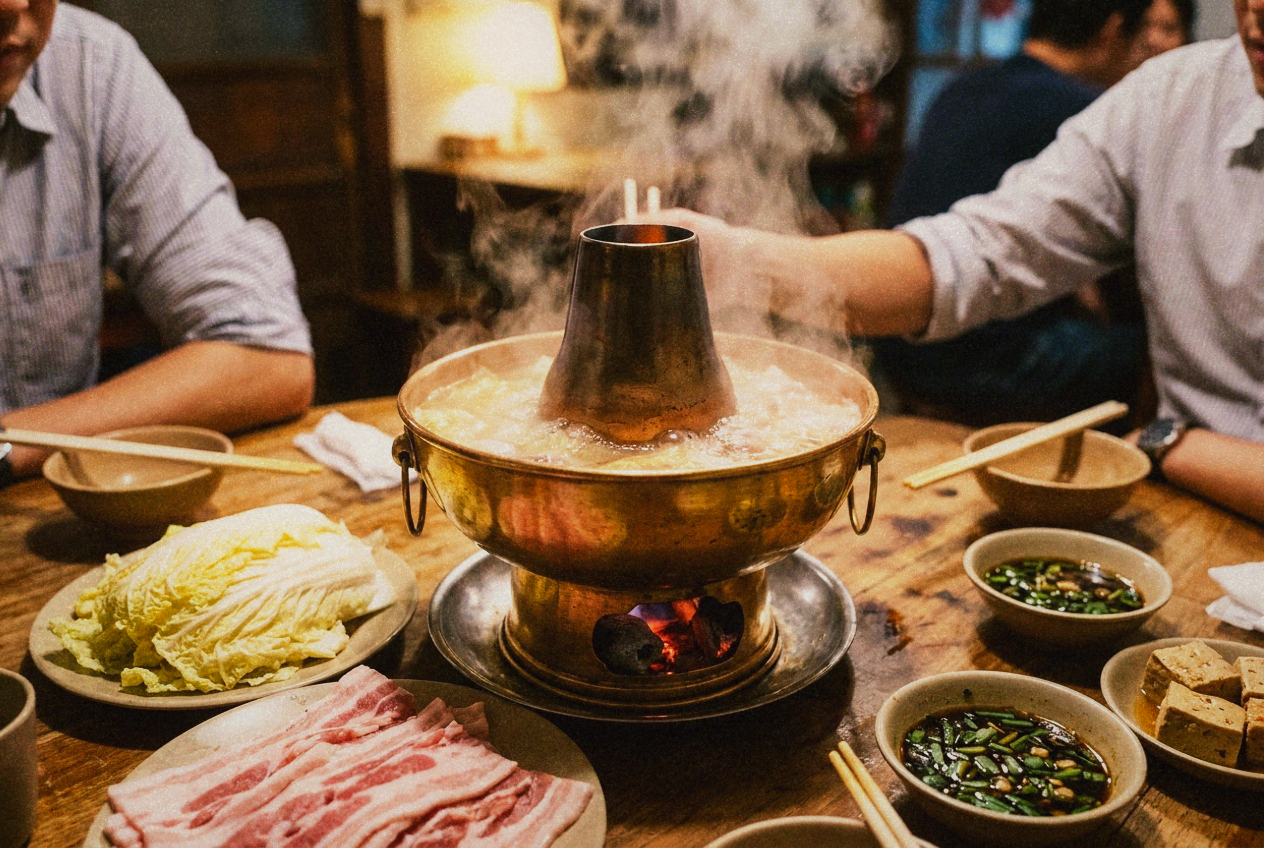 FIRST SIGHTWEBGLThe chimney is not for show. The charcoal inside keeps the sour broth at a rolling simmer while you work through the pork. · Color and grain by First Sight · Gold 200. · First Sight 色彩與顆粒調校 · Gold 200
The solo weeknight, no apology
There is a particular Taipei loneliness that hot pot cured before anyone called it self-care: eating alone on a Tuesday. The 個人鍋, the personal one-pot, exists so you never have to feel strange about it. 石二鍋 is the reliable answer, a single portion from around NT$248 with free refills on broth, sauce, and drink, and a choice of pork, beef, chicken, or fish. Their sauce bar is the actual reason to go. A good 沙茶 base with raw egg, garlic, soy, and a spoon of the chili oil is a rite of passage, and everyone's ratio is slightly wrong in a way they will defend to the death.
If the craving is Japanese and bottomless, 涮乃葉 (Syabuyo) does a shabu-shabu buffet from around NT$480 at weekday lunch, with a self-service bar of a hundred-odd vegetables, and the swishing of paper-thin beef through clear 昆布 broth that gives shabu its name. Either way, you are at a counter, you are warm, and no one is looking at you. That is the whole gift.
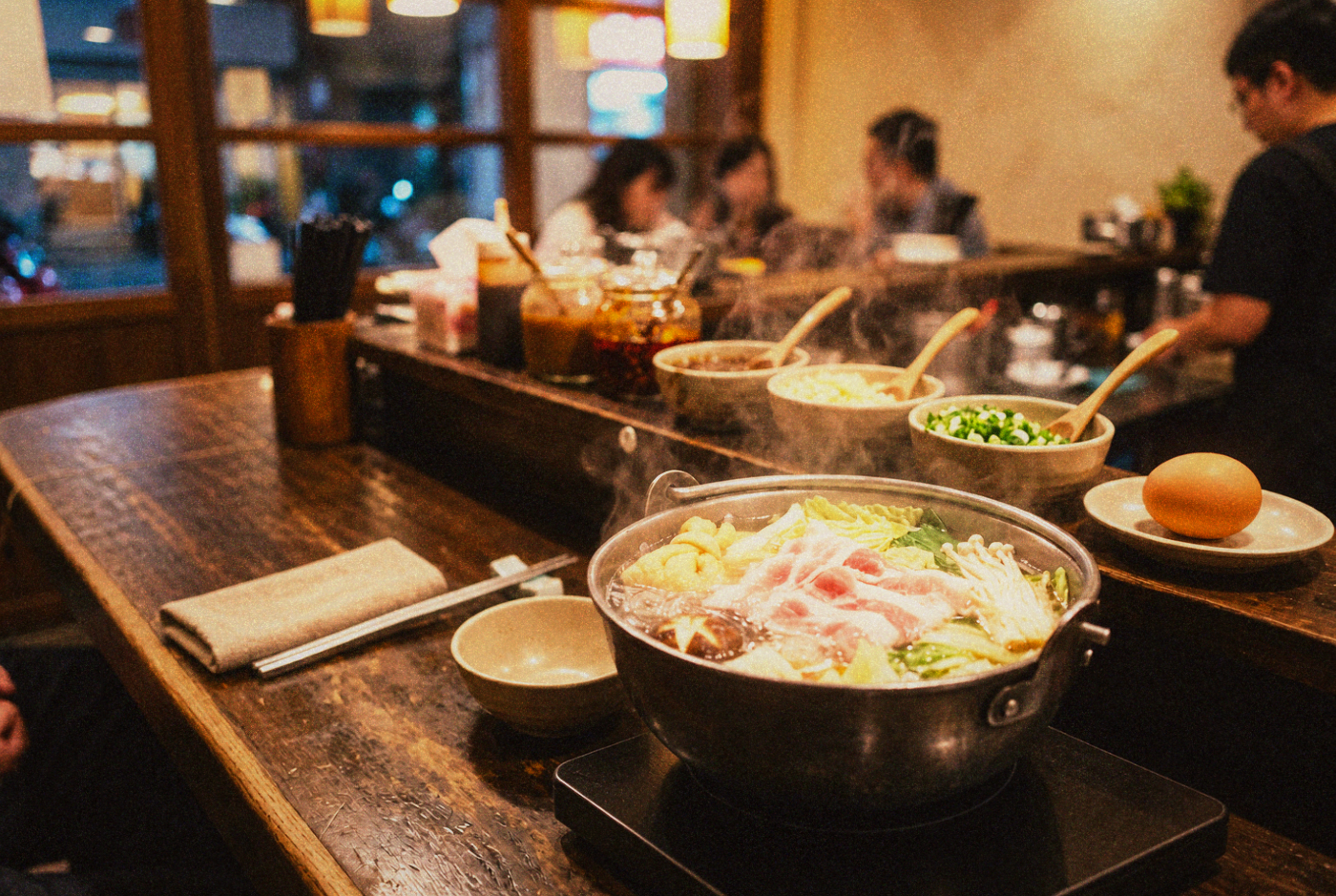 FIRST SIGHTWEBGLThe personal pot took the shame out of the solo Tuesday dinner. The sauce bar is the real reason regulars come back. · Color and grain by First Sight · Gold 200. · First Sight 色彩與顆粒調校 · Gold 200
The cold-snap medicine
When a genuine cold front comes through, and it does, a few times each winter, Taipei stops wanting hot pot and starts craving its stranger cousins: 薑母鴨 and 羊肉爐. These are less hot pot than warming medicine that happens to arrive in a bubbling clay pot. 薑母鴨 is duck stewed with old ginger, sesame oil, and rice wine until the broth is dark and almost medicinal, and you add 米血, tofu skin, and enoki as you go. The charcoal-fired ones are worth the search. 鴨味仔炭火薑母鴨 near 龍山寺 station on 莒光路 does it over real charcoal and also runs a red-braised 羊肉爐 and a 九尾雞. You will walk out smelling of sesame oil and ginger and you will not care, because your whole body will finally be warm.
How to eat it well
A few things separate people who grew up with hot pot from people learning it. Build your sauce before the food arrives, not after, so the flavors marry. Sesame-based 麻醬 belongs with the sour-cabbage pot; 沙茶 belongs almost everywhere else. Cook in order: dense things and root vegetables first because they take longest, leafy greens and thin meat last because they take seconds. Keep the raw meat and the cooked food on separate ends of the table, and never let the pot go dry, which means asking for a broth top-up long before you think you need one. Add the 冬粉 or noodles at the very end, when the broth has become the best thing in the pot, seasoned by everything that swam through it.
And then sit there. The point of hot pot is not efficiency. It is the three hours. It is the slowing down, the arguing over whether the meat is done, the last piece of tofu nobody claims. On a cold Taipei night, with the window fogged and the street gone quiet, it is the closest thing the city has to a fireplace.
Comments (0)
Loading comments...