
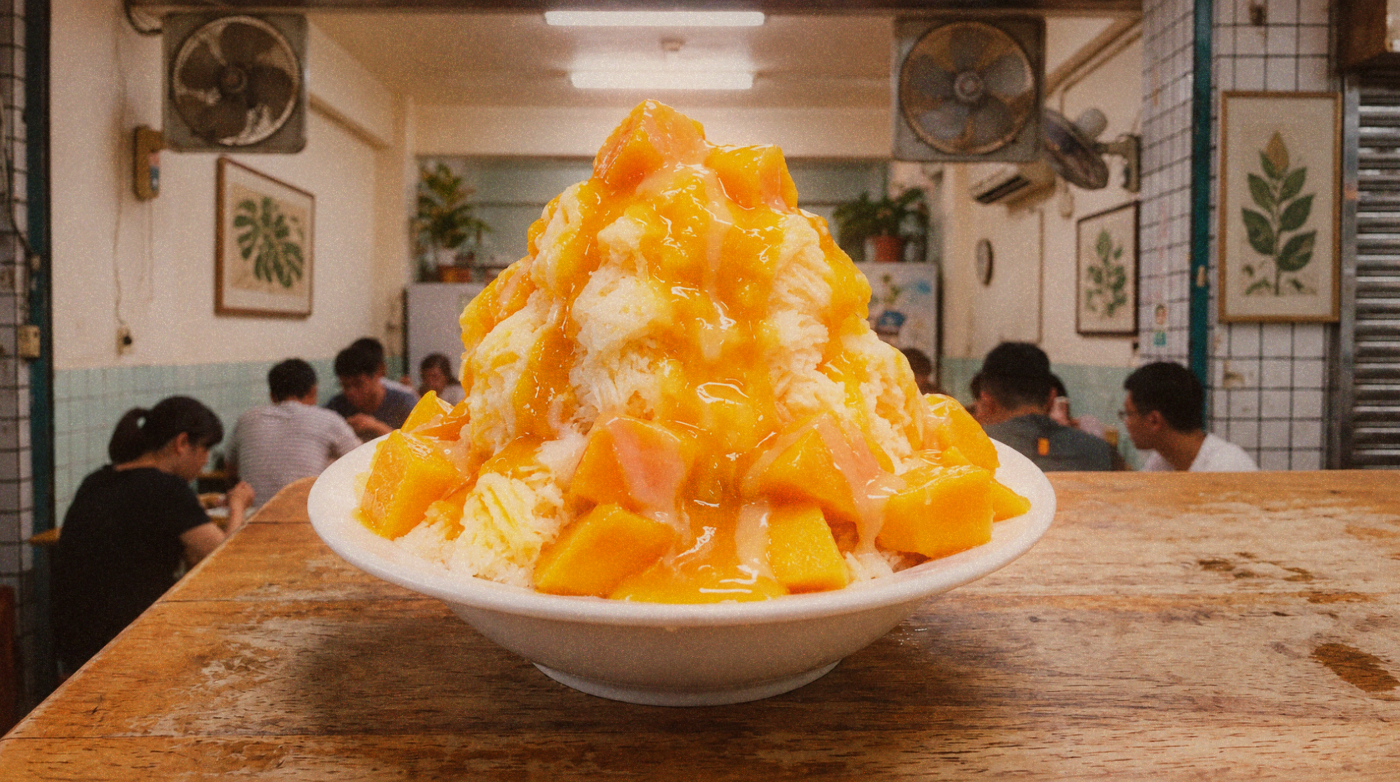
The sound is what you notice first. A low mechanical grind, then a high whine as the blade catches the block. At Bingzan on Shuanglian Street, the ice machine sits right behind the counter, so you hear it before you see your bowl come together. The aunty working the station grabs a mango from the stack, slices it in clean arcs directly over the shaved ice, then drizzles condensed milk and a thick mango sauce that's a shade darker than the fruit. The whole process takes maybe ninety seconds. There's no menu deliberation. Almost everyone orders the same thing.
It's a Tuesday afternoon in June, 34 degrees outside, every seat taken. A couple near the door eats fast, almost urgently, because the ice starts collapsing the moment it hits the table. That's the thing about shaved ice in Taipei. It's a race against thermodynamics.
Mango shaved ice gets most of the tourist attention, deservedly so, but it's one branch of a much larger tree. To eat well through a Taipei summer, you need to understand what you're looking at.
Three kinds of ice, three different experiences
Walk into any ice shop in Taipei and you'll encounter one of three styles. They look similar from a distance. They're very different in your mouth.
刨冰 (baobing) is the original. Coarse shaved ice, granular and crunchy, piled into a bowl and loaded with toppings. The ice itself isn't the star. The toppings are: red bean, green bean, taro balls, grass jelly, tapioca pearls, peanuts, whatever you point at behind the glass. A ladle of sugar syrup or condensed milk ties it together. Cheap (often NT$50 to NT$70), satisfying, and completely unfussy. You'll find it at night markets and old-school shops that haven't changed their signage since the 1990s.
雪花冰 (xuehuabing), snow ice, is the refinement. The base is frozen milk or flavored liquid, shaved into ribbons so thin they look like fabric. The texture is closer to gelato than to traditional ice. It melts on your tongue instead of crunching. This is the format that made mango shaved ice famous internationally, because the milk base amplifies the fruit in a way plain ice can't. Typically NT$150 to NT$250 per bowl.
綿綿冰 (mianmianbing), cotton ice, splits the difference. The texture is smoother than baobing but denser than snow ice, almost like a very soft sorbet. The flavor is usually baked into the ice itself (taro cotton ice, mango cotton ice) rather than added on top. You'll see this less often in dedicated ice shops and more in night market stalls, served in a cup with a spoon.
The distinction matters because it determines what you should order where. Asking for baobing toppings on snow ice is like putting ketchup on sashimi. Technically possible. Culturally confused.
Distinct styles of Taiwanese shaved ice. 刨冰 (coarse, topping-focused), 雪花冰 (milk-based ribbons), and 綿綿冰 (dense and smooth). Each has its own shops, its own logic, and its own loyal following. Knowing which is which saves you from ordering the wrong thing.
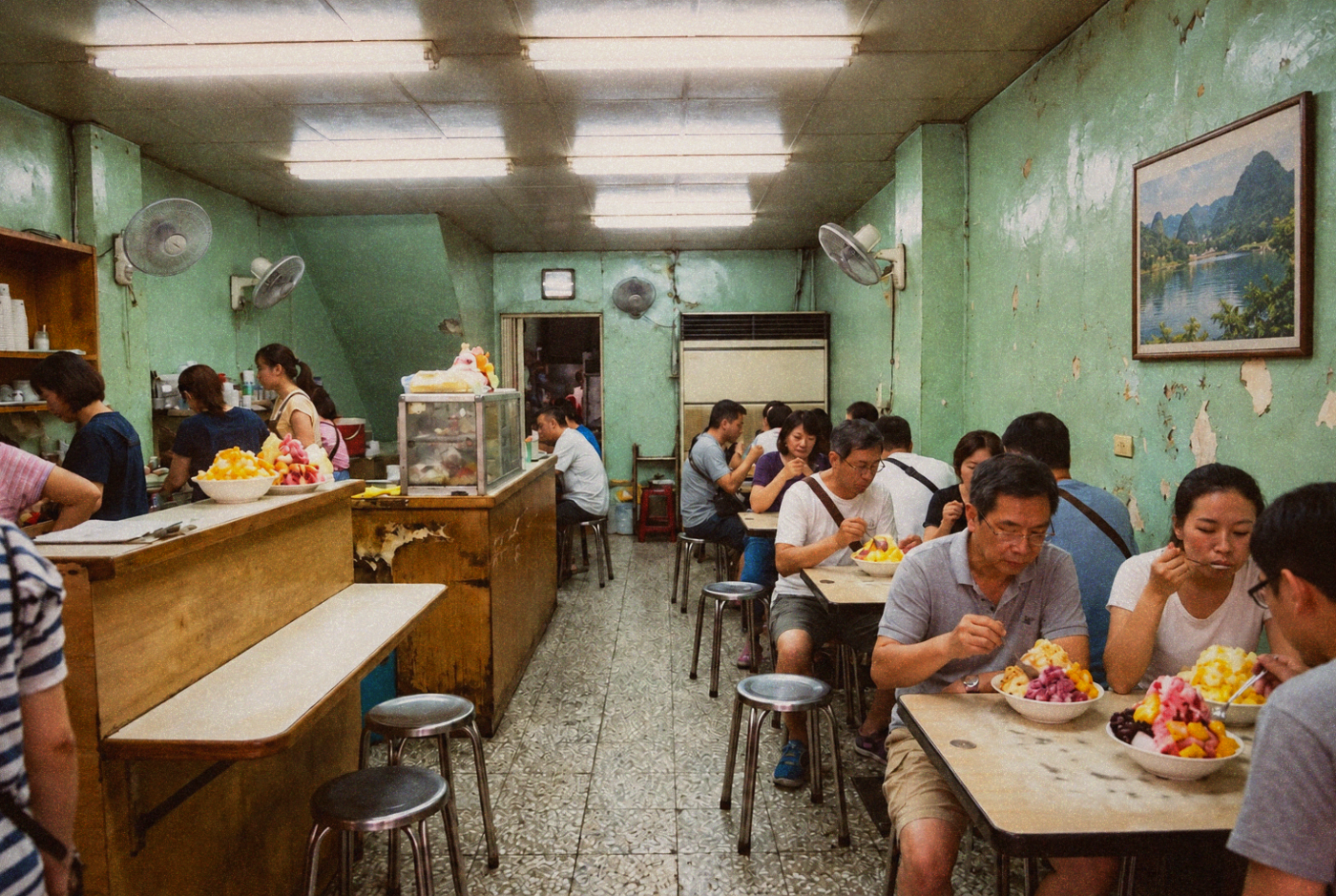
 FIRST SIGHTWEBGLA cool bowl of shaved ice and a seat inside a neighborhood shop. · Color and grain by First Sight · Gold 200. · First Sight 色彩與顆粒調校 · Gold 200
The mango ice shops that actually matter
Mango season in Taiwan runs roughly May through September, peaking in June and July when Aiwen and Jinhuang mangoes from Tainan and Pingtung flood the markets. During those months, mango shaved ice becomes something close to a civic obligation.
Bingzan (冰讚) is the one locals send you to. 雙連街2號 in Datong District, five minutes from Shuanglian MRT, 11:30am to 11pm daily. The mangoes are cut to order, not pre-sliced and sitting in a tray, which keeps the flavor brighter and the texture firmer. Shaved ice, fresh mango, mango sauce, condensed milk. That's it. When mango season ends, Bingzan pivots to hotpot from November through March, which is either pragmatic or poetic depending on how much caffeine you've had.
Chunmei Ice Shop (春美冰菓室) at 敦化北路120巷54號 in Songshan District, three to four minutes from Nanjing Fuxing MRT Exit 7. The retro look isn't curated. The shop has just been open long enough to come back into style without trying. Mango milk ice is NT$220 and generous. But the real move is the handmade almond tofu, recommended by Chef Andre Chiang, which tastes nothing like the rubbery almond jelly at buffets. Silky, lightly sweet, worth ordering even if you came for the mango. They also do taro milk ice, pearl milk tea ice, matcha ice, and a black sugar shaved ice from NT$85. Pay first at the counter, pick up by number.
Smoothie House (思慕昔) at 永康街15號 sits near the old location where Ice Monster built its original reputation. The Yongkang Street area remains ground zero for mango ice tourism, and Smoothie House handles the volume without cutting corners. If you're already there for Din Tai Fung or the Yongkang food walk, this is the natural stop.
Ice Monster now operates at 松高路16號 in Xinyi District. The original Yongkang shop closed after a family dispute, and the brand restarted in the commercial district. More polished than the old-school spots, price reflects the location. Worth visiting if you're already in Xinyi, not worth crossing the city for.
Mango Emperor (芒果皇帝) at 永康街2巷2-1號 rounds out the Yongkang cluster. Smaller, solid mango ice, typically shorter lines.
Beyond mango: the flavors locals actually eat all summer
Mango ice is seasonal and tourist-facing. Taiwanese people eat shaved ice year-round, and the toppings they choose tell a different story.
Taro (芋頭) might be the more beloved flavor across the island. Real steamed taro, mashed until creamy but still textured, layered over snow ice with condensed milk. Chunmei's taro milk ice is a strong version. The flavor is earthy and subtly sweet, nothing like the artificial taro flavoring in boba drinks.
Matcha (抹茶) snow ice has become popular in Taipei, especially at shops sourcing Japanese-grade matcha powder. The bitterness against condensed milk sweetness works particularly well in the snow ice format.
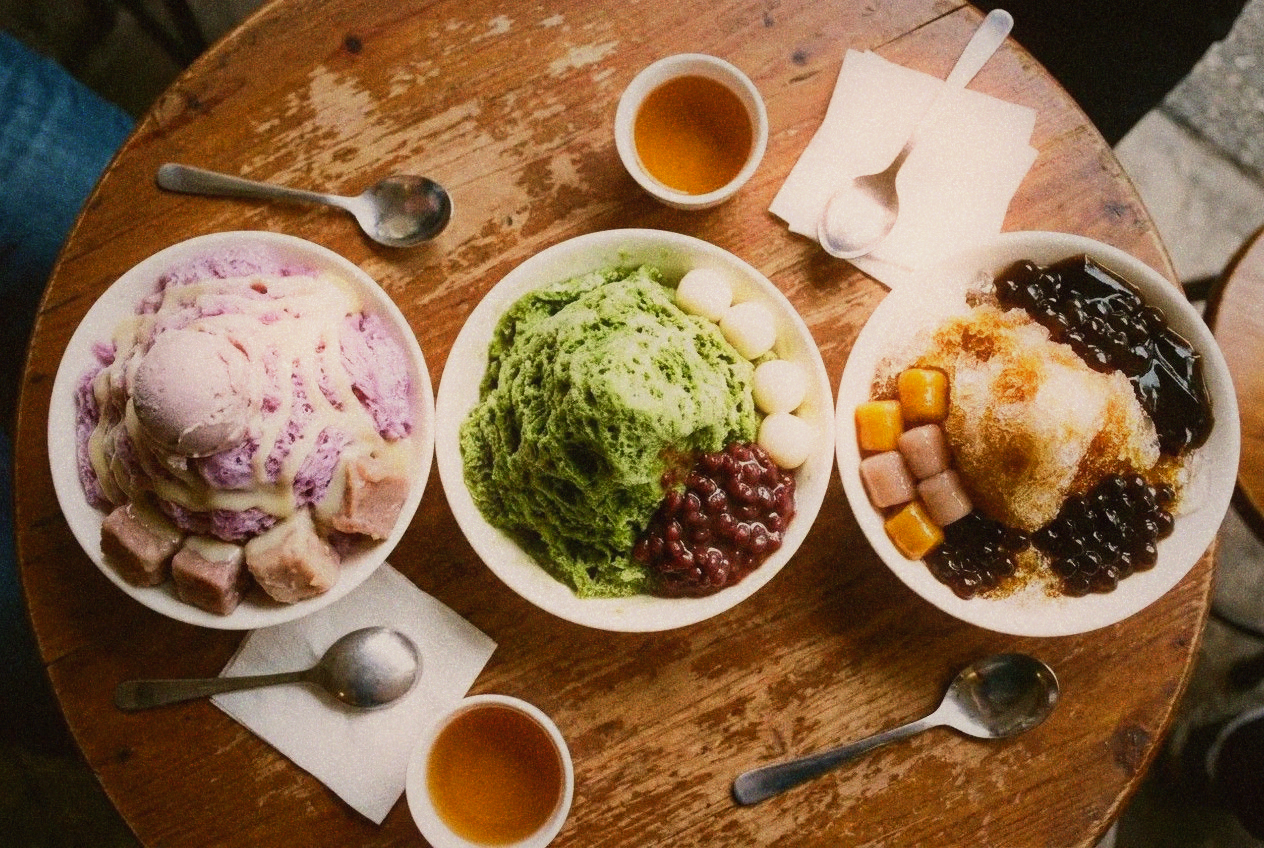 FIRST SIGHTWEBGLTaro, matcha, and traditional: Taipei's shaved ice shops serve every flavor you can imagine · Color and grain by First Sight · Gold 200. · First Sight 色彩與顆粒調校 · Gold 200
Traditional topping bowls are where the real depth lives. A classic baobing order: red bean (紅豆), slow-cooked until the skins split, alongside grass jelly (仙草), cubed and wobbly, with tapioca pearls and sugar syrup. Every neighborhood ice shop has its own combination. Regulars have standing orders. This version doesn't photograph well but tastes like Taipei summers.
The tourists line up for mango ice, which is fair. But if you leave Taipei thinking shaved ice is only about mango, you've missed most of the menu and all of the local obsession with toppings.
The other ways Taipei stays cool
Shaved ice dominates, but Taipei's summer dessert landscape extends well beyond it.
Douhua (豆花) is soft tofu pudding in a light ginger or sugar syrup. The texture, when done right, is barely there. It trembles on the spoon. Cold in summer, warm in winter, with the same toppings as shaved ice: red bean, peanuts, taro balls, tapioca. A cold douhua on a 35-degree afternoon is one of the most quietly satisfying things in this city. Most traditional shops sell it for NT$40 to NT$60.
Aiyu jelly (愛玉) is uniquely Taiwanese. The seeds of a native mountain fig are rubbed in water until they release a pectin that sets into a golden, barely-flavored jelly. Served with lemon syrup and ice. The taste is subtle, more about temperature and texture than flavor. Good aiyu has a clean, slightly citric quality. Bad aiyu tastes like lemon water with gelatin. Night market stalls sell it cheaply, but quality varies wildly.
Grass jelly (仙草) shows up as a shaved ice topping, but it's also served on its own in sweetened water with ice. In southern Taiwan, grass jelly drinks are as common as bubble tea. The flavor is herbal and slightly bitter, like a mild tea. It grows on you. By the end of a Taipei summer, you'll be craving it.
FAQ
When is mango shaved ice season?
May through September, peaking in June and July. Some shops start in April with early fruit, but the flavor is better mid-summer. After September, most mango ice shops switch flavors or close. Bingzan switches to hotpot.
How much does shaved ice cost?
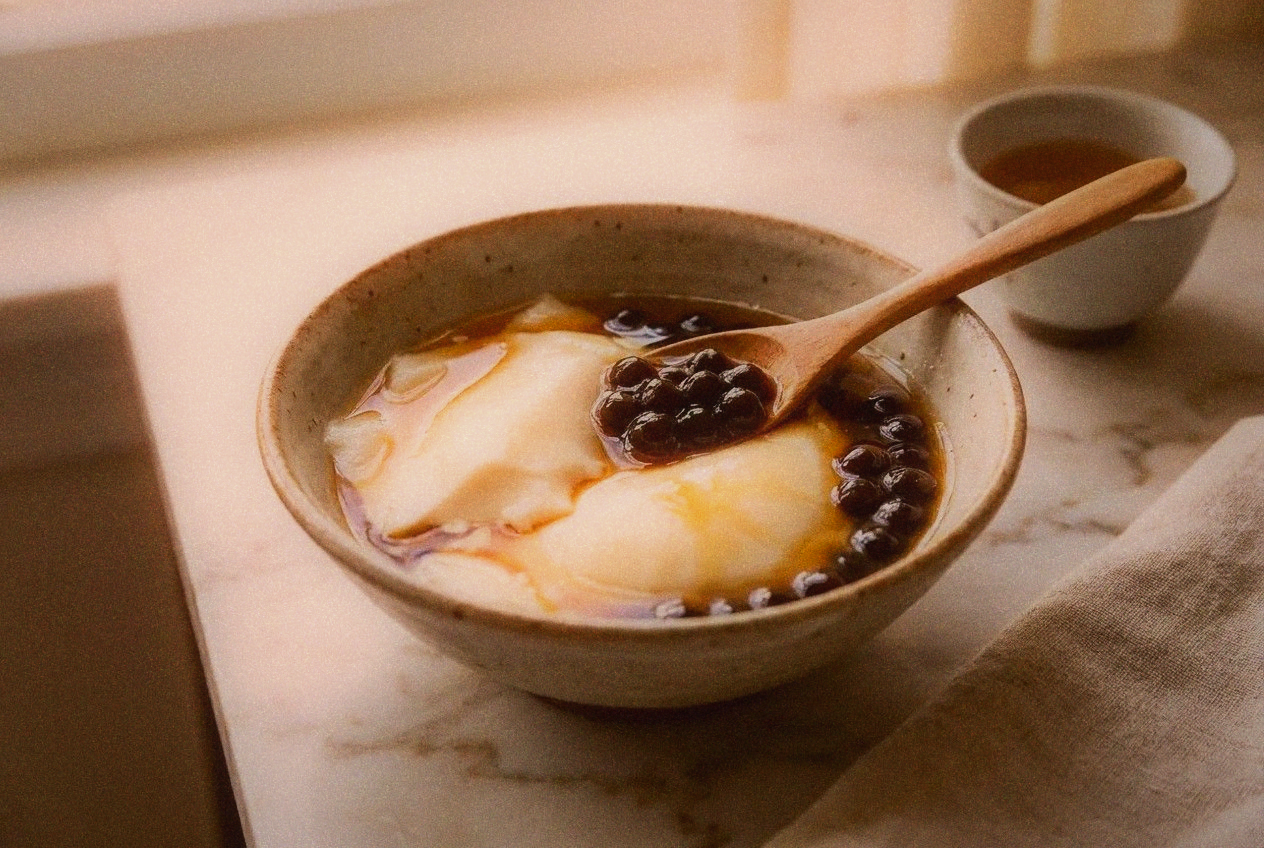 FIRST SIGHTWEBGLDouhua with ginger syrup and tapioca: sometimes the simplest desserts win · Color and grain by First Sight · Gold 200. · First Sight 色彩與顆粒調校 · Gold 200
Traditional baobing NT$50 to NT$80. Snow ice and mango bowls NT$150 to NT$250. Douhua and aiyu NT$40 to NT$60.
Can I get shaved ice in winter?
Yes. Baobing shops run year-round, often with warm toppings like hot red bean soup. Some snow ice shops reduce hours or close. Douhua shops switch to warm.
What's the difference between 雪花冰 and regular shaved ice?
Base and texture. Baobing shaves plain ice into coarse crystals. Snow ice freezes flavored milk, then shaves it into thin ribbons. Creamier, melts faster, costs more. Both good, just different desserts.
Is shaved ice safe for dietary restrictions?
Most is naturally gluten-free. Douhua is soy-based. Aiyu is vegan. Some toppings contain starch. Condensed milk is dairy. Pointing at toppings and asking "這個有什麼?" works at most shops.
Read next: The Best Bubble Tea Shops in Taiwan | Taipei Night Market Food Guide
Read next: Best Breakfast in Taipei | Taiwan Mango Season Guide
Comments (0)
Loading comments...