
Getting sick in a country that isn't yours is one of the quiet fears of moving abroad. You don't know where to go, you don't know what it will cost, and you don't know whether anyone will understand what hurts. Taiwan is one of the easiest places in the world to set that fear down. The island runs a single national health system that is fast, remarkably cheap, and open to foreign residents on almost the same terms as everyone else, and once you have used it once, the whole thing stops being frightening.
People who move here from the United States or much of Europe tend to have the same reaction the first time they see a doctor: a mix of disbelief and relief. You walk into a clinic without an appointment, wait a short while, see a doctor, walk out with your medicine, and pay less than you spent on breakfast. That is not a lucky day. That is just how it usually works.
The system that makes it all work
Taiwan's National Health Insurance, known locally as 健保, launched in 1995 and now covers virtually the entire population, foreign residents included. It is a single government-run scheme rather than a patchwork of private plans, which is exactly why it feels so simple in daily life. One card, one system, accepted almost everywhere from a tiny neighbourhood clinic to the largest teaching hospital. There is no network to check and no surprise bill waiting in the post a month later.
It is also, by design, comprehensive. Doctor visits, hospital stays, surgery, most prescription drugs, dental care, and even traditional Chinese medicine all sit under the same umbrella. You pay a modest monthly premium and a small fee each time you use it, and the system covers the rest. For most people the everyday cost of staying healthy here is low enough that they simply stop thinking about it.
Whether you qualify, and when
Enrolment is tied to legal residency, and the timing depends on why you are here. If you come to work, your employer normally signs you up from your first days on the job, and your coverage starts almost immediately. If you come to study, to join family, or on another kind of resident permit, you generally become eligible after you have lived in Taiwan legally for six continuous months, with one short trip abroad allowed inside that window.
Once you qualify, joining is not really optional, and that is a good thing: it keeps the pool wide and the price low. The premium is based on income, so a salaried worker and their employer share it, while someone without a local salary tends to pay a flat amount that lands somewhere in the range of a few hundred to eight hundred NT dollars a month. For what you get, it is one of the best deals in the world.

 FIRST SIGHTWEBGLThe health card is the key to the whole system. Hand it over at reception and everything else follows. · Color and grain by First Sight · Gold 200. · First Sight 色彩與顆粒調校 · Gold 200
The card that does everything
When you enrol you are issued a National Health Insurance card, a small chip card with your photo on it. This card is the thing you actually use. You hand it to the receptionist at any clinic or hospital, they tap it, and your record and coverage come up instantly. Keep it in your wallet next to your bank cards, because you will reach for it more often than you expect. There is now a virtual version and an app as well, but the physical card is still what most people carry.
Guard it the way you would a bank card, and if you lose it, a replacement is straightforward to arrange. The card is not just proof of insurance; it quietly carries your recent visit and prescription history, which is part of how a doctor you have never met can get up to speed on you in a minute or two.
Clinic or hospital? Start small
The single most useful habit to learn is to start small. For anything ordinary, a cold that won't quit, a rash, a sore ear, a stomach that has turned against you, you want a clinic, called a 診所, not a hospital. Taiwan is full of them, often several on a single block, and many are run by specialists: an ear-nose-and-throat clinic here, a dermatologist there, a paediatrician around the corner. You rarely need an appointment. You walk in, register, and wait for your number.
Hospitals, the big 醫院, are for serious illness, injuries, specialist referrals, and emergencies. They are excellent, but they are busier and more expensive to walk into cold, and the largest medical centres often expect you to book a numbered slot online or by phone before you arrive. Going straight to a major hospital for something a clinic could handle also costs you more out of pocket, a gentle nudge from the system to see the neighbourhood doctor first.
How a clinic visit actually goes
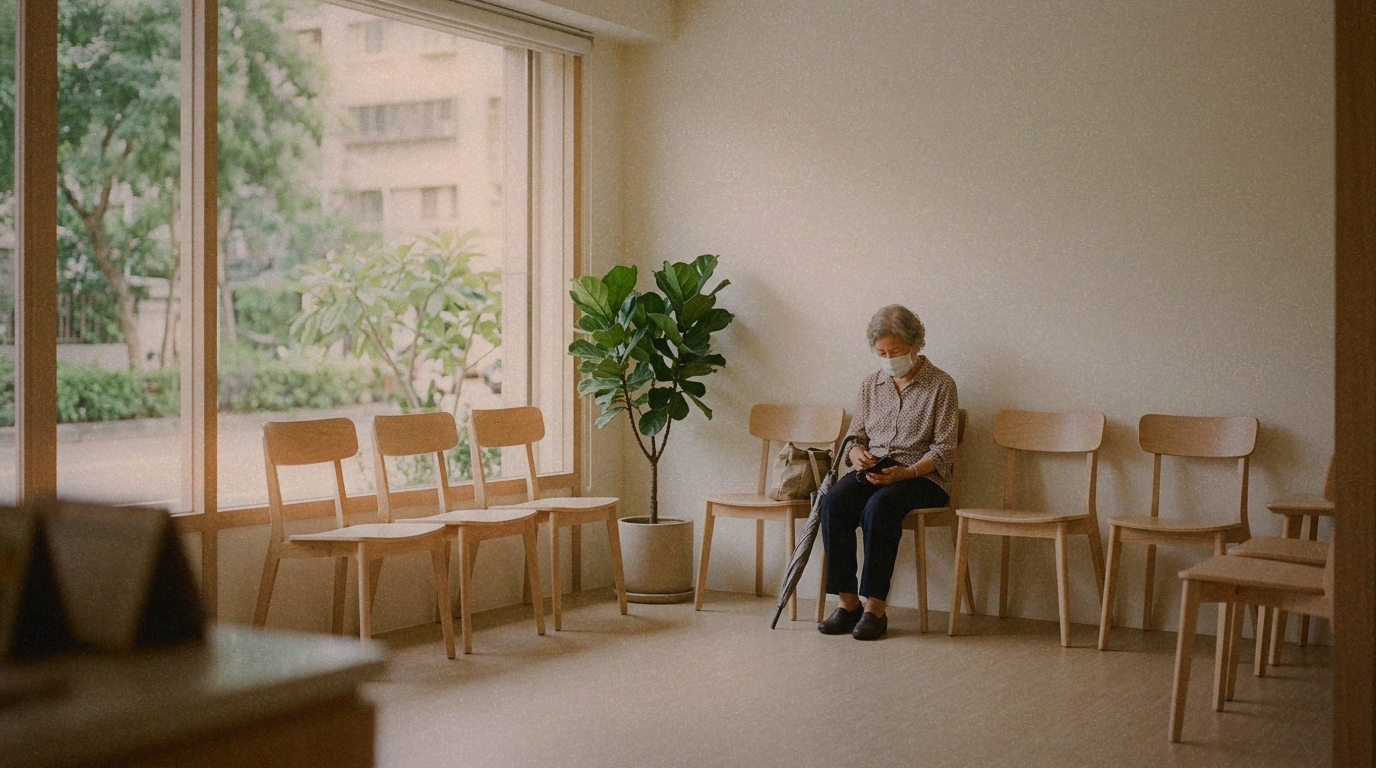
The first time is the only awkward one. You find a clinic, step inside, and hand your health card to the person at the desk, usually with a small registration fee. They give you a number. You sit in the waiting room, which more often than not is calm and bright, until your number comes up on a screen or is called out. The doctor sees you, and here the pace can surprise Westerners: consultations are efficient, sometimes only a few minutes, but competent and to the point.
After the doctor, one of two things happens. Many clinics dispense your medicine on the spot from a little window, so you pay your small copay, collect a neat paper packet of pills, and you are done, often within the hour. Others hand you a prescription to take to a pharmacy. Either way the amount you pay at the end is usually small enough to make first-timers ask whether they have misheard.
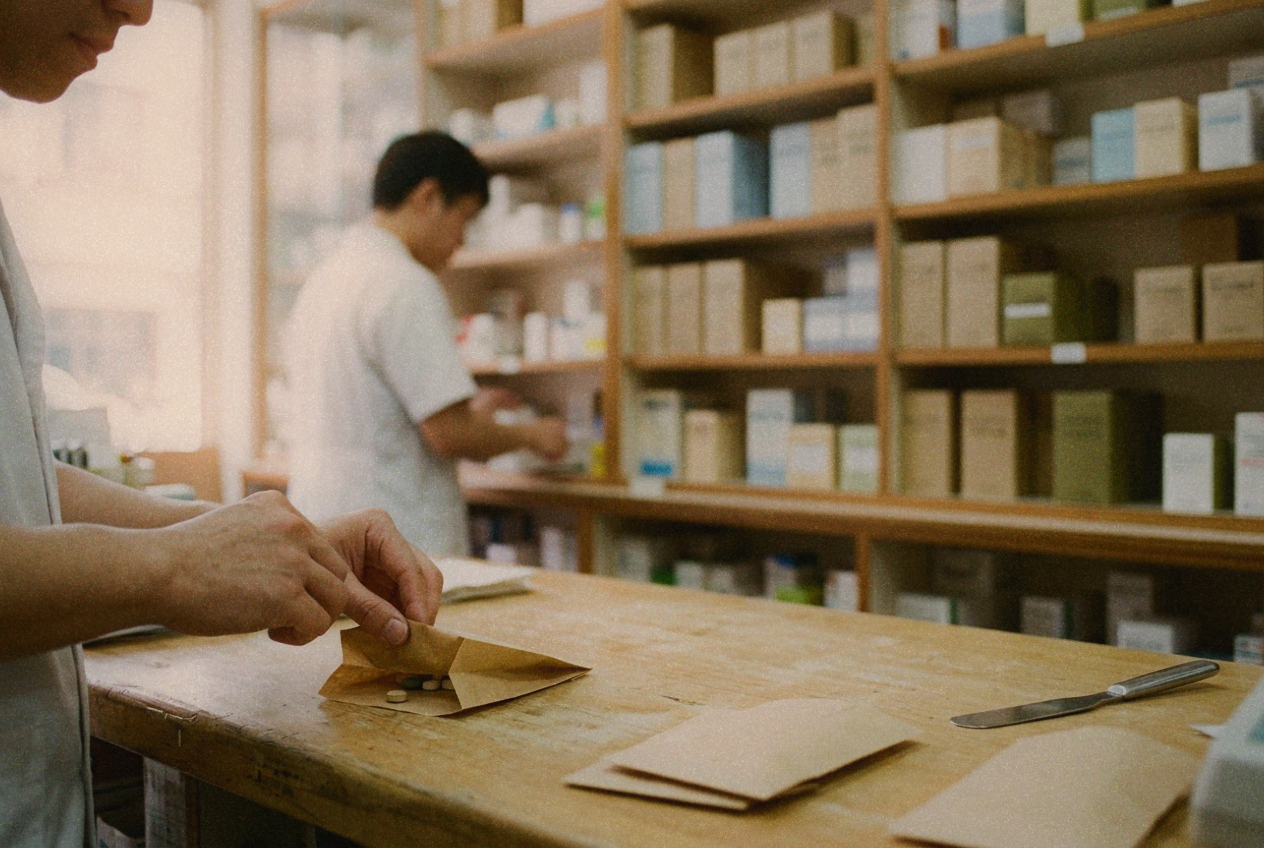 FIRST SIGHTWEBGLMany clinics dispense medicine on site; where they don't, a contracted pharmacy fills the prescription for the same small copay. · Color and grain by First Sight · Gold 200. · First Sight 色彩與顆粒調校 · Gold 200
Prescriptions and the pharmacy
Pharmacies, 藥局, are everywhere, and the ones contracted with national health insurance will fill your prescription for the same low copay you would pay at a clinic window. Pharmacists here are knowledgeable and generally happy to help, so if you are unsure about a medication, ask. It is worth knowing that prescription-only drugs, antibiotics in particular, really do require a prescription, so you cannot simply buy them over the counter.
For everyday, non-prescription needs, painkillers, cold remedies, plasters, stomach medicine, you have two easy options. Independent pharmacies stock all of it, and so do the chain drugstores you will see on every busy street, where the same shelves also hold skincare and toiletries. If you take a regular medication from home, bring an empty box or a photo of the packaging; the generic name printed on it helps a pharmacist find the local equivalent fast.
Chinese medicine and dental, also covered
One pleasant surprise for newcomers is how much sits inside the system. Dental care, cleanings, fillings and the like, is covered, so there is no reason to put off the dentist. So is traditional Chinese medicine: if you want to try acupuncture or a course of herbal treatment from a licensed 中醫 practitioner, national health insurance covers that too, at the same gentle prices. It is a rare thing to be able to choose between a Western doctor and a Chinese-medicine one on the same card, and here you can.
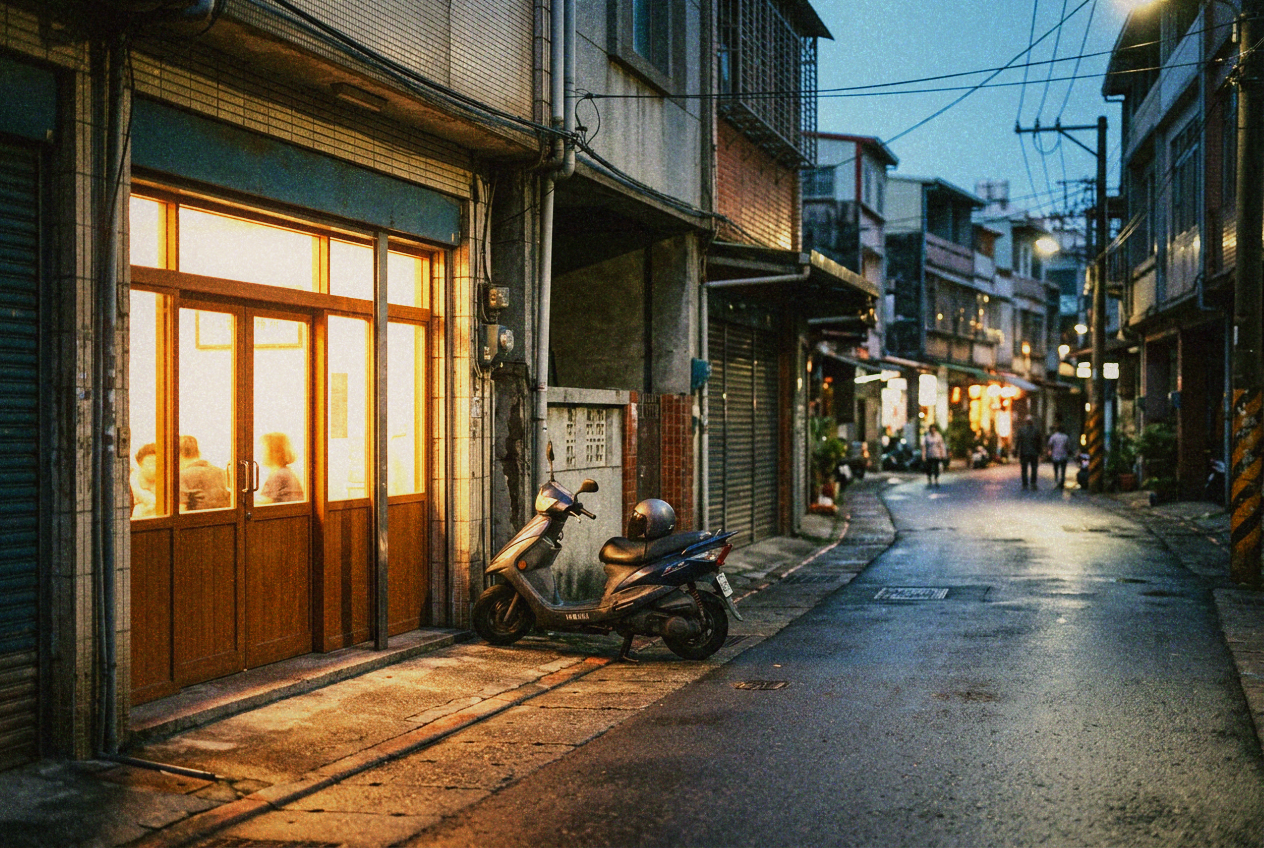 FIRST SIGHTWEBGLThere is usually a clinic within a few minutes' walk of wherever you live, still lit and open into the evening. · Color and grain by First Sight · Gold 200. · First Sight 色彩與顆粒調校 · Gold 200
The language question
The worry everyone has is language, and it is more manageable than you fear. Large hospitals in the cities often have international patient services and English-speaking staff, and are the safest bet for anything complex. At a small local clinic your mileage varies, but Taiwanese doctors have generally trained with English medical texts and can read the technical words even when conversation is halting. A translation app on your phone covers most of the gap. Writing your main symptom down, or pointing, works more often than you would think, and staff are used to helping foreign patients find their way.
If you are only visiting, or not yet covered
Tourists and new arrivals who are not yet enrolled are not locked out; they simply pay out of pocket, and the good news is that even the full price is modest by American or European standards. A self-pay clinic visit runs to a moderate sum rather than a frightening one, and hospitals will always treat an emergency first and sort out payment after. That said, if you are visiting, travel insurance is still worth having for the rare serious event, and if you are moving here, the months before your coverage begins are the ones to be a little careful.
Emergencies
If something is genuinely urgent, the number for an ambulance is 119, which also reaches the fire service; 110 is the police. In a serious situation you can also go straight to a hospital emergency room, the 急診, at any hour. Emergency care is taken seriously and delivered quickly, and worrying about insurance or paperwork is not something you need to do in the moment. Deal with the emergency first; everything administrative can wait until afterwards.
What tends to stay with you
What surprises most foreigners about healthcare in Taiwan is not any single feature but the feeling of it: that seeing a doctor can be quick, affordable, and unremarkable, the kind of errand you run on a Tuesday afternoon without dread. There is a quiet dignity in a system that treats getting better as something ordinary and within everyone's reach. The first visit takes a small act of courage, in a new place with a new language. By the second, you will already know the drill, and one of the biggest anxieties of living abroad will simply have dissolved.
Comments (0)
Loading comments...