
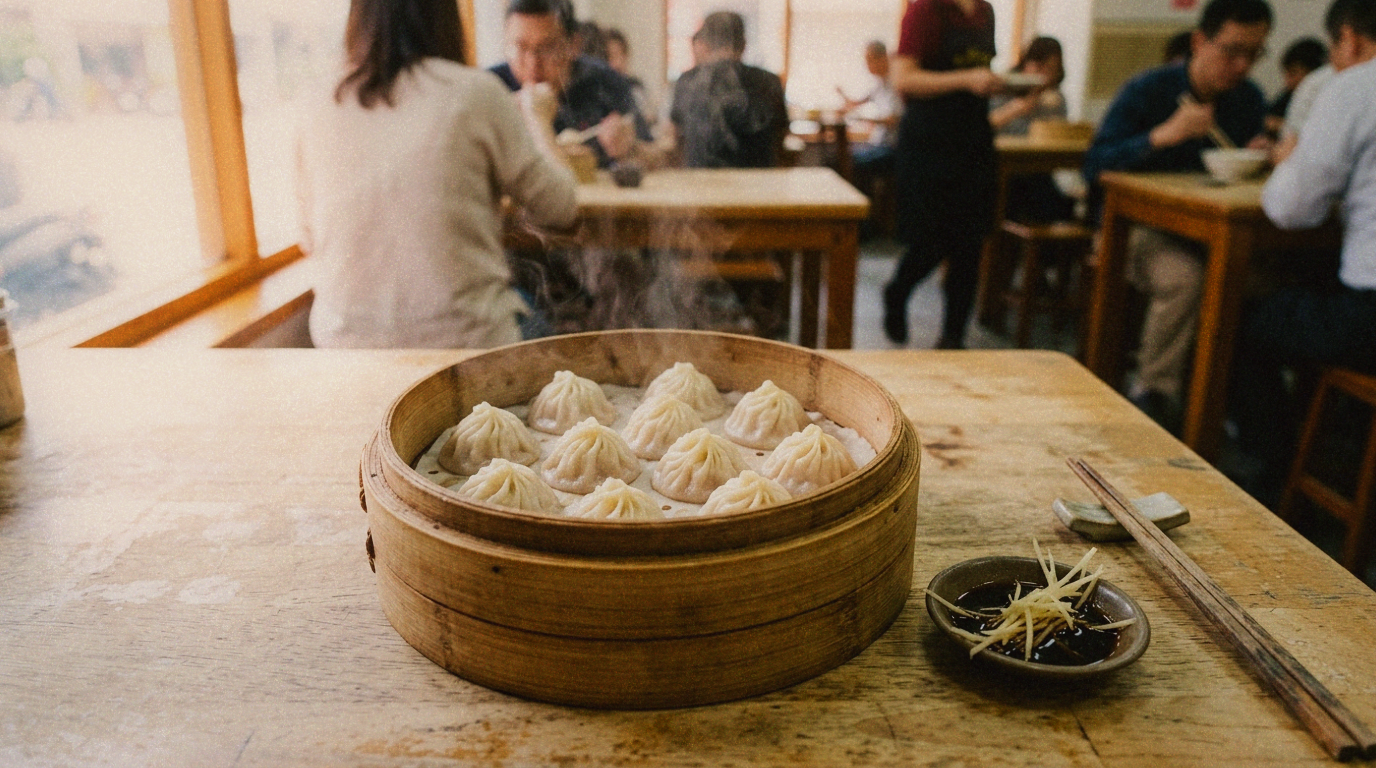
The first time I ate a proper xiaolongbao, I did it wrong. I picked it up too fast, bit straight into the side, and got a mouthful of scalding soup and a shirt with a story to tell. The man at the next table watched the whole thing happen with the patience of someone who has seen a hundred tourists make the same mistake, then quietly showed me how it is done: onto the spoon, a small bite in the side, let the steam out, sip, then eat. I have thought about that dumpling more than I would like to admit.
Taiwan did not invent the soup dumpling — that honour belongs to Shanghai — but it may have perfected it, and it certainly gave it to the world. The restaurant that made xiaolongbao globally famous started as a cooking-oil shop in Taipei, and today there is a branch in half the major cities on earth. Somewhere along that journey, a humble steamed dumpling became a kind of national calling card. This is a guide to understanding it: what is actually going on inside that fragile skin, how to eat one gracefully, and where to find the good ones once you stop chasing the famous one.
The magic trick, explained: how soup gets inside a dumpling
The question everyone asks first is the right one. How does the soup get in there? The answer is quietly clever: it is not poured in, it is folded in as a solid. Cooks make a rich stock — usually pork bones and often skin, sometimes with a little Jinhua-style ham — and let it set in the fridge into a wobbling, savoury jelly. That jelly is diced, mixed into the seasoned pork filling, and wrapped inside the dumpling cold. Then the steam does the rest.
When the basket hits the heat, the jelly melts back into liquid, and what was a small parcel of meat becomes a parcel of meat swimming in its own hot broth. It is a magic trick performed with gelatin and patience. It also explains why timing matters so much: a xiaolongbao is at its best in the few minutes after it leaves the steamer, when the skin is taut and the soup is molten. Wait too long and the skin drinks the soup and the whole thing goes slack.
The filling itself is mostly pork, traditionally a fattier cut for juiciness, seasoned simply so the meat and the broth do the talking. Taiwan's version tends to be a little more delicate and less sweet than the Shanghai original, with a thinner skin and a cleaner, less oily soup. That restraint is the house style, and once you notice it you start tasting it everywhere.
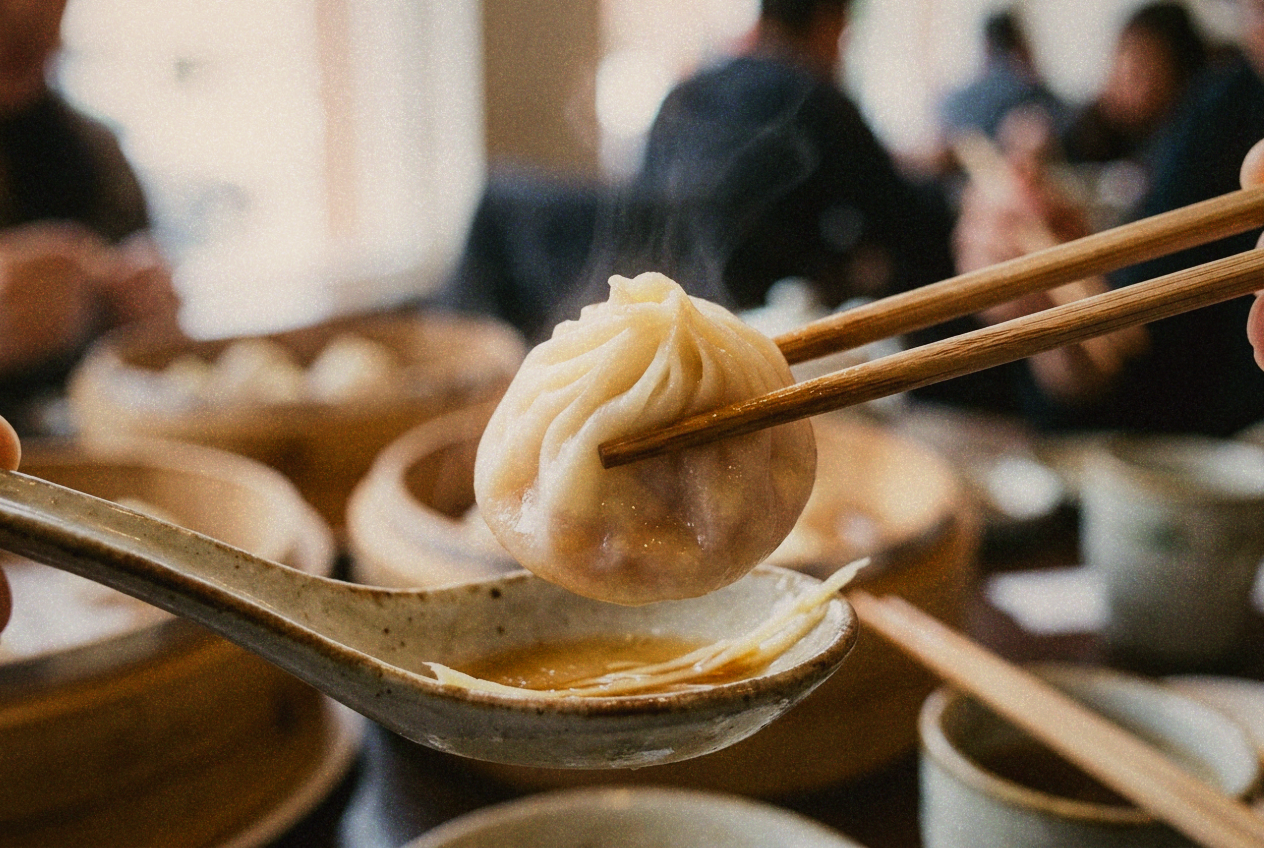
 FIRST SIGHTWEBGLThe whole trick in one parcel: skin thin enough to turn translucent, soup folded in as jelly and melted by the steam. · Color and grain by First Sight · Gold 200. · First Sight 色彩與顆粒調校 · Gold 200
The skin is the other half of the art, and it is harder than it looks. It has to be rolled thin enough to turn translucent and hold a pleated top, yet strong enough not to tear under the weight of hot liquid. At the famous places the standard is almost architectural — a target of eighteen or more folds gathered into a neat little topknot, and a set weight for the whole dumpling. It sounds fussy until you watch a skilled wrapper do it in a few seconds, over and over, with the calm of someone tying their shoes.
How to eat one without wearing it
Here is the method the man at the next table taught me, and it works every time. Lift the dumpling gently by the topknot — the thick pleated part is the handle, and the one place the skin will not tear — and lay it on your soup spoon rather than lifting it straight to your mouth. Resist the urge to rush; it is hotter than you think.
Then nick a small opening in the side and let the steam escape for a moment. Sip the soup off the spoon, or let it pool there to cool. Some people add a few slivers of ginger and a drop of black vinegar at this point; some eat the first one plain to taste the broth clean. Then eat the dumpling in one or two bites. The order matters less than the pause — the whole trick is giving the soup ten seconds to stop trying to hurt you.
The dipping sauce is simpler than it looks, too. The classic is fine ginger threads in a little Zhenjiang black vinegar, roughly three parts vinegar to one part soy if you are mixing your own, though many purists skip the soy entirely. The ginger is not a garnish; its sharpness cuts the richness of the pork and resets your palate between dumplings. Go light — the soup already did the seasoning.
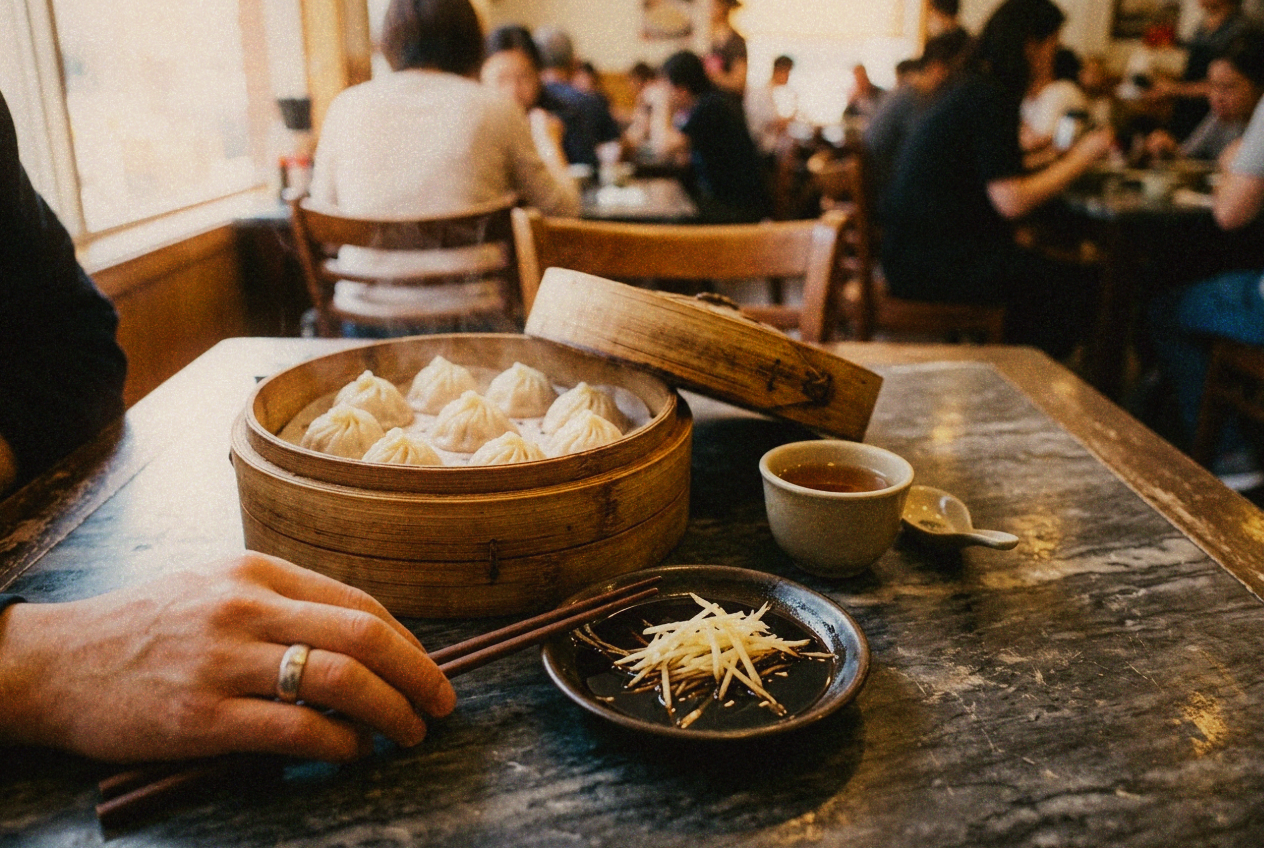 FIRST SIGHTWEBGLGinger and a little black vinegar — not a garnish, but the sharp note that resets your palate between dumplings. · Color and grain by First Sight · Gold 200. · First Sight 色彩與顆粒調校 · Gold 200
The famous one, and why it earned it
It is fashionable to be tired of the world-famous chain, and unfair. The reason it conquered the planet is that it is genuinely, boringly consistent — the same thin skin and hot soup in Taipei, Tokyo, Los Angeles or Sydney, turned out at a scale that should make consistency impossible. Watching the white-hatted teams work behind glass, weighing filling and counting folds, you understand that this is less a kitchen than a discipline. If you have never had a great soup dumpling, it is still the safest first one you will ever eat.
But the famous house is a floor, not a ceiling. Taiwan is full of quieter places doing xiaolongbao just as well, sometimes better, and usually for less. Once you know what a good one feels like — taut skin, a real flood of soup, filling that tastes of pork and not just salt — you can start judging for yourself, which is far more fun than queueing for the sure thing.
Where locals actually go
Ask around and the same neighbourhood names come up. Some swear by the old-guard Taipei institutions that have been folding by hand since long before the global boom; others prefer the no-frills shops where a bamboo basket costs a fraction of the tourist price and the auntie at the counter has opinions about how you are eating. The common thread is turnover: the best soup dumplings come from kitchens busy enough that nothing sits, so a steady local crowd is a better sign than a famous name.
A few practical tells. Look for a shop that wraps to order rather than steaming in advance; watch whether the baskets come out fogged and fast; notice if the regulars are eating dumplings or something else entirely. And do not overlook the humble breakfast and lunch spots that do xiaolongbao alongside pan-fried buns and noodle soups — some of the best dumplings in Taiwan come out of places with laminated menus and plastic stools.
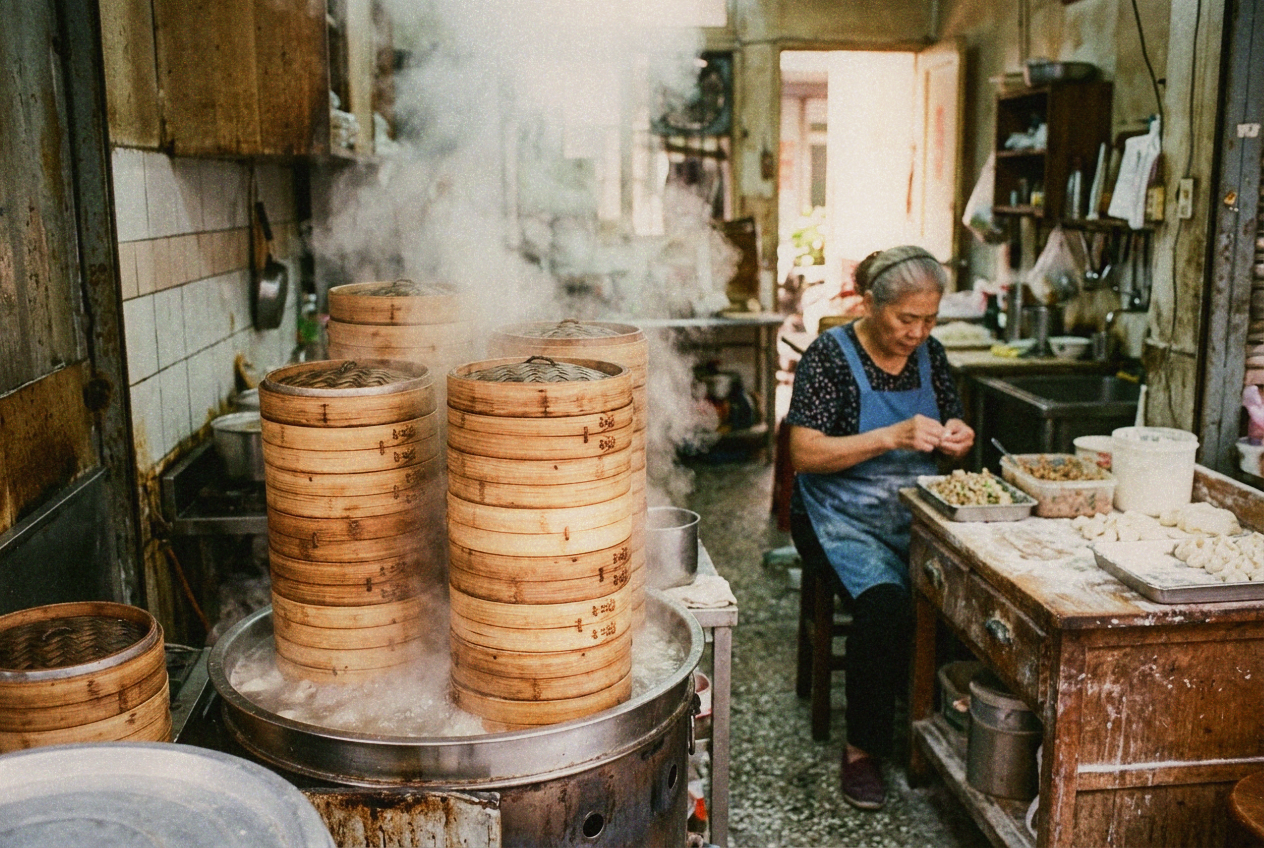 FIRST SIGHTWEBGLThe best baskets come from kitchens too busy for anything to sit. Turnover beats a famous name. · Color and grain by First Sight · Gold 200. · First Sight 色彩與顆粒調校 · Gold 200
The wider family: it is not only xiaolongbao
Once you are in dumpling territory, it is worth knowing the cousins, because menus rarely translate them well. Shengjianbao are the pan-fried version — thicker skinned, crisp-bottomed, with the same soupy surprise inside and a satisfying sizzle. Guotie, potstickers, are longer and open-ended, fried flat and crunchy on one side. Shuijiao are the everyday boiled dumplings families eat by the dozen, sold frozen in every supermarket and beloved for good reason.
And then there are tangbao, which confusingly also translates as 'soup dumpling' but usually points to a larger, soupier version you drink through a straw at some shops — a bit of theatre, but a delicious one. None of this needs memorising before you go. Point, order, and pay attention to what lands; the map fills itself in after a few baskets.
Why a dumpling is worth this much attention
It is easy to be sniffy about a food this popular, and easy to forget that popularity, in this case, was earned one impossible little parcel at a time. A xiaolongbao is a small argument for doing ordinary things with extraordinary care: the set stock, the counted folds, the fixed weight, the exact minute it should be eaten. Nothing about it is expensive or rare. All of it is exacting.
That, in the end, is the Taiwanese thing about it. This is not luxury food; it is everyday food held to a quietly ferocious standard, and available on more or less any corner. You can eat a life-changing version for the price of a sandwich, standing up, on a Tuesday. Order a basket, lift one gently by its little topknot, and give it the ten seconds of attention it is asking for. It will return the favour.
Comments (0)
Loading comments...