Last April I found mold growing on the back of a leather jacket I'd hung in my closet three months earlier. Not the kind you wipe off with a damp cloth. The kind that has already eaten into the material, leaving a pattern of grey-green spots that no amount of cleaning would undo. A NT$8,000 jacket, gone. The closet smelled like a cave. When I pulled shoes out of boxes on the floor, the insoles were furry.
I'd been living in Taipei for two years at that point. I knew it was humid. I just didn't realize what 80% relative humidity does over time when you're not actively fighting it. My apartment was on the second floor of an old building in Zhongzheng District, north-facing, with a bathroom that never fully dried out and a bedroom window that stayed shut most of the winter because the air outside was somehow wetter than the air inside.
That week I bought my first dehumidifier. I got it wrong. I bought one that was too small for the space, ran it in the wrong room, and didn't understand why the water tank was full every four hours but nothing felt different. Six months later I replaced it with a properly sized unit, and within a week, the apartment transformed. The closet stopped smelling. The bathroom tiles stopped growing that pink film. My glasses stopped fogging up every time I opened the front door.
This is what I learned.
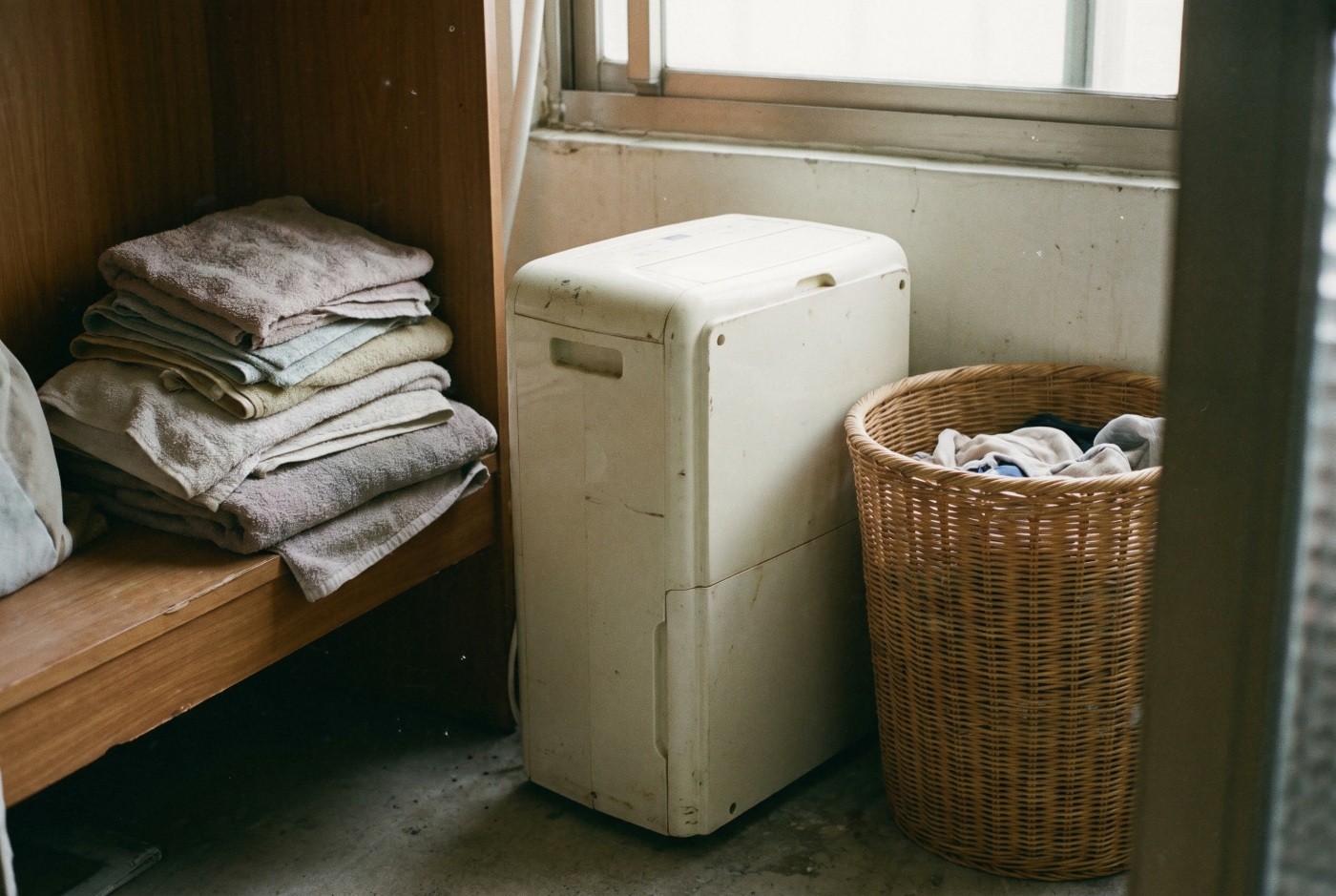
!A dehumidifier running in a typical Taipei apartment living room, condensation visible on the water tank A dehumidifier in a Taipei apartment is not a luxury appliance. It is infrastructure, like a water heater or a functioning lock on your front door.
Why Taiwan is a special case
Taipei's average relative humidity sits above 75% for roughly eight months of the year. During plum rain season (May and June), it regularly hits 85 to 90%. The northern half of the island gets it worse because winter brings a particular misery: cold and wet, temperatures around 12 to 16 degrees, humidity still above 80%, and no central heating. Your walls sweat. Condensation forms on tile floors. Leather, wood, paper, electronics, fabric, anything that can absorb moisture will absorb moisture.
#### 80%+ Average relative humidity in Taipei from October through June. That's roughly eight months of the year above the threshold where mold actively grows. The commonly recommended indoor target is 50 to 60%. Without a dehumidifier, most Taipei apartments never get close.
Southern Taiwan is drier in winter, but summer humidity is brutal everywhere. If you live anywhere on this island, you need a dehumidifier. Not maybe. Not if your apartment feels damp. You need one.
Compressor vs. desiccant: which type for Taiwan
Two technologies, and the choice is simpler than most buying guides make it sound.
Compressor dehumidifiers (壓縮機式) work like a mini air conditioner. They pull air across a cold coil, water condenses out, dry air blows back into the room. They are effective, energy-efficient, and powerful. They're also louder and heavier, and they struggle below about 15 degrees Celsius because the coil can frost up. Every major brand in Taiwan (Panasonic, Mitsubishi, Hitachi, Sharp, LG) sells compressor models. About 95% of dehumidifiers sold in Taiwan are this type.
Desiccant dehumidifiers (除濕輪式) use a rotating wheel of moisture-absorbing material and a heater to dry the wheel. They work at any temperature, they're lighter and quieter, and they raise the room temperature slightly (which you don't want in a Taipei summer). They cost more to run because of the heater element, and their capacity is generally lower.
For Taiwan, the answer is compressor for almost everyone. The climate is warm and extremely humid most of the year, which is exactly where compressor units perform best. The only scenario where desiccant makes sense is if you need to dehumidify a very cold space (an unheated storage room in winter, a mountain cabin) or if noise is your absolute top priority and you're willing to pay higher electricity bills.

FIRST SIGHTWEBGLRow of different sized dehumidifiers lined up in a Taiwan electronics store. bright retail lighting · This photo is developed by FIRST SIGHT film stocks. · 這張照片是使用 FIRST SIGHT 底片配方調校而成的How to size it: the ping formula
This is where most people get it wrong, and it's the single biggest factor in whether your dehumidifier actually makes a difference.
The standard formula in Taiwan: your room size in ping (坪) multiplied by 0.8 equals the daily capacity in liters you need. A 10-ping living room needs about 8 liters per day. A 15-ping open-plan space needs 12 liters.
But that formula assumes a standard scenario. If your apartment is on a lower floor, north-facing, near water, has poor ventilation, or has a bathroom without a window (extremely common in Taipei), size up. I'd recommend going one tier higher than the formula suggests. If the math says 8 liters, buy a 10 or 12 liter unit. A dehumidifier that's slightly too powerful for your space will reach the target humidity faster, run fewer hours, and actually use less electricity than an undersized unit that grinds away all day without ever getting the room below 70%.
I learned this the hard way. My first dehumidifier was a 6-liter unit in a 12-ping apartment. It ran continuously, filled the tank three times a day, and the humidity never dropped below 72%. When I replaced it with a 12-liter Panasonic, the apartment hit 55% within two hours and the machine cycled off on its own. The electricity bill actually went down.
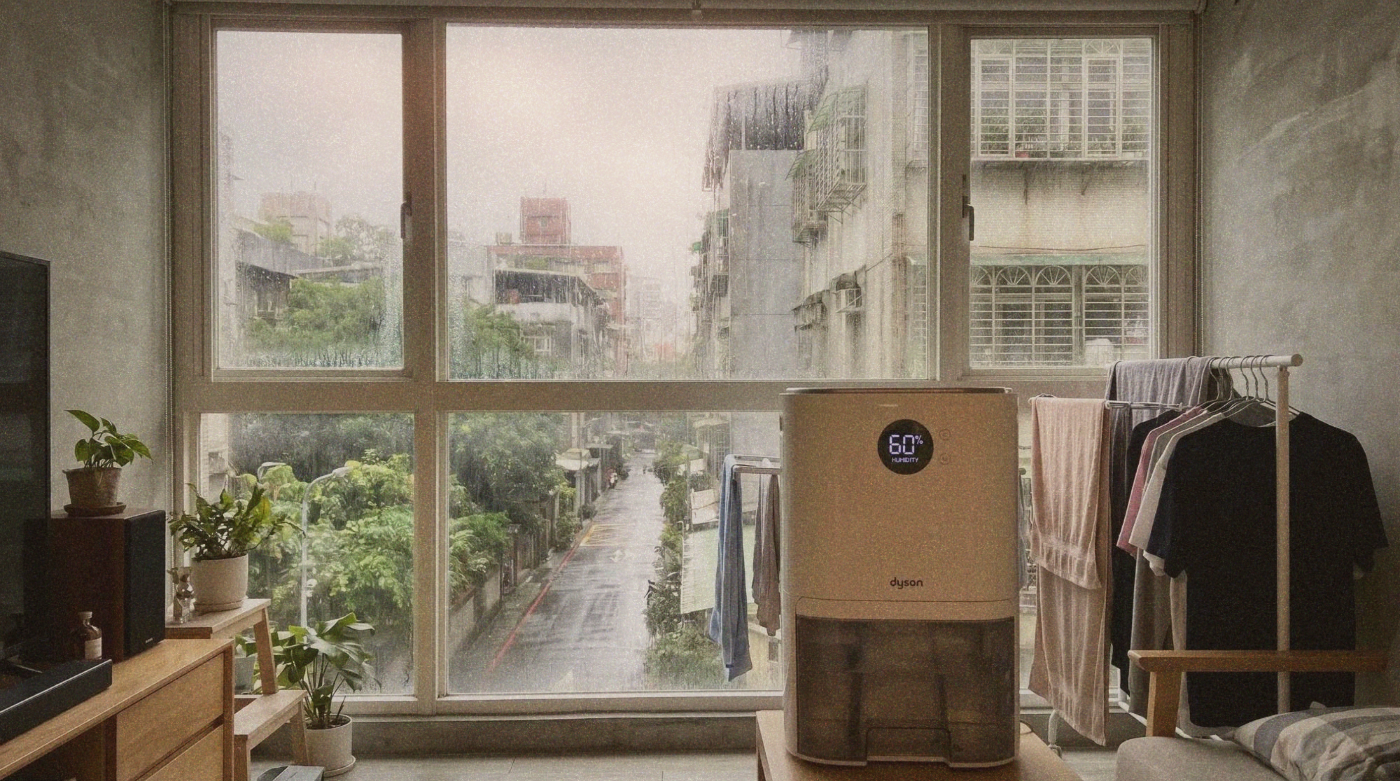
!Close-up of a dehumidifier control panel showing humidity reading and settings Most modern dehumidifiers have a humidity sensor and auto-shutoff. Set the target to 55% and let it cycle. Don't run it 24 hours on maximum.
The brands that matter in Taiwan
You'll see a dozen brands on momo and PChome. These are the ones worth your money.
Panasonic (國際牌). The most popular brand in Taiwan and the safest choice. Their F-Y series covers every size. The F-Y24GX (12L/day, one-bedroom to small living room, roughly NT$9,000 to NT$10,500) is a workhorse with Level 1 energy efficiency and Nanoe X air purification. The F-YV32MH (16L/day, roughly NT$13,000 to NT$15,000) adds inverter technology, WiFi control, and handles spaces up to 20 ping. Panasonic filters are easy to find, service centers are everywhere, and parts availability is the best of any brand. If you don't know what to buy, buy Panasonic.
Mitsubishi (三菱). Japanese-made, premium-priced, and genuinely excellent. The MJ-E120AT (12L/day, roughly NT$13,900 to NT$17,000) is the one people on PTT and Mobile01 keep recommending because it's quieter than most competitors and built to last a decade. The MJ-EV250HM (24.8L/day, roughly NT$20,900 to NT$27,900) is for large living rooms or open-plan apartments up to 30 ping. It has HEPA filtration and variable-speed operation. Mitsubishi costs 30 to 50% more than equivalent Panasonic models, but the build quality is noticeably better.
Hitachi (日立). Solid mid-range. The RD-14FR (7L/day, roughly NT$6,300 to NT$7,500) is a good entry point for a single bedroom, with Level 1 energy efficiency and a 5-liter tank. Quiet enough for sleeping. Hitachi's larger models are fine but don't stand out the way Panasonic and Mitsubishi do.
Sharp (夏普). Their selling point is Plasmacluster ion technology, which is genuinely good at odor removal. The DW-L12FT-W (12L/day, roughly NT$9,000 to NT$11,000) combines dehumidification with HEPA air purification and a 5-year filter lifespan. Good choice if you want a two-in-one machine for a bedroom.
LG. The MD171QSK1 (17L/day, roughly NT$13,000 to NT$16,000) is the quietest large-capacity unit I've used. Dual inverter compressor, WiFi control, 18 safety features. It looks better than the Japanese brands if that matters to you. The downside: LG's service network in Taiwan is smaller than Panasonic or Hitachi.
[taiwan-card] Budget pick | Hitachi RD-14FR | 7L/day, Level 1 energy efficiency, NT$6,300 to NT$7,500. Best for bedrooms up to 8 ping. Quiet, reliable, no frills. The one to buy if you just need a dehumidifier and don't want to overthink it. Best value | Panasonic F-Y24GX | 12L/day, Level 1, NT$9,000 to NT$10,500. Covers up to 15 ping. Nanoe X purification, auto-humidity control. The default recommendation for most one-bedroom and two-bedroom apartments. Best for large spaces | Panasonic F-YV32MH | 16L/day, inverter, NT$13,000 to NT$15,000. Handles up to 20 ping. WiFi smart control, dual dehumidification system. The pick for living rooms and open kitchens. Premium pick | Mitsubishi MJ-E120AT | 12L/day, Level 1, NT$13,900 to NT$17,000. Japanese-made, quietest operation, exceptional build quality. Costs more, lasts longer, runs quieter. The buy-it-once choice. Quiet powerhouse | LG MD171QSK1 | 17L/day, dual inverter, NT$13,000 to NT$16,000. Lowest noise in its class, WiFi control, sleek design. Best if noise sensitivity is your main concern. Two-in-one | Sharp DW-L12FT-W | 12L/day, NT$9,000 to NT$11,000. HEPA + Plasmacluster air purification, 5-year filter life. Best combined dehumidifier and air purifier for bedrooms.

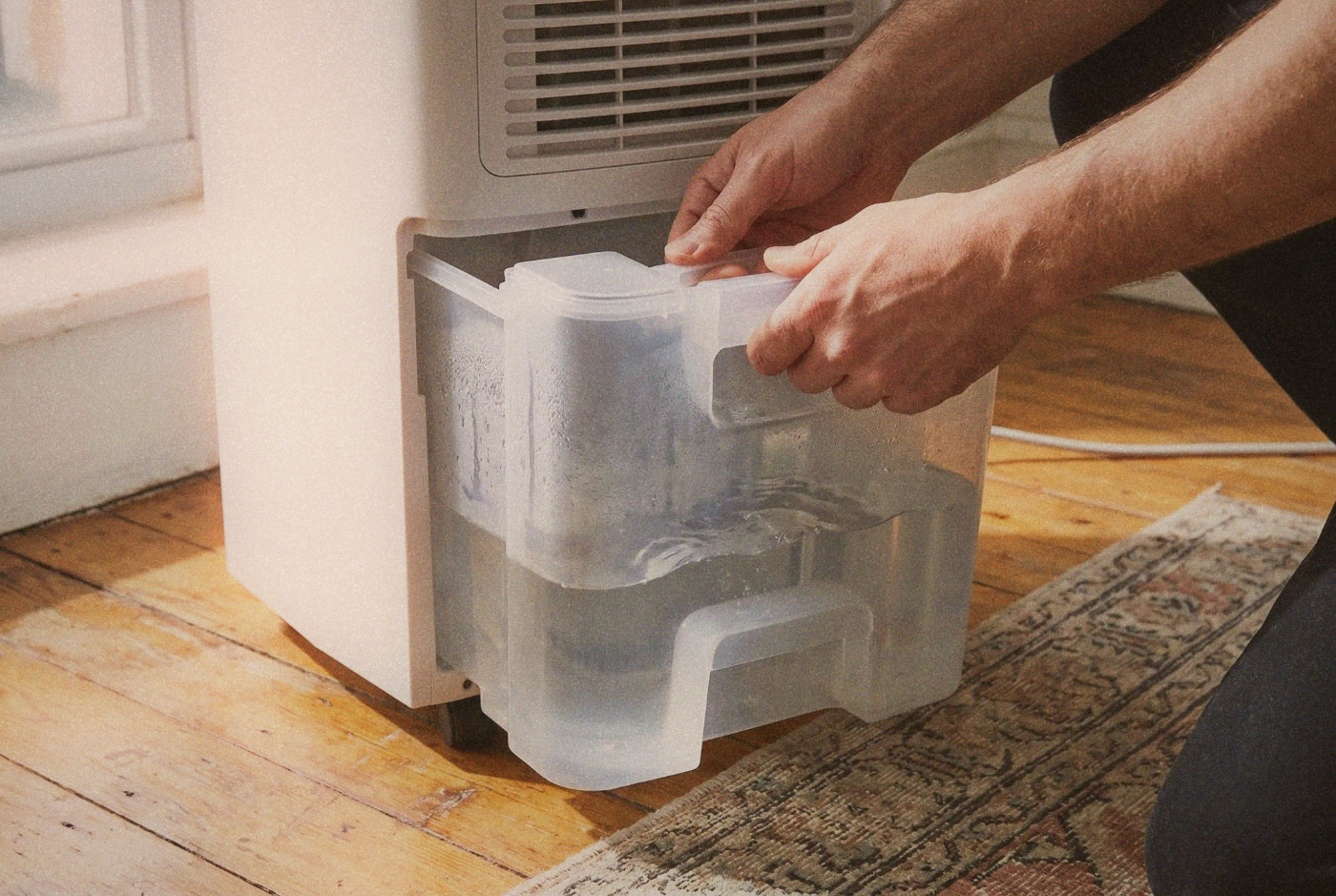
FIRST SIGHTWEBGLClose-up of hands pulling out a full water tank from a dehumidifier. water visible through translucent tank · This photo is developed by FIRST SIGHT film stocks. · 這張照片是使用 FIRST SIGHT 底片配方調校而成的Energy efficiency actually matters here
Unlike a lot of appliance ratings that don't make a real difference to your bill, energy efficiency on a dehumidifier matters because you're running it for hundreds of hours a year. Taiwan's energy efficiency labeling system (能源效率標示) rates dehumidifiers from Level 1 (most efficient) to Level 5. The metric is EF, or energy factor, measured in liters per kilowatt-hour. Higher EF means more water removed per unit of electricity.
#### NT$1,200 Government rebate for purchasing a Level 1 energy-efficient dehumidifier (12L capacity or above). The 貨物稅減免 program lets you claim up to NT$1,200 back. For units between 9 and 12L, the rebate is NT$900. Under 9L, it's NT$500. You apply after purchase with your receipt and the product's energy label.
The difference is real. A Level 1 unit with an EF of 2.47 running 12 hours a day uses about 4.3 kWh to dehumidify 10.5 liters. A Level 4 unit with an EF of 1.72 uses 6.1 kWh for the same job. Over a year, that adds up to a few hundred NT$ in electricity savings, plus the government rebate. Always buy Level 1 if you can. The upfront price difference is usually smaller than the lifetime savings.
Where to actually put it
This sounds obvious but it's the second most common mistake after buying the wrong size. Your dehumidifier works best in a closed space. Shut the doors and windows. If you're trying to dehumidify your living room with the bedroom door and bathroom door open, you're asking a 12-liter machine to do a 20-liter job.
For most Taipei apartments, the best strategy is to run the dehumidifier in the main living area during the day (doors to bedrooms open if you want to share the effect across a small apartment), then move it or run a second smaller unit in the bedroom at night. Keep bathroom doors closed when running the dehumidifier, and run it in the bathroom separately after you shower.
Place it at least 30 centimeters from walls and furniture. Don't tuck it into a corner. It needs airflow on all sides to work properly.
Filter maintenance (the thing everyone forgets)
Every dehumidifier has a filter that catches dust. If you don't clean it, airflow drops, efficiency drops, and the unit works harder for less result. Clean the filter every two weeks during heavy-use months (basically March through October in northern Taiwan). It takes sixty seconds. Pop it out, rinse it under the tap, let it dry, put it back.
If your unit has a HEPA or activated carbon filter (Sharp and some Mitsubishi models), those need replacing on the manufacturer's schedule, usually every one to two years. Budget NT$500 to NT$1,500 per replacement depending on the brand.
The water tank also needs occasional cleaning. Once a month, empty it and wipe the inside with a diluted vinegar solution. Stagnant water in a warm tank grows bacteria, and you don't want your dehumidifier blowing that back into the room.
!A person removing and cleaning a dehumidifier filter under running water Sixty seconds every two weeks. That's the maintenance commitment. If you skip it, your NT$10,000 machine performs like a NT$3,000 one.
The continuous drain hack

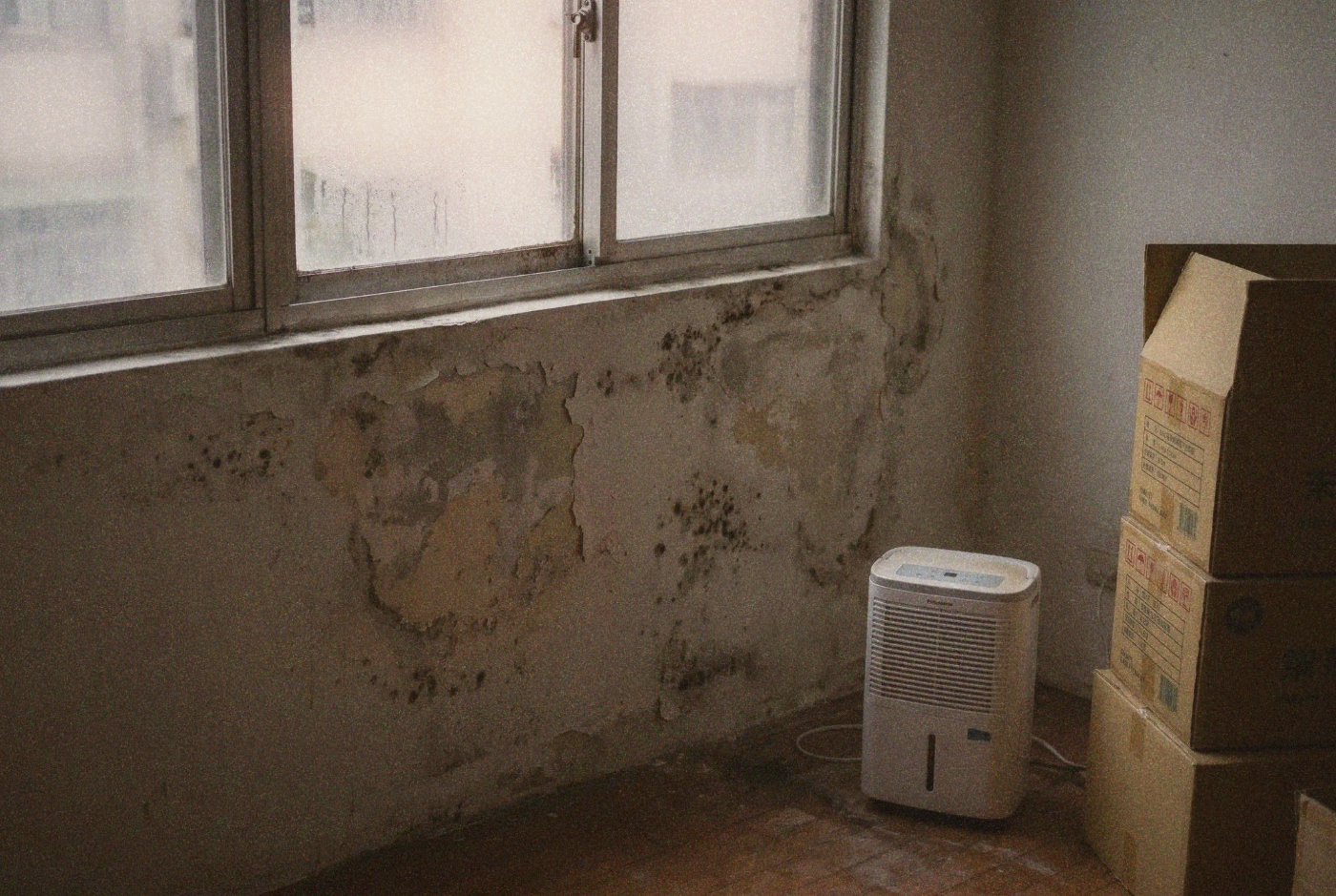
FIRST SIGHTWEBGLTaipei apartment corner showing moisture damage on wall. peeling paint · This photo is developed by FIRST SIGHT film stocks. · 這張照片是使用 FIRST SIGHT 底片配方調校而成的Most dehumidifiers have a small hole on the back for a drain hose. If you set the machine up near a bathroom drain or a laundry sink, you can attach a standard hose (usually included or NT$100 to buy) and let the water drain continuously. No more emptying the tank. The machine just runs until it hits the target humidity and stops on its own.
This is especially useful during plum rain season, when a 12-liter unit in a damp apartment will fill its 3 to 5 liter tank two or three times a day. If you're at work, the machine stops when the tank is full and the humidity climbs right back up. Continuous drain solves this completely.
What about those mini dehumidifiers
The small ones that cost NT$500 to NT$2,000, use Peltier semiconductor technology, and claim to remove 300 to 800ml of moisture per day. I've tried two of them. They work in a closet or a very small enclosed space like a shoe cabinet. They do not work for a room. If your space is larger than roughly two square meters, a Peltier mini dehumidifier will not make a perceptible difference.
The Roommi portable units (roughly NT$2,000 to NT$4,000) are better than generic brands and genuinely useful for small bedrooms in dry seasons or as a closet supplement. But they're a supplement, not a replacement for a real compressor unit.
FAQ
How many liters per day do I need? Multiply your room size in ping by 0.8. That's the minimum. If your apartment is on a low floor, north-facing, or has poor ventilation, go one size up. An oversized dehumidifier is better than an undersized one.
Should I run it all day? No. Set the target humidity to 55% and let the machine cycle. Most modern units have a humidistat and will turn on and off automatically. Running it on maximum 24 hours a day wastes electricity and overdries the air.
Can a dehumidifier replace an air purifier? Some models (Sharp, certain Panasonic and Mitsubishi units) include HEPA filters and purification features. They'll handle basic dust and allergens, but they won't match a dedicated air purifier for PM2.5 filtration. If air quality is a serious concern, get both.
When should I buy one? Best deals happen in March and April (pre-plum-rain sales), during Double 11, and in December clearance. Avoid buying in May or June when demand peaks and prices are highest. The government energy efficiency rebate is available year-round.
How long does a dehumidifier last? A good compressor unit lasts 8 to 12 years with basic maintenance. Mitsubishi and Panasonic have the best longevity track records. The compressor is the component that eventually fails, and it's usually not worth repairing.
Is the government rebate worth the paperwork? Yes. It takes about 15 minutes to apply online. You need your purchase receipt and the product's energy efficiency label (printed on the box or the unit itself). NT$1,200 back on a Level 1 unit above 12 liters. That's effectively a 10% discount on most mid-range machines.

Comments (0)
Loading comments...