
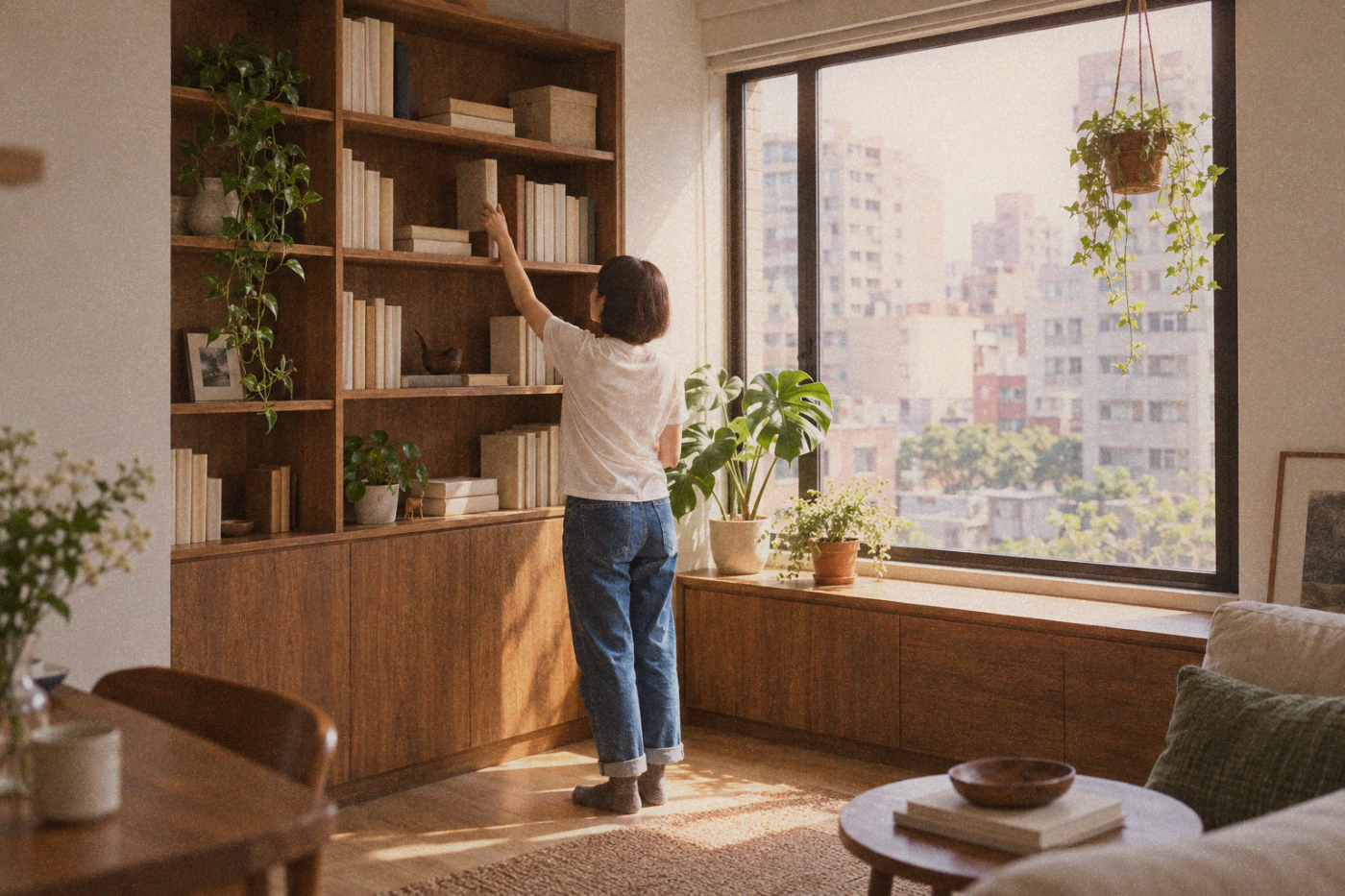
Wan-Ting's apartment in Zhongshan measures eight ping. That's roughly 26 square meters, or about the size of a studio bedroom anywhere else in the world. When she moved in three years ago, her first week felt like a game of Tetris. A double bed took up half the bedroom. The kitchen was a galley strip that fit one person at a time. But what struck her wasn't the tightness. It was how much stuff she owned that she'd never see again if she didn't organize it strategically.
This is the reality of living in Taipei. Average apartment size has stayed flat for decades, hovering around 35-40 ping of gross floor area even in new construction, which is a very different number from what you actually live in. Small apartments aren't a trend here. They're the baseline. And that means storage isn't optional. It's a design problem that determines whether you live comfortably or spend three years searching for that one pair of winter gloves.
You don't need to renovate or spend a fortune. A few principles about how vertical space, zones, and multifunctional furniture actually work will get you most of the way there.
Taipei's apartments include a mix of newer developments in Xinyi and Daan, where a compact one-bedroom might rent for NT$25,000-35,000 per month, and older walk-ups in neighborhoods like Zhongshan where rent sits lower but vertical space is more generous. The trade-off is always square footage. But height is free. This is where most people miss the opportunity.
Vertical storage is the first principle. When you live in eight ping, you can't think horizontally. The wall is your inventory. Look at your bedroom: the gap between the top of your closet rod and the ceiling is probably two feet of dead space that could hold seasonal bags or archives. Above the toilet in the bathroom sits another two feet. Above the refrigerator in the kitchen is a shelf most people leave empty because they can't see it. These pockets aren't charming design features. They're survival equipment.
The Japanese organizing system, popularized by Marie Kondo, emphasizes vertical folding for clothes. Instead of stacking sweaters in a pile where you can only see the top two, you fold them so they stand upright like files in a drawer. Suddenly you see everything. You reach for something without destabilizing the whole stack. This works especially well in Taiwan because it aligns with how tidy, efficiency-focused living actually feels here. You can store more in a small drawer using Kondo's method than you can fit in double the space using traditional folding.
Small apartments force you to be honest about what you actually use.
The IKEA KALLAX shelving system has become something of a standard in Taipei micro-apartments. The 77x147 centimeter version fits against most bedroom walls, and the open cubes let you mix visible display with hidden storage (fabric boxes tucked inside). A hybrid approach (KALLAX as structure, MUJI fabric storage boxes as inserts) balances cost, flexibility, and visual cohesion. One set costs roughly NT$2,500-4,000 depending on the size, and MUJI boxes run NT$300-800 each.
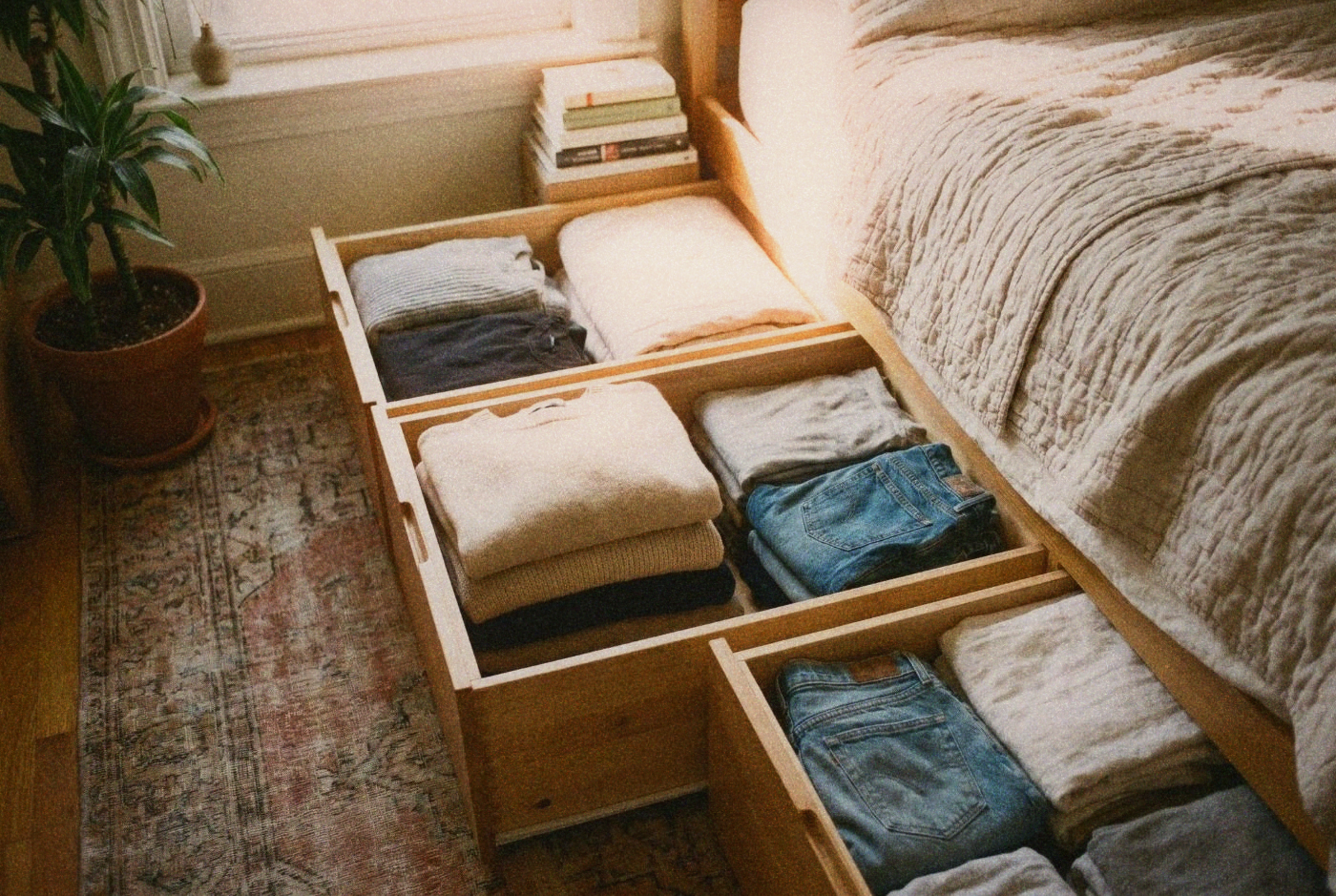
 FIRST SIGHTWEBGLUnder-bed storage drawers pulled open in a small bedroom. neatly folded clothes inside · Color and grain by First Sight · Gold 200. · First Sight 色彩與顆粒調校 · Gold 200
But the real win isn't spending money. It's thinking in zones. Your bedroom isn't one room. It's a sleeping zone, a dressing zone, a work zone if your desk is there, and a storage zone. Each zone needs different solutions. The sleeping zone needs a bed frame with drawers underneath (another vertical trick, horizontal space you're already occupying). The dressing zone needs a clothing rod and shelf. The work zone needs a desk with cubbies above it, not beside it, because floor space is currency.
Your kitchen, too. Taipei apartments often have minimal cabinet space. The solution isn't more cabinets. It's ceiling height. A rolling cart pushed into a corner becomes a spice and dish storage unit. A shelf affixed to the wall above the stove (safely, away from steam) becomes a place for daily-use items. Hooks on the inside of cabinet doors multiply your storage without expanding the cabinet itself. These are small moves, but in an eight-ping apartment, small moves compound.
Multifunctional furniture isn't a luxury. It's the structure of the apartment. A bed with drawers underneath stops being "a bed with storage" and becomes a necessity. A desk that folds down from the wall is your home office only when you need it. A low shelving unit can double as a room divider, separating your sleeping area from your living area visually without closing it off.
The hardest part isn't the organizing system. It's the ruthlessness it requires. Small apartments force you to be honest about what you actually use. That bread maker you've owned for five years and never plugged in, the clothes you're saving for a different version of yourself, the books you feel like you should read, these items don't add up. They crowd out the things that actually matter.
Once you move past the guilt, the math is simple. You have limited space. Every object you keep is taking real estate that could hold something you use weekly. This isn't deprivation. It's permission. Living in eight ping isn't about sacrifice. It's about clarity.
Living small teaches you to notice what you own.
Start with one zone. Pick your bedroom or kitchen, not everything at once. Take everything out of that zone and sort it into four piles: use it regularly, use it occasionally, never used it, and gifts you feel obligated to keep. Be strict with the "occasionally" pile. Once a year isn't the same as regularly. Seasonal items (heavy coats, beach gear) go into labeled bins in that ceiling-height storage you found. Everything else either goes or finds a permanent home within arm's reach.
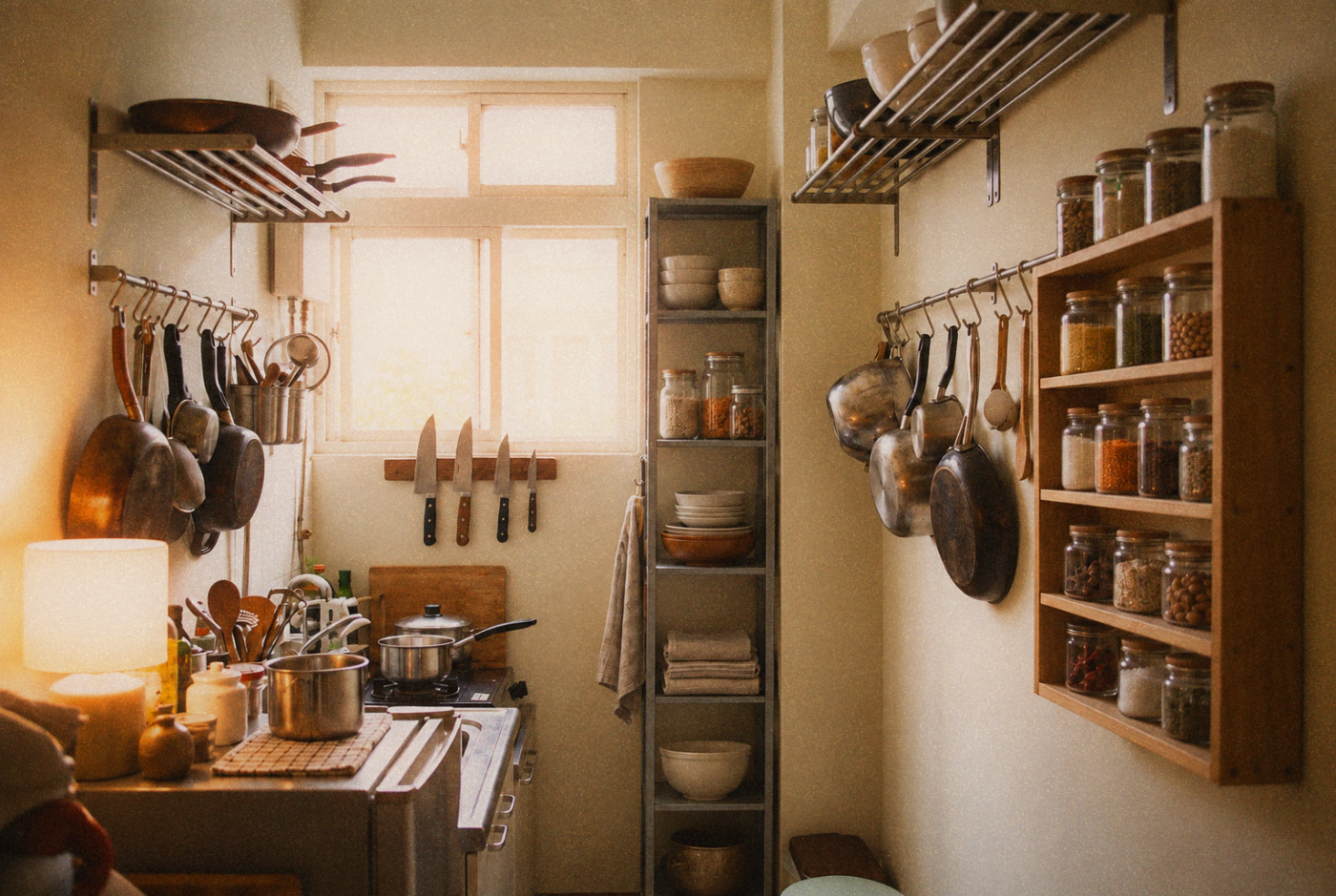 FIRST SIGHTWEBGLCompact Taipei kitchen with magnetic knife strip. hanging utensils · Color and grain by First Sight · Gold 200. · First Sight 色彩與顆粒調校 · Gold 200
The second zone can wait a month. You'll learn from the first one. You'll discover that you don't actually need a dish rack because your cabinet shelves have enough room if you organize them vertically. You'll realize you can keep half the Tupperware and double your spice storage. These small discoveries compound faster than you'd expect.
Taiwan-based home goods stores like HOLA and Nitori carry storage solutions designed for local living conditions. They understand that high humidity in summer means breathable shelving and moisture-resistant materials. They know that building codes often restrict wall anchoring, so many solutions are freestanding. These details matter in a humid subtropical climate where mold can develop quickly in sealed containers.
[taiwan-card] KALLAX Series | IKEA Taiwan | Modern, modular cube shelving available in white, black-brown, and natural finishes. Sized 77x147cm, fits standard bedroom walls. Couples well with MUJI fabric inserts. Price: NT$2,500-4,000 MUJI Fabric Storage Boxes | MUJI Taiwan | Stackable, breathable fabric boxes in S/M/L sizes. Collapse when empty, perfect for seasonal items or underbed storage. Individual boxes NT$300-800 B&Q Tool & Organization Section | Multiple Taipei locations | Stocks hooks, shelf brackets, wall anchors, and pegboard systems designed for Asian apartments. Good for custom solutions if your walls won't take standard installation
The last step is maintenance. Small spaces don't stay organized by accident. You need a system that doesn't require willpower. This might mean a "one in, one out" rule for clothes. It might mean monthly shelf audits where you check what's actually being used. It might mean a specific shelf for things that need to go, which you clear out monthly instead of letting accumulate.
Wan-Ting's apartment still measures eight ping. But now she opens every drawer and sees exactly what she has. She hasn't bought new storage furniture in two years. Instead, she bought a wall-mounted drying rack, a hanging organizer for the back of her bedroom door, and three shelves above her desk. Total cost: maybe NT$3,000. She lives more comfortably now than when she had twice the space, because she's learned the difference between living small and living constrained.
Small isn't a temporary phase you endure. Small is a skill you develop.
FAQ
How much should I budget for storage solutions if I'm starting from zero?
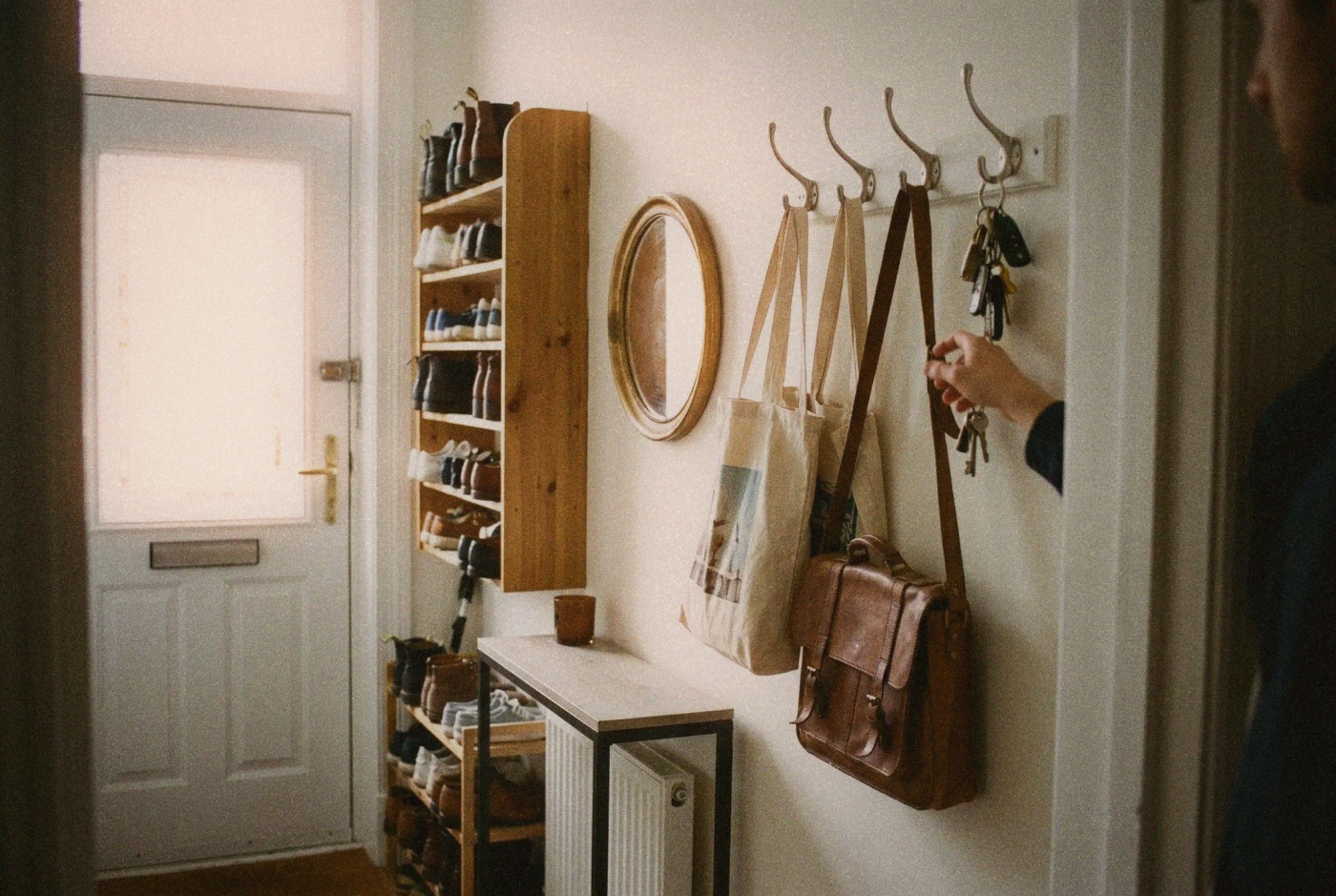 FIRST SIGHTWEBGLNarrow apartment entryway with wall-mounted shoe rack. hooks holding bags and keys · Color and grain by First Sight · Gold 200. · First Sight 色彩與顆粒調校 · Gold 200
You can create a functional system for NT$5,000-8,000 if you focus on one main area. A single KALLAX unit (NT$2,500-4,000), a set of three or four MUJI boxes (NT$1,500-3,000), and wall-mounted shelves (NT$1,000-2,000) cover most micro-apartments. Avoid buying multiple systems at once. Start small, test what works, then expand.
My apartment has concrete walls that won't take anchors. What do I do?
Freestanding furniture is your friend. KALLAX units don't need to be mounted, they're stable on their own if you position them against a wall. Rolling shelving units and corner shelving carts add storage without drilling. If you rent, landlords usually prefer freestanding solutions anyway.
Should I invest in custom closets or built-in storage?
Only if you're staying more than five years. Most Taipei renters move within 3-4 years, and landlords charge to repair wall changes. Better to build a modular system with KALLAX and furniture that you can take with you. You'll actually use it more flexibly anyway.
How do I deal with humidity and smell in sealed containers?
Use breathable fabric boxes instead of plastic. MUJI boxes and linen storage bags allow air circulation, which prevents mold and musty smells that plague sealed containers in Taipei's summer. Dessicant packets or activated charcoal inside fabric boxes help further. Check every few months.
Comments (0)
Loading comments...