
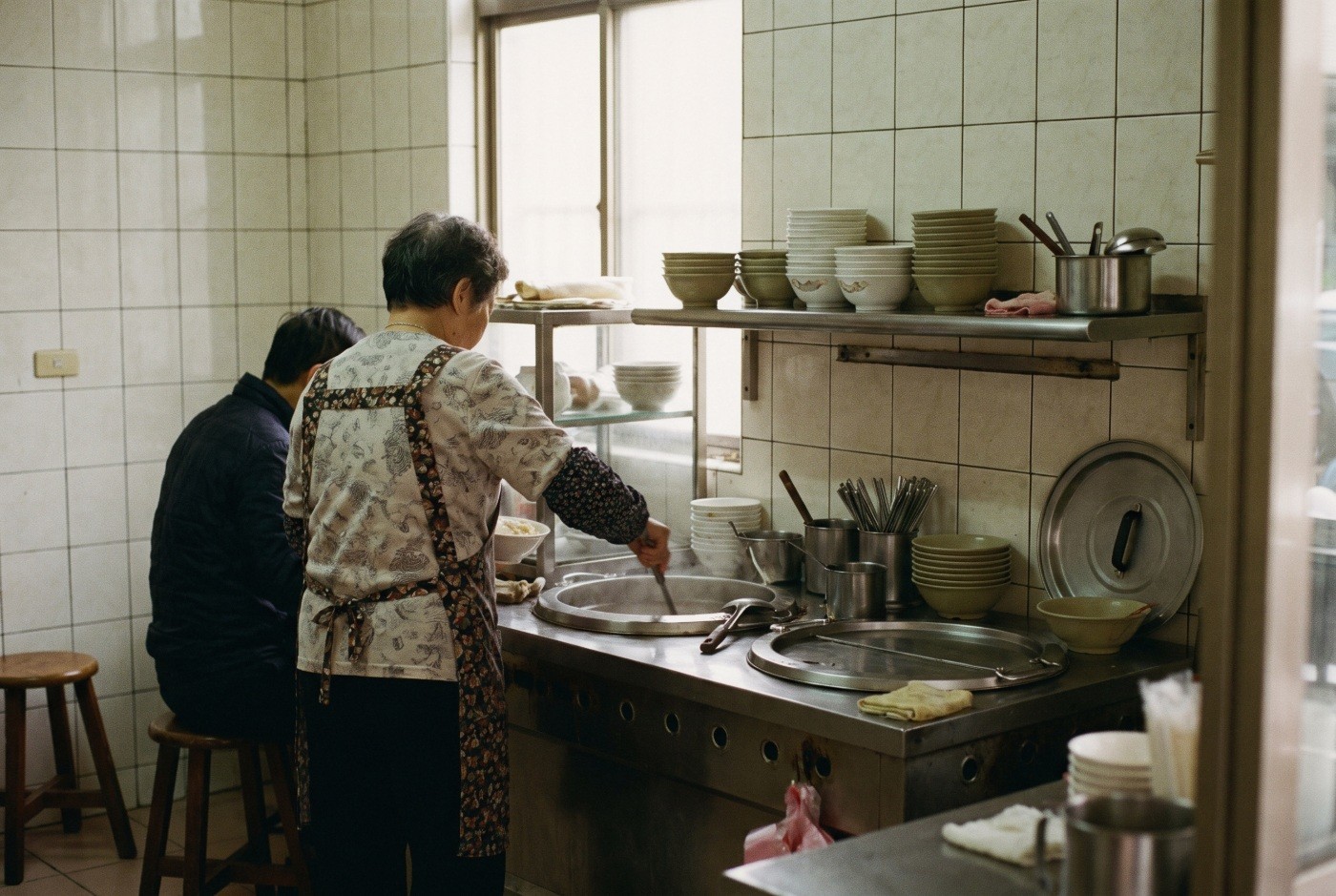
There's a man on Yongji Road who parks a steel cart between a scooter repair shop and a shuttered pharmacy every morning at 5:15. He doesn't have a name on the cart. No signage, no menu, no QR code for Google Maps reviews. He has a griddle, a thermos of soy milk, a plastic bin of eggs, and a stack of 蛋餅 wrappers he made at 4am in a kitchen that is also his living room.
By 7:30, the eggs are gone. By 8, the cart is gone too, folded and wheeled into the alley behind the pharmacy, invisible until tomorrow. If you didn't know it was there, you wouldn't know it was there.
He's been doing this for twenty-two years. He doesn't know how many more he has.
A city that used to eat on the sidewalk
Taipei's breakfast culture didn't start in shops. It started on carts — portable, illegal in the way most useful things in Taipei used to be illegal, and so tightly woven into the rhythm of neighborhoods that removing them felt like removing a verb from a sentence. The cart was how you ate before you went to work. Before the MRT. Before convenience stores sold 飯糰 in plastic wrap and called it breakfast.
The carts served a specific function: they appeared when people needed them and disappeared when they didn't. A 豆漿 cart at the corner of a school at 6:30am. A 蔥油餅 cart outside a factory gate at shift change. A 飯糰 vendor who knew which bus drivers wanted extra 油條 and which ones wanted pickled vegetables instead. This was precision logistics disguised as a man with a cart.
In the 1980s and 1990s, Taipei had thousands of them. The exact number was never counted because counting them would have meant acknowledging them, and acknowledging them would have meant regulating them, and regulating them would have meant someone in a government office had to define what a breakfast cart was, which is harder than it sounds.
What happened
Three things killed the breakfast cart. None of them were dramatic.
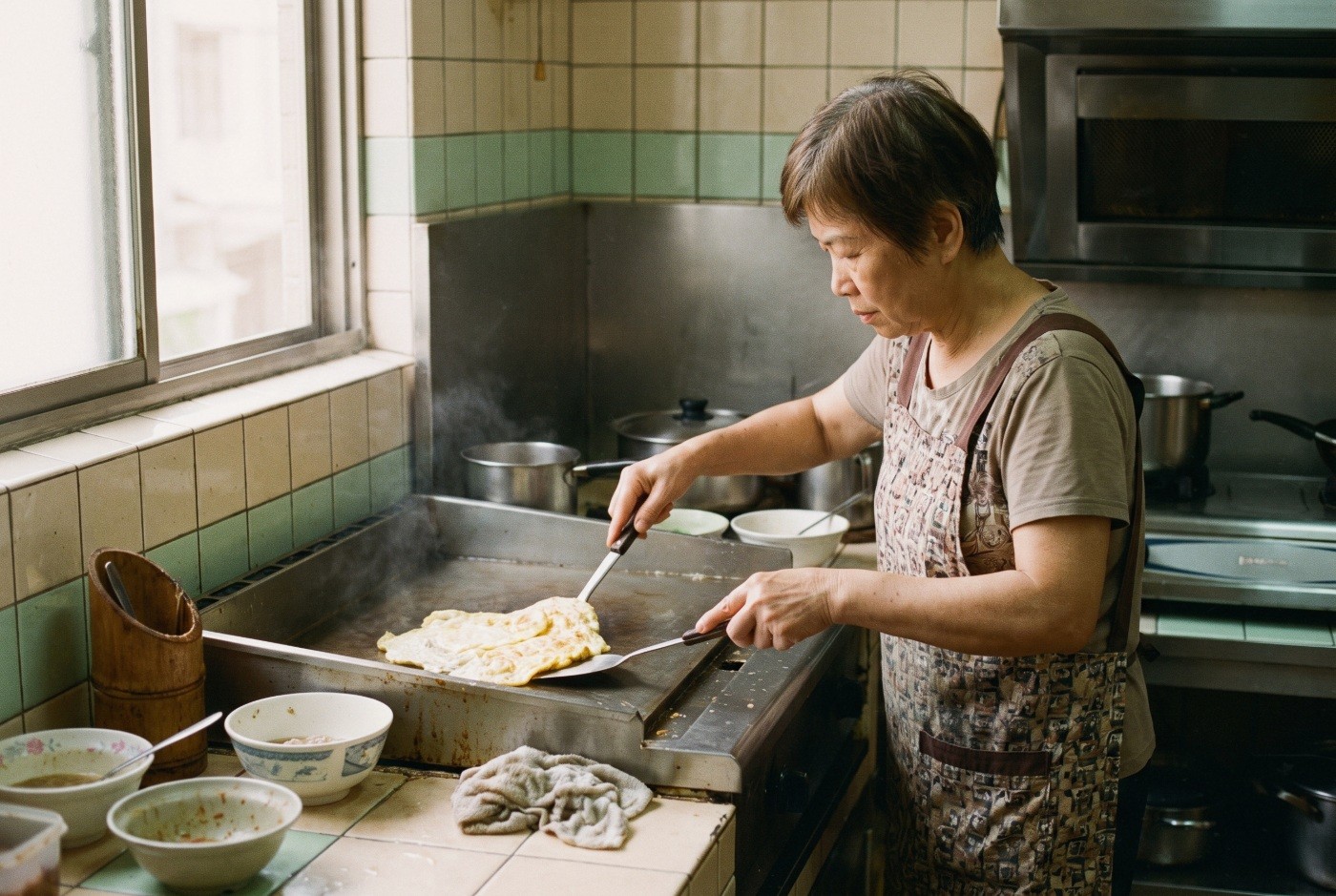
 FIRST SIGHTWEBGLIllustration: An egg pancake cooking on a griddle. · Color and grain by First Sight · Gold 200. · First Sight 色彩與顆粒調校 · Gold 200
First, the sidewalks got regulated. Taipei's push toward urban order — wider sidewalks, accessibility ramps, scooter parking zones — left less room for a cart that needs exactly two square meters and a power outlet that doesn't exist. The regulations weren't targeting breakfast carts. They were targeting chaos. But the carts were part of the chaos, so they went.
Second, rent happened differently. The breakfast cart was viable because it required no rent. You parked on public space. When that space became contested — when the city started issuing fines, when neighbors complained, when the local 里長 stopped looking the other way — the cost of operating went from zero to impossible. A cart vendor making 3,000 NT on a good morning can't absorb a 1,200 NT fine.
Third, the vendors got old. The man on Yongji Road is 68. His knees hurt. His son works in IT in Neihu and has never made a 蛋餅 in his life. This isn't a tragedy narrative — the son has a good job, and the father is proud. But no one is replacing the father. The skill of running a breakfast cart — the timing, the heat control, the knowledge of which corner gets foot traffic at 6:15 versus 6:45 — is not being passed down because it doesn't need to be. There are enough breakfast shops now. The city adapted.
But the city adapted into something slightly different. And the difference matters if you pay attention.
The difference between a cart and a shop
A breakfast shop has fluorescent lights, a laminated menu, a number system, and a teenager working a shift they don't want to be working. The food is consistent. The 蛋餅 is the same every time. The soy milk comes from a supplier. The experience is transactional in the way a convenience store is transactional — it works, it's efficient, and you don't think about it afterward.
A breakfast cart has a person. Not an employee — a person. Someone who chose to wake up at 4am to feed people because that's what they know how to do. The 蛋餅 varies because the griddle has character and the vendor adjusts the heat by feel. The soy milk is either too hot or perfect, never lukewarm, because a thermos doesn't do lukewarm. The interaction takes ninety seconds and involves eye contact and sometimes a comment about the weather that you didn't ask for but somehow needed.
This is not nostalgia. Nostalgia is dangerous because it makes you think the old thing was better. The old thing wasn't better. The old thing was different, and the difference contained something — a texture of daily life, a specific kind of human exchange — that the new thing doesn't contain and doesn't try to contain.
When you buy breakfast from a cart, you're participating in a transaction that has no digital footprint. No receipt. No review. No record that it happened. Tomorrow the cart will be there, or it won't be, and you'll adjust. This is what it feels like to live in a city that hasn't fully optimized itself yet. Taipei is optimizing. The carts are what it's optimizing away.
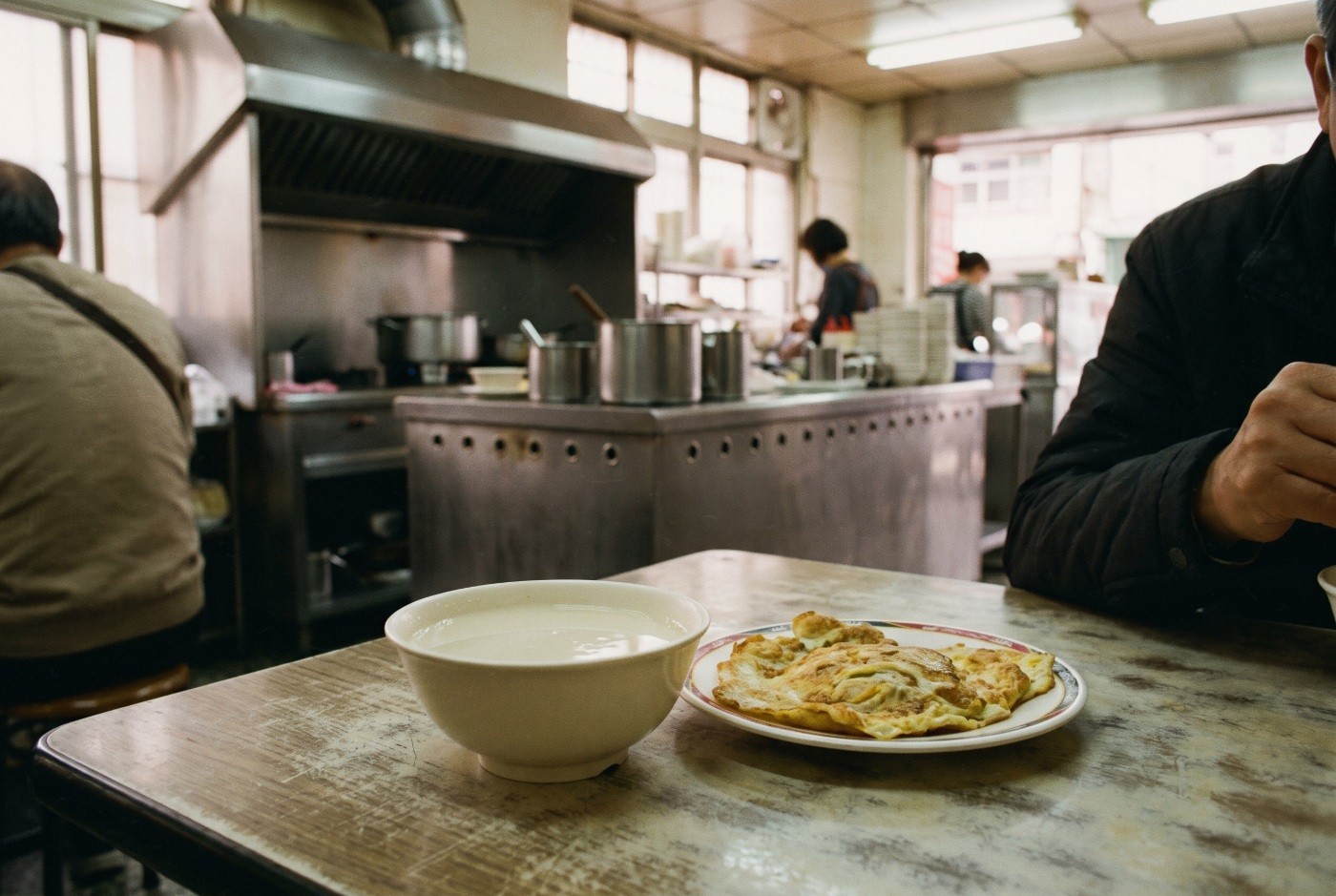 FIRST SIGHTWEBGLIllustration: Soy milk and an egg pancake at a breakfast shop. · Color and grain by First Sight · Gold 200. · First Sight 色彩與顆粒調校 · Gold 200
Where to still find them
They're harder to find every year. But here's what I know, as of this writing:
Yongji Road, Xinyi District. The man described above. Between the scooter shop and the pharmacy. 5:15 to 8am, no Sundays. Cash only, obviously. His 蛋餅 has a crispness that comes from twenty-two years of knowing exactly when to flip. The soy milk is unsweetened unless you ask.
Shuanglian area, Datong District. Two or three carts still operate in the streets around the market. They move. You have to walk around. The 飯糰 vendor near the temple is the one to find — she wraps them tight in a way that the rice stays warm for twenty minutes, which means you can eat it on the bus.
Wanhua, near Longshan Temple. The oldest concentration of remaining cart vendors. Not because Wanhua is nostalgic — because Wanhua hasn't been redeveloped as aggressively. The 豆漿 cart on Xiyuan Road is excellent but the vendor's hours are unpredictable. He's 74.
Sanxia Old Street area. Not Taipei proper, but worth the trip. A few vendors still work the morning market on weekdays. Weekends are too crowded with tourists for a cart to operate.
The pattern is clear: carts survive where the city hasn't finished changing. This is not a permanent condition.
What you're eating
The cart breakfast canon is small and fixed:
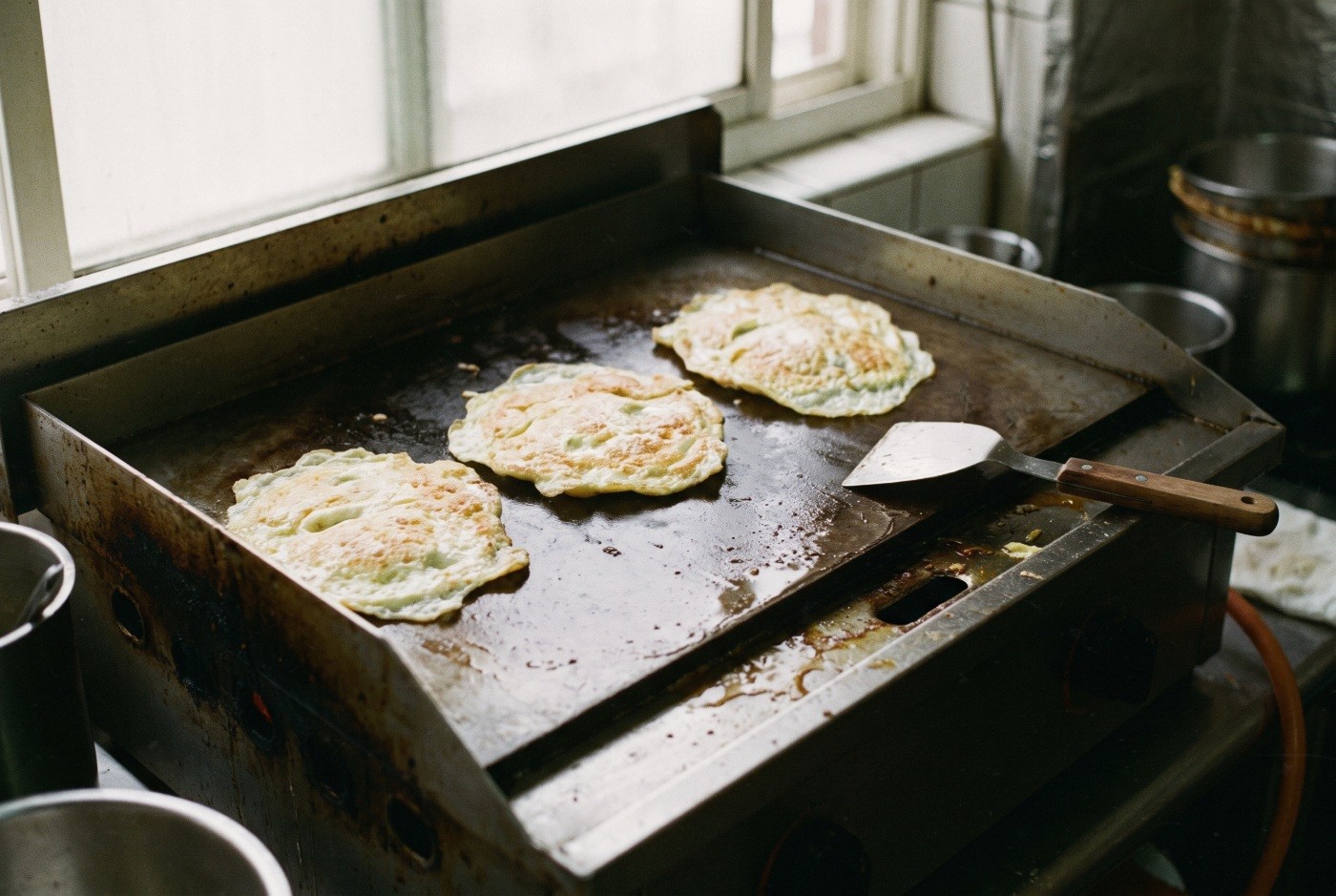 FIRST SIGHTWEBGLIllustration: Egg pancakes on a well-used griddle. · Color and grain by First Sight · Gold 200. · First Sight 色彩與顆粒調校 · Gold 200
蛋餅 (dàn bǐng) — Egg crepe. Flour wrapper, egg, sometimes corn or cheese in the modern versions, but a cart vendor doesn't do modern versions. A cart 蛋餅 is wrapper, egg, soy paste, and the heat of a griddle that's been seasoned by years.
飯糰 (fàn tuán) — Rice roll. Sticky rice wrapped around 油條 (fried dough stick), pickled vegetables, dried pork floss, and sometimes a preserved egg. The construction is an engineering problem: too loose and it falls apart, too tight and the rice compresses. The best vendors solve this in about eight seconds.
豆漿 (dòu jiāng) — Soy milk. Hot, unsweetened or lightly sweetened, made from soybeans the vendor soaked overnight. Not the same as the packaged version. Not close to the same.
蔥油餅 (cōng yóu bǐng) — Scallion pancake. Dough stretched, scattered with scallions, folded, pressed flat, and pan-fried until the outside cracks and the inside stays chewy. A good scallion pancake from a cart has a sound when you tear it — a specific crackle that means the layers separated correctly.
These four items are what Taipei breakfast was before it became a category. Before it got documented and ranked and turned into listicles. They're still the best things to eat in the morning if your definition of best includes the context in which you eat them.
A note on time
The man on Yongji Road won't be there forever. He knows it. I know it. He told me once, while wrapping a 蛋餅 in a plastic bag, that his regular customers are also getting older. "The young ones go to Louisa," he said, meaning the coffee chain. He didn't say it with bitterness. He said it the way you'd say the weather is changing. It is what it is.
If you live in Taipei and you've never eaten from a cart, you should, before the option closes. Not because it's a cultural experience — that framing is already wrong, already turns it into something to consume rather than something to participate in. Go because it's breakfast, and it's good, and the person making it is good at what they do, and that specific combination of things is temporary in a way that most things in Taipei are not.
Comments (0)
Loading comments...