
Tainan doesn't do brunch. It does breakfast, for three hours, across half the old city.*
The city wakes slowly. By 6am the incense is already burning outside the temples, the breakfast shops are pulling up their metal shutters, and the men on scooters are delivering trays of fish soup to restaurants that won't open for another two hours. There's a version of Tainan that only exists in the early morning, and it tastes better than any other version.
This route covers five stops across the historic center. It's walkable, about 3km total, or easy on a YouBike. Budget three hours and NT$400–600 for the full loop.
Why Tainan for breakfast? The city's position as Taiwan's oldest settlement means it's accumulated four centuries of food culture. Unlike Taipei's morning eating (which tends toward speed and efficiency), Tainan breakfast is leisurely. It's built on dishes that require time: slow-cooked soups, hand-rolled rice cakes, fermented proteins. The pace here feels intentional, people sit, they linger, they order a second bowl. The ritual matters as much as the food.
The Route & Sensory Details
Stop 1: 牛肉湯 (Beef Soup) · 6:00–6:45am
 FIRST SIGHTWEBGLColor and grain by First Sight · Gold 200.First Sight 色彩與顆粒調校 · Gold 200
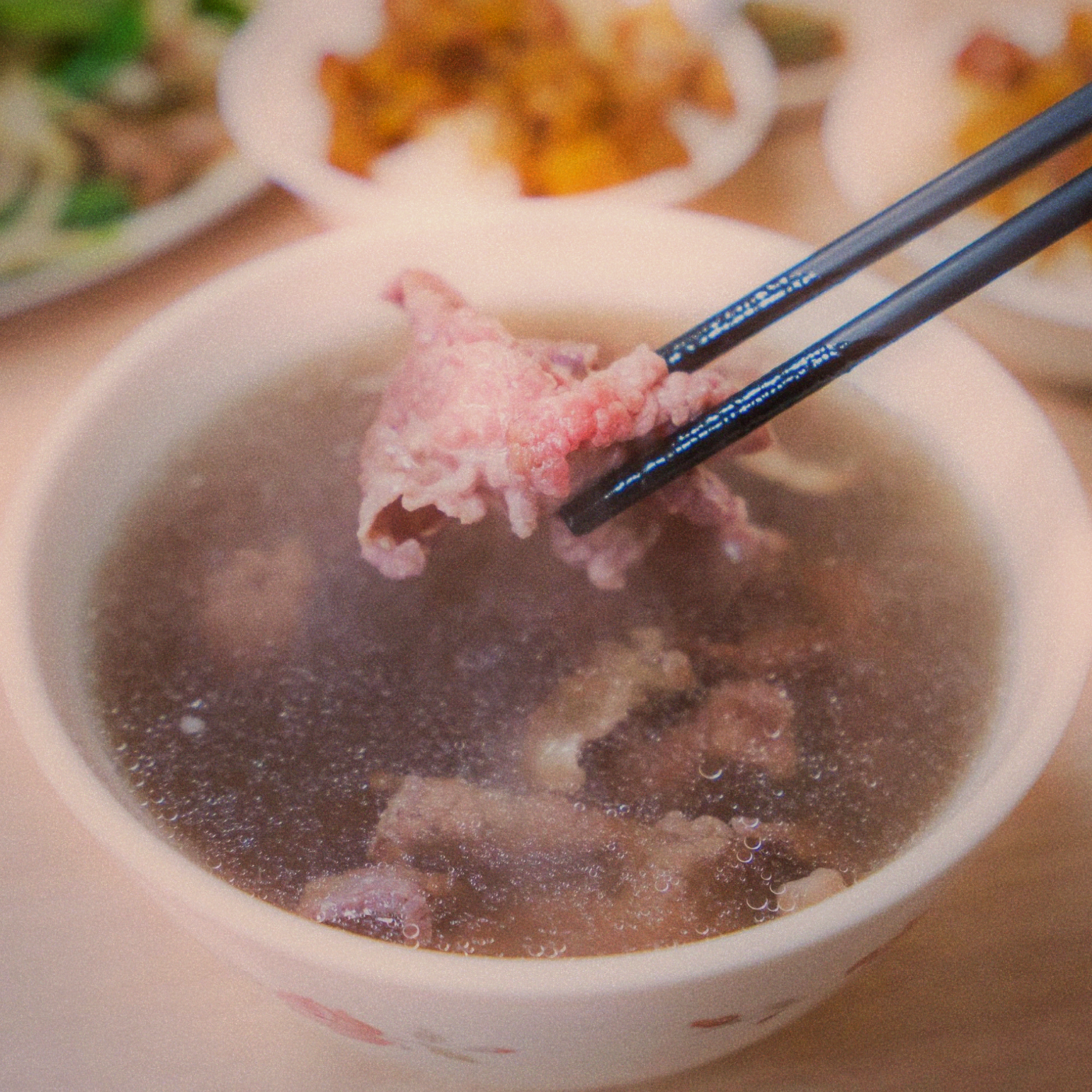
Start at 阿財牛肉湯 (No. 160, Kaishan Road / 開山路160號, West Central District / 中西區). One bowl of 牛肉湯 半熟 with white rice. This is the anchor stop, everything else is dessert and palate cleansers.
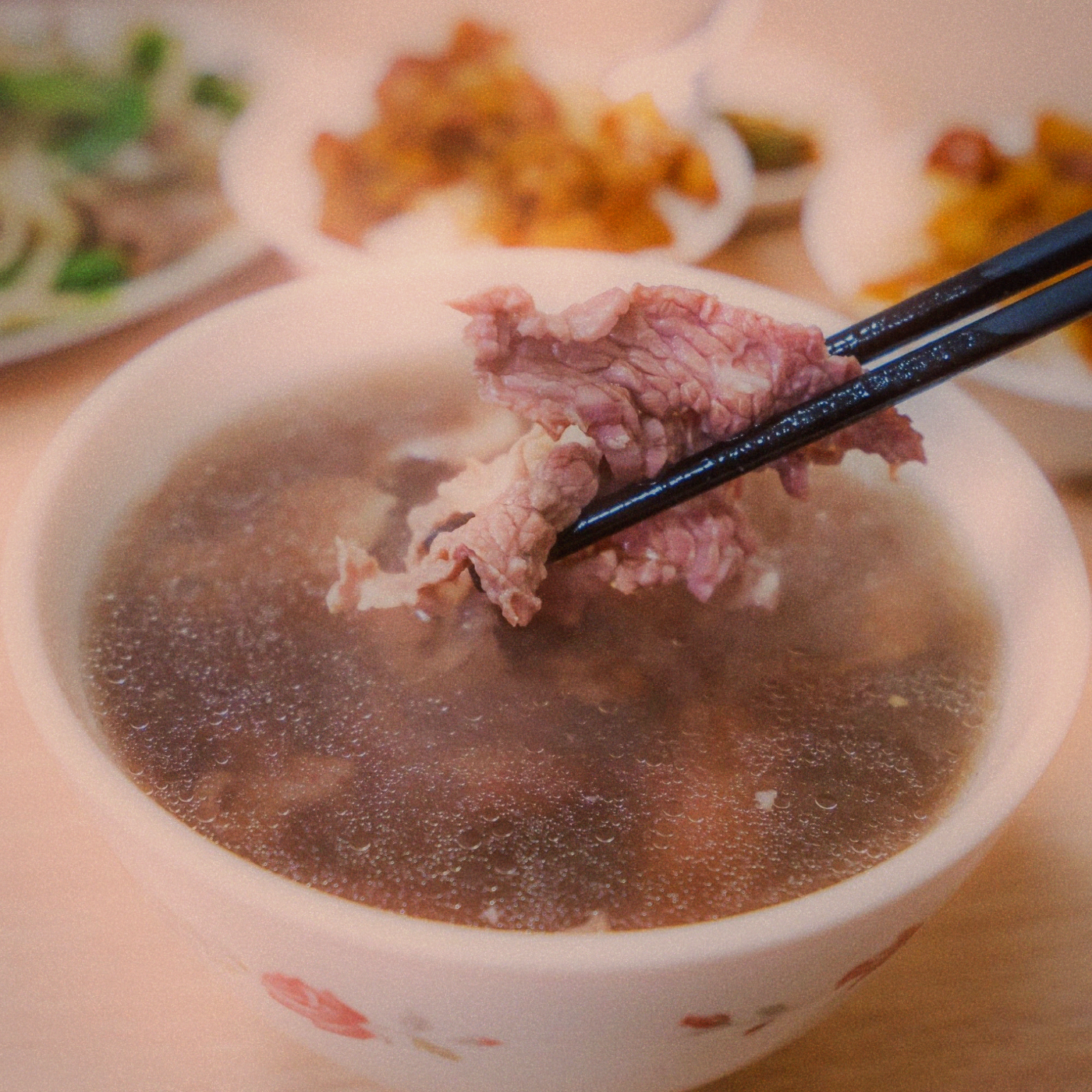
The experience: You'll know you're in the right place by the smell, deep, meaty, mineral-tinged broth simmering since 3am. The shop is deliberately spare: white tile walls, metal tables, harsh fluorescent lighting. There's no ambiance in the traditional sense. What exists instead is absolute focus. The broth arrives steaming, with thin slices of beef so fresh they're still pink in the center. The rice is white, simple, steamed in a metal rice cooker that's been running for hours.
This is not a casual meal. This is breakfast as first sustenance, the dish designed to wake up your stomach and set the foundation for the three hours ahead. The heat, the salt, the protein hit all at once.
牛肉湯半熟 means the beef is half-cooked, cooked through on the outside, rare in the center. This is the proper way; avoid the well-done version. The point is tenderness.
Why this shop specifically: Aqiang (阿財) has been doing this for 30+ years. The broth is made from beef bones and offal simmered overnight. Every element is calibrated. The rice is parboiled so it absorbs the broth without becoming mushy. The bowl arrives at a specific temperature, not hotter.
See our full guide to [Tainan's best beef soup shops] for other options if Aqiang is closed or wait times exceed 20 minutes.
Budget: NT$130–150 | Order timing: 5:45am–7:30am (after 7:30am expect lines)
Stop 2: 碗粿 (Savory Rice Cake) · 7:00–7:20am
 FIRST SIGHTWEBGLColor and grain by First Sight · Gold 200.First Sight 色彩與顆粒調校 · Gold 200
Walk 10 minutes north along Kaishan Road to 富盛號碗粿 (No. 180, Zhongzheng Road / 中正路180號, West Central District). Open since 1872, one of the oldest operating food shops in Taiwan. Look for the small storefront with a painted wooden sign; it's easy to miss.
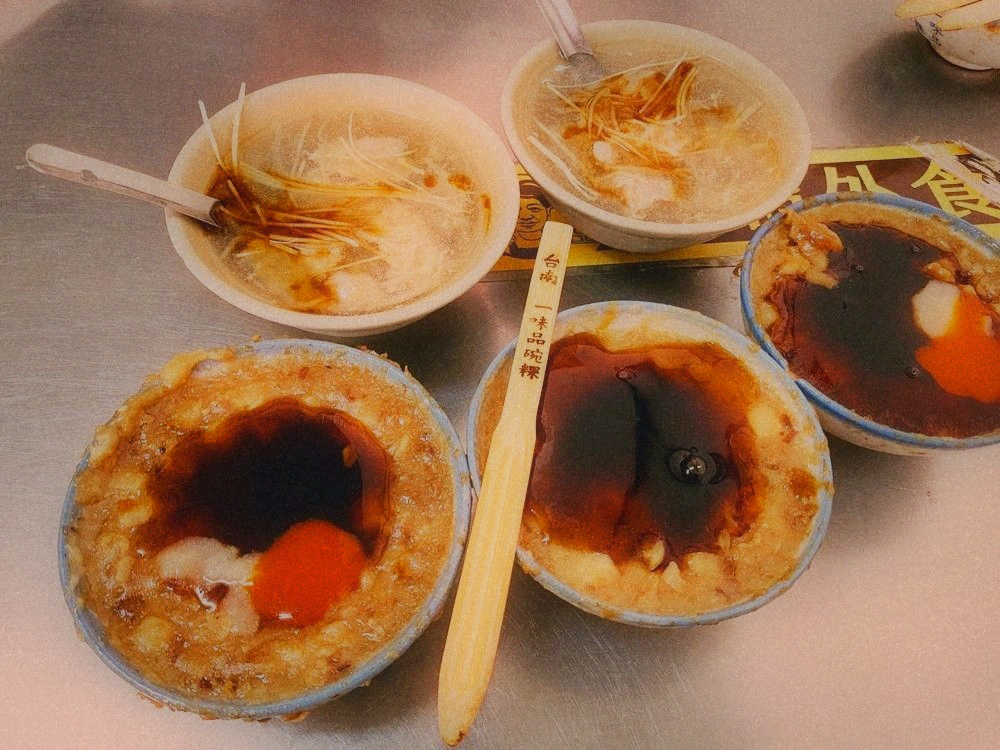
The experience: The shop smells like steam and pork fat in the best way. The 碗粿 here is a steamed savory rice cake: dense, slightly gelatinous, topped with braised pork shoulder (more flavorful than thigh), a salted duck egg yolk (creamy, deep orange), and dried shrimp (umami punch). The cake sits in a ceramic bowl, still warm from the steamer.
Eat it with a plastic spoon. The texture is important, it should feel slightly gelatinous on the tongue, not cake-like. The toppings are distributed to hit each spoonful: a bit of pork, a bit of yolk, a bit of shrimp, a bit of cake.
碗粿 is Taiwanese breakfast tradition at its most fundamental. It's made from rice flour, not whole rice, which gives it the distinctive dense-but-yielding texture. It's served plain, without soup or additional sauce. The depth comes entirely from the toppings.
Size note: They're small. Many people eat two. It's normal to order multiples.
How to order: Say 碗粿 (wán-ké in Taiwanese, wǎn guǒ in Mandarin) and hold up fingers for quantity. Locals order in Taiwanese; it helps. Aim for 1–2 bowls per person.
Budget: NT$50–100 per person | Order timing: 6:30am–9:30am (rarely sells out but quality diminishes after 9am)
Stop 3: 虱目魚湯 (Milkfish Soup) · 7:30–7:50am
Another 10-minute walk to 阿憨鹹粥 (No. 5, Gongzheng Road / 公正路5號, West Central District). This is saltiness. This is brininess. This is how the sea tastes when it's been seasoned into a bowl.
The experience: Milkfish (虱目魚) is Tainan's signature protein, raised in the vast flat ponds south of the city. The fish are freshwater-adapted, which makes the meat sweeter and less "fishy" than ocean fish. The soup here is made from fish bones and head, simmered with ginger. It's clean, mineral-bright, slightly sweet from the fish collagen.
The fish arrives in pieces, some spine-on (for chewing), some boneless fillet. The soup is served in a large ceramic bowl, with a side of white rice or rice congee. The broth itself is the focus; drink it directly from the bowl between spoonfuls of fish.
Milkfish soup is lighter than beef soup. It's a palate reset after the heavy beef stop. By the third stop, your stomach understands the rhythm: heavy protein, lighter protein, now something with vegetables is coming.
Why this location: Family-run since 1975. The broth is made fresh daily, starting at 4am. The fish comes from specific ponds in Annan District, south of the city, the same suppliers for 40+ years. The cook, now in her 70s, has a relationship with the fishermen.
The cultural significance: Milkfish farming is Tainan's agricultural legacy. In the 1700s, the ponds were created as salt ponds. They were later adapted for fish. Today, the ponds occupy roughly 5,000 hectares around Tainan, visible from the train. Eating milkfish soup is eating the city's history.
How to order: 虱目魚湯 (sī-ba̍k-hî-thng) for soup, or 虱目魚粥 (sī-ba̍k-hî-tshoo̍h) if you want congee instead of rice. Either is fine.
Budget: NT$60–90 per person | Order timing: 6:00am–9:00am
Stop 4: 蘿蔔糕 (Turnip Cake, Pan-Fried) · 8:00–8:15am
Stop at any traditional breakfast cart near Chikan Tower (赤崁樓), the iconic red fortress in central Tainan. By 7am there are usually two to three carts set up on the plaza's east side. They're gone by 9am. There's no fixed address, this is street food in its truest form.
The experience: You'll identify the stall by the sound: the sharp sizzle of a cast-iron griddle, the smell of hot oil and radish cake caramelizing at the edges. Watch the vendor pan-fry the turnip cake (thick slices, pre-made, cut into rectangles). The edges crisp and brown while the center stays creamy. They plate it, drizzle it with sweet soy sauce (slightly thick, molasses-colored), and swipe a line of chili paste (bright red, medium heat, made fresh that morning or the day before).
蘿蔔糕 is radish cake, a savory cake made from shredded daikon, rice flour, and sometimes pork. It's steamed as a block, then sliced and pan-fried. The exterior shatters slightly under your teeth. The interior is yielding. The sweet-spicy sauce brings it all together.
This is the point where the meal shifts from pure sustenance to pleasure. The first three stops were fuel. This stop, with its caramelized edges and precise sauce balance, is where eating becomes enjoyable again.
Cultural context: Turnip cake is a Cantonese invention originally, but Tainan adapted it into something more aggressively seasoned. Taipei versions tend toward subtle; Tainan's chili paste is unapologetic.
Pro tip: Watch the vendor before ordering. Different carts have different griddle temperatures and sauce ratios. Pick the one that's browning the cake most evenly.
Budget: NT$30–50 per piece | Order timing: 6:30am–9:00am (later carts often run out by 8:45am)
Stop 5: 愛玉冰 (Aiyu Jelly in Iced Lemon Water) · 8:30–9:00am
End at 莉莉水果店 (No. 1, Fuqian Road / 府前路一段1號, West Central District). Yes, a fruit shop at 8:30am. Tainan breakfast always ends in sweetness. This is non-negotiable.
The experience: 愛玉冰 is a translucent jelly made from the seeds of the Ficus pumila vine, a mountain fig. The seeds are soaked and hand-rubbed under running water to release a gel-forming compound. The resulting jelly is wobbled, nearly clear, vaguely pink from the plant matter. It's served in a glass with iced lemon water, sometimes with a touch of honey or rock sugar.
The texture is gelatinous but not quite solid, it shivers when the glass moves, holding its shape but feeling liquid on the tongue. The flavor is neutral, almost blank, allowing the lemon and ice to dominate. It's not sweet. It's refreshing in the way that cool water is refreshing. It's the perfect palate reset after an hour and a half of eating.
Sit outside on the plastic stool if there's space. Watch the city finish waking up. Tainan's breakfast culture is not rushed, and this final stop reinforces that. You finish slowly.
Why *愛玉*: It's a Taiwanese food tradition, not common outside the island. It's made from hand-labor, the rubbing cannot be mechanized. It's seasonal; summer versions (May–September) are more delicate and gelatinous. Winter versions (October–April) are thicker, less refined. Peak season is June–August when the humidity helps the gel set.
Budget: NT$50–70 | Order timing: 8:00am–11:00am (fruit shops stay open longer)
Route Logistics
Total walk: Approximately 2.8km. Entirely flat; no hills or difficult terrain. Walkable in 50 minutes at a casual pace, but budgeting 10 minutes per stop for ordering, waiting, and eating means the full route takes 3 hours.
YouBike stations: Located at Tainan High-Speed Rail Station (台南高鐵站) and near Chikan Tower (赤崁樓). Bikes are cheaper than taxis for this route.
Cash only: All five stops are cash-only. No card readers. Bring NT$600 in small bills.
Route difficulty: None. This is an easy walk through the historic center. The streets are flat, the traffic is light in the morning, and you're never more than 10 minutes from the next stop.
Best day to go: Tuesday–Sunday. Aqiang beef soup is closed Tuesdays, so if you're going on a Tuesday, move Stop 1 to 三財牛肉湯 (another reliable shop) or rearrange the route to start at Stop 2.
Timing is critical: Before 7am, wait times are minimal everywhere. At 7am–8am, lines begin to form at popular stops. After 9am, several stops begin to sell out or close. The 6am–8am window is ideal.
Why Tainan's Breakfast Culture is Different
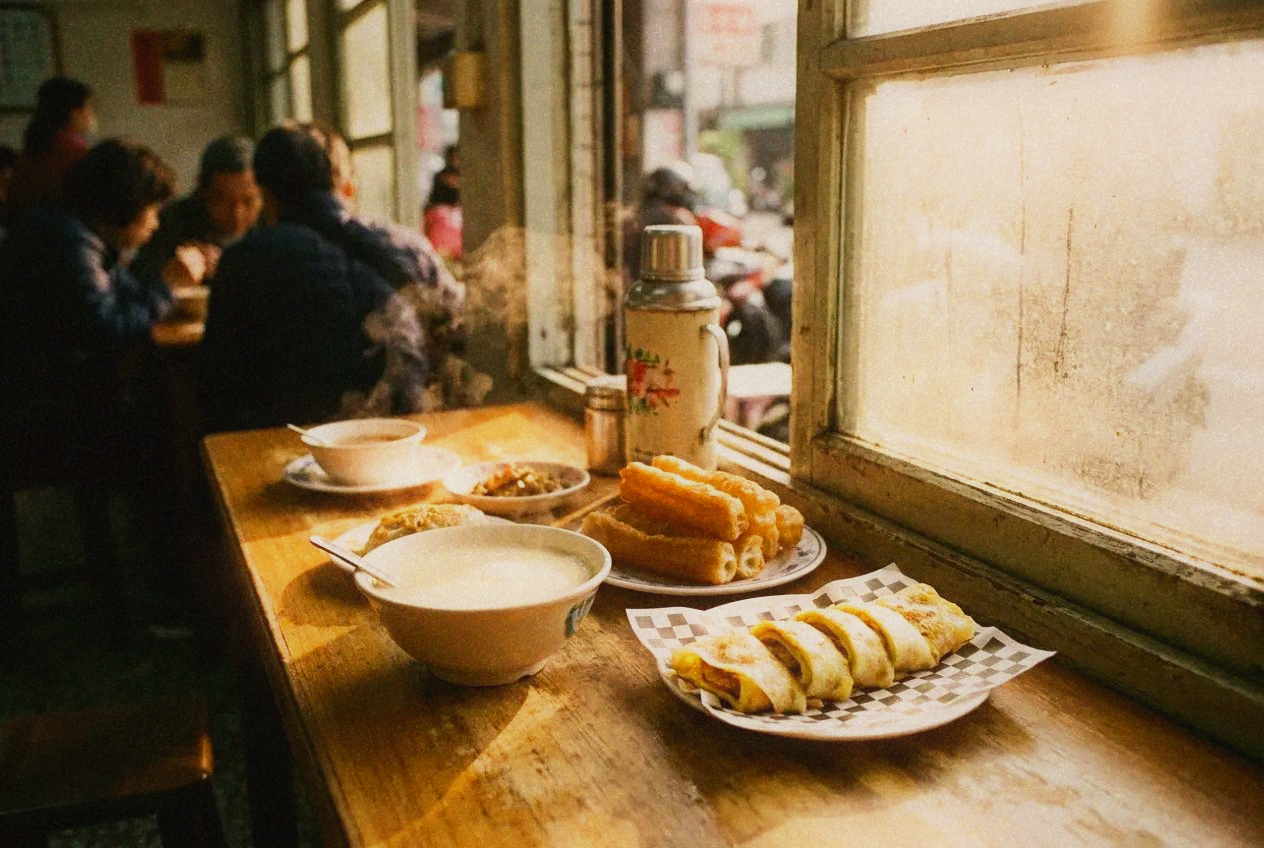 FIRST SIGHTWEBGLA Tainan breakfast spread: soy milk, youtiao, dan bing. The table is small, the portions generous, the pace unhurried. · Color and grain by First Sight · Gold 200. · First Sight 色彩與顆粒調校 · Gold 200
Taipei breakfast emphasizes speed and variety. You grab a crepe, a soy milk, a youtiao, and you're moving. It's fuel on the go.
Tainan breakfast emphasizes depth. Each stop specializes in one thing. You spend 15–20 minutes eating. You're encouraged to linger. The culture assumes you have time, or that taking time is the point.
This came from Tainan's role as Taiwan's oldest city, a place where rituals have accumulated over centuries. It wasn't modernized as aggressively as Taipei. The breakfast culture remained unhurried.
Additionally, Tainan's cuisine relies on fermented and slow-cooked proteins: milkfish, beef, shrimp paste, salted eggs. These are flavors that require time to appreciate. You can't rush them.
Related Context: The Historical Layers
Tainan's food culture is a palimpsest. The milkfish ponds come from Dutch colonial era salt operations. The beef soup comes from post-war Hakka and mainland Chinese influences. The turnip cake comes from Cantonese dim sum traditions, adapted locally. The 愛玉 is indigenous to Taiwan.
Walking through Tainan for breakfast is walking through Taiwan's food history compressed into one morning. Understanding where each dish comes from deepens the experience.
Some links in this article are affiliate links. If you purchase through them,OQUA may earn a small commission at no extra cost to you. This helps support our editorial work. We only link to products and services we genuinely reference in our writing.
Comments (0)
Loading comments...