
The bus climbs for forty minutes out of the coast, switchback after switchback, until the sea drops away below and the windows fog with cloud. Then you round a bend and Jiufen appears all at once — a town of grey tiled roofs stacked up a green hillside, red lanterns strung along invisible alleys, the whole thing half-dissolved in mist. It looks less like a place you drive to than a place that surfaces for a few hours and might be gone by morning.
It is not gone by morning, of course. Jiufen (九份, roughly "nine portions") is a real town on the northeast shoulder of Taiwan, about an hour from Taipei, and on a Saturday afternoon it is one of the most crowded square kilometres on the island. But it earns its reputation. Few places in Taiwan reward you so quickly for simply showing up and walking uphill.
A town built on gold
The name is older than the fame. Local lore says that in the nineteenth century only nine families lived here, so remote that goods were ordered in "nine portions" whenever anything came up the mountain. Then, in the 1890s, gold was found in the hills, and the nine portions became a boomtown. For half a century Jiufen was one of the richest corners of the island — miners, merchants, teahouses, theatres, and the kind of restless money that builds a town fast and sideways.
The gold ran out after the Second World War, the mines closed, and Jiufen slid into a long, quiet decline. The steep lanes and wooden houses simply stayed where they were, weathering, half-abandoned, waiting. That accidental preservation is exactly why the town feels the way it does now: nothing here was designed for tourists — it was designed for a vanished industry and then left alone.
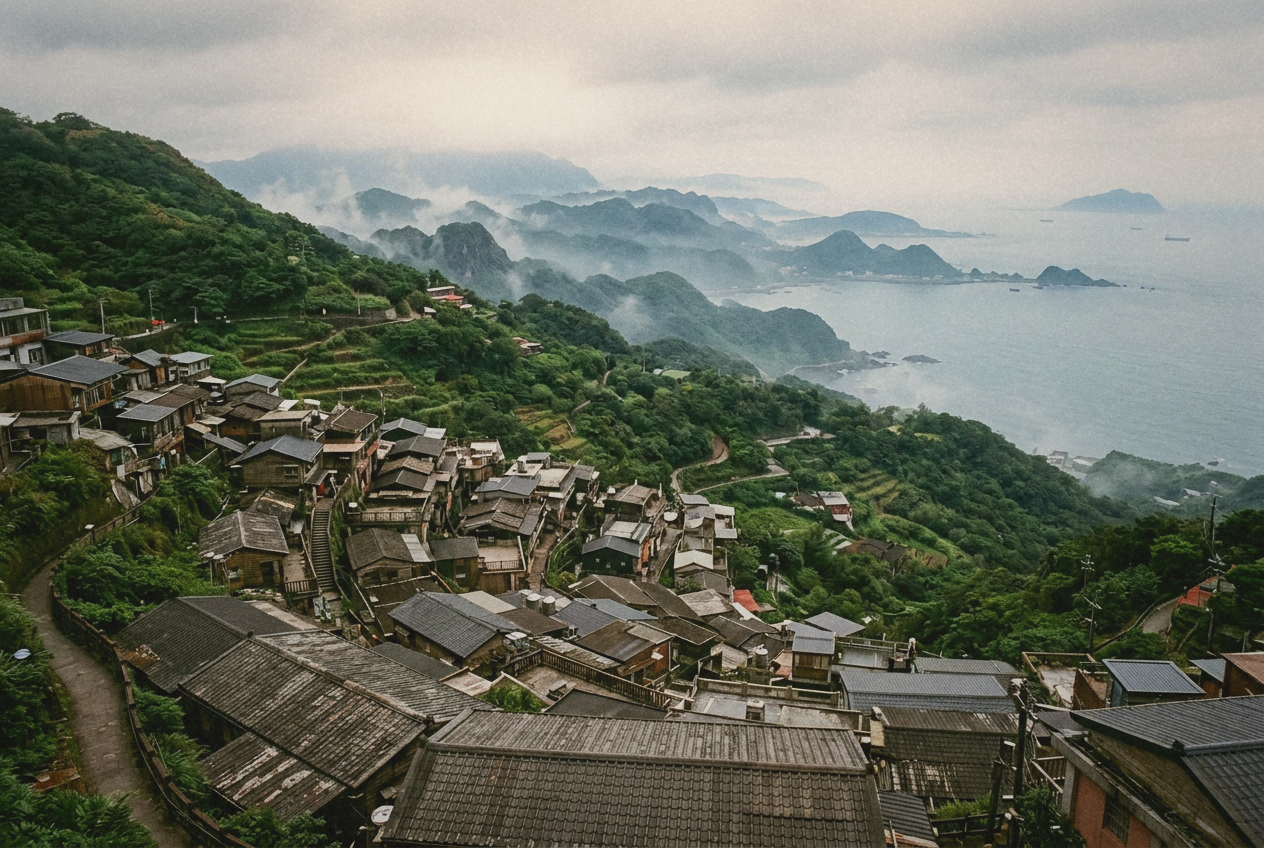
 FIRST SIGHTWEBGLThe town was built for a gold industry that vanished after the war. The accidental preservation is why it still feels the way it does. · Color and grain by First Sight · Portra 400. · First Sight 色彩與顆粒調校 · Portra 400
The stairways and the old street
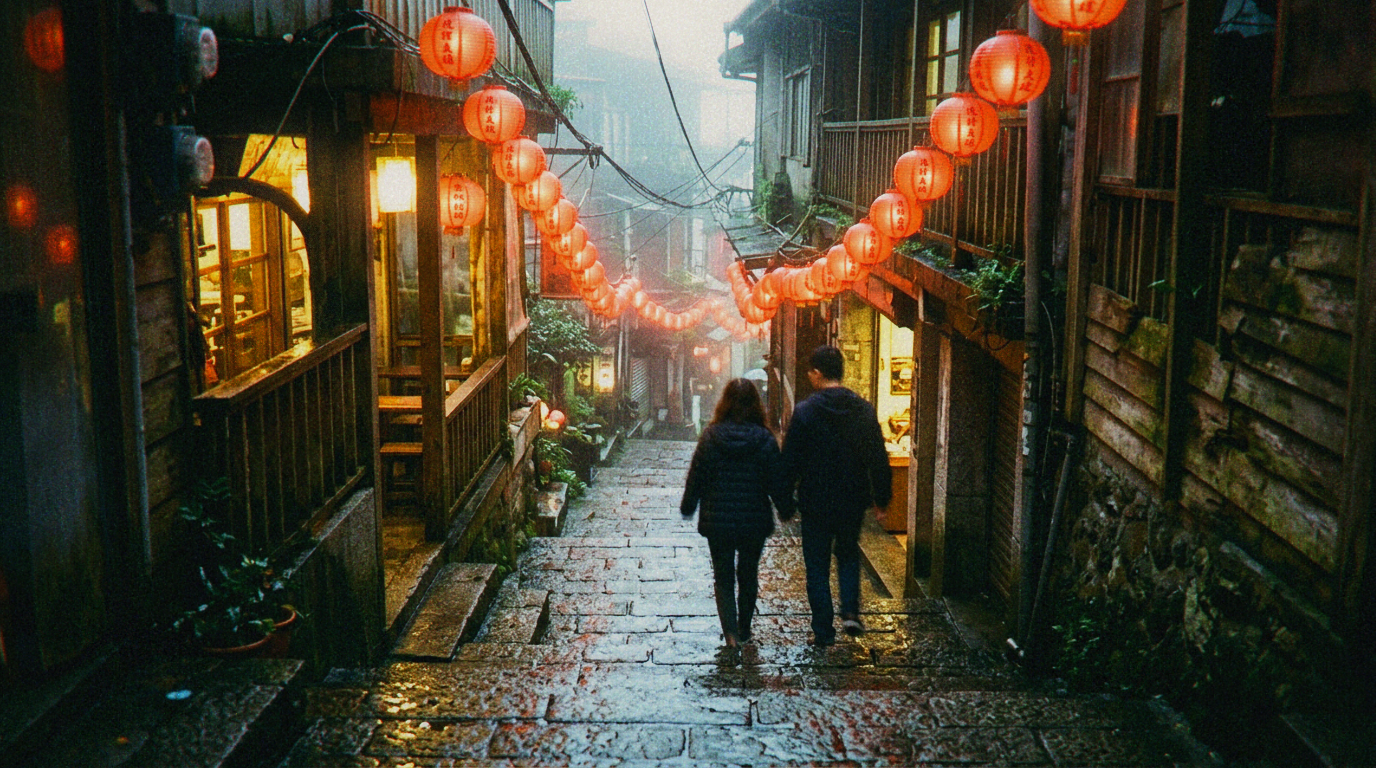
Jiufen has no grid. It has stairs. The town is essentially two intersecting lanes threaded through the hillside — Jishan Street, the covered "old street" where the food and shops are, and Shuqi Road, the near-vertical stone staircase most people have seen in photographs without knowing its name. Everything else branches off these in short flights of steps, alleys barely wide enough for two people, doorways that open directly onto the drop.
Jishan Street is the loud heart of it: a narrow tunnel of a lane, roofed against the frequent rain, packed shoulder to shoulder with stalls selling taro balls, fish-ball soup, peanut ice-cream rolls, dried mushrooms and every imaginable souvenir. It is sensory overload in the best and worst senses — delicious, exhausting, impossible to rush. Give in to the current and let it carry you; fighting it is how you end up miserable.
The teahouses are the whole point
If you do one thing in Jiufen, sit down in a teahouse. The old wooden tea houses stacked along Shuqi Road are the reason to come and the reason to stay past dark. You take a table by a window or on a balcony, order a pot of Taiwanese high-mountain oolong and a small plate of sweets, and someone shows you how to rinse the leaves and pour. Then you do very little for an hour, watching the mist move across the valley and the lights come on below.
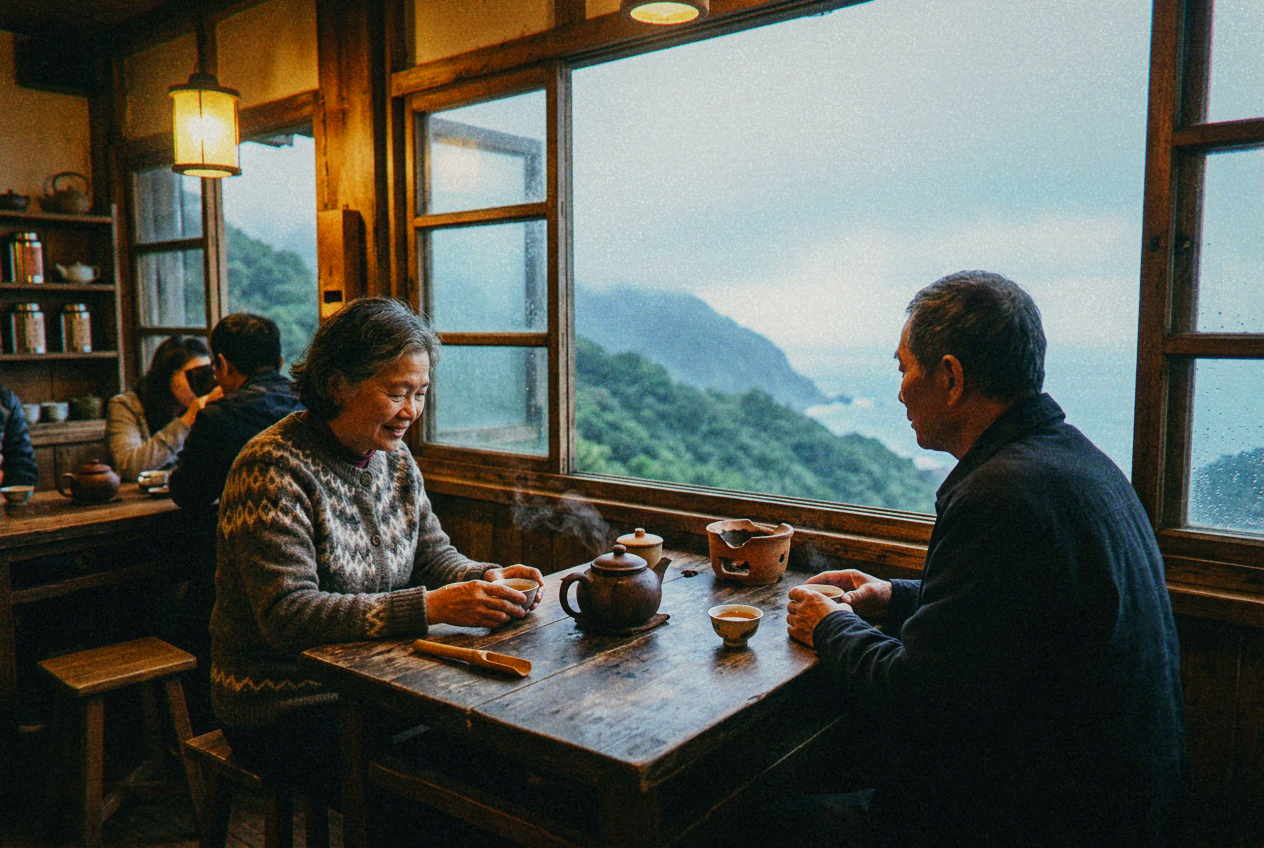 FIRST SIGHTWEBGLOrder a pot of high-mountain oolong, take a balcony seat, and do very little for an hour. You are renting the view and the time. · Color and grain by First Sight · Superia. · First Sight 色彩與顆粒調校 · Superia
It is not cheap — a pot of tea for two can cost more than a full meal down the hill — and that is the trade. You are renting the view and the time, not just the leaves. Go up a floor if you can; the higher balconies look clean over the rooftops to the ocean, and on a clear evening the water turns the colour of pewter while the town glows amber beneath you. This is the image people carry home.
What to eat
Jiufen's signature is taro balls (芋圓, yùyuán) — chewy, faintly sweet dumplings of taro and sweet potato, served hot in a ginger broth in winter or cold over shaved ice in summer. The best-known shops have been making them the same way for decades, and the texture — springy and soft at once — is worth the queue. Have them hot if the mist is in; there is no better small comfort on a cold, wet afternoon.
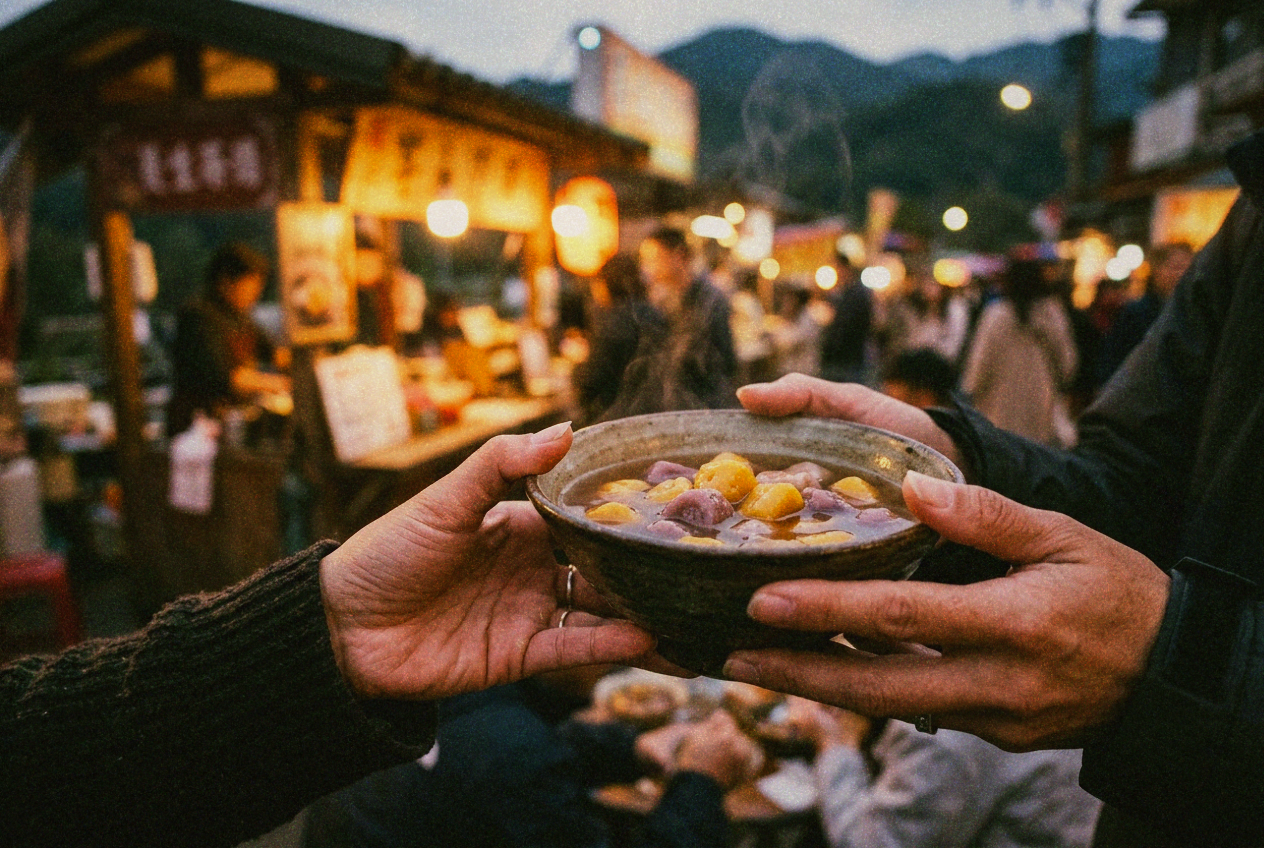 FIRST SIGHTWEBGLTaro balls, hot in ginger broth when the mist is in — there is no better small comfort on a cold, wet afternoon. · Color and grain by First Sight · Gold 200. · First Sight 色彩與顆粒調校 · Gold 200
Beyond the taro balls, graze widely: fish-ball and meatball soup, savoury rice dumplings wrapped in bamboo leaf, grilled sausage, nougat and peanut brittle, and the famous peanut ice-cream roll — shavings of hard peanut candy and two scoops of ice cream wrapped in a thin crepe with a scatter of coriander, which sounds wrong and tastes right. Eat as you walk; almost nothing here needs a table.
About that Spirited Away rumour
You will read everywhere that Jiufen inspired the bathhouse in Hayao Miyazaki's Spirited Away. It is a lovely story, and Studio Ghibli has politely denied it more than once. The truth is gentler and more interesting: Jiufen looks like the film because both draw on the same well of old East Asian mountain-town atmosphere — lanterns, wooden balconies, steam, the feeling of a place slightly out of time. You do not need the myth. Stand on Shuqi Road at dusk and you will understand why the rumour refuses to die.
When to go, and when to leave
The paradox of Jiufen is that the best hours are the ones most visitors miss. The tour buses arrive around lunch and pour out again by five or six, so the town is at its most crowded exactly when it is least magical — flat afternoon light, wall-to-wall people. Stay through the changeover. As the day-trippers drain away and the lanterns come on, the same lanes you were fighting through become quiet, glowing and genuinely dreamlike.
Come on a weekday if your schedule allows, and make peace with the weather: Jiufen is one of the wettest, mistiest spots in Taiwan, and a grey drizzle is not a spoiled trip — it is the town in its natural state. Bring a light rain jacket, wear shoes with grip for the wet stone stairs, and do not over-plan. Jiufen is small; the pleasure is in wandering, not in ticking off sights.
How to reach it from Taipei
The simplest route is the direct bus (Keelung Transit 1062) from the Zhongxiao Fuxing area, which winds straight up to Jiufen in a little over an hour. For a faster, more reliable trip, take the train to Ruifang (about 40 minutes from Taipei Main Station) and switch to a local bus or a short taxi for the climb. Coming back after dark, expect a queue for the bus; a shared taxi down to Ruifang station is often worth it.
However you arrive, give Jiufen a half-day at least, and if you can, stay until the lanterns win. The town has survived gold, abandonment and its own fame, and it still knows how to do the one thing it has always done best: catch the last light, hang it in a red lantern, and hold it over the sea for a little while longer.
Comments (0)
Loading comments...