
The first time I went to Taichung, I did it wrong. I took an early train, ate a famous pastry, photographed a famous wall, and was back in Taipei by dinner, mildly unimpressed and quietly convinced that everyone who liked Taichung was being generous. It took a second visit, an overnight one, to understand what I had missed. Taichung is not a sightseeing city. It is a living-pace city. It reveals itself somewhere around the second coffee on Saturday afternoon, when you realise you have not looked at your phone in an hour and the weather has been perfect the entire time.
That weather is the thing nobody leads with. Taichung sits in a basin that shelters it from the northeast monsoon, which means while Taipei spends February under a grey drizzle, Taichung is dry and bright and about four degrees more pleasant. This is why people move here. It is also why a weekend works better than a day trip: you want an evening, and a slow morning, and enough time to sit outside.
Getting there, and the transfer nobody mentions
The high speed rail does Taipei to Taichung in about 47 minutes on a direct service, an hour with stops. The catch is that the HSR station is not in the city. It is at Xinwuri, south of the centre, and you connect from there to Taichung Main Station on a local train that takes roughly ten minutes and runs constantly. Factor it in and the door-to-door is still comfortably under two hours.
Once you are in the city, adjust your expectations about transit. Taichung has one MRT line, the green line, and it is useful for a few things and irrelevant for most. The city runs on scooters, buses, YouBike, and taxis, and distances are longer than they look on a map. Budget for taxis or rent a scooter if you are licensed. This is the single biggest planning error visitors make.
Friday evening: the green spine
Start where the city is most itself. The 草悟道 is a long green pedestrian corridor running roughly north to south through the western district, connecting the museum end to the shopping end, lined with trees, cafes, and small design shops. It is the closest thing Taiwan has to a boulevard built for loitering.
Halfway along sits 審計新村, a cluster of low mid-century government dormitories that were saved from demolition and handed to small businesses. Now the old apartments hold ceramicists, leather workers, and coffee roasters, with a weekend market spilling into the courtyard under the trees. It is touristy in the way that a place can be popular and still good. Go in the late afternoon when the light comes through sideways, buy something small, and eat from the stalls rather than making a dinner plan.
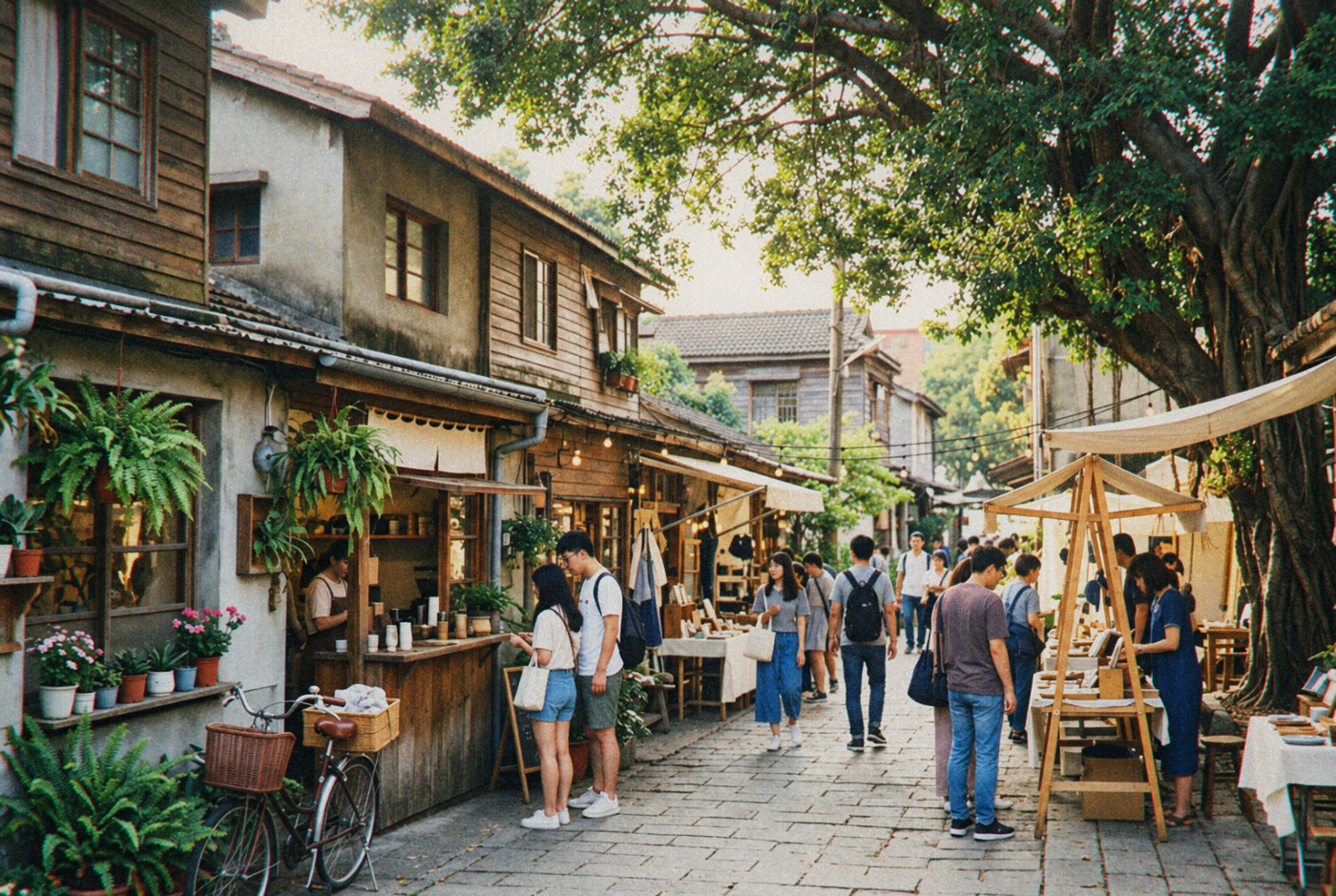
 FIRST SIGHTWEBGLSmall craft stalls and coffee counters along a shaded market lane. · Color and grain by First Sight · Superia. · First Sight 色彩與顆粒調校 · Superia
If you want the loud version of the night instead, 逢甲夜市 near Feng Chia University is the largest night market in the country by most counts, sprawling across 文華路, 逢甲路, and 福星路. It is a student market, which means portions are big, prices are low, and the innovation rate is absurd. Fried chicken cutlets the size of a face, sweet potato balls, and whatever the current invention is. Go early, around six, or accept that you will be moving with a crowd.
Saturday morning: the art the capital does not have
Taipei has more museums. Taichung has the National Taiwan Museum of Fine Arts, which is the only national-level art museum in the country and one of the largest in Asia, sitting at the western end of the green corridor with a ten-hectare sculpture park around it. General admission to the permanent collection is free. What makes it worth the morning is not any single work, it is the scale: enormous halls, generous ceilings, and a park that means you can walk out of a gallery straight into shade without paying to come back in.
Do it slowly. Then walk twenty minutes back up the corridor for coffee. Taichung takes coffee seriously in a way that is less performative than Taipei, and the roasters along the green spine are where the city's cafe culture actually lives.
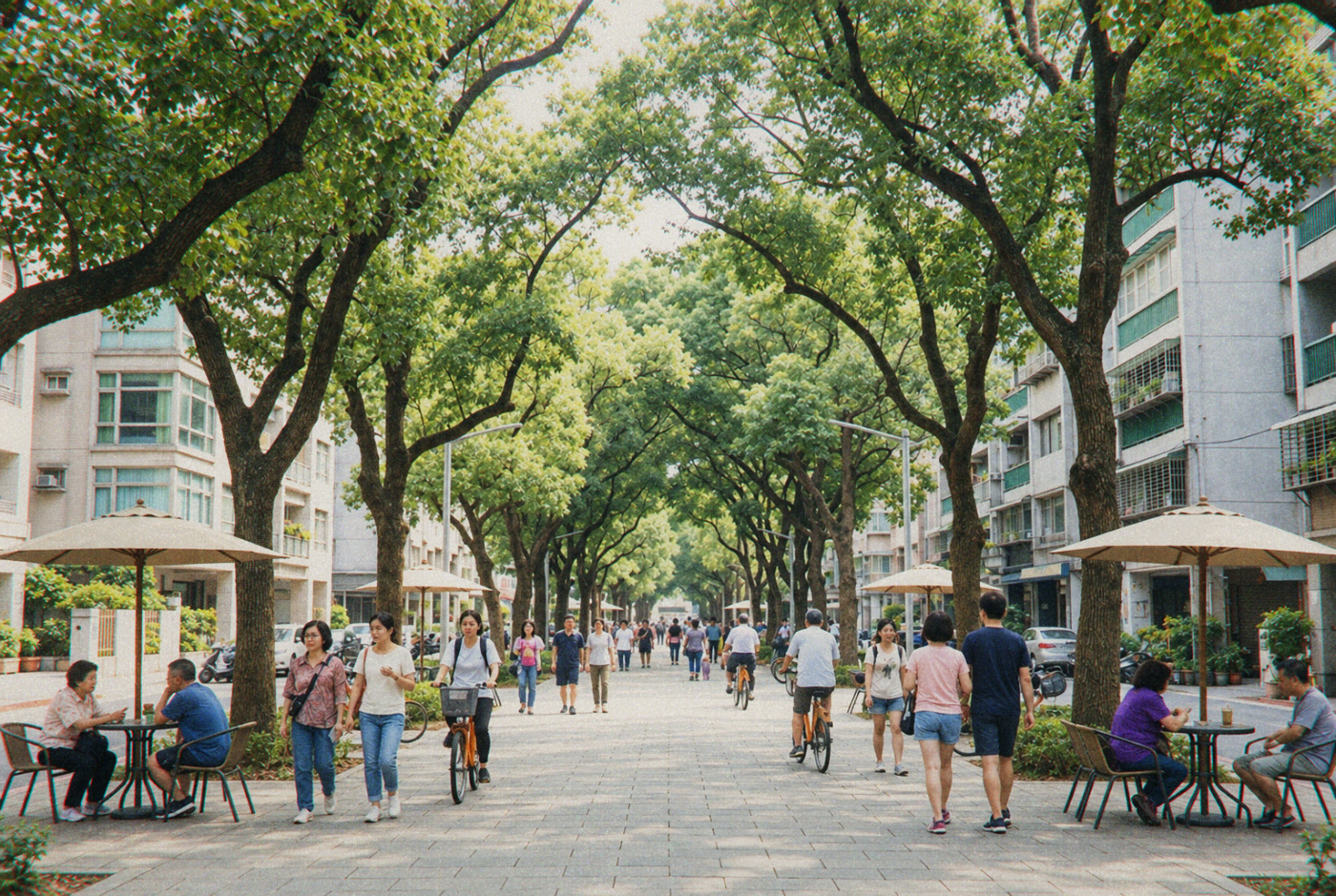 FIRST SIGHTWEBGLPeople walking and cycling along a tree-lined city promenade. · Color and grain by First Sight · Superia. · First Sight 色彩與顆粒調校 · Superia
Saturday afternoon: sugar, colour, and a very good building
Two Taichung institutions sit within a short taxi ride of each other. 宮原眼科, at 中山路 20 號 in the old central district, was a Japanese-era ophthalmology clinic that a local confectioner restored into a dessert hall. Inside is a soaring atrium with dark wood shelving stacked to the ceiling like a library. The ice cream is the point: choose your scoops, pile on fresh Taiwanese fruit and toppings, and eat it standing outside while looking at the brickwork. It is a tourist queue and it is genuinely worth it.
Then 彩虹眷村, the Rainbow Village, on 春安路 56 巷 in Nantun, open daily and free. This is a small remnant of a military dependants' village that a resident, Huang Yung-fu, began painting in his eighties when the site was slated for demolition. The painting saved it. It takes fifteen minutes to see, it is smaller than the photographs suggest, and standing in it is still moving, because the whole thing began as one old man's argument against erasure.
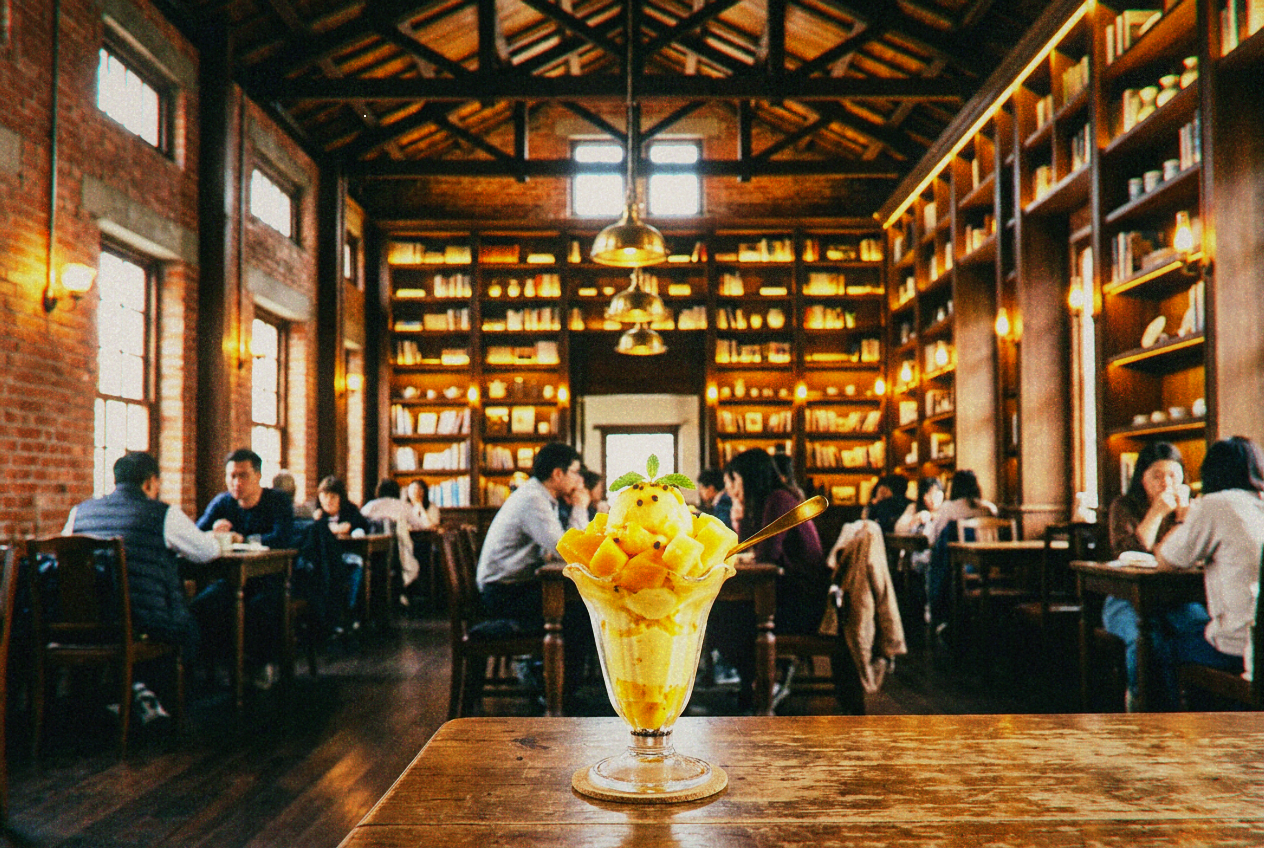 FIRST SIGHTWEBGLA fruit ice-cream sundae in a cafe with tall wooden shelves. · Color and grain by First Sight · Superia. · First Sight 色彩與顆粒調校 · Superia
Architecture people should add two more. The National Taichung Theater on 惠來路二段 101 號, by Toyo Ito, is a building made of curved concrete surfaces with almost no straight lines, and the public levels are open Tuesday to Sunday, roughly 11:30 to 21:00, closed Mondays. The Luce Chapel at Tunghai University, by Chen Chi-kuan and I.M. Pei, is a sixty-year-old curve of tiled roof that still looks like it was finished last year. The Tunghai campus around it is worth the walk on its own.
Saturday sunset: time it with the tide
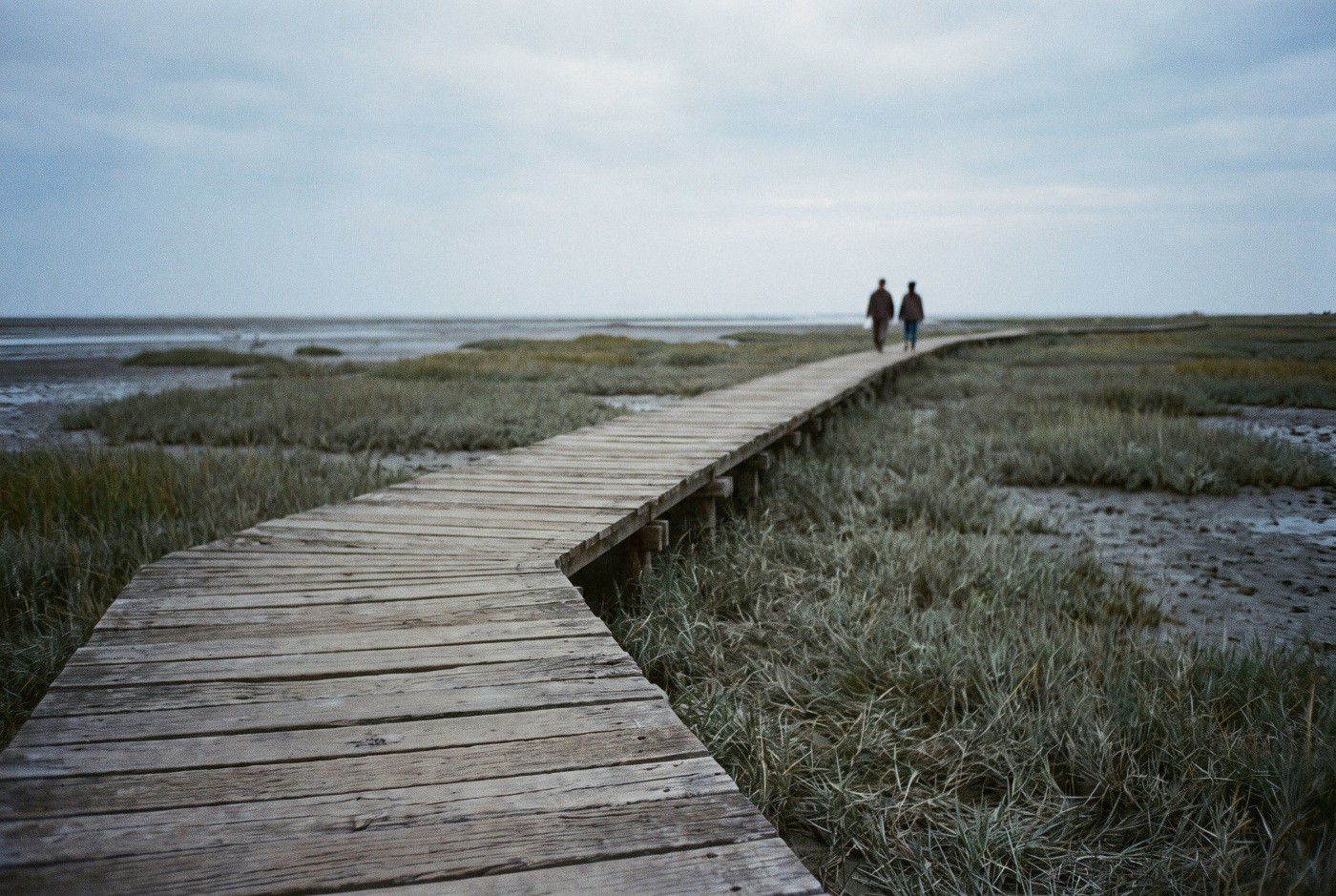
The Gaomei Wetlands are the reason to stay overnight, and the reason most day-trippers miss the best thing in Taichung. It is a vast tidal flat at the mouth of the Dajia River, roughly an hour from the city, where a long wooden boardwalk runs out across water so still it turns into a mirror, with wind turbines standing along the horizon. At sunset the whole thing goes orange and violet and doubles itself in the water.
Here is the part that ruins people's plans: the boardwalk closes around high tide. It generally operates from about 08:00 to 18:00, but it shuts roughly an hour and a half before high tide, two hours on a spring tide, and reopens the same interval after. Check the tide table for the day before you commit, and aim for a day when low or mid tide lines up with sunset. Get there an hour early, bring a layer because the wind off the strait is real, and do not wear anything you mind getting muddy.
Sunday: the slow one
Do not schedule Sunday. This is the entire argument for staying over. Have a long breakfast, walk the green corridor again in the morning when it belongs to joggers and dog walkers, and pick one thing: the botanical garden and its greenhouse near 館前路, a bookshop, a second museum room you skipped.
Buy 太陽餅 before you leave, the flaky Taichung sun cake, which is the correct souvenir and comes in a dozen competing versions along 自由路. Then take the local train back to Xinwuri and be home in Taipei with the evening still ahead of you.
Comments (0)
Loading comments...