
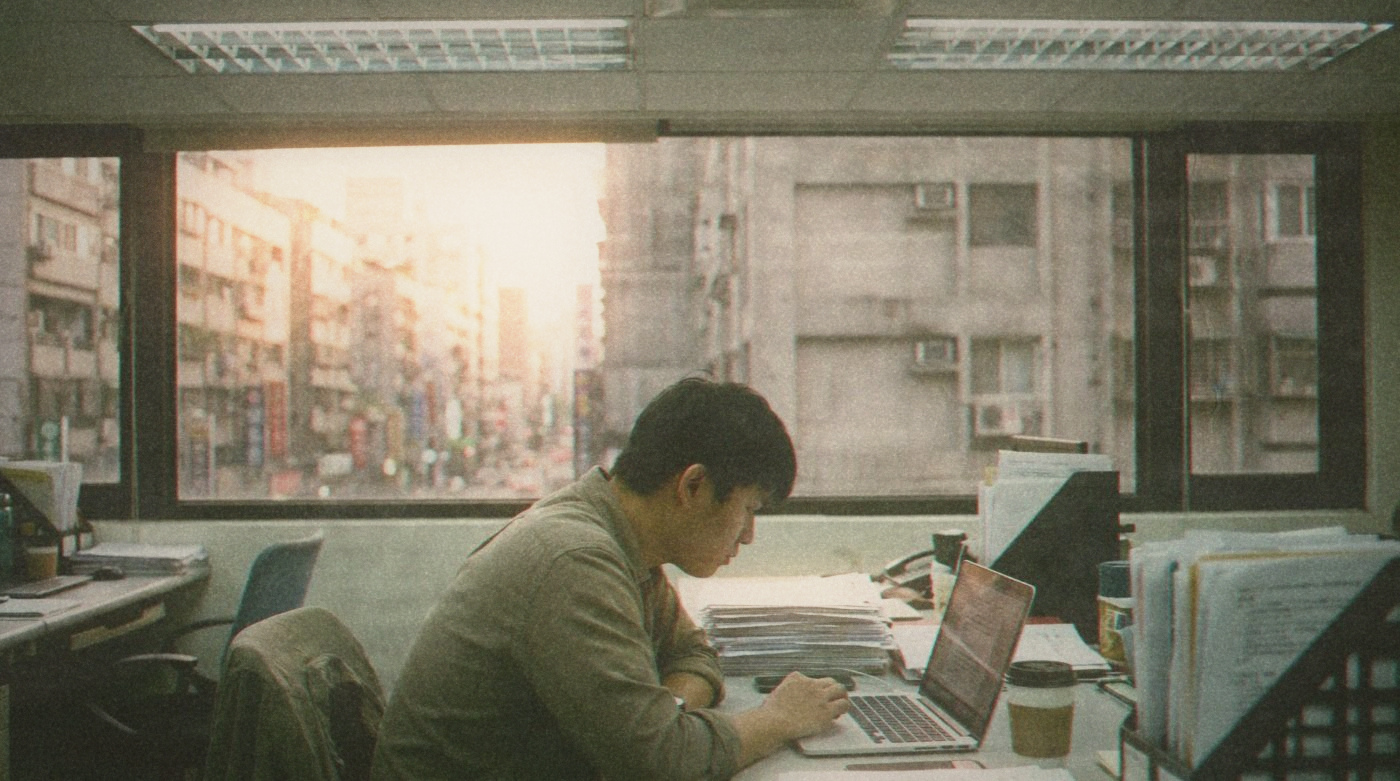
You know the feeling before you know the name for it. That pull at the base of your skull, somewhere between tension and a dull ache, that shows up around 3pm and doesn't fully leave until you've been horizontal for an hour. Your shoulders have crept up toward your ears again. Your upper back has rounded into a shape that, if you caught your reflection in the elevator doors, you'd straighten out of immediately. Then forget about five minutes later.
Neck pain, shoulder tightness, that vague soreness between the shoulder blades. If you work at a desk in Taiwan, there's roughly a coin-flip chance you're dealing with at least one of these. Research on office workers puts the numbers at 53.5% for neck pain, 53.2% for lower back pain, and 51.6% for shoulder complaints. More than half. And Taiwan's work culture makes it worse. At 2,033 hours per year, Taiwanese workers log more hours than nearly every OECD country. Only Singapore, Mexico, and Costa Rica rank higher. That's a lot of time spent in a chair, leaning toward a screen, with your head drifting forward centimeter by centimeter.
Most people try stretching. Stretching feels good. It provides temporary relief, loosens things up for twenty minutes, and then you're back in the same position doing the same thing. The problem isn't that your muscles are tight. The problem is that some muscles are too weak to hold you upright, and the tight ones have taken over because the weak ones checked out.
This has a name. Physiotherapists call it Upper Cross Syndrome, and once you understand the pattern, you'll recognize it everywhere.
The pattern nobody explains
Upper Cross Syndrome describes a specific set of muscle imbalances. Your head and neck drift forward. Your upper back rounds. Your shoulders roll inward. It looks like bad posture, and it is, but there's a mechanical reason it happens.
The muscles on the front of your body, your pectorals, upper trapezius, and levator scapulae (the muscle running from your neck to the top of your shoulder blade), get tight and shortened from hours of reaching toward a keyboard. Meanwhile, the muscles that should pull you back into alignment, your deep neck flexors, rhomboids, and lower trapezius, get progressively weaker. They're not being asked to do anything, so they stop showing up.
The tight muscles pull you forward. The weak muscles can't pull you back. That's the cross. And stretching only addresses one half of it. You can stretch your chest and neck all day, but if the opposing muscles don't get stronger, you'll drift right back into the same pattern within an hour of sitting down.
I spent a year doing yoga and neck stretches thinking my posture would fix itself. It felt better temporarily. Nothing actually changed until I started loading the muscles that were supposed to hold me upright in the first place.
Three exercises that target the actual problem
You don't need a complicated program. Three movements, done consistently, address the specific weaknesses behind desk posture. All of them can be done at any gym with a cable machine or a pull-up bar.
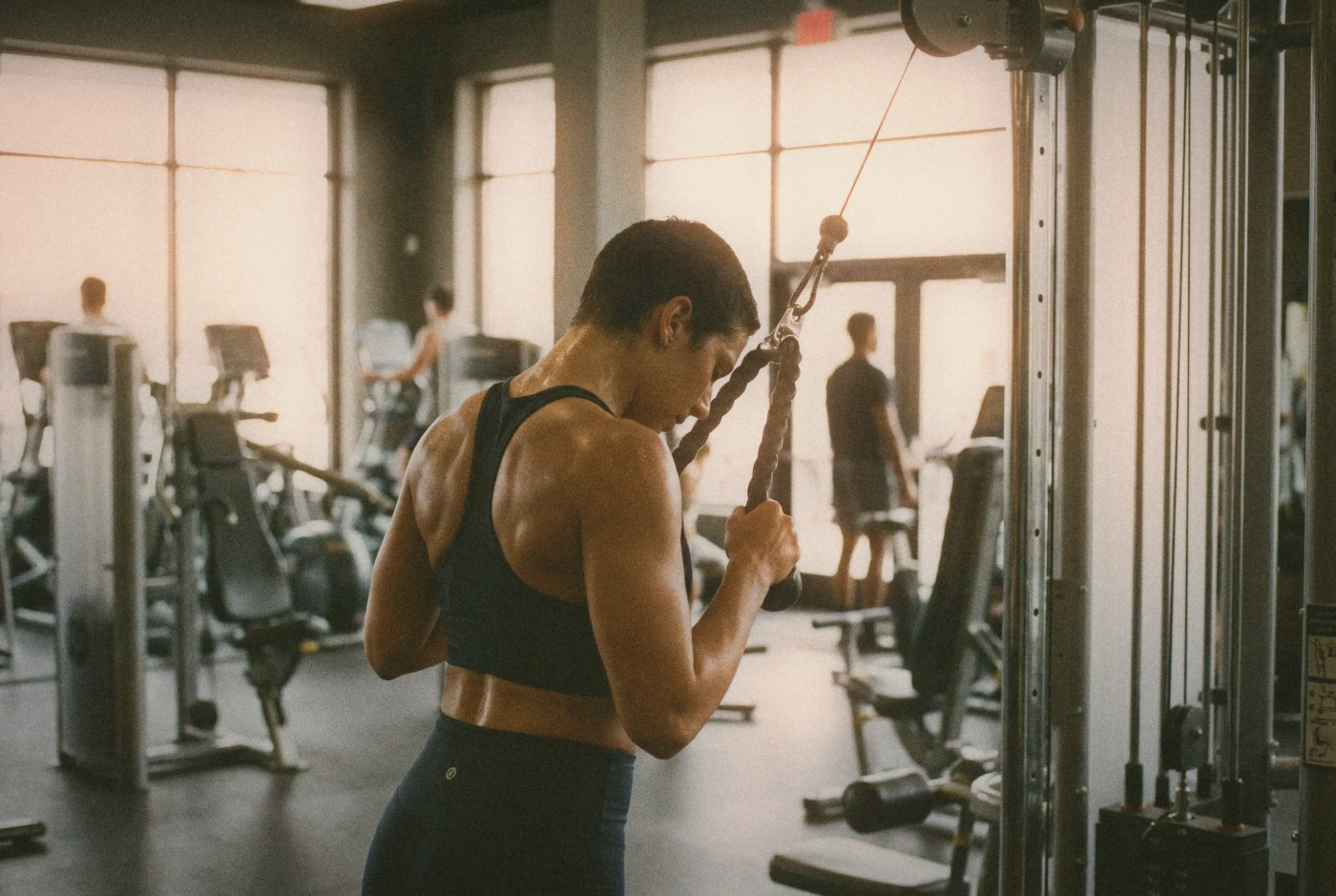
 FIRST SIGHTWEBGLPerson performing cable face pulls at a gym. back muscles engaged · Color and grain by First Sight · Portra 400. · First Sight 色彩與顆粒調校 · Portra 400
Face pulls. This one does more for posture than almost any other single exercise, and most people have never tried it. You pull a cable or resistance band toward your face, elbows high, squeezing your shoulder blades together at the end of the movement. It strengthens the mid and lower trapezius, posterior deltoids, and teres minor, the exact muscles that pull your shoulders back and down. It also actively lengthens your pectorals through the movement. Two to three sets of 15 reps, light weight, focusing on the squeeze at the end. If you only add one exercise, make it this one.
Rows. Cable rows or dumbbell rows strengthen your rhomboids and middle trapezius. These are the muscles between your shoulder blades that should be holding your upper back straight. When they're weak, your thoracic spine rounds forward and your shoulders roll in. Rows are the direct fix. Three sets of 10 to 12, moderate weight, pulling your elbows back rather than just your hands.
Dead hangs. Find a pull-up bar, grab it with both hands, and hang. That's it. Your body weight creates gentle traction that decompresses the spine, increases the space between vertebrae, and stretches the lats and pectorals that have tightened from sitting. Start with 15 to 20 seconds if you've never done it. Work toward 30 to 60 seconds. Three sets. It's also excellent for grip strength, which turns out to be one of the strongest predictors of overall longevity.
The timeline nobody tells you about
Here's the honest version. Posture correction through resistance training is not fast. But it's more permanent than anything else you'll try.
Weeks 1 to 3. You'll feel the exercises working muscles you didn't know existed. The area between your shoulder blades will be sore in a new way, a good kind of sore, the kind that means tissue is being challenged. Your posture won't look different yet. This is the phase where most people quit because nothing visible has changed. Don't quit.
Weeks 4 to 8. Muscle activation starts to change. You'll catch yourself sitting taller without thinking about it. The 3pm neck ache starts showing up less frequently, or less intensely. Other people probably won't notice yet, but you will. Your body is learning to recruit the right muscles again.
Weeks 8 to 16. Visible structural change. Your shoulders sit further back at rest. Your head doesn't jut forward as much. If someone takes a photo of you from the side, you'll look noticeably different from four months ago. This is also when the pain reduction becomes consistent rather than occasional.
Month 6 and beyond. The new posture becomes your default. You still need to maintain the exercises, probably two to three times per week, but the correction holds. Sitting at a desk doesn't undo it anymore because the muscles are strong enough to counteract the position.
Posture correction is one of those things where the results lag far behind the work. The first month feels pointless. The sixth month feels like a different body. Trust the lag.
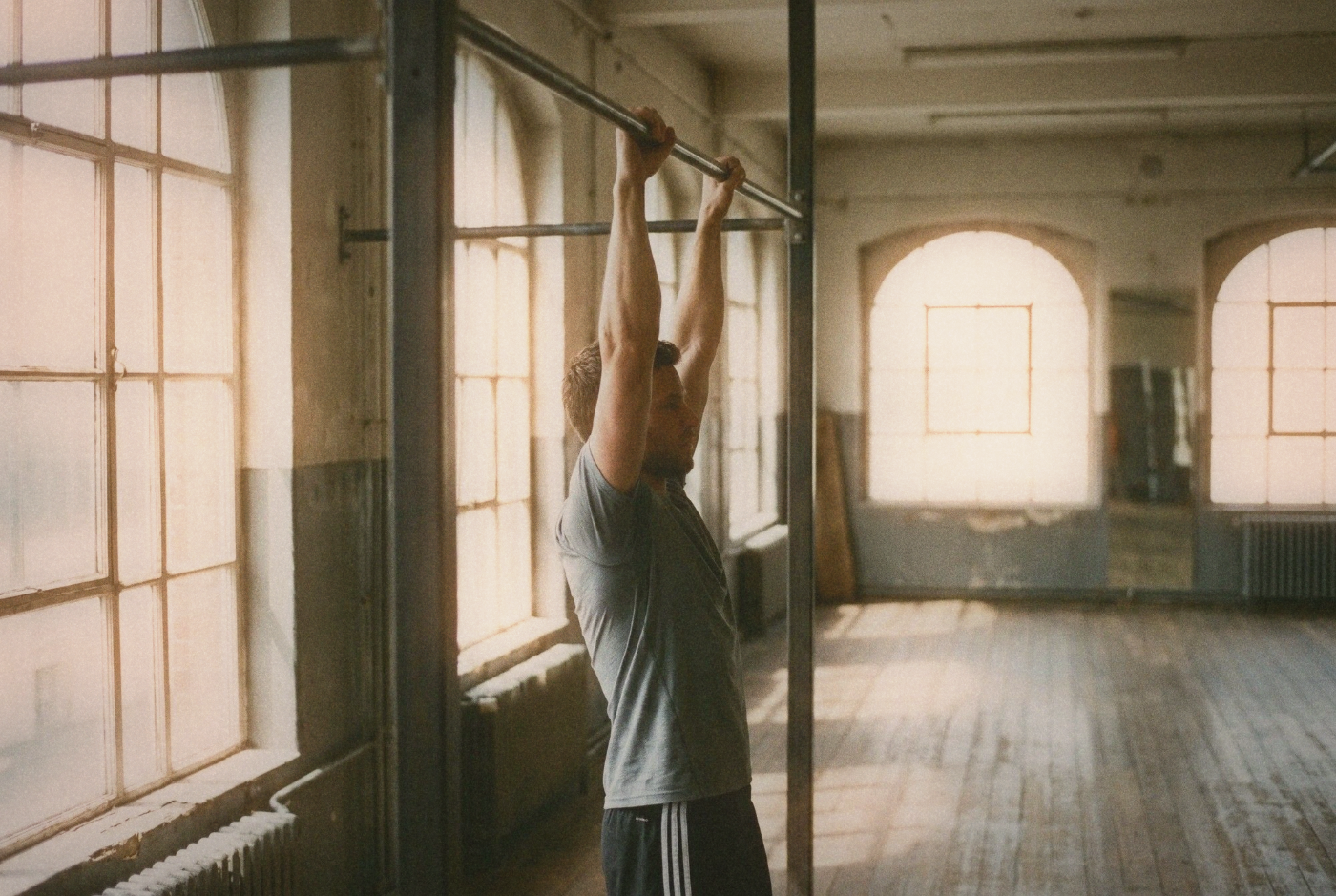 FIRST SIGHTWEBGLMan doing a dead hang from a pull-up bar. arms extended · Color and grain by First Sight · Portra 400. · First Sight 色彩與顆粒調校 · Portra 400
Where to do this in Taipei
You don't need an expensive gym. You need a cable machine and a pull-up bar.
Taipei's 運動中心 network is the most cost-effective option. Every district has at least one, most have several, and the gyms charge NT$50 per hour. Zhongshan, Da'an, Xinyi, Nangang, all of them have the basic equipment you need: cable machines, dumbbells, pull-up bars. The facilities are clean and functional. They're not fancy. They have what matters.
If you want more guidance, private gyms like World Gym locations across Taipei offer personal training with coaches who can specifically assess your posture and build a corrective program. Monthly memberships average around NT$1,388. Studios like 植健身 (Fit Plant Gym) in Da'an focus on functional movement patterns that directly address alignment issues.
For people who want a structured corrective program with a trained professional, look for trainers with NASM CES (Corrective Exercise Specialist) certification. Several independent studios in Taipei have trainers with this credential. A few sessions to learn proper form on face pulls and rows is worth the investment, especially if you've never done them before. Bad form on a cable row does nothing for your posture.
When stretching isn't enough: seeing a 復健科 doctor
If your neck pain is sharp rather than dull, if you have numbness or tingling running down your arms, if your range of motion has noticeably decreased, or if the pain doesn't improve after six to eight weeks of consistent exercise, stop guessing and see a specialist.
In Taiwan, 復健科 (rehabilitation medicine) is the relevant department, and it's covered by NHI. The first visit involves a consultation and diagnosis. From the second treatment course onward, your copay is just NT$50 per session. For moderate to severe cases, even that fee can be waived. This is remarkably affordable rehabilitation care. Use it.
Major hospitals like Taipei Medical University Hospital, Chang Gung Memorial Hospital, and Taipei City Hospital all have established rehabilitation departments with physical therapists who specialize in musculoskeletal issues. For something less clinical, clinics like 宜德復健科診所 and 勁緻物理治療所 are well-reviewed options.
The honest guideline: start with exercise for mild to moderate postural pain. If it's been two months of consistent work and you're not improving, or if the symptoms are more than just aches, get professional assessment. The two approaches work well together. A 復健科 doctor can identify specific imbalances and prescribe targeted exercises, and you continue building strength at the gym.
 FIRST SIGHTWEBGLPhysical therapist checking patient alignment and posture in a rehabilitation clinic. hands on shoulders adjusting · Color and grain by First Sight · Portra 400. · First Sight 色彩與顆粒調校 · Portra 400
The bigger picture
Posture isn't a vanity problem, even though it's often treated like one. Chronic forward head posture increases the effective load on your cervical spine by up to 27 kilograms. That's the weight of a carry-on suitcase pressing down on your neck, all day, every day. Over years, this contributes to disc degeneration, nerve compression, headaches, and the kind of chronic pain that erodes quality of life slowly enough that you barely notice until it's significant.
Fixing it with resistance training addresses the root cause rather than the symptoms. Stretching manages symptoms. Massage manages symptoms. A new ergonomic chair manages symptoms. Strengthening the muscles that hold your skeleton in the right position actually solves the problem. It takes longer. It requires consistency. But six months from now, you'll have a body that holds itself upright because the muscles can do their job, not because you're constantly reminding yourself to sit up straight.
FAQ
How often should I do these exercises? Three times per week is the sweet spot. You need enough frequency for the muscles to adapt, but they also need recovery time. Face pulls and rows on your gym days, dead hangs whenever you see a pull-up bar.
Can I fix posture just with stretching? Stretching addresses tightness but not weakness. It's half the equation. Without strengthening the weak muscles, you'll get temporary relief but no lasting structural change. Do both, but prioritize the strength work.
I sit 10 hours a day. Will exercise even help? Yes, but you also need to break up the sitting. Stand for two minutes every 30 to 45 minutes. The exercise builds the strength to hold good posture. The movement breaks prevent you from locking into the bad position all day.
Should I start with a trainer or on my own? If you've never done cable rows or face pulls, two to three sessions with a trainer to learn proper form is worth it. Bad form means the wrong muscles are doing the work, which defeats the purpose. After that, you can train independently.
Is it too late if I've had bad posture for years? No. Muscle responds to stimulus regardless of how long the imbalance has existed. People who've had rounded shoulders for a decade still see measurable improvement within 8 to 16 weeks of consistent training. The timeline might be slightly longer, but the body adapts.
Comments (0)
Loading comments...