
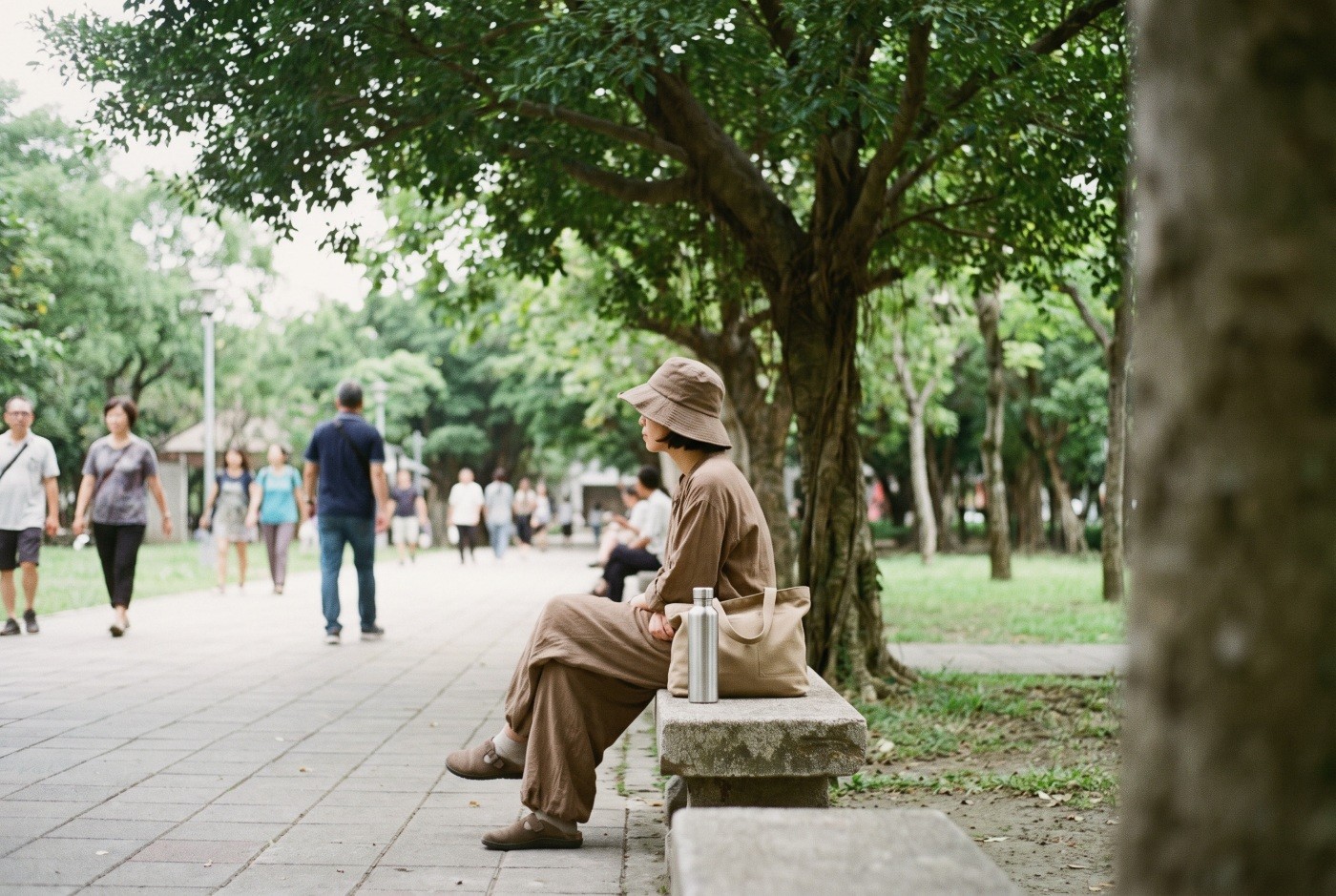
I stepped out of Taipei Main Station on a July afternoon and the air hit me like a wet towel straight from the dryer. I'd been in Taiwan for three months at that point, long enough to think I understood the climate. I did not. Nothing prepares you for the moment when 34°C meets 80% humidity and your body registers a real feel of 42°C. My glasses fogged instantly. My shirt was soaked through in the time it took to cross Zhongxiao West Road.
That was four summers ago. I've since learned that you don't survive Taiwan's summer by fighting the heat. You adjust, slowly, to a set of rhythms that locals figured out generations before air conditioning existed. Most of what I know now came from Taiwanese friends, a few traditional Chinese medicine practitioners, and the trial-and-error of someone who kept getting it wrong.
Hydrating differently
My first instinct was to drink ice water constantly. Big bottles, as cold as possible, refilled at every convenience store. It helped in the moment but left me feeling sluggish and bloated by mid-afternoon.
A Taiwanese coworker watched me drain a frozen bottle and said, very casually, "You know that's making it worse, right?" She explained the traditional Chinese medicine perspective: ice-cold drinks can shock the digestive system and essentially "lock" heat inside the body instead of letting it dissipate naturally. The stomach contracts, digestion slows, and you end up feeling heavier, not cooler. I was skeptical. But after a week of switching to room temperature water and cool (not frozen) teas, I noticed the afternoon bloating disappeared.
The local approach to summer hydration goes well beyond water. Mung bean soup, sold at every traditional dessert shop and most convenience stores, is the quintessential cooling food in TCM. Chrysanthemum tea is another staple. Barley water, star fruit juice, winter melon tea. These aren't random choices. They're classified as "cooling" in the TCM system, meaning they help the body release excess heat.
"The first lesson of a Taiwan summer isn't to cool down. It's to stop heating up from the inside."
At drink shops, I started ordering half sugar, less ice. The half sugar because full sugar in 35°C heat makes you thirstier twenty minutes later. The less ice because a cup that's 60% ice cubes is a cup that's 40% drink and diluting fast. These are small adjustments that every local makes without thinking about it. It took me a whole summer to figure them out.
What to eat (and what to eat less of)
The food shift surprised me more than the drinking one. I'd always been a heavy protein, lots of grilled meat kind of person. That works fine in temperate climates. In a Taipei July, it was making me miserable.
TCM categorizes heavy barbecue, excessive red meat, deep-fried food, and very spicy dishes as creating "damp-heat" in the body. I don't fully understand the theoretical framework, honestly, but I understand the practical result: after a big 燒肉 dinner in summer, I'd wake up puffy, sluggish, and sweating through the sheets more than usual.
The cooling foods that actually helped: watermelon (available everywhere from May through September), cucumber, lotus root, pears, and bitter melon. Bitter melon is an acquired taste, and I still haven't fully acquired it, but stir-fried with eggs it's tolerable and genuinely effective. The watermelon situation in Taiwan is excellent. Summer watermelons here are a different category from the mealy, flavorless ones I grew up with.
42°C
Real feel temperature on a typical Taipei summer afternoon. The recorded air temperature might read 34°C, but humidity of 75-80% pushes the heat index to dangerous levels. Urban heat island effect adds another layer in the city center.
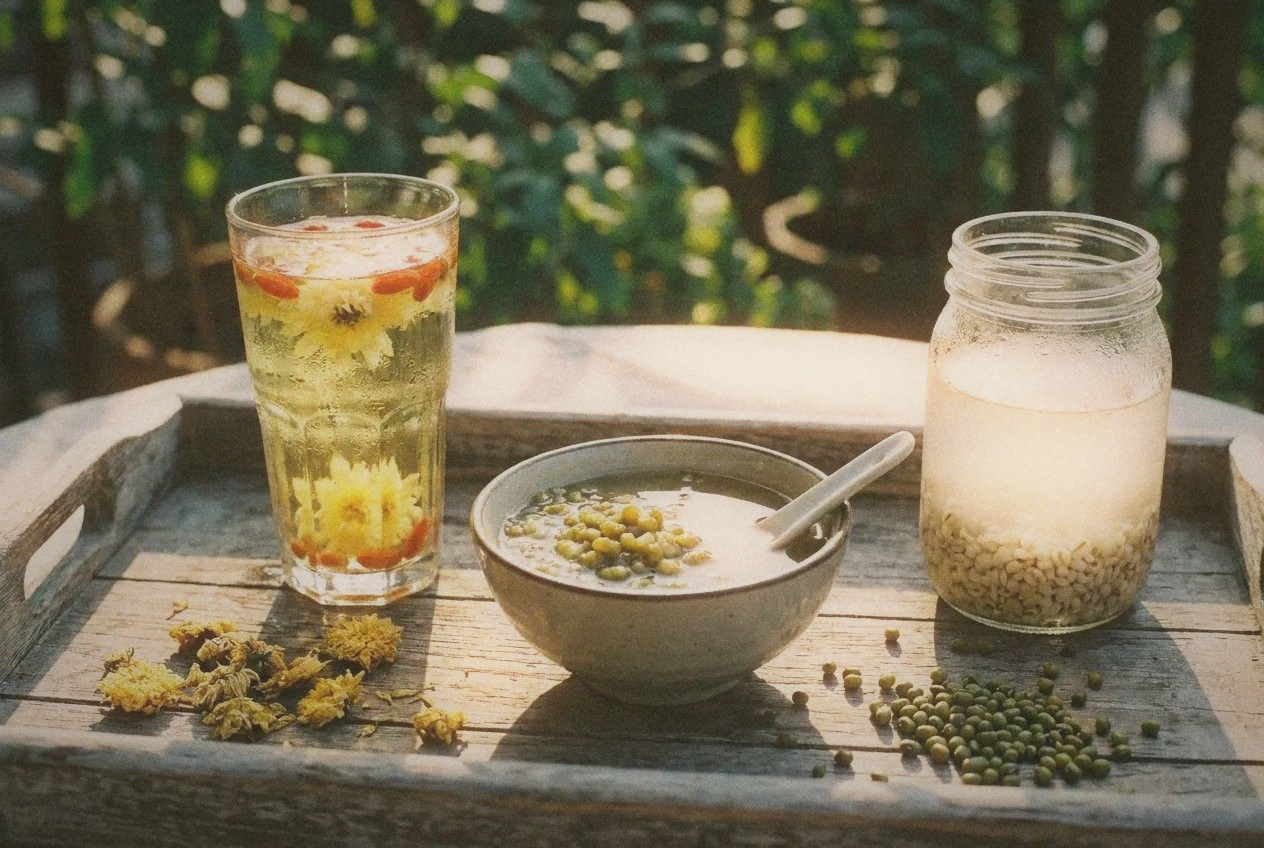
 FIRST SIGHTWEBGLChrysanthemum tea, mung bean soup, barley water: Taiwan's original cooling system · Color and grain by First Sight · Portra 400. · First Sight 色彩與顆粒調校 · Portra 400
I didn't cut out grilled food entirely. That would be unreasonable and sad. But I shifted ratios. More soup-based meals. More vegetables. Fruit after dinner instead of heavy desserts. The difference in how I felt by the second week was noticeable enough that I've kept the pattern every summer since.
Moving through a city that wants to melt you
The first summer, I would just walk places. Straight lines, shortest route, same as I'd do anywhere. By the second summer, I had developed the local instinct: plan every route through shade, underground passages, and air-conditioned buildings.
Taipei has an extensive network of underground shopping corridors connected to MRT stations. The Zhongshan to Shuanglian underground passage is a full kilometer of climate-controlled walking. East Metro Mall runs underneath Zhongxiao Dunhua. You can get from Taipei Main Station to Beimen Station entirely underground. Learning these routes changes summer in Taipei from miserable to manageable.
Department stores are the other piece. Between Shin Kong Mitsukoshi, Breeze Center, and the various shopping complexes along Zhongxiao, you can hop from air conditioning to air conditioning with only brief outdoor exposure. I'm not suggesting you shop your way through summer. But knowing where the cool zones are, and planning your walking routes through them, is just practical.
Clothing matters too. I switched from dark synthetic fabrics to loose, light-colored cotton and linen. It sounds obvious but I resisted it for a long time because my wardrobe was built for a different climate. A loose linen shirt breathes in a way that a fitted polyester one absolutely does not. Carry a small towel and a water bottle. Every convenience store sells both.
Exercise timing
I used to run at lunch. In summer, I now understand this was genuinely dangerous. Taipei frequently hits 35°C by midday, and with humidity, the real feel can approach 40°C. Heat exhaustion is not an abstract risk.
The adjustment is straightforward. Early morning, before 7am, or evening, after 6pm. There's a reason the riverside paths along the Tamsui River and Keelung River are packed with runners at 6am and nearly empty at noon. Dawn in summer Taipei is actually beautiful. The light is soft, the temperature is in the high twenties, and the city hasn't fully woken up yet. I've become a morning person entirely because of Taiwan's summer.
Before 7am
The exercise window. Morning temperatures of 27-28°C with lower humidity are manageable. By 10am, conditions shift rapidly. Evening after 6pm works too, but residual heat from pavement and buildings keeps temperatures higher than morning.
If you absolutely can't do mornings, indoor options work. Most gyms and public sports centers have air conditioning. Swimming is ideal for summer. Taipei has public pools in nearly every district, and they're busy all summer long.
Sleeping in the heat
This was the hardest adjustment. My first summer, I tried to save on electricity by running the AC only intermittently and using fans. I slept terribly. Woke up sweating at 3am, couldn't fall back asleep, dragged through the next day.
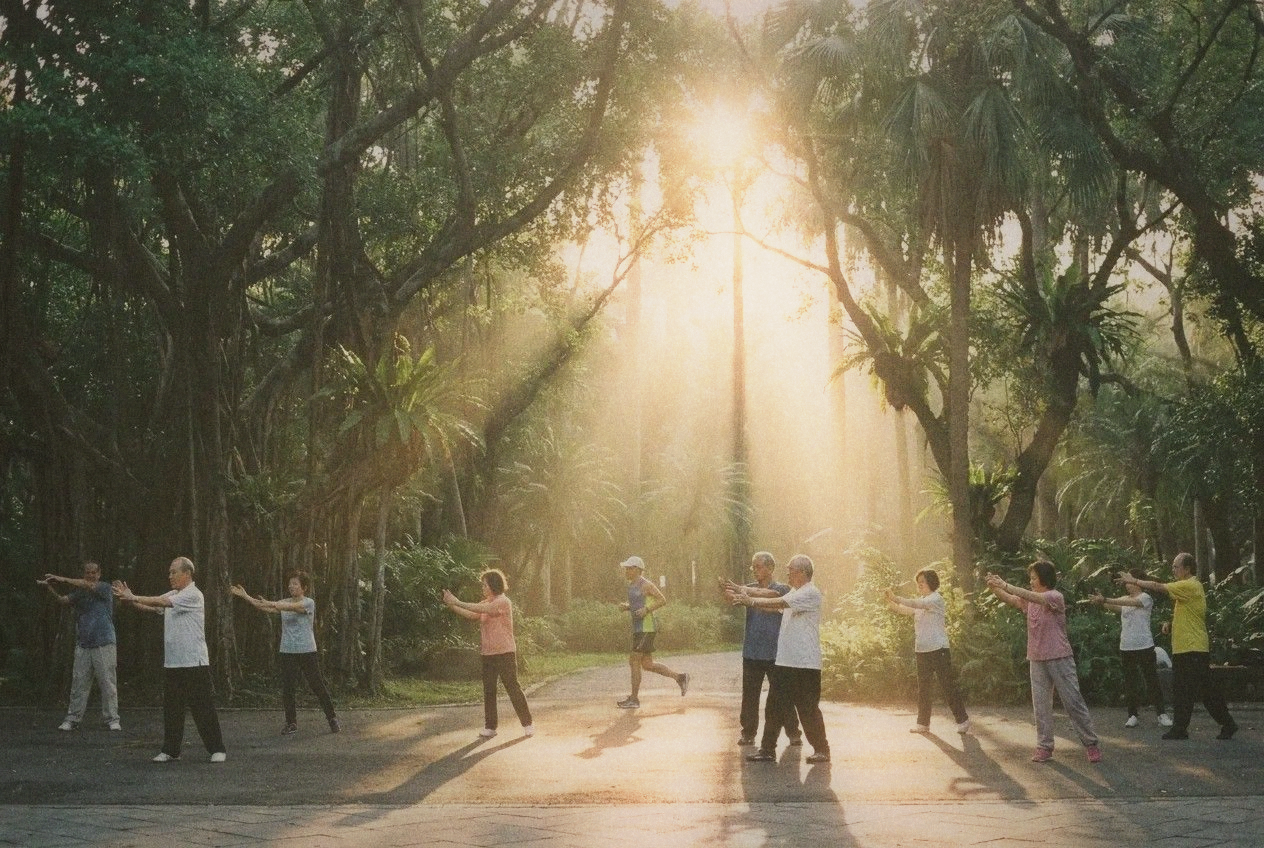 FIRST SIGHTWEBGLDa'an Forest Park at 6 AM: the only time exercising outside makes sense in summer · Color and grain by First Sight · Portra 400. · First Sight 色彩與顆粒調校 · Portra 400
The sweet spot, and most Taiwanese households have figured this out: set the AC to 26-27°C and run it all night. This range is energy-efficient enough that your electricity bill doesn't double, and cool enough for your body to drop its core temperature and trigger proper sleep. Add a fan for air circulation. The combination of steady cool air from the AC and gentle movement from a fan is more effective than either alone.
Keep curtains or blinds closed during the day, especially on south and west-facing windows. A room that's been baking in afternoon sun takes hours to cool down, and your AC has to work much harder. Block the heat before it gets in.
Light bedding helps. Swap winter quilts for a thin cotton blanket or just a flat sheet. Bamboo mat bedding, still used in many Taiwanese households, stays cooler than regular sheets. I tried one and it genuinely made a difference on the nights I kept the AC a degree higher.
The mountain escape
When it all becomes too much, there's an option that most of Taiwan is within a few hours of: go up. Temperature drops roughly 6°C for every 1,000 meters of elevation. At sea level, Taipei is cooking at 35°C. Alishan, at 2,500 meters, sits at a pleasant 25°C. Cingjing Farm in Nantou County, at 1,750 meters, is similarly cool.
A weekend in Alishan in July feels like someone pressed a reset button. The air is thin and clean, the temperature requires a light jacket in the morning, and you suddenly remember what it feels like to not be sweating. The forest trails are cool and shaded. The tea is excellent. It's not running away from the heat. It's giving your body a break from the relentless metabolic work of staying cool in subtropical lowlands.
Cingjing Farm is closer to Taichung and easier to reach. The mountain bus from Puli takes about an hour. The views of the Central Mountain Range are worth the trip even without the temperature relief.
25°C
Summer temperature at Alishan (2,500m elevation), compared to 34-35°C in coastal cities. A weekend in the mountains is the most effective heat reset available. The 10°C difference feels like changing seasons entirely.
Even a day trip to Yangmingshan, just 30 minutes from central Taipei, drops the temperature by a few degrees and gets you into shade and moving air. It's not Alishan, but at 7am on a Saturday, the trails above Beitou are a different world from the streets below.
Making peace with it
After four summers, I've stopped treating the heat as an enemy. Taiwan's summer is intense, genuinely intense, but the discomfort comes less from the temperature itself and more from resisting it. Fighting the heat with ice-cold everything, refusing to change your schedule, wearing the same clothes you'd wear in October, those are the things that make summer miserable.
The locals didn't build a culture of cooling teas and early mornings and underground passages because they read an article about it. They built it because it works. The advice I keep coming back to is not dramatic or complicated. Drink cool things, not frozen. Eat lighter. Move through shade. Sleep in a room you've kept cool all day. And when you can, go to the mountains.
Taiwan's summer lasts roughly from May through September. That's almost half the year. You can spend it fighting, or you can spend it adapting. Adapting is better.
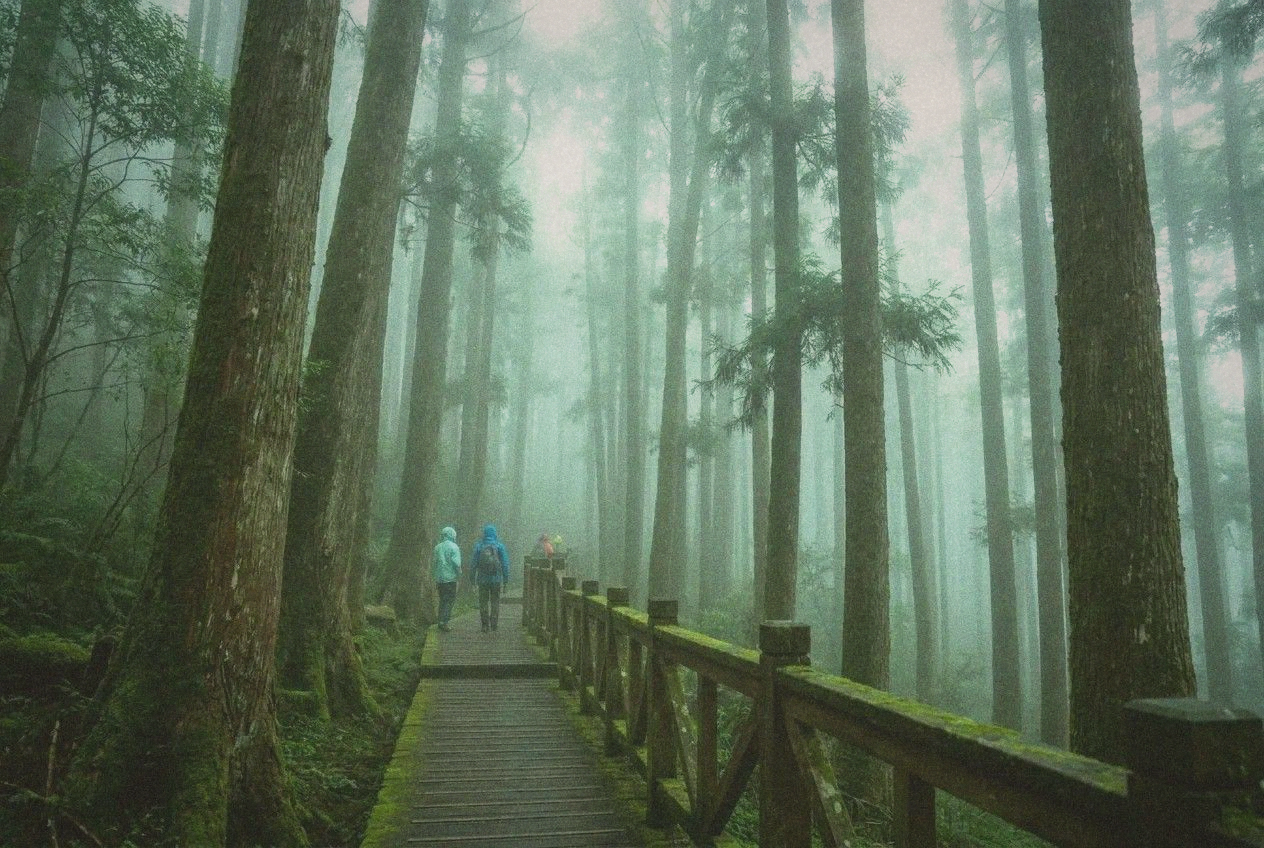 FIRST SIGHTWEBGLAlishan forest: 20 degrees cooler than Taipei, and two hours away by car · Color and grain by First Sight · Portra 400. · First Sight 色彩與顆粒調校 · Portra 400
FAQ
How much water should I drink per day in Taiwan's summer?
More than you think. Roughly 2.5 to 3 liters as a baseline, more if you're exercising or spending time outdoors. But don't just drink plain water. Mix in barley water, chrysanthemum tea, or mung bean soup. They hydrate and help your body manage heat at the same time.
Is it really bad to drink ice-cold water?
The TCM perspective says yes, room temperature or cool is better for digestion and heat regulation. Western medicine is less definitive on this, but many people in Taiwan report feeling better with less ice. Try it for a week and see. The worst case is you drink slightly less cold water.
What's the best time to visit Taiwan to avoid the heat?
October through December is ideal. Warm but not punishing, low humidity, clear skies. March and April are also pleasant but can be rainy. January and February are cool and sometimes cold, especially in the north.
Are there indoor activities for the hottest days?
Plenty. Taipei's museums are excellent and air-conditioned. Hot spring resorts in Beitou run year-round. Indoor climbing gyms, swimming pools, and movie theaters are all standard summer escapes. Department stores have become de facto community cooling centers.
Should I worry about heat stroke?
Yes, take it seriously. Stay hydrated, avoid prolonged outdoor exposure between 11am and 3pm, wear a hat and sunscreen, and watch for warning signs: dizziness, nausea, confusion, or stopping sweating in extreme heat. If someone shows these symptoms, get them to shade and cool them down immediately.
Read next: Sleep Optimization 2026: The Rules That Actually Work | Best Running Routes in Taipei | Morning Sunlight and Your Circadian Rhythm
Comments (0)
Loading comments...