
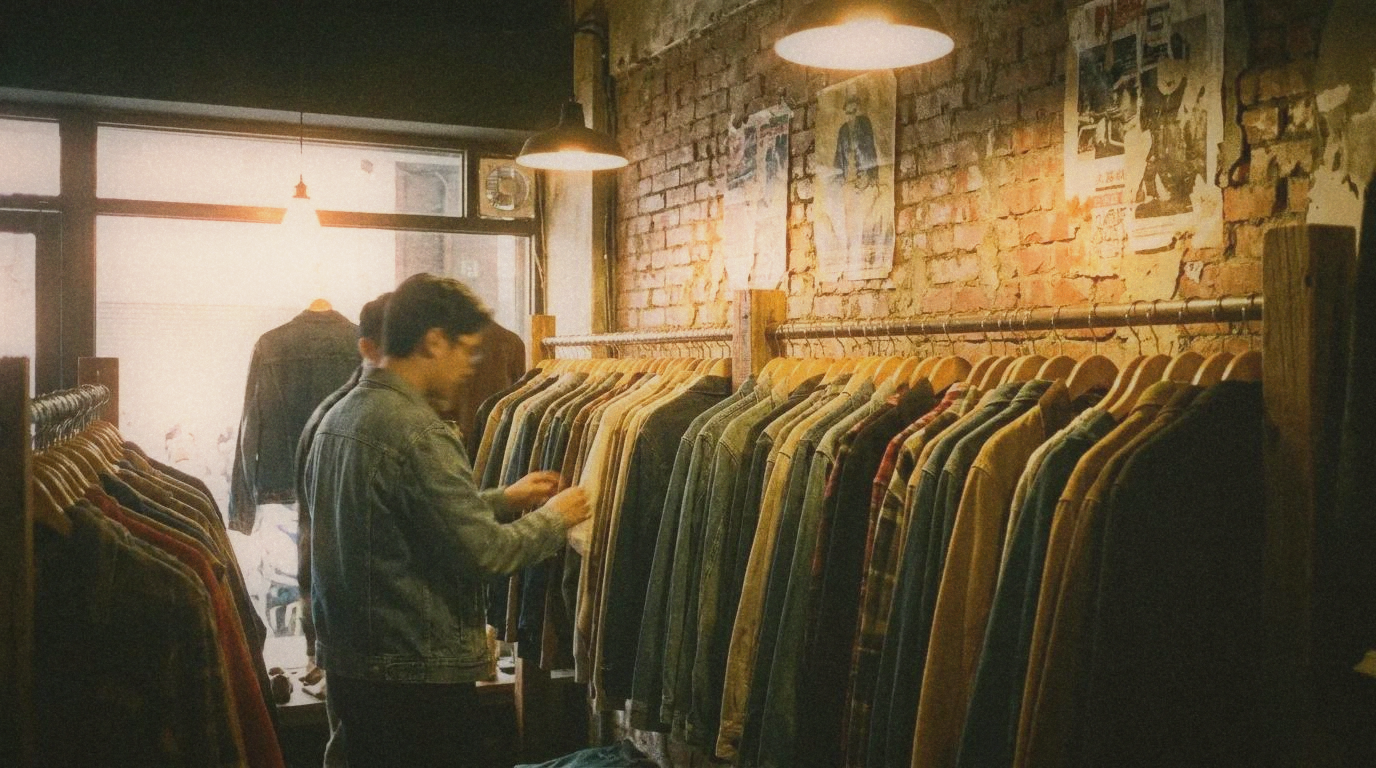
The blazer cost NT$1,800. It was hanging between a pair of wide-leg Dickies and a Hawaiian shirt from the early 1990s, in a shop on Lane 41 off Chifeng Street where the afternoon light hits the clothing racks at exactly the right angle to make everything look cinematic. The label said nothing I recognized. The lining was intact, the seams double-stitched, and the lapels sat flat without any pulling. I tried it on over a white tee, checked the shoulders in a mirror propped against the wall, and bought it.
That was two years ago. I've worn it to client dinners, weekend brunches, and one particularly sweaty evening wedding in Tainan where I should have known better. The blazer survived all of it. The wrinkles settled into something that looks intentional. The fabric, some kind of cotton-linen blend from an era when blends were heavier, handles Taipei humidity better than a NT$5,000 jacket I bought new and gave away six months later because the polyester lining made my back sweat through every meeting.
That blazer was the third piece of what became, without much planning, a 20-piece wardrobe built almost entirely from secondhand shops and online platforms. The whole thing cost less than NT$22,000. If I'd bought equivalent quality new, I'd be looking at double that, maybe more.
This is the practical case for building a capsule wardrobe from secondhand pieces in Taiwan. Not the environmental argument (though it exists), not the trend argument (though secondhand is growing at roughly 22% annually across Asia). The practical case: Taiwan's climate rewards well-made clothing and punishes cheap clothing, and the secondhand market is where well-made clothing goes after someone else already paid the new price.
Where to look
Taipei's secondhand scene clusters in a few neighborhoods, and Chifeng Street in Zhongshan is the center of it. The street runs through narrow lanes between Zhongshan MRT and Shuanglian MRT, and every third storefront is either a vintage shop, a ramen place, or a coffee shop the size of a parking space. It's the kind of neighborhood where you can visit four shops in two hours without getting tired.
Travis Vintage (No. 4, Lane 41, Chifeng St, Datong District) has been here since 2015. Owner Travis curates by era and feeling rather than category, which means 1970s American denim hangs next to Japanese haori jackets and Scandinavian wool pieces. He opens in the evenings, usually from 4pm onward. Most pieces run NT$1,500 to 3,500. The quality floor is high. I've never found anything here with bad stitching.
EWF Vintage (Lane 49, Chifeng St, 12pm to 9pm daily) takes the maximalist approach. Two floors of everything: Mexican embroidered dresses, Austrian dirndls, vintage kimonos, band tees, Japanese designer pieces. They've been around since 2013 and have a second location near Dihua Street. Prices run NT$1,000 to 2,500 for most items. If you're specifically looking for Japanese vintage, this is where to start.
Banana Cats (No. 11, Lane 49, Chifeng St) is smaller and more curated. They specialize in vintage dresses and bags, with leather goods care services on site. The neighborhood around Lane 49 is worth a slow walk even if you don't buy anything.
!Interior of a vintage clothing shop with racks of carefully organized pieces A Saturday afternoon on Chifeng Street. The shops open late and close late, which means you can browse after work without rushing.
Beyond Chifeng, the 師大商圈 (Shida) area near National Taiwan Normal University has smaller shops and student-friendly prices, some pieces starting under NT$500. The selection leans younger and more trend-driven, but basics like denim and cotton tees show up regularly.
Online is where the volume lives. 旋轉拍賣 (Carousell) is Taiwan's biggest C2C secondhand platform, and the clothing section is enormous. Search for specific items, filter by size, negotiate price. The advantage over physical shops: you can hunt for exactly what you need instead of browsing and hoping. The disadvantage: you can't touch the fabric or check the seams until it arrives. 蝦皮 (Shopee) has a growing secondhand section too, searchable under "二手衣." Prices are often lower, but curation is nonexistent. You're sorting through volume.
"The best pieces don't last long online. If you see something in your size with clear photos and honest descriptions, don't think about it for three days. It'll be gone."
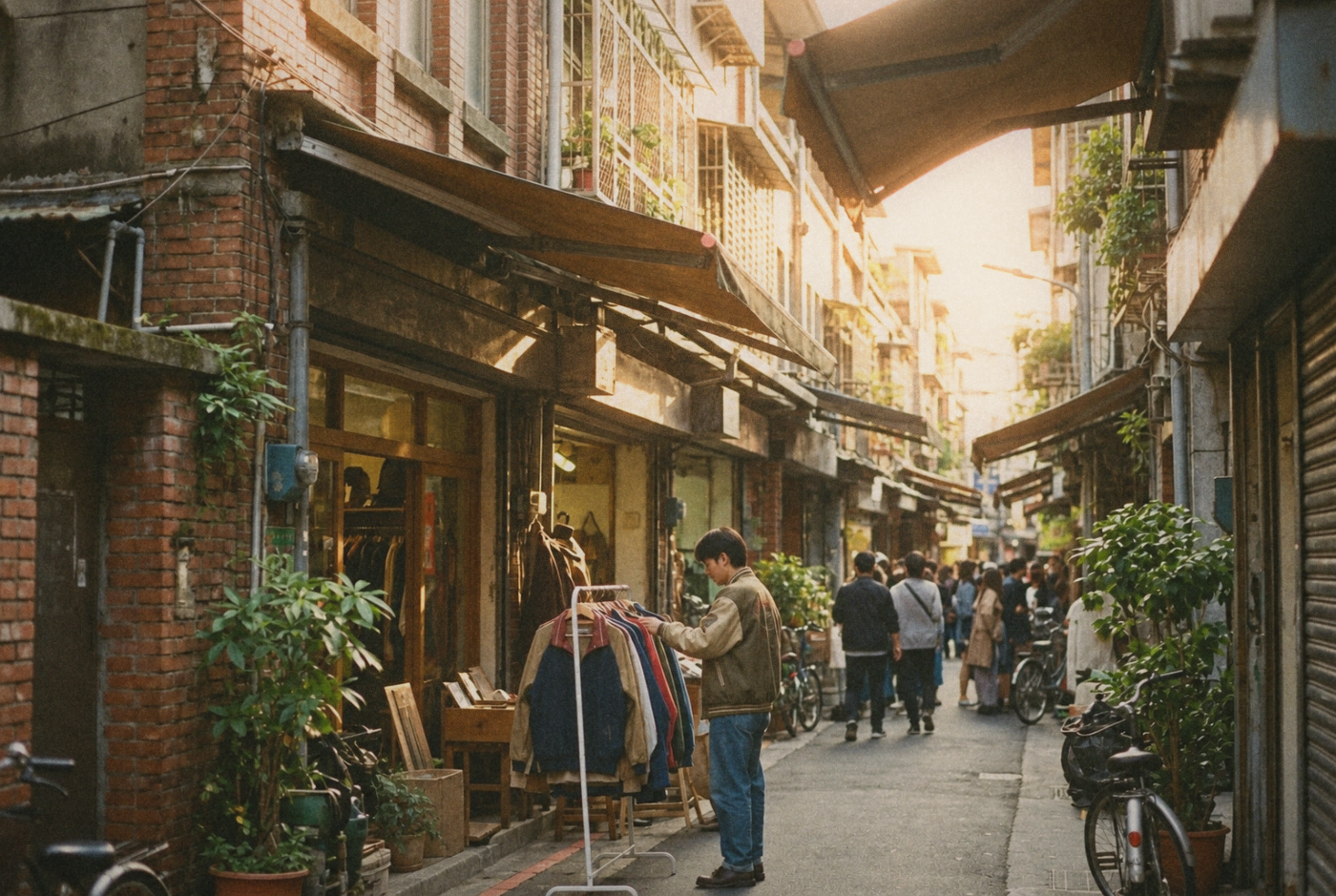
 FIRST SIGHTWEBGLNarrow alley on Chifeng Street Taipei with small vintage shop fronts. afternoon light filtering between buildings · Color and grain by First Sight · Portra 400. · First Sight 色彩與顆粒調校 · Portra 400
What to check before you buy
Secondhand quality inspection takes about thirty seconds once you know what to look for. This applies equally to shop visits and to evaluating photos online.
Seams first. Turn the garment inside out. Double-stitched seams are good. Single-stitched seams that show stress marks or pulling threads are a sign the piece is near the end of its life. Check the armholes and the crotch on trousers. These are where stress concentrates.
Fabric feel. Rub the fabric between your fingers. Good natural fibers feel alive, textured, slightly irregular. Bad synthetic feels plasticky and uniform. Pilling on the surface is cosmetic and fixable with a fabric shaver. Pilling combined with thinning means the fabric is wearing out.
Stains. Check the collar, the underarms, and the cuffs. These are where sweat and oils accumulate. Small stains on vintage pieces are normal and often removable with a soak in oxygenated bleach. Yellow pit stains set into white fabric are permanent. Walk away from those.
Hardware. Test every zipper, button, and snap. Replacing a zipper costs NT$200 to 500 at a tailor, which is fine if the piece is worth it. But if three buttons are missing and the zipper sticks, the math stops working.
Construction. Look at how the collar is attached, how the buttons are sewn, how the hem is finished. On older pieces, hand-finished details like rolled hems and cross-stitched buttons are a sign of quality that you rarely find in modern clothing at any price.
The 20-piece capsule, broken down
This is what a functional secondhand capsule wardrobe looks like in Taiwan, built for a climate that's 75 to 80% humidity year-round, with summers above 34 degrees and a plum rain season that lasts most of June.
Hot season (June through September): 10 pieces
| Piece | Approx. NT$ | |---|---| | 3 cotton or linen tees | NT$600-1,200 each | | 2 linen or cotton-blend shirts | NT$1,000-2,000 each | | 2 lightweight trousers (cotton or linen blend) | NT$1,200-2,500 each | | 1 pair of shorts | NT$500-1,000 | | 1 light cardigan (for offices blasting AC at 22 degrees) | NT$800-1,500 | | 1 rain jacket | NT$600-1,500 |
Cool season (October through March): 7 pieces
| Piece | Approx. NT$ | |---|---| | 1 denim jacket or chore coat | NT$1,500-3,000 | | 1 wool or wool-blend sweater | NT$1,200-2,500 | | 1 heavier button-down shirt | NT$800-1,800 | | 1 pair of darker trousers or jeans | NT$1,000-2,500 | | 1 windproof outer layer | NT$1,500-3,500 | | 1 scarf or high-neck layer | NT$400-1,000 | | 1 thermal undershirt | NT$300-600 |
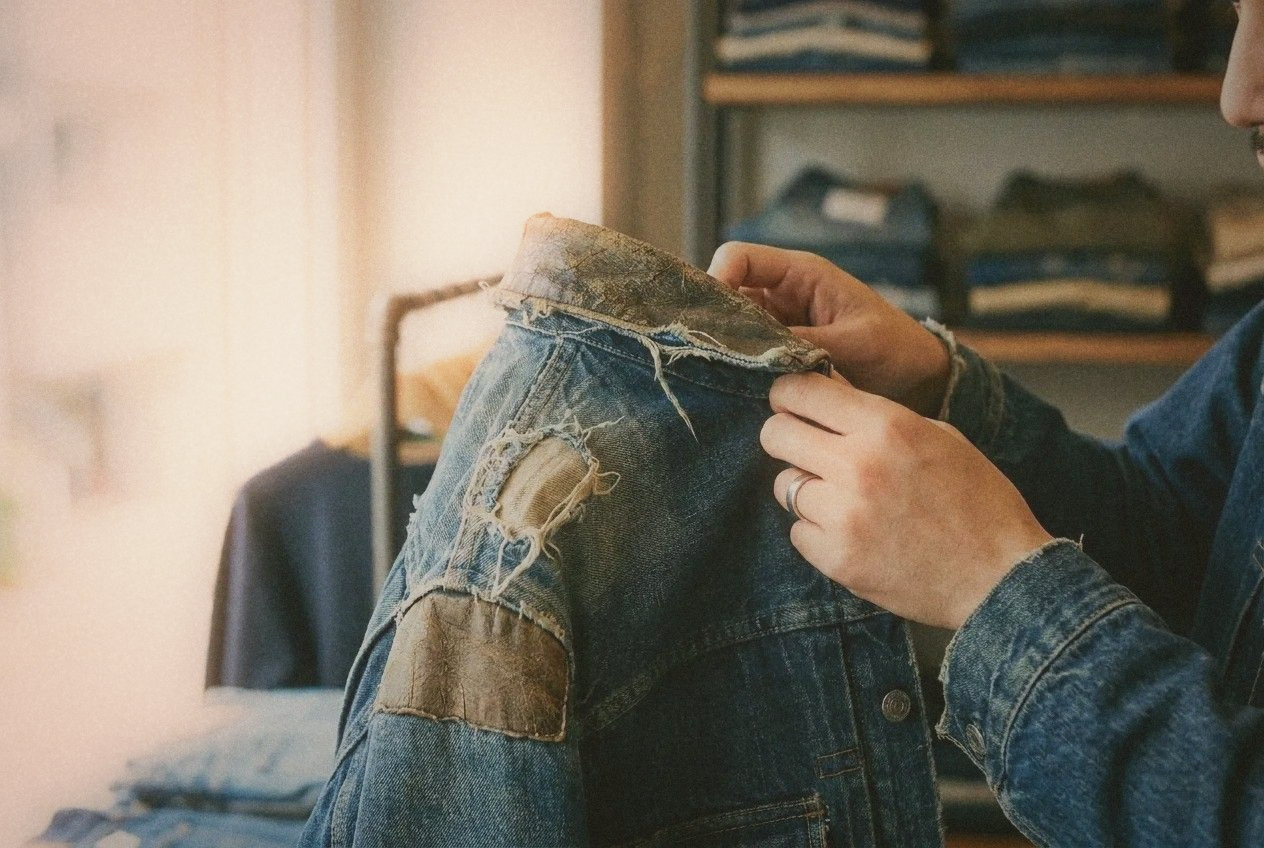 FIRST SIGHTWEBGLClose-up of hands examining vintage fabric texture on a denim jacket. worn leather and cotton details visible · Color and grain by First Sight · Portra 400. · First Sight 色彩與顆粒調校 · Portra 400
Year-round: 3 pieces
| Piece | Approx. NT$ | |---|---| | 1 blazer or structured jacket | NT$1,500-3,500 | | 1 pair of versatile shoes | NT$800-2,000 | | 1 belt | NT$300-800 |
Total estimate: NT$16,000 to 25,000 for 20 pieces of quality that would cost NT$40,000 or more new.
The numbers flex depending on where you shop and how patient you are. Online platforms trend cheaper. Curated vintage shops in Chifeng trend higher but with better quality assurance. The sweet spot is mixing both: buy your basics online where fit is predictable, buy your statement pieces in person where you can inspect construction.
!Close-up of hands examining the seams of a vintage garment Thirty seconds of inspection saves you from buying someone else's problem. Seams, fabric, stains, hardware. In that order.
The humidity problem (and how to solve it)
Here's the part nobody talks about until their favorite vintage find develops a faint musty smell three weeks after purchase. Taiwan's humidity doesn't just affect what you wear. It affects how you store what you wear.
At 75 to 80% relative humidity, mold grows on stored fabric. That's not an occasional risk. That's the baseline. Every closet in Taipei is a mold incubator unless you actively fight it.
The 除濕機 (dehumidifier) is not optional. It's the single most important clothing care tool you own. Run it in your closet or bedroom with the door closed for a few hours daily, especially during plum rain season in June and typhoon season through September. Target 55 to 60% humidity inside the closet. Most dehumidifiers have a humidity display and an auto-shutoff setting. A basic unit costs NT$3,000 to 6,000 and pays for itself in preserved clothing within a season.
Beyond the dehumidifier: store vintage pieces with space between them on the rack. Cramped closets trap moisture between garments. Use cedar blocks or charcoal dehumidifying bags as a supplement, not a replacement. Wash vintage pieces gently, cold water, mild detergent, inside-out, hang to dry in a ventilated space rather than direct sunlight. Linen and cotton get stronger when wet, but harsh detergent and hot water break down the old fibers faster than new ones.
For pieces you don't wear often, breathable garment bags beat plastic. Plastic traps moisture inside. Cotton or canvas bags let air circulate while keeping dust off. This matters especially for wool and wool-blend pieces, which are mold magnets when stored in humid air.
A note on smell
Vintage clothes sometimes arrive with a musty or closet smell. This is almost always fixable. Soak in cold water with a cup of white vinegar for an hour, then wash normally. For stubborn smells, an overnight soak in baking soda and water works. Sunlight helps too: hang the piece outside for a few hours on a dry day. The UV does the work.
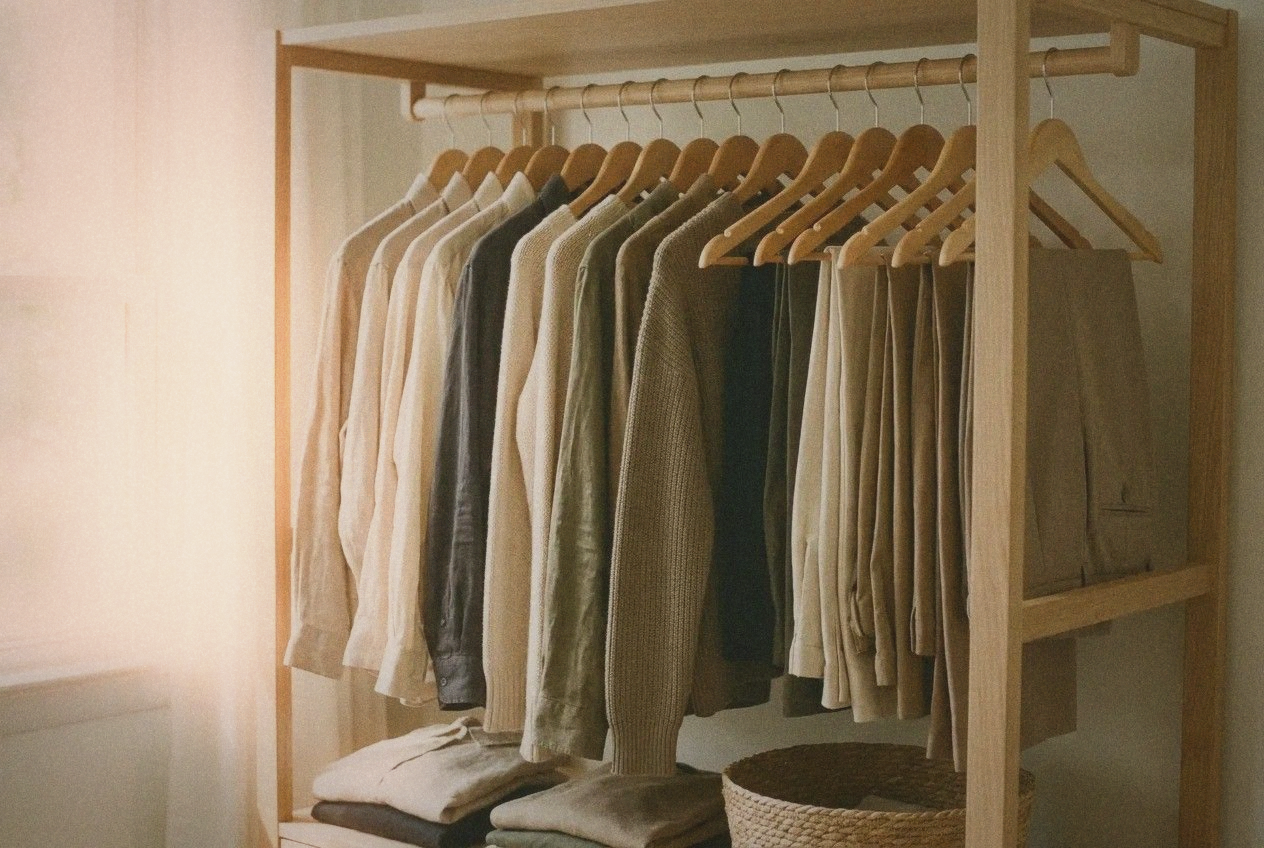 FIRST SIGHTWEBGLMinimalist capsule wardrobe neatly arranged on wooden hangers inside an open wardrobe. neutral tones earth colors · Color and grain by First Sight · Portra 400. · First Sight 色彩與顆粒調校 · Portra 400
The only smell that's a deal-breaker is mildew that's actually in the fabric, not on it. If a piece smells moldy after two washes, the mold has penetrated the fibers. Let it go.
!Neatly organized closet with vintage clothing, a dehumidifier visible in the corner The unglamorous truth about vintage in Taiwan: your closet needs a dehumidifier more than it needs another jacket.
Why this works here
Taiwan's secondhand market is growing fast, and the reasons are more practical than ideological. Young professionals are realizing that a NT$2,000 vintage linen shirt from the 1990s outlasts a NT$500 fast-fashion shirt by years. The math converts people faster than any sustainability lecture.
The climate does the rest of the persuading. Cheap synthetic fabrics fall apart in Taiwan's humidity. Polyester blends trap sweat and smell bad by mid-afternoon in summer. Poorly set dyes bleed after a few subtropical wash cycles. The pieces that survive all this, the ones that made it to vintage shop racks still looking good after years, are by definition the ones built to last. Secondhand shopping in Taiwan is, in a weird way, pre-filtered for quality. The junk already got thrown away.
That's the thing I didn't expect when I started buying secondhand. I thought I was making a budget choice. I was actually making a quality choice that happened to cost less.
FAQ
Is secondhand clothing hygienic? Yes. Wash everything before wearing it, which you should do with new clothes anyway (new garments carry chemical residues from manufacturing). A cold wash with mild detergent handles it. For extra peace of mind, a vinegar soak kills bacteria without damaging old fibers.
What's the best platform for buying secondhand in Taiwan? 旋轉拍賣 (Carousell) for the biggest selection and easiest search. 蝦皮 (Shopee) for lower prices but more sorting required. For in-person shopping, Chifeng Street in Zhongshan is the starting point. Each has trade-offs, and the best approach is using all three.
How much can you save vs buying new? Roughly 40 to 60%. A 20-piece capsule wardrobe from secondhand sources runs NT$15,000 to 25,000. Equivalent quality new would be NT$40,000 or more. The savings compound over time because well-made vintage pieces tend to last longer than current fast-fashion alternatives.
How do you deal with sizing inconsistency in vintage? Vintage sizing is wildly inconsistent across eras and countries. A "medium" from 1980s America is not the same as a "medium" from 2020s Taiwan. Ignore the label. Measure your body, bring a tape measure to shops, and check the garment's actual measurements rather than trusting the tag. Online, always ask for exact measurements before buying.
Won't vintage clothes smell? Sometimes, when you first get them. A cold soak in white vinegar for an hour, followed by a normal wash, fixes most odors. Sunlight helps with stubborn cases. The only unfixable smell is deep mildew that has penetrated the fibers. If two washes don't clear it, move on.
Comments (0)
Loading comments...