
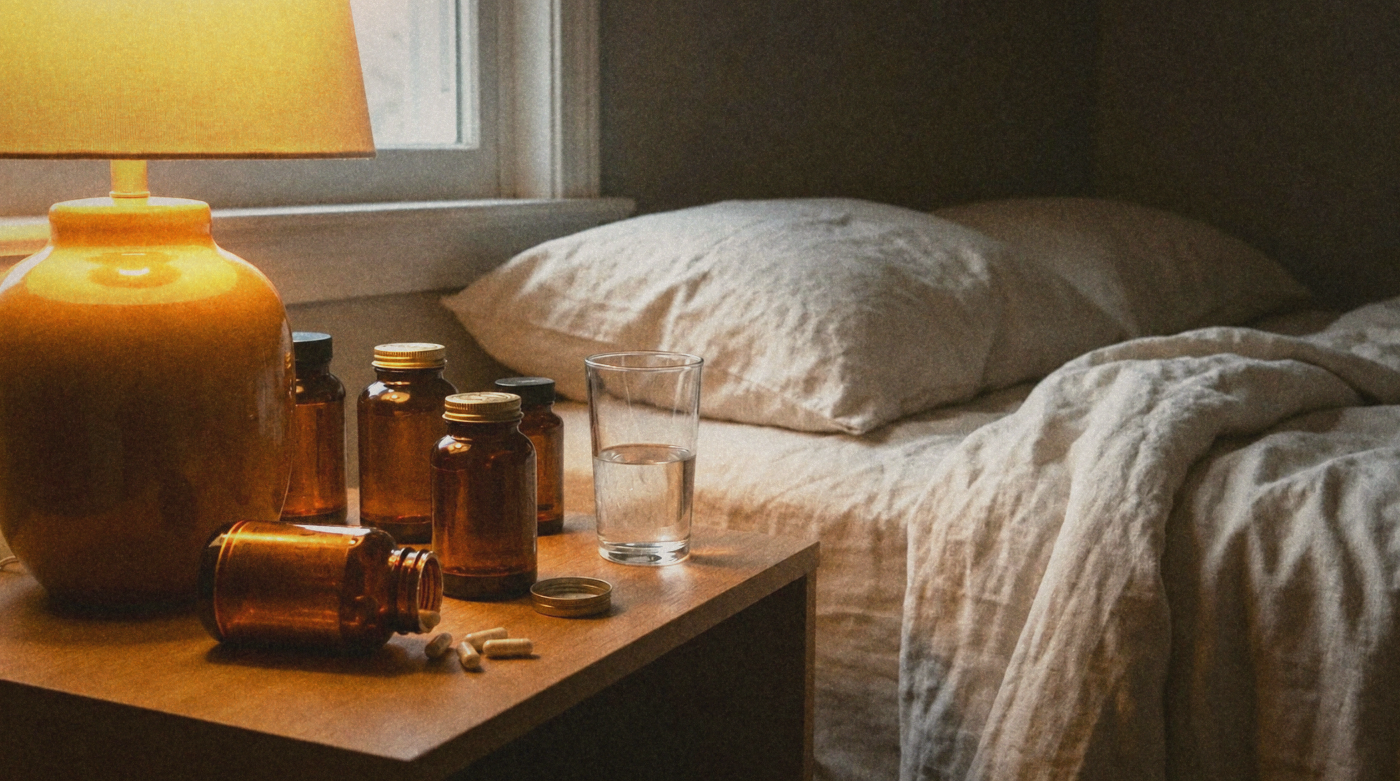
The sleep supplement market is worth $4.2 billion globally and growing 8% annually. Most of that money is spent on products that either don't work, work for the wrong reasons, or work temporarily before creating the problem they were supposed to solve.
This isn't an anti-supplement article. Some sleep supplements have genuine evidence behind them. But the gap between what the research shows and what the marketing claims is wider for sleep products than almost any other category in health. Most people's supplement approach is backwards, they buy supplements first, then try to fit them into their sleep routine. The correct approach is to master the free interventions (light, temperature, timing), then add supplements only if sleep remains poor. Here's what actually holds up under scientific scrutiny.
The supplement aisle is selling you a sledgehammer when you need a feather.
Why Most People's Supplement Approach Is Backwards
Here's what most people do: 1. Sleep is bad 2. Buy melatonin 3. Wonder why it stops working after two weeks 4. Buy more supplements 5. Sleep is still bad
Here's what the research supports: 1. Sleep is bad 2. Fix your sleep environment (light, temperature, timing) 3. If sleep is still poor after 4 weeks, try one supplement 4. Wait 2-4 weeks to assess if it's working 5. Only add another supplement if needed
The difference is massive. Most sleep supplement users are taking cocktails of supplements while their bedroom is still 24°C with ambient light from a phone alarm. No supplement fixes a broken environment.
The Evidence Ranked
Tier 1: Strong Evidence
Magnesium Glycinate, The Most Underrated Sleep Supplement
Magnesium is involved in over 300 enzymatic reactions in your body. For sleep specifically, magnesium activates GABA receptors, the same neurochemical pathway targeted by prescription sleep medications like benzodiazepines. But magnesium does it gently, without the addiction risk or morning grogginess.
The evidence is robust: A 2012 study in the Journal of Research in Medical Sciences found that 500mg magnesium supplementation improved sleep quality, sleep time, and melatonin levels in elderly insomniacs. A 2021 systematic review in Nutrients confirmed consistent improvements across studies. More recently, research from the University of Colorado showed that magnesium-deficient individuals saw 30-minute improvements in sleep latency (time to fall asleep) within one week of supplementation.
The catch: form matters. Most commercial magnesium supplements are magnesium oxide, cheap, poorly absorbed, and likely to cause digestive issues (loose stools). Glycinate is the chelated form, meaning magnesium is bonded to the amino acid glycine. This has two advantages: it's absorbed better (60-80% bioavailability vs. 5% for oxide), and the glycine itself has independent sleep benefits.
Dose: 200–400mg magnesium glycinate, 30–60 minutes before bed. Most people need 300-400mg. Start at 200mg and increase if needed. If you experience loose stools, you've exceeded your tolerance, reduce the dose.
In Taiwan: Available at Cosmed, Watsons, and iHerb. Look specifically for "glycinate" or "bisglycinate" forms. Brands: NOW Foods (widely available), Doctor's Best (also common). Cost: NT$400–800 for a 60-day supply (roughly NT$6–13 per day). Better value at Costco if you have a membership.
Timeline: Takes 1-2 weeks for full effect. Don't expect immediate sleep on night one. Your nervous system needs time to recalibrate.
Glycine, The Thermostat Trick
Glycine is a simple amino acid that lowers your core body temperature. Sleep requires your core temperature to drop by approximately 1–1.5°C. Glycine accelerates this process.
The evidence: Research from the Ajinomoto Group showed that 3g of glycine taken 30 minutes before bed reduced time to sleep onset by an average of 13 minutes and improved subjective sleep quality in healthy adults. Another study found that glycine improved sleep efficiency (percentage of time in bed actually spent sleeping) from 75% to 87%.
Key detail: The effect is temperature-mediated, not sedative. Glycine doesn't make you drowsy. It tells your nervous system to cool down. This works especially well if your bedroom is too warm or if you have high baseline body temperature.
Dose: 3g powder dissolved in water, 30 minutes before bed. The powder form is more effective than capsules at this dose, capsules dissolve slower and the effect is reduced.
Timing: Take glycine when your bedroom is cool (18–20°C). If your room is 23°C, glycine won't help much. The cold environment is doing 70% of the work.
In Taiwan: Available as pure powder on iHerb or in bulk supplement stores in Taipei (look for 健身房 or 保健品 shops in busy areas). Cost: NT$300–500 for a 2-month supply (roughly NT$5–8 per day). Tastes slightly sweet, neutral flavor, dissolves easily.
Timeline: Faster than magnesium. Most people notice improved sleep latency within the first night, though subjective quality improvements take a few days.
!Supplements and herbal tea on a nightstand in dim warm light Proper supplementation requires understanding form, timing, and dosage, not mixing random bottles.
Tier 2: Moderate Evidence, Specific Use Cases
Melatonin, The Timing Hormone, Not A Sleeping Pill
 FIRST SIGHTWEBGLA bottle on the shelf is a starting point for questions, not a promise of better sleep. · Color and grain by First Sight · Portra 400. · First Sight 色彩與顆粒調校 · Portra 400
This is the most popular and most misunderstood sleep supplement. Here's the critical distinction: melatonin is not a sedative. It's a timing signal. It tells your brain when to expect sleep, not how to sleep.
Your body naturally produces 0.1–0.3mg of melatonin in the evening. It doesn't knock you out. It gradually shifts your brain into a sleep-ready state. This is why melatonin works so well for specific issues (jet lag, shift work adjustment) but poorly for others (chronic insomnia, 3am waking).
When melatonin genuinely works:
- Jet lag (strong evidence): Crossing time zones disrupts your circadian rhythm. Taking 0.3–0.5mg melatonin at the new location's bedtime helps reset your clock. Studies show 50-70% improvement in symptoms within 3-4 days.
- Shift work adjustment (moderate evidence): If you're transitioning to night shifts, melatonin helps your body adapt. Best taken 30 minutes before your planned sleep time.
- Delayed sleep phase syndrome (moderate evidence): If you naturally can't fall asleep until 2am, melatonin 2-3 hours before your desired bedtime can gradually shift your rhythm earlier.
When melatonin doesn't work: - Chronic insomnia or trouble staying asleep: If your problem is 3am waking or fragmented sleep, melatonin won't help. It's a timing signal, not a sleep maintenance tool. - General sleep quality improvement: If you sleep 6 hours instead of wanting 8, melatonin won't extend your sleep duration. The research is clear on this. - Middle-of-the-night waking: Melatonin has a short half-life (20-40 minutes). By 3am, it's already metabolized. It can't help you return to sleep.
The dose problem, most products are wrong:
This is critical. Commercial melatonin dosing is almost universally excessive. Most tablets contain 3–10mg. Your body produces 0.1–0.3mg naturally. Taking 10x–100x your natural production doesn't improve efficacy. Instead, it overwhelms your melatonin receptors. Your body responds by downregulating receptors, meaning your own melatonin production becomes less effective long-term. You become dependent on the supplement.
Correct dose: 0.3–0.5mg, taken 2 hours before your desired sleep onset. This mimics your natural melatonin rise curve. The timing is critical, not 30 minutes before, not 1 hour before, but 2 hours. This allows the melatonin to build gradually and sync with your natural circadian rhythm.
How to achieve correct dose in Taiwan: Melatonin is classified as a pharmaceutical in Taiwan and technically requires a prescription. However, it's widely available at pharmacies (藥局) in the supplement section at NT$200–500. Most tablets are 3mg. You'll need a pill cutter (available at any pharmacy for NT$20–30). Cut the tablet into quarters to get approximately 0.75mg, then take one quarter (roughly 0.2–0.3mg). This is tedious but essential for correct dosing.
Alternative: Some specialty pharmacies or iHerb carry lower-dose melatonin (0.5–1mg), which you can use instead.
Timeline: Melatonin is immediate, it's a timing signal, not a building process. You'll notice effects on night one, though optimal rhythm adjustment takes 3-7 days of consistent use.
L-Theanine, The Anxiety Reducer, Not A Knocker-Out
L-theanine is an amino acid found naturally in green tea and black tea. It doesn't make you sleepy. Instead, it reduces the mental chatter and anxiety that prevent sleep.
How it works: L-theanine promotes alpha brain wave activity, the relaxed-but-alert state associated with meditation. It doesn't induce delta waves (deep sleep waves). It just quiets your prefrontal cortex (the worried part of your brain).
The evidence: A 2019 study in the journal Nutrients found that 100mg L-theanine taken twice daily (morning and evening) improved sleep quality and reduced anxiety in people with sleep disturbances. A 2016 study found that L-theanine improved subjective sleep quality without causing daytime drowsiness.
When to use it: If your sleep problem is racing thoughts, anxiety, or inability to "turn off your brain," L-theanine is more appropriate than melatonin or even magnesium. It directly addresses the mental mechanism keeping you awake.
Dose: 200mg, 30–60 minutes before bed. Can also be taken during the day (100–200mg) for calm focus without drowsiness, useful if you're anxious at work.
In Taiwan: Widely available at pharmacies and health food stores. Or drink two cups of high-quality green tea in the late afternoon, the natural L-theanine content (about 100–200mg per cup) plus the calming ritual may be as effective as the supplement at a fraction of the cost.
Timeline: 30 minutes to 1 hour. You'll feel the anxiolytic (anti-anxiety) effect before you feel the sleep effect.
Best brands in Taiwan: Look for L-theanine at Watsons, Cosmed, or health food stores. iHerb also carries pure L-theanine powder.
Tier 3: Insufficient Evidence
Valerian Root (纈草): Inconsistent results across studies. Some show modest 15-20 minute improvements in sleep latency, others show nothing. The smell is terrible (like fermented socks). The placebo effect may account for most perceived benefit. Skip it unless you've tried everything else and have a particular attachment to herbal products.
Lavender Supplements: The aromatherapy evidence (inhaling lavender essential oil) is solid and moderate. Oral lavender supplements have very little evidence. If lavender helps you, it's probably the ritual and smell, not the ingested compound. Use aromatherapy instead.
CBD: The research is early and confusing. Low doses may increase wakefulness. Higher doses may promote sleep. Individual variation is enormous. The products available in Taiwan have negligible CBD content due to regulations (less than 0.3% is legal). Probably not worth the cost.
GABA Supplements: Oral GABA poorly crosses the blood-brain barrier. The evidence for sleep improvement is weak. Your body's own GABA production, supported by magnesium and glycine, is more effective than supplemental GABA. Skip this and take magnesium instead.
Passionflower, Hops, Lemon Balm: Some evidence for anxiety reduction, but not specifically for sleep. Might help indirectly if anxiety is your issue, but magnesium or L-theanine are more direct.
What to Try First, In Order, Only If Needed
Step 0: Fix the Free Stuff First
 FIRST SIGHTWEBGLPerson lying in bed in a dark room. only moonlight through curtains · Color and grain by First Sight · Portra 400. · First Sight 色彩與顆粒調校 · Portra 400
Before any supplement, address the basics that are free or nearly free:
1. Consistent wake time, the single most effective sleep intervention. Same time every day, including weekends. If you're going to bed at random times and waking at random times, no supplement will fix your sleep.
2. Morning sunlight, 10 minutes outside before 9am, without sunglasses. This sets your circadian rhythm better than any supplement. It's free and takes 10 minutes.
3. Dim lights at 9pm, one floor lamp, no overhead LEDs. Switch your phone to Night Shift or warm mode. Thirty seconds of effort, major neurological effect.
4. Cool bedroom, 18–20°C. This is non-negotiable for quality sleep. If your room is 23°C, no supplement helps much. Adjust your AC or open a window.
5. No screens 60 minutes before bed, the blue light suppresses melatonin production and keeps your nervous system activated. If you're taking melatonin supplements while staring at your phone, you're fighting yourself.
6. No food 2 hours before bed, digestion elevates core temperature and triggers insulin response, both of which interfere with melatonin.
If you've done all six of those consistently for 4 weeks and sleep is still poor, then consider supplements.
Step 1: Magnesium Glycinate
If sleep is still poor after fixing the basics, start here. This is the most evidence-backed, safest, cheapest first supplement. Take 300mg, 30 minutes before bed. Try for 2 weeks. If no improvement, move to step 2. If improvement, stick with it.
Step 2: Add Glycine
If magnesium alone doesn't cut it and your bedroom is cool (18–20°C), add 3g glycine powder. Take it 30 minutes before bed, with magnesium. Glycine + magnesium is a common and very safe combination.
Step 3: Assess the Problem
Before adding more, identify which specific problem you're solving: - Can't fall asleep? (sleep latency issue), glycine is better than melatonin - Wake at 3am?, glycine won't help; you need to fix your evening (see the 3am article) - Mind won't turn off?, L-theanine addresses this directly - Sleep feels shallow?, magnesium helps more than others
Step 4: Add L-Theanine or Adjust Based On Problem
If racing thoughts are the issue: 200mg L-theanine, 30 minutes before bed.
If 3am waking: Skip supplements for now. This is an evening/cortisol problem, not a supplement problem. See the dedicated article on 3am waking.
Step 5: Melatonin Only For Specific Use Cases
Melatonin only if you're experiencing jet lag, shift work adjustment, or have delayed sleep phase syndrome. Otherwise, don't use it for chronic insomnia.
If you do use melatonin: 0.3–0.5mg (yes, that small), taken 2 hours before desired sleep. Cut a 3mg tablet into quarters.
Why Combination Supplements Are Usually Worse Than Individual Ones
Sleep supplement companies love to sell "sleep stacks", magnesium + melatonin + passionflower + valerian + lavender in one capsule. This is marketing, not science.
Problems with combination products:
1. Synergy is unknown. We know magnesium works and glycine works. We don't know if they're better together or if they interfere. Combining multiple unknowns creates uncertainty.
2. Dosing is compromised. To fit five ingredients in one capsule, none of them can be at full effective dose. You're getting 150mg magnesium (you need 300mg) and 1g glycine (you need 3g).
3. If it works, you don't know why. If you take a five-ingredient product and sleep improves, which ingredient did it? You can't adjust or optimize.
Start with single ingredients at full effective doses. Add others only if needed.
Long-Term Safety
Magnesium glycinate: Safe indefinitely. It's a nutrient, not a drug. Your body excretes excess through urine. No dependency risk.
 FIRST SIGHTWEBGLCapsules and tablets on a pale stone surface. · Color and grain by First Sight · Portra 400. · First Sight 色彩與顆粒調校 · Portra 400
Glycine: Safe indefinitely. It's an amino acid. No dependency risk. Some people report no maximum effective dose, they can take 5–10g without issue.
L-theanine: Safe indefinitely. No dependency risk. Some people develop tolerance, but it's not common.
Melatonin: Should not be used daily long-term. Regular daily use causes receptor downregulation, your body adapts to the supplement and your own melatonin production becomes less effective. If you need melatonin for more than 2-3 weeks, use it cyclically (5 days on, 2 days off) or see a sleep specialist about the underlying issue.
Taiwan-Specific Purchasing Guide
Cosmed / Watsons: - Magnesium glycinate: NOW Foods, Doctor's Best - L-theanine: various brands available - Pure glycine: might not carry, go to iHerb instead - Melatonin: available, but usually high-dose (3mg+)
iHerb (online, ships to Taiwan): - Best source for magnesium glycinate in bulk - Pure glycine powder (cheaper per serving) - Low-dose melatonin (0.5–1mg) - All supplements cost 30–50% less than local pharmacy
藥局: - Melatonin (various brands, low cost) - L-theanine (often labeled 左旋麩醰氨酸) - Some carry magnesium in various forms
CostCo (if you have membership): - Magnesium supplements, usually good value - L-theanine sometimes available - Watch for sales on bulk bottles
保健食品店 in major malls: - Usually more expensive than iHerb - But stock specialty products - Staff can sometimes give advice
Timing of purchase: - iHerb: order 1-2 weeks in advance, free shipping on orders NT$1,500+ - Local: higher per-unit cost but immediate availability
FAQ
Can I take all of these together?
Magnesium glycinate + glycine + L-theanine is a common, safe, and often effective combination. Many sleep doctors recommend this stack. Melatonin only if you have specific timing-related sleep issues (jet lag, shift work). Don't add melatonin to a standard sleep stack unless you have a specific reason.
How long before supplements work?
Magnesium: 1–2 weeks for full effect. Glycine: same night to 1 week. L-theanine: same night. Melatonin: same night (it's a timing signal). Most people notice something within the first week, but the improvement stabilizes over 2-4 weeks.
What if I take a supplement and it stops working after two weeks?
This is called tolerance. Melatonin causes it most reliably. Magnesium less so. Solution: take a 1-week break (cold turkey is fine, no withdrawal risk), then restart. Your receptors will recalibrate. Alternatively, cycle the supplement (5 days on, 2 days off) to maintain sensitivity.
Should I take supplements with food or on an empty stomach?
Magnesium: better absorbed with some food. Glycine and L-theanine: either way. Melatonin: empty stomach is slightly better (faster absorption), but the difference is small.
What's the difference between magnesium glycinate and magnesium threonate?
Threonate is marketed as crossing the blood-brain barrier better for cognitive benefits. For sleep, glycinate is better-studied and cheaper. Don't overthink it, glycinate works.
Can I overdose on these supplements?
Magnesium: unlikely. Your body excretes excess. Maximum safe dose is around 500-600mg daily. Glycine: very hard to overdose. Doses of 10g+ have been tested safely. L-theanine: very safe at any dose. Melatonin: toxicity is essentially impossible, but high doses cause rebound insomnia long-term.
What about supplements while on prescription sleep medications?
Don't combine without talking to your doctor. Some supplements (especially magnesium at high doses) can interact with benzodiazepines or other sleep medications. Most doctors will say it's fine, but confirm first.
Is melatonin different in Taiwan vs. elsewhere?
No. Melatonin is a molecule, it's the same everywhere. The issue is dosing. Taiwan sells fewer very-low-dose options than Western markets, so you might need a pill cutter.
Related: [You're Not Bad at Sleep. Your Evening Is.](/articles/why-do-i-wake-up-at-3am-sleep-fix) · [Sleep Optimization 2026: The 12 Rules](/articles/sleep-optimization-2026) · [Morning Light: The Sleep Tool You're Not Using](/articles/morning-sunlight-circadian-rhythm-sleep)
Comments (0)
Loading comments...