
There is a moment every May when you step out of the MRT, the sun hits the side of your face, and your skin does a small involuntary flinch. That flinch is correct. From May through September, Taiwan's UV index routinely reaches the "extreme" band, the same reading you'd get standing on a tropical beach at noon, except you're just trying to walk two blocks to lunch.
The rest of the world tends to treat sun protection as a beach-day afterthought: grab some sunscreen, done. Taiwan treats it as a daily discipline with its own wardrobe. Arm sleeves, parasols, UV-cut jackets, wide brims. To a newcomer it can read as excessive. After one July here, it reads as obvious. The people gliding around comfortably covered are not hiding from summer. They've simply solved it.
Why sun protection is a style category here, not a quirk
The breathable-fabric conversation (linen, Tencel, and the rest) is about staying cool. Sun protection is a different problem sitting right on top of it. You can be perfectly cool in a linen shirt and still cook the backs of your hands and forearms on a 30-minute scooter ride. The two goals sometimes pull against each other: more coverage usually means more heat. The whole craft of dressing for a Taiwan summer is resolving that tension so you're covered and still breathing.
Check the UPF label, then look at coverage and fit. A fabric rated UPF 50 blocks about 98% of ultraviolet radiation under its rating conditions. Wetness or stretching can reduce protection, so a tight or soaked garment is not an unchanging shield. Combine suitable clothing with shade, a hat and sunscreen on exposed skin. Source: The Skin Cancer Foundation.
Arm sleeves: the thing nobody outside Asia understands
Slip-on UV arm sleeves (袖套) are the single most Taiwanese piece of summer kit. Visitors find them baffling; residents own three pairs. The logic is airtight: they cover the most sun-exposed part of your body on a scooter or a walk, they cost almost nothing, and good ones use contact-cooling yarn that actually feels a degree or two colder than bare skin. You wear a short-sleeve tee, pull the sleeves on for the commute, peel them off at your desk. Total coverage, zero commitment.
Buy them at any Watsons or Cosmed, at Decathlon for the sportier cooling versions, or in bulk at any 五金行 style variety shop. Expect NT$100 to NT$300 a pair. The only real tip: get a shade that reads as intentional (charcoal, navy, a muted earth tone) rather than the flesh-tone ones that try to disappear and mostly just look strange.
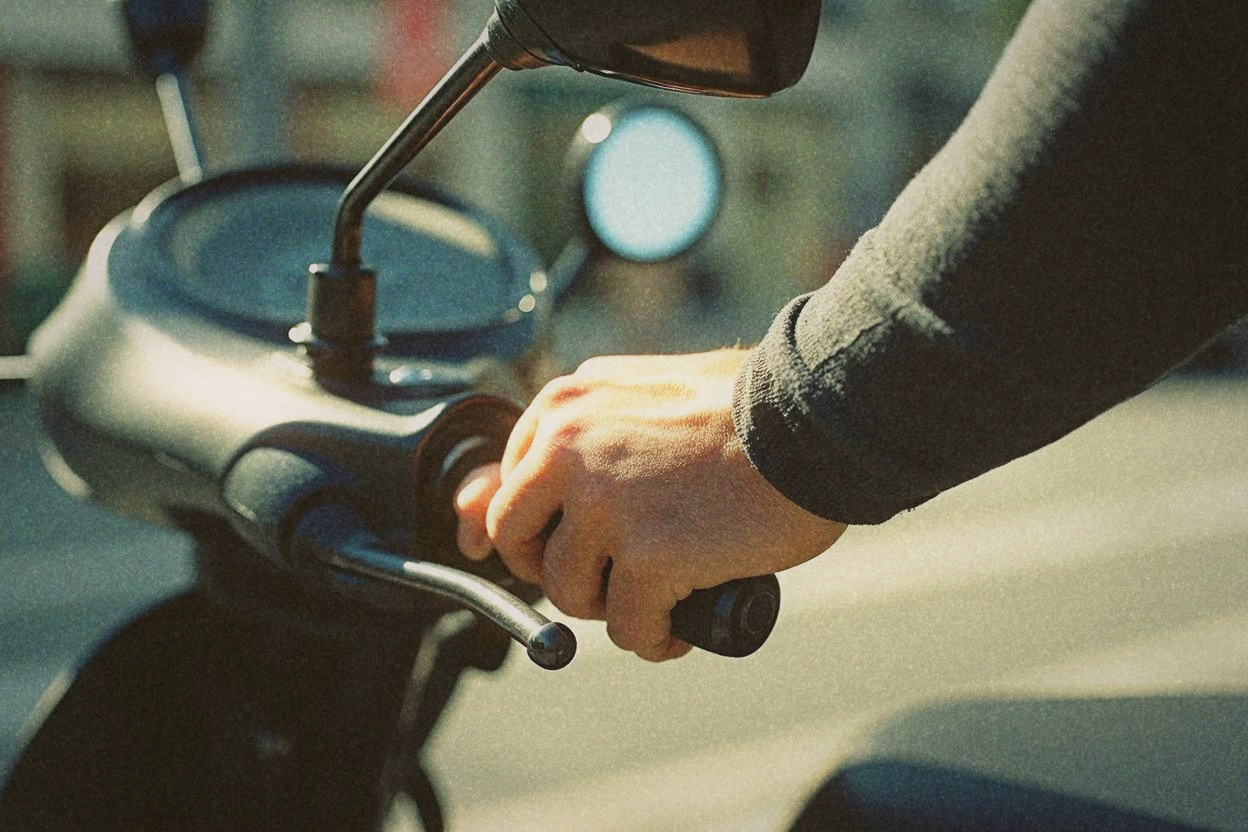
 FIRST SIGHTWEBGLContact-cooling UV arm sleeves — the most Taiwanese piece of summer kit — cover the most sun-exposed part of a scooter commute. · Color and grain by First Sight · Portra 400. · First Sight 色彩與顆粒調校 · Portra 400
The parasol is not just for aunties
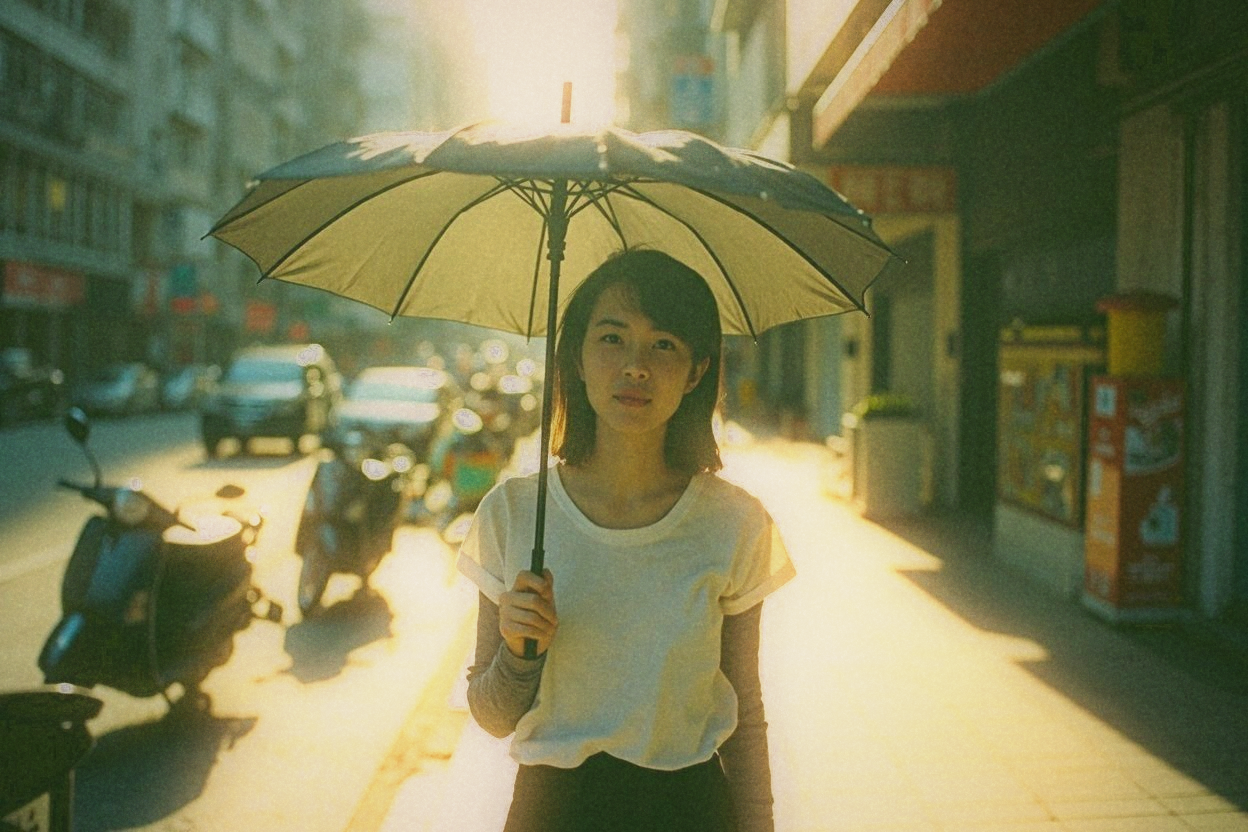
The single most effective sun tool in Taiwan is also the one foreigners resist the longest: the UV-cut parasol (陽傘). A good one drops the temperature under it by a genuinely noticeable margin, because you are walking in your own patch of shade. Look for a canopy with a black or silver UV coating rated UPF 50+; the coating, not the color of the fabric, does the work. Many double as rain umbrellas (晴雨兩用), which in a climate with daily afternoon storms is not a nice-to-have, it's the whole point.
You can grab a decent 晴雨兩用 parasol for NT$300 to NT$800 in any department store or 生活工場, and step up to a serious coated, wind-resistant one for NT$800 to NT$1,500. The style move is to treat it like any other accessory: a clean solid canopy, a comfortable handle, nothing frilly. Held with a bit of confidence, it reads less "grandma" and more "person who understands physics."
 FIRST SIGHTWEBGLA UPF 50+ coated parasol lets you walk in your own patch of shade — the coating, not the fabric colour, does the work. · Color and grain by First Sight · Portra 400. · First Sight 色彩與顆粒調校 · Portra 400
UV-cut jackets and the summer "sun shirt"
The lightweight UV-cut jacket (防曬外套) is the piece that quietly ties the whole system together. Think of it as a shirt with a hood that weighs almost nothing, packs into its own pocket, and blocks the sun on your arms and shoulders. UNIQLO's UV Protection line (the Pocketable Parka and the AIRism UV-cut hoodie) is the reference point: widely available, breathable, UPF-rated, and around NT$790 to NT$990. Decathlon's anti-UV running tops do the same job for less if you don't mind a sportier cut.
The trick is fit. A UV jacket sized like a raincoat looks like you're bracing for a typhoon. Sized close and worn open over a tee, sleeves pushed up when you're in the shade, it just looks like an intentional light layer. It also solves the AC problem for free: the same jacket that blocks the sun outside handles the 22-degree office inside.
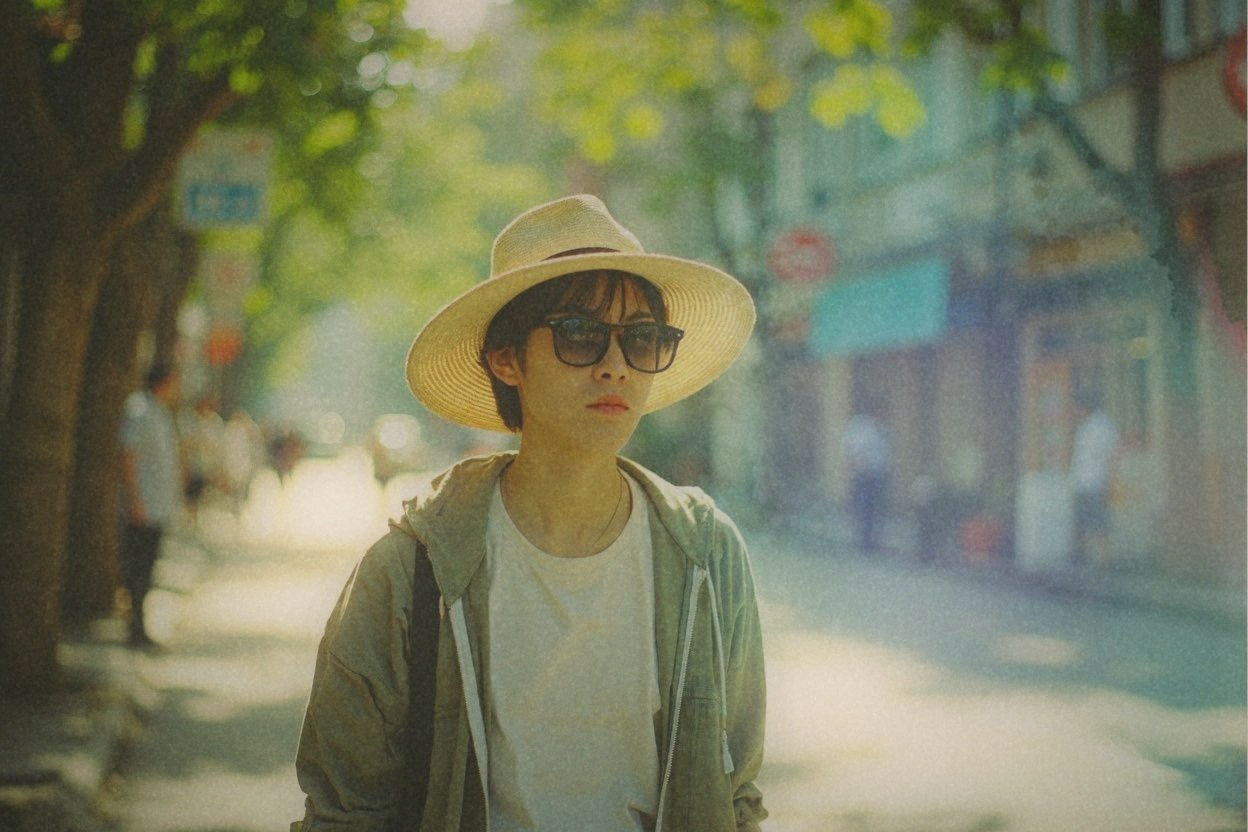 FIRST SIGHTWEBGLA packable UV-cut jacket, wide-brim hat and UV400 shades cover what fabric can, and handle the 22-degree office for free. · Color and grain by First Sight · Portra 400. · First Sight 色彩與顆粒調校 · Portra 400
Hats, sunglasses, and the face you can't cover in fabric
Fabric handles your limbs; your face and eyes need their own plan. A wide-brim hat (a brim of at least 7cm) shades your face, ears and the back of your neck in a way a baseball cap never will, and a packable straw or a UV-cut bucket hat survives being crushed in a bag. Sunglasses should say UV400 on the tag, which blocks 100% of UVA and UVB; anything less is just tinted plastic that makes your pupils dilate and lets in more damage, which is worse than nothing.
And yes, sunscreen still matters for the parts fabric can't reach: face, ears, the tops of your feet in sandals, the part in your hair. A broad-spectrum SPF 50 PA++++ is the Taiwan-summer standard, and the Japanese and Korean gels sold in every Watsons wear far better under humidity than heavy Western creams. Reapply if you're out for hours. The clothes are the durable layer; sunscreen is the patch for everything they leave exposed.
What to actually buy, and where
You can assemble the entire kit in one afternoon. Start at UNIQLO for the UV Protection jacket and an AIRism base layer. Cross to Decathlon for cheap cooling arm sleeves and an anti-UV cap. Pick up a 晴雨兩用 parasol and a wide-brim hat at any department store or 生活工場, and grab a face sunscreen and a spare pair of sleeves at Watsons or Cosmed on the way home. Total damage: comfortably under NT$3,000 for a full head-to-hands system you'll use every day for five months.
For a version with more design character, Taiwan's own labels are worth the detour. WISDOM builds technical "urban outdoor" pieces engineered for exactly this climate, and Tainan's oqLiq designs for humid urban heat with real sustainability credentials. Pinkoi is the easiest place to browse local UV-cut and technical wear online. Buy the cheap essentials from the chains; save the budget for one or two local pieces you'll actually enjoy wearing.
Frequently Asked
Some links in this article are affiliate links. If you purchase through them,OQUA may earn a small commission at no extra cost to you. This helps support our editorial work. We only link to products and services we genuinely reference in our writing.
Comments (0)
Loading comments...