
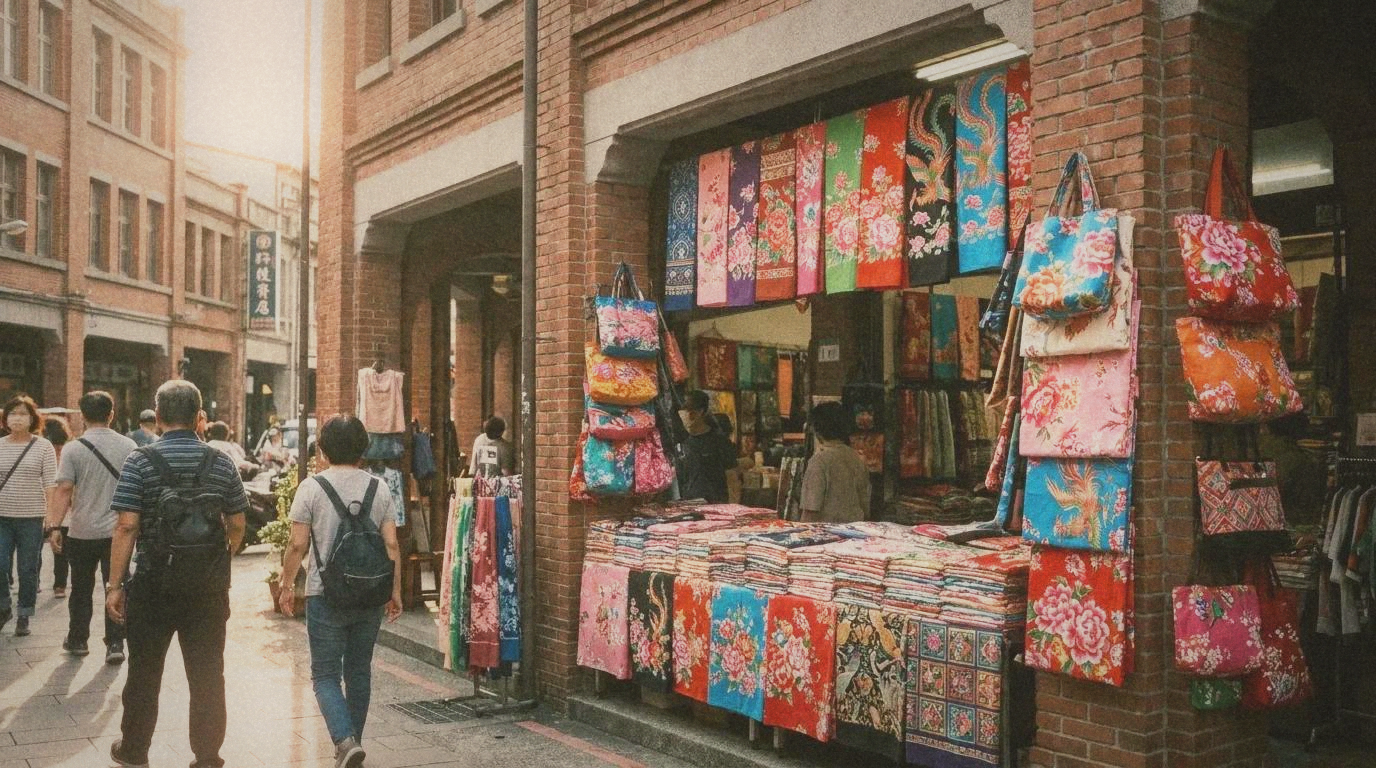
On a Tuesday afternoon in Dadaocheng, in the narrow storefront where 印花樂 inBlooom has operated since 2008, a woman is ironing transfer prints onto organic cotton tote bags. The print is a stylized Taiwan blue magpie, rendered in the brand's signature flat illustration style, the kind of motif that looks simple until you notice the tail feathers reference the ceramic tiles on the building across the street. The shop smells like fabric sizing and old wood. Three doors down, past a dried goods store that's been there since the Japanese colonial period, Story Wear occupies a renovated shophouse where every garment on the rack was, in a previous life, somebody else's jeans.
This is Dihua Street, and the fact that two of Taiwan's most interesting sustainable fashion brands ended up here is not a coincidence. Dadaocheng was a textile trading hub in the 1920s. The neighborhood remembers cloth.
But the brands working here are building something that has nothing to do with nostalgia. Taiwan is becoming one of the more compelling sustainable fashion stories in Asia, and the reason has less to do with ideology than with infrastructure. The island's textile industry supplies performance fabrics to Nike, Adidas, and Lululemon. It controls over 70% of the global functional fabric market. When a Taiwanese designer decides to make a recycled-polyester jacket, they don't have to source material from another country. The factory is a two-hour train ride away. Sometimes closer.
!A quiet street in Dadaocheng with traditional shophouse facades and modern storefronts Dihua Street, Dadaocheng. Two of Taiwan's leading sustainable brands operate within walking distance of each other, in a neighborhood that's been trading textiles for a century.
The brands making it real
印花樂 inBlooom started in 2008 when three National Taiwan University of Arts graduates decided to build a brand around Taiwanese visual identity. The prints are the first thing people notice: glass begonias, old floor tiles, Taiwan crows, patterns drawn from things you'd see walking around Taipei if you looked down or up instead of straight ahead. But the material choices are what set it apart in the sustainability space. inBlooom uses organic cotton and recycled polyester across its product lines. The company is B Corp certified, employs roughly 30 people, and works with local factories and community workshops rather than outsourcing overseas. They have multiple retail locations across Taipei.
The brand doesn't talk much about sustainability in its marketing. The Taiwanese motifs are the selling point. The organic cotton is just how they make things. There's something instructive in that approach: the sustainability is structural, not performative. It's baked into how the company operates, not bolted on as a campaign.
Story Wear takes a more confrontational position. Based in Dadaocheng, the brand uses 100% upcycled fabric waste, primarily denim. Every garment is labeled with the name of the seamstress who made it and the hours it took. The makers are skilled women from disadvantaged backgrounds: unemployed seamstresses, mothers of severely disabled children, women who needed flexible, dignified work. The denim comes from factory waste that would otherwise go to incineration.
"Each piece is different because no two source materials are identical. That's not a limitation. That's the whole point."
At Taipei Fashion Week SS25, Story Wear collaborated with RHINOSHIELD, the phone case brand, on a collection that blurred the line between tech accessories and garments. It was a strange pairing that somehow worked, partly because both companies are obsessed with waste reduction and partly because Taipei Fashion Week has become the kind of stage where that pairing makes sense.
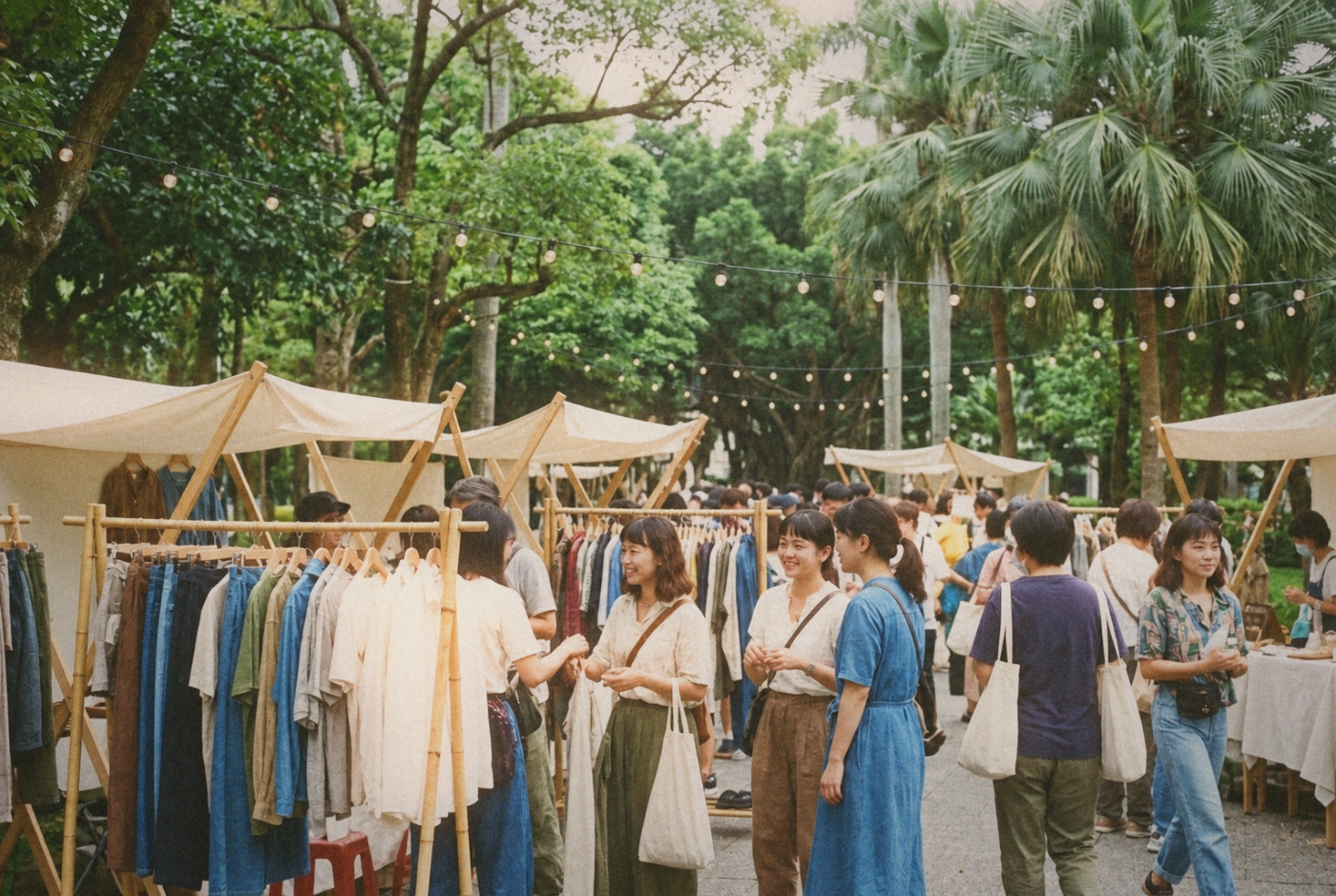
 FIRST SIGHTWEBGLOutdoor sustainable fashion market event in a Taipei park. clothing racks and browsing shoppers · Color and grain by First Sight · Portra 400. · First Sight 色彩與顆粒調校 · Portra 400
繭裹子 Twine is the quiet powerhouse. Founded in 2010 by Liz Tsai and Vinka Yang, both with architecture backgrounds, Twine is fair trade certified, B Corp certified, and the only World Fair Trade Organization member in Taiwan. It coordinates Fashion Revolution activities on the island. The brand uses organic cotton, organic wool, natural dyes, and recycled materials, sourcing from producer communities in Nepal, Kenya, and Chile. Half of Twine's revenue goes back to those producers.
Nine branches across Taiwan, and the stores feel more like community spaces than retail shops. The architecture background shows: clean sightlines, natural materials, the kind of spatial logic that makes you slow down rather than browse faster. Twine also represents something unusual in the sustainable fashion landscape. Most brands either focus on environmental sustainability or social sustainability. Twine does both, and has the certifications to prove it, which is harder than it sounds.
好日子 agooday took a different path into sustainable fashion entirely. The brand is best known for the Pockeat food bag, a reusable container that raised over NT$20 million on crowdfunding in 2017. From food bags, agooday expanded into sustainable household products: bamboo toothbrushes, silk dental floss, items designed to replace the single-use plastics that define convenience culture in Taiwan. The fashion connection is indirect but significant. agooday proved that Taiwanese consumers will pay a premium for well-designed sustainable products when the value proposition is clear. That proof of concept opened doors for every sustainable brand that followed.
Taipei Fashion Week and the circular pivot
Taipei Fashion Week AW25, held at Songshan Cultural and Creative Park in March 2025, carried the theme "Regenerative - Circular Fashion." It was the first fashion week in Asia to devote its entire programming to sustainable fashion. Not a sustainable sidebar. Not a green pavilion tucked behind the main stage. The whole thing.
!Songshan Cultural and Creative Park exterior with fashion week signage Songshan Cultural and Creative Park, site of Taipei Fashion Week AW25. The first fashion week in Asia entirely devoted to circular and regenerative fashion.
DYCTEAM showed collections made from ocean-recycled yarn using 3D knitting technology. Weavism presented garments made from PET recycled fibers. The SS26 season continued the sustainability focus, suggesting this isn't a one-off theme but a genuine reorientation.
The government noticed. Taiwan's "2050 Circular Economy Roadmap," a draft unveiled in October 2025, names textiles as one of six priority sectors. The targets are ambitious: double resource productivity, reduce per capita material consumption by 30%, increase the circularity rate by 2.5 times. The Ministry of Environment is funding industry-academia collaboration on textile recycling technologies. Whether government roadmaps translate into real change is always an open question, but the fact that textiles made the priority list at all reflects how central the industry is to Taiwan's economy.
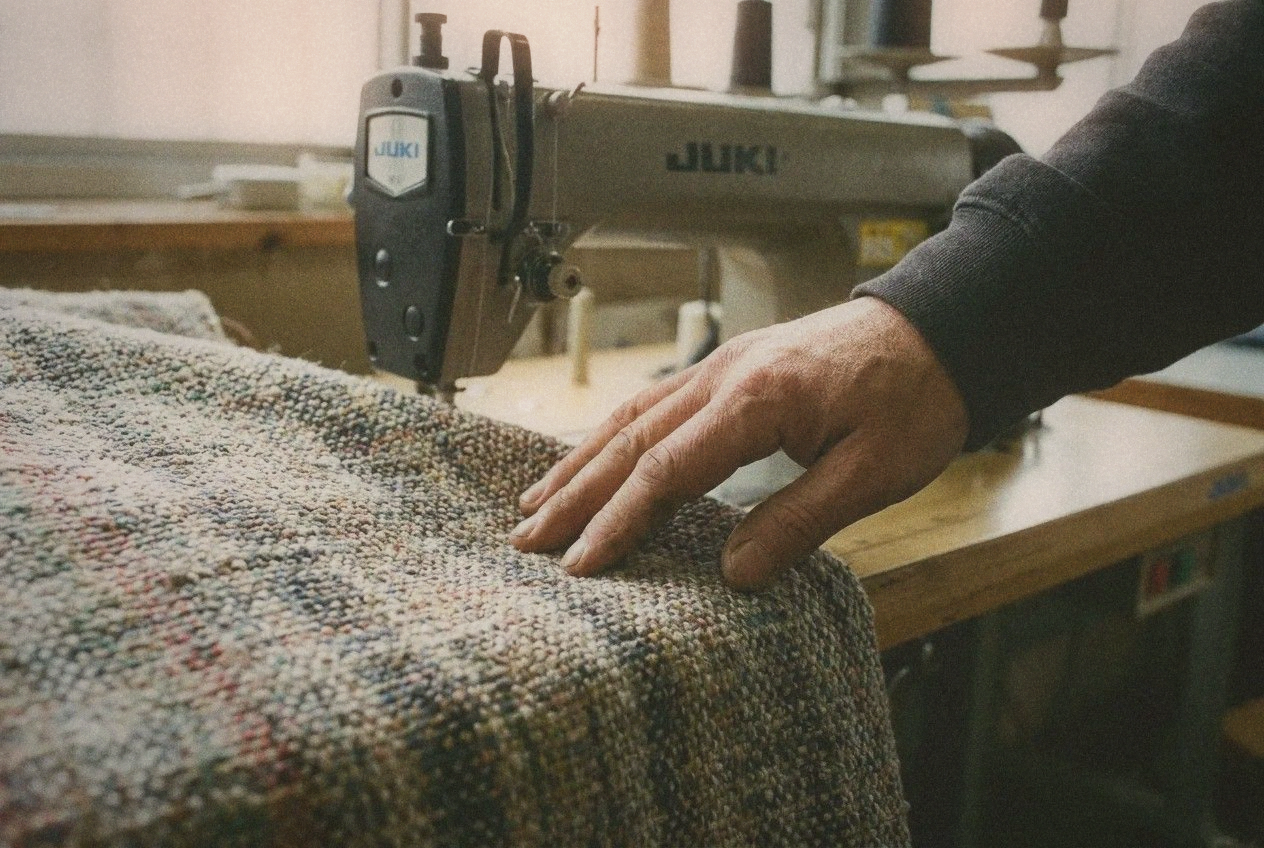 FIRST SIGHTWEBGLClose-up of recycled fabric textile with visible weave texture. hand touching the material · Color and grain by First Sight · Portra 400. · First Sight 色彩與顆粒調校 · Portra 400
The consumer shift
The supply side is only half the story. Taiwanese consumers are changing too, and faster than most industry reports predicted.
A recent survey found that 86% of Taiwanese users have purchased secondhand items. The secondhand market is projected to grow from USD $5.2 billion in 2025 to $17.9 billion by 2031, a compound annual growth rate of 22.8%. Gen Z normalized thrifting in a culture that once associated used goods with scarcity. Environmental awareness is growing, but so is a simpler motivation: good secondhand pieces cost less and often last longer than fast fashion bought new.
!A rack of curated secondhand clothing in a Taipei vintage shop The secondhand market in Taiwan is growing at 22.8% annually. For Gen Z shoppers, vintage isn't a compromise. It's the preferred way to buy.
The cultural shift matters because it creates demand that didn't exist a decade ago. When 印花樂 opened in 2008, organic cotton was a hard sell. Customers wanted the prints, not the sourcing story. Now the sourcing story is part of why people walk in. Brands that were ahead of the curve are finding that the curve has caught up.
What makes Taiwan different
Most sustainable fashion stories in Asia center on Japan or South Korea. Taiwan rarely makes the list, which is odd given its advantages.
The textile infrastructure is the obvious one. But there's a subtler factor: scale. Taiwan is small enough that a brand in Taipei can visit its factory in Taoyuan, check the dyeing process, meet the workers, and be home for dinner. That proximity makes transparency easier. It also makes greenwashing harder. When the factory is two hours away and journalists can visit, claims get checked.
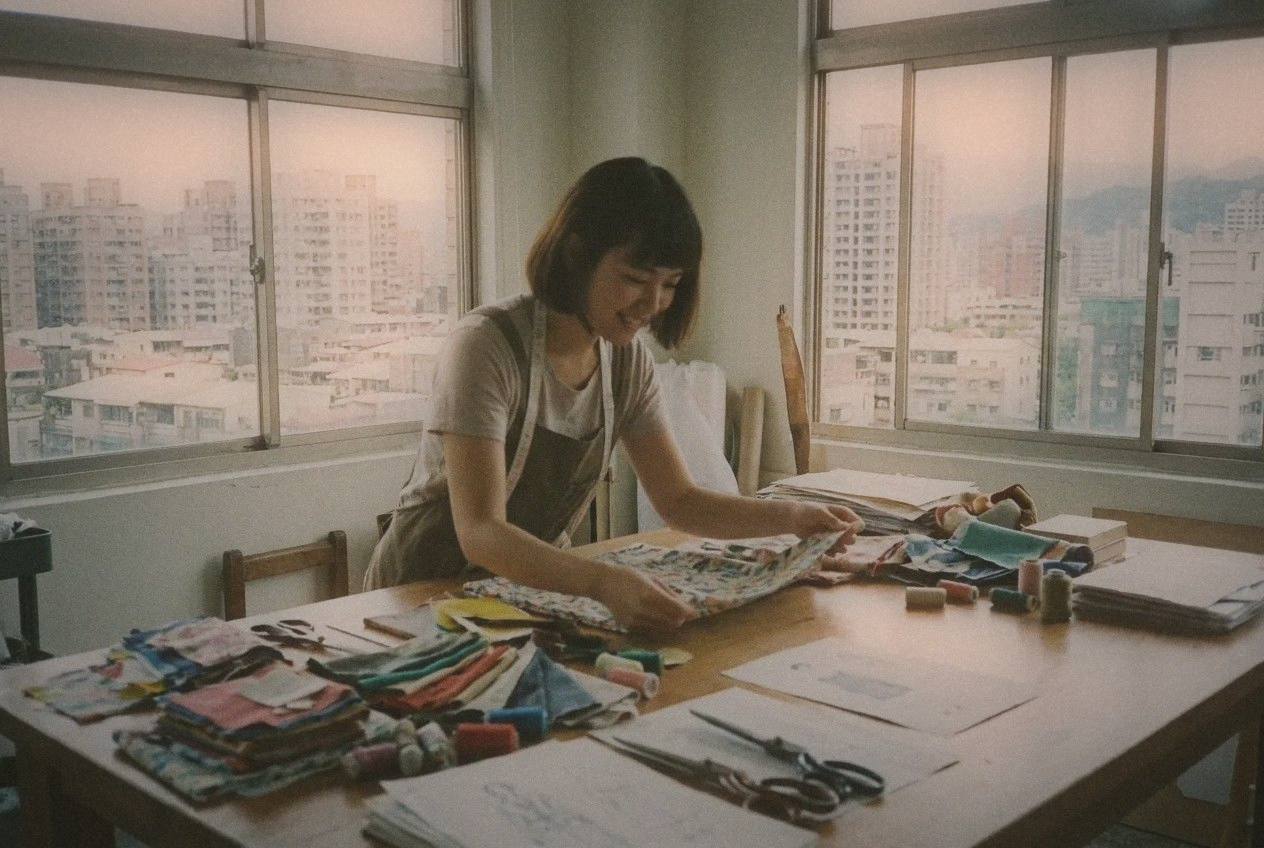 FIRST SIGHTWEBGLYoung Taiwanese fashion designer working at a wooden table in a bright studio. fabric swatches and scissors spread out · Color and grain by First Sight · Portra 400. · First Sight 色彩與顆粒調校 · Portra 400
There's also the cultural piece. Taiwan has a strong maker tradition, a population comfortable with repair and reuse, a night market culture that values resourcefulness over waste. The grandmother who restitches a torn seam instead of buying a replacement isn't performing sustainability. She just doesn't like waste. That sensibility, when combined with a world-class textile industry and a new generation of designers who grew up inside it, produces something worth paying attention to.
The brands profiled here are small. 印花樂 employs about 30 people. Story Wear's production is limited by the pace of handwork. Twine operates nine stores, not ninety. None of them are going to displace Zara or Uniqlo. But they don't need to. They need to prove that clothes can be made well, made fairly, and made from materials that don't require extracting new resources from a planet that's running out of patience. On that count, they're doing the work.
FAQ
Is sustainable fashion more expensive? Per purchase, usually yes. Per wear, often no. A NT$3,000 organic cotton shirt worn 200 times costs NT$15 per wear. A NT$500 fast fashion shirt worn 15 times costs NT$33 per wear. The upfront number is higher. The long-term cost is lower. Brands like agooday and inBlooom also offer accessories and household items at accessible price points.
Where can I buy sustainable fashion in Taipei? Dadaocheng is the starting point. Story Wear and inBlooom both have shops on or near Dihua Street. Twine has nine locations across Taiwan, with several in Taipei. For secondhand and vintage, Zhongshan and Shida neighborhoods have the densest concentration of shops. Taipei Fashion Week events at Songshan Cultural and Creative Park also feature sustainable designers.
What makes Taiwan's textile industry special? Taiwan produces over 70% of the world's functional fabrics. The same mills that make performance gear for global sportswear brands are now developing ocean-recycled fibers, coffee-yarn textiles, and oyster shell fabrics. Most countries that want to do sustainable fashion have to import the technology. Taiwan already has it.
Are these brands available online? Yes. inBlooom, Story Wear, Twine, and agooday all have online shops. inBlooom ships internationally. Story Wear's pieces are one-of-a-kind, so online stock changes frequently. Twine's online store carries its full range of fair trade products.
How do I know if a brand is genuinely sustainable? Look for third-party certifications: B Corp, Fair Trade, WFTO membership. These require independent audits, not self-reporting. In Taiwan, inBlooom and Twine are both B Corp certified. Twine is the only WFTO member on the island. Beyond certifications, transparency is the best signal. Can the brand tell you where its materials come from, who made the garment, and what happens to the product at end of life? The brands worth trusting can answer all three.
Comments (0)
Loading comments...