
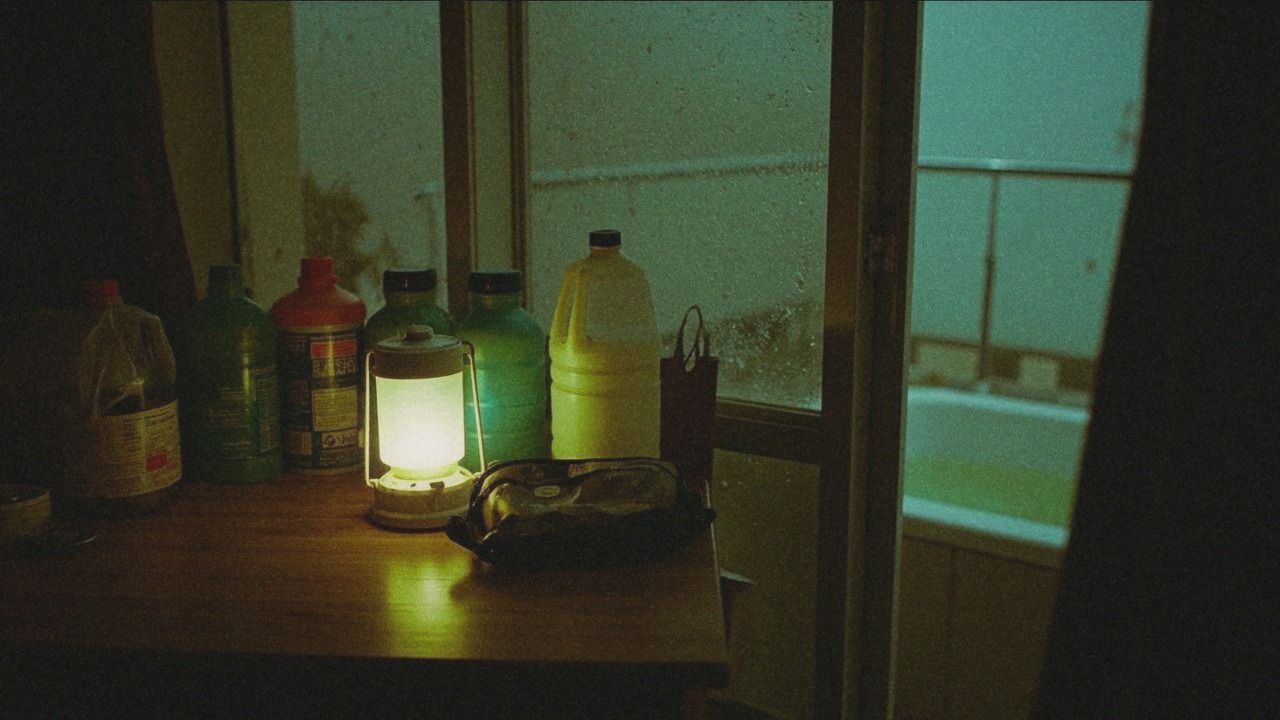
Typhoon season in Taiwan runs from July through September, and if you live in a Taipei apartment, the storm you actually need to prepare for is rarely the dramatic one on the news. It is the ordinary one: a mid-strength typhoon that parks over the island for a day, knocks out power to your building for six hours, backs up a floor drain, and turns your sealed-box apartment into a warm, dark, slightly damp room you cannot leave. None of that is dangerous if you are ready. All of it is miserable if you are not.
This is a practical, apartment-specific guide: what the warnings actually mean, a 72-hour timeline, exactly what to stock and where to buy it in Taipei, how to secure a high-rise unit, and what to do the moment the power or water stops. Most of it costs under NT$2,000 and an afternoon.
Reading the warnings without the panic
Taiwan's Central Weather Administration (中央氣象署) issues two headline alerts. A 海上颱風警報 (sea warning) means the storm is within roughly 100km of Taiwanese waters — your cue to start, not to worry. A 陸上颱風警報 (land warning) means land impact is expected within about 18 hours — this is when you top up water, charge everything, and bring the balcony in. Whether work and school are cancelled (停班停課) is decided by your city government, not the weather agency, and is posted on the DGPA's natural-disaster page and mirrored by every news app — usually the night before by 10pm, or by 4:30am for a morning call.
Why a Taipei apartment is its own kind of prep
Detached houses worry about the roof and the yard. Apartments have a different list. Wind accelerates as it funnels between tall buildings, so the gust hitting your 14th-floor window is stronger than the number on the forecast. Older aluminium window frames and balcony doors seep water along the bottom track long before anything 'floods'. Your water does not come from the city directly — it comes from a rooftop or basement tank fed by a building pump, so if the pump loses power your taps run dry even when the city supply is fine. And the basement carpark is the first thing to flood in heavy rain.
The 72-hour timeline
You do not need to do everything at once. Spread it across the three days the warnings give you and none of it feels urgent.
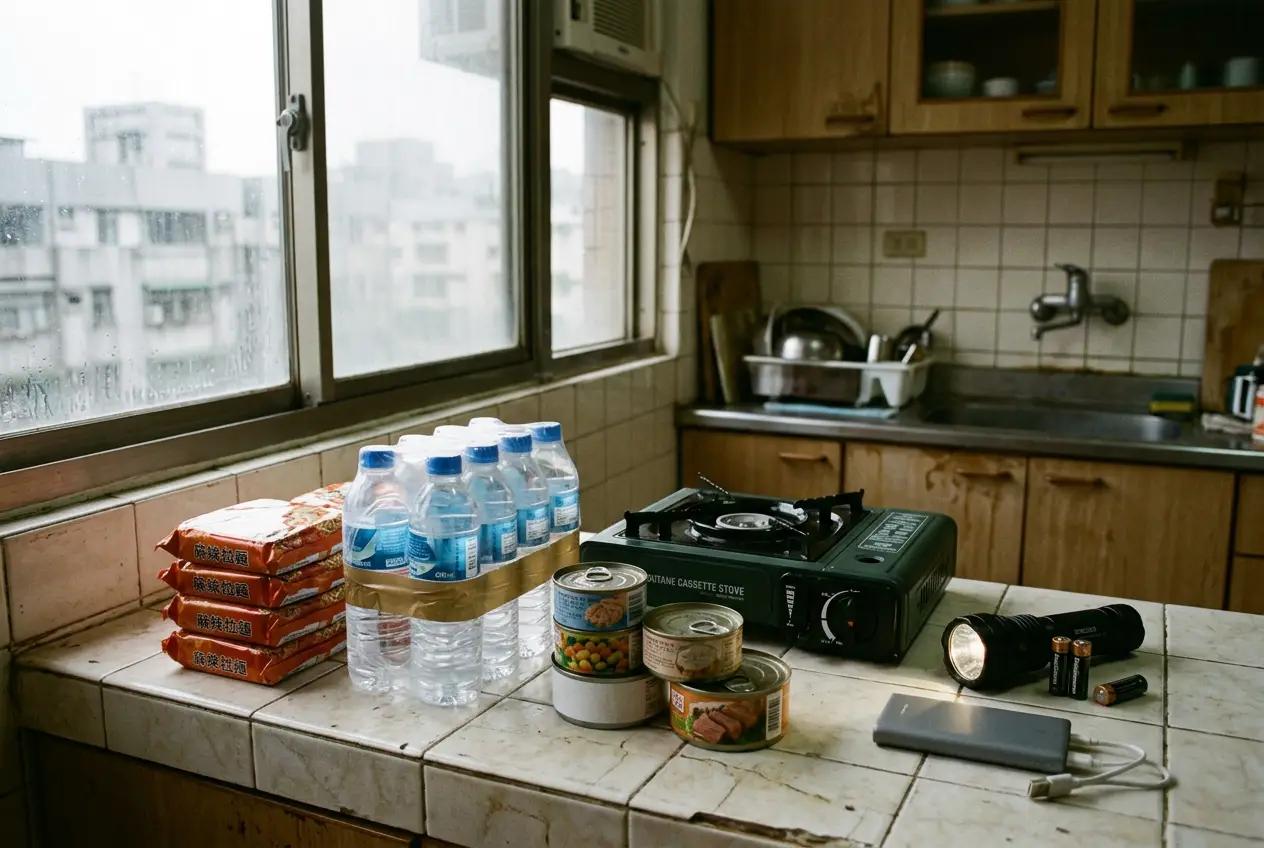
 FIRST SIGHTWEBGLThe whole kit fits on one counter: water first, then food that needs no power, then light. Buy it before the warning, not during the queue. · This photo is developed by FIRST SIGHT film stocks. · 這張照片是使用 FIRST SIGHT 底片配方調校而成的
What to actually stock
Ignore the survivalist lists. For a Taipei typhoon you are covering three days of no shopping, a possible power cut, and a possible water cut. That is it.
Water — the one thing you can't improvise
Store about 3 litres per person per day for drinking and cooking, three days deep — roughly 9 litres a person, or two of the big 6-litre bottles from 全聯 or any convenience store. Buy it; do not bottle tap water and forget it. Separately, for washing and flushing, fill the bathtub and a couple of buckets once the land warning is up. A filled tub is 100+ litres of grey water — enough to keep a toilet flushing for days.
Food that needs no power and no water
Think 'picnic in the dark', not camping. Bread, peanut butter, crackers, canned fish and 鮪魚, fruit, nuts, 泡麵 you can eat dry or with hot water from a thermos, and 御飯糰 and 茶葉蛋 from the 7-11 downstairs on the way home. Anything that needs the stove is a bonus, not a plan. Keep a manual can opener. If you have a camping gas stove, great — but never run it, or any generator, indoors.
Power and light
One good rechargeable LED lantern or headlamp beats six phone torches — you want your hands free and your phone battery saved. A 20,000mAh power bank recharges a phone four to five times; two of them will carry a couple of phones through a long outage. Charge them to full at T–48H. Candles are a fire risk in a sealed apartment during high wind; skip them.
Medicine and first aid
A week of any prescription you take, refilled before the storm. A basic kit: plasters, antiseptic, painkillers, anti-diarrhoeal, rehydration salts, and any 常備藥 for fever or an upset stomach. A non-contact thermometer. If anyone in the home relies on powered medical equipment, tell your building 管理室 in advance and have a backup power plan.
Sanitation, for when the water stops
Wet wipes and hand sanitiser do the work of a shower. Keep toilet paper stocked, plus a roll of heavy rubbish bags — if the building drainage backs up you want to bag waste, not fight the plumbing. This is the unglamorous category everyone skips and then desperately wishes they hadn't.
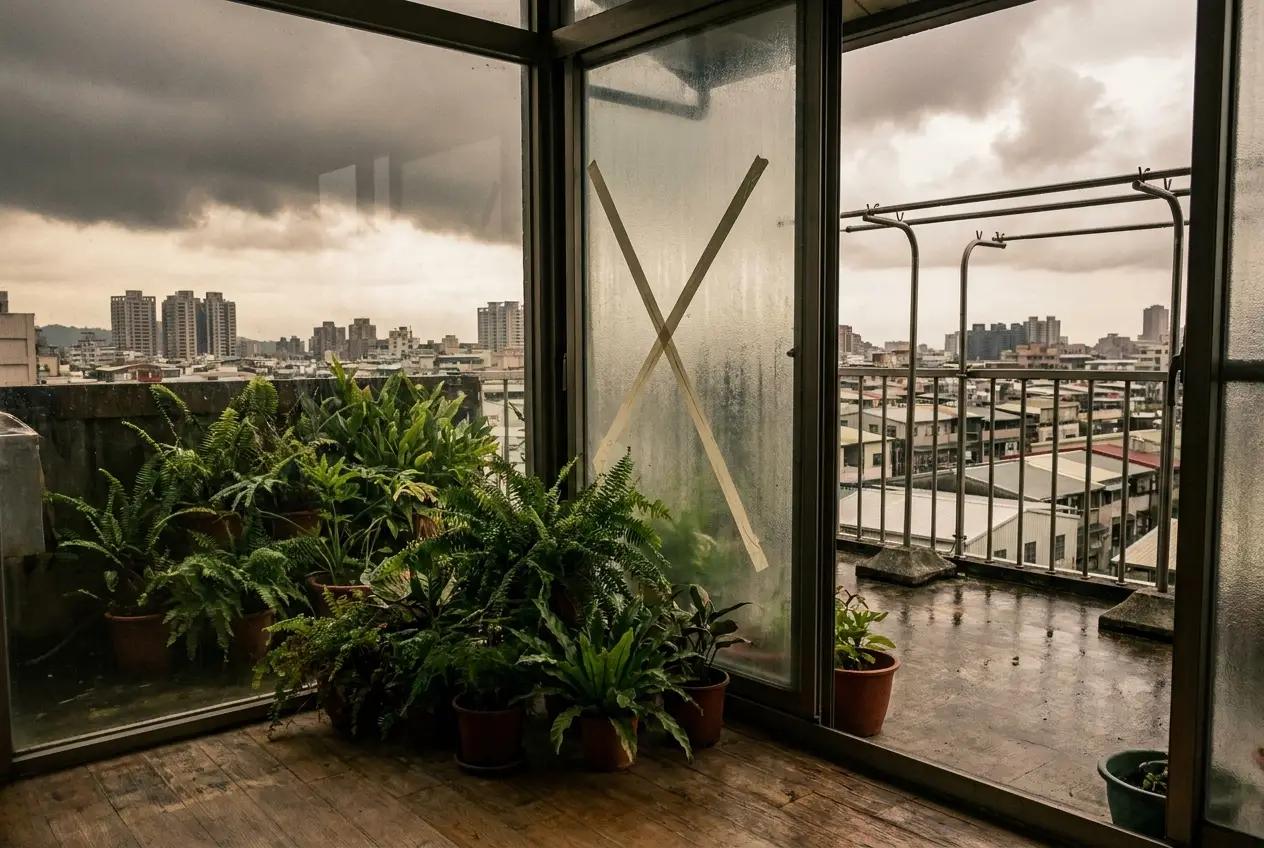 FIRST SIGHTWEBGLPlants in, poles down, tape on the glass. The balcony is where a Taipei apartment loses to the wind first. · This photo is developed by FIRST SIGHT film stocks. · 這張照片是使用 FIRST SIGHT 底片配方調校而成的
Securing the apartment
The goal is simple: keep wind and water outside. Close and latch every window — a latched window resists rattling and pressure far better than one just pushed to. The old habit of taping a big rice-paper X on the glass does little against modern pressure; if a window genuinely worries you, a proper safety film applied ahead of season is the real fix. Lay towels along interior window tracks and balcony-door sills to catch seepage, and check the balcony floor drain is clear so it can actually drain.
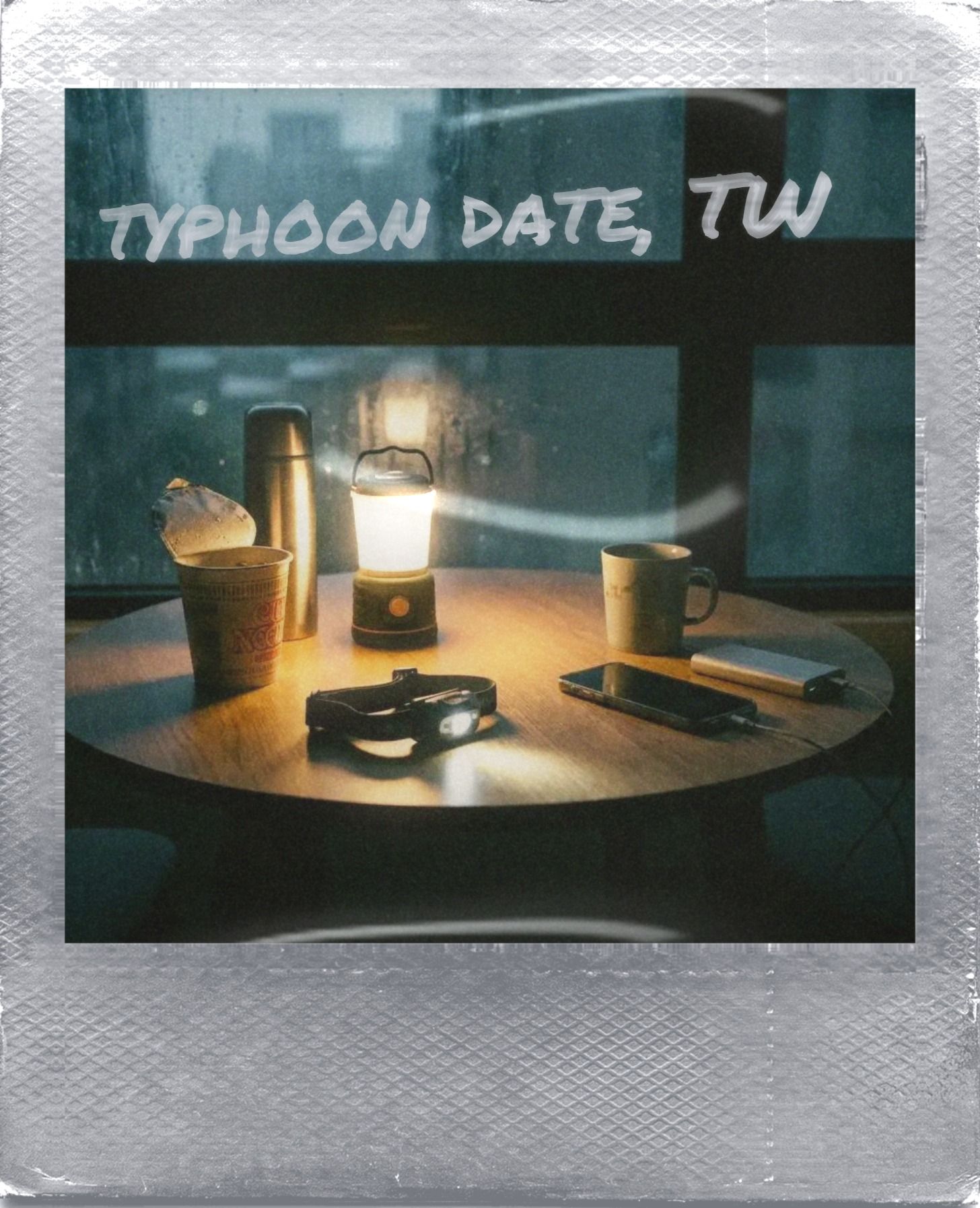 FIRST SIGHTWEBGLWhen the power goes, a lantern and a charged power bank turn a blackout from an emergency into an evening. · This photo is developed by FIRST SIGHT film stocks. · 這張照片是使用 FIRST SIGHT 底片配方調校而成的
When the power or water goes
No power
Keep the fridge and freezer shut — a closed fridge holds safe for about four hours, a full freezer for 24 to 48. Don't 'check' it. Switch to your lantern, not your phone. If the building's water pump is electric (most are), your taps will stop too, which is exactly why the bathtub is full. Report the outage to 台電 (Taipower) on 1911. Then genuinely relax — a Taipei outage is almost always hours, not days.
No water
Drink and cook from your stored bottles. Flush with a bucket of bathtub water poured straight into the bowl — no handle needed. Sponge-bathe with wipes or a little bottled water. If the outage is the whole area rather than just your pump, the Taipei Water Department (台北自來水事業處) usually posts a restoration time; buildings with a rooftop tank often get water back before street-level supply does.
After the all-clear
Wait for the warning to be lifted before you open windows or go out — the calm eye is not the end. Then walk the apartment: check window tracks and ceilings for leaks, photograph any damage for your landlord or insurer before you clean it up, and pour out every saucer, bucket, and bottle-cap of standing water — post-typhoon standing water is where dengue mosquitoes breed. Report fallen trees, blocked roads, or downed lines to the city on 1999, and flag any shared-area damage to the building 管理室.
Renting vs owning
If you rent, you are responsible for your own supplies and for limiting damage, but structural problems — a leaking window frame, a failed pump, water through the ceiling — are the landlord's to fix. Photograph everything and report it in writing (a LINE message is fine, and timestamped). If you own, this is the season to actually hold home insurance that covers wind and water, to service the AC brackets and window seals before the warnings, and to know where your unit's main water valve is.
Frequently Asked
Done properly, a typhoon becomes almost pleasant: the city stops, the deliveries pause, and you have an enforced day indoors with a full bathtub, a shelf of snacks, a charged phone, and nothing you're supposed to be doing. A few hours of prep is what turns a dark, anxious night into exactly that. Stay safe — 颱風來時見。
Some links in this article are affiliate links. If you purchase through them, OQUA may earn a small commission at no extra cost to you. This helps support our editorial work. We only link to products and services we genuinely reference in our writing.
Comments (0)
Loading comments...